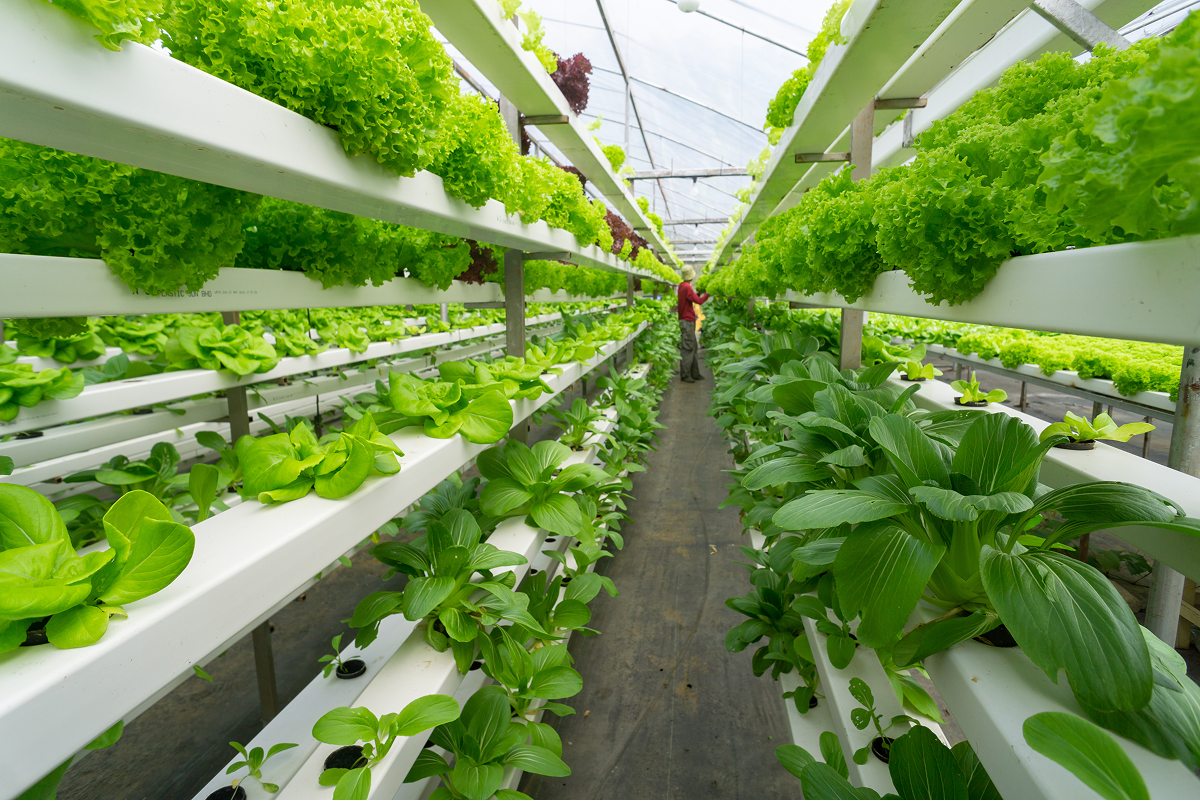

Vertical farming is the commercial practice of producing crops in vertically stacked layers within a controlled environment agriculture (CEA) facility. It uses soilless methods like hydroponics, aeroponics, or aquaponics, paired with optimized artificial lighting and climate control, to maximize yield per square meter.
For agribusiness executives and operations managers, vertical agriculture represents a shift from horizontal acreage to cubic volumetric production. Shrinking arable land, volatile supply chains, and growing pressure for climate-smart food systems are driving this transition. The global vertical farming market is valued between $7.5 and $8 billion in 2026, with projections pointing toward $19 to $40 billion by the early 2030s.
This guide covers systems, agronomic mechanics, crop selection, and commercial economics for CEA operators.
What is Vertical Farming? Understanding the Industrial CEA Model
Your success in vertical farming starts with understanding how it works. Here’s the foundational model behind modern indoor vertical farming facilities.
Traditional agriculture measures productivity by the acre. The vertical farming model flips that equation entirely. Instead of sprawling across flat land, a vertical farming facility stacks growing layers upward inside a warehouse, shipping container, or purpose-built structure. This transition from 2D to 3D production means you can grow substantially more produce per square foot of floor space than any open-field operation.
The Three Pillars of Modern Vertical Agriculture
Every controlled environment agriculture operation rests on three core pillars:
- Physical Structure: It includes repurposed warehouses, modular shipping containers, vertical towers, and high-density racking systems. The physical layout determines how many tiers of growing space you can fit and directly impacts your per-square-meter yield.
- Soilless Agronomy: Vertical farms eliminate topsoil. Instead, they use inert growing media like rockwool, coco coir, or phenolic foam to anchor plant roots, while delivering nutrients directly through water-based solutions. This is what makes fertigation systems so central to vertical farming operations.
- Controlled Environment Agriculture (CEA): The growing space is completely isolated from external weather, biology, and solar cycles. Temperature, humidity, CO2 levels, and light are all managed by the operator, giving you total control over your production environment year-round.
Macro Drivers in the Vertical Farming Industry
Several forces are accelerating the growth of the vertical farming industry:
- Global Food Security: With the world’s population expected to reach 9.7 billion by 2050, traditional agriculture alone cannot keep pace with demand.
- ESG Mandates: Investors and retailers are increasingly requiring sustainability credentials from food suppliers.
- Eliminating the “3,000-Mile Salad”: Growing produce in urban distribution hubs cuts transportation distances, reducing spoilage and emissions tied to long-distance supply chains.
How Does Vertical Farming Work? The Core Engineering & Agronomic Mechanisms
Running a commercial vertical farm requires an interconnected system of lighting, climate control, nutrient management, and automation. Here is how each one works.
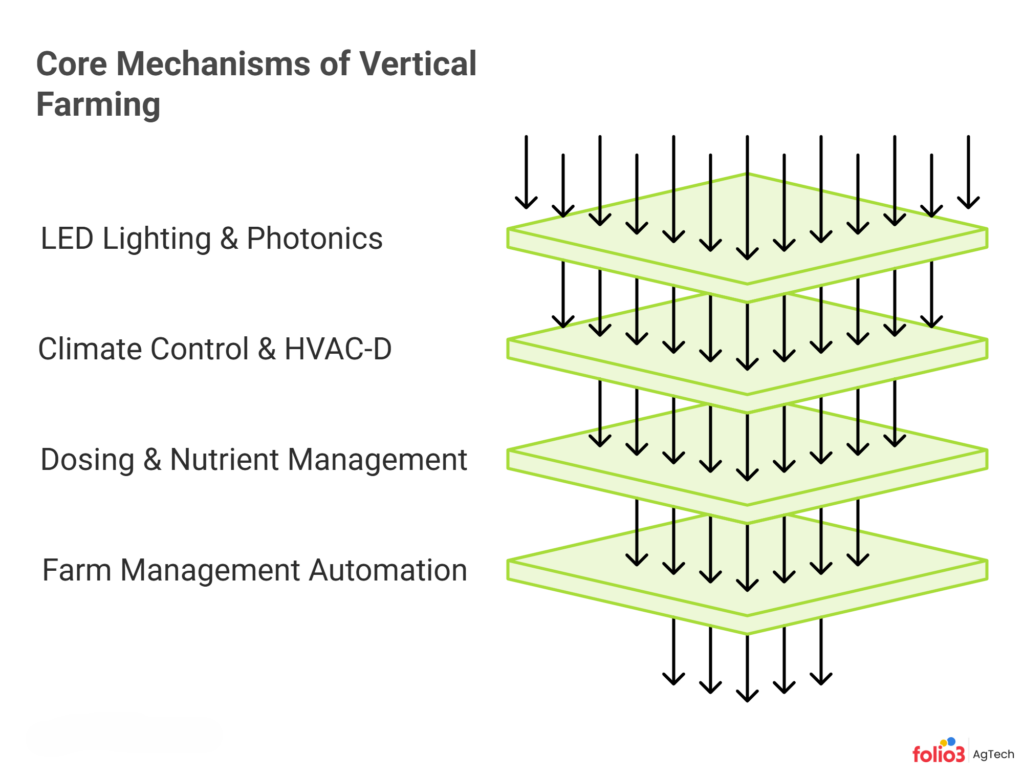
1. Precision LED Lighting & Photonics
Traditional HPS (High-Pressure Sodium) bulbs generate too much heat and waste energy. Modern vertical farms use high-efficiency LED grow lights tuned to specific wavelengths.
Two metrics matter here: Photosynthetically Active Radiation (PAR), which measures the light spectrum plants can use, and Photosynthetic Photon Flux Density (PPFD), which tells you how much usable light reaches your canopy per second.
The real advantage of LEDs is dynamic spectrum manipulation. By adjusting blue-to-red light ratios, you can trigger specific plant responses. More blue light promotes vegetative growth and root density. Shifting toward red encourages flowering. Some operators manipulate anthocyanin production to enhance color in leafy greens, boosting retail value.
2. Advanced Climate Control & HVAC-D
Climate control is the single biggest capital and operational hurdle in vertical farming technology. HVAC-D (Heating, Ventilation, Air Conditioning, and Dehumidification) keeps your grow room environment stable.
- Vapor Pressure Deficit (VPD) Management: It is the balance between air temperature, relative humidity, and canopy transpiration. Get it wrong, and you face tip burn on leafy greens or fungal pathogens like powdery mildew. Understanding VPD fundamentals is critical for any CEA operator.
- Airflow Modeling: In a facility with 10-meter racking, horizontal and vertical airflow must be modeled to ensure every plant receives consistent temperature and humidity, regardless of rack position.
- Dehumidification: Plants transpire water constantly. In a sealed environment, that moisture must be actively removed, or you risk condensation, mold, and crop loss.
3. Automated Dosing & Nutrient Management
Nutrient delivery in a vertical farm is a precision operation managed by real-time sensor arrays.
- Continuous Monitoring: Sensors track pH, Dissolved Oxygen (DO), Electrical Conductivity (EC), and water temperature around the clock. Any drift triggers automated corrections.
- Closed-Loop Fertigation: Automated dosing pumps inject macro- and micro-nutrients into the water supply. Return water is sterilized via UV-C and ozone before recirculation. This closed-loop approach is one reason vertical farms use up to 95% less water than conventional agriculture. Detecting nutrient deficiencies is also easier in this controlled setting.
4. Automation & Farm Management Software (FMS)
Labor is one of the largest operational expenses in a vertical farming facility. Robotic seeding, transplanting, and harvesting lines reduce contamination risk and can cut labor OpEx by more than 50%, reflecting the broader push toward robotics in agriculture.
AI-driven yield prediction is also gaining traction. Farm Management Software integrates with IoT sensor networks to automate lighting, nutrient dosing, and climate adjustments in real time.
Vertical Farming Systems Compared: Hydroponics, Aeroponics, Aquaponics & Hybrids
The system you choose depends on three factors: your capital budget, target crops, and local energy costs. Here is a breakdown of each architecture.
Hydroponic Vertical Farming (NFT & DWC)
Hydroponic vertical farming is the commercial standard. Nutrient Film Technique (NFT) runs a thin stream of nutrient solution over plant roots inside channels. Deep Water Culture (DWC) suspends roots in an aerated nutrient bath. Both are highly reliable, scalable, and modular. Hydroponics holds the largest market share at 53.5% of the global vertical farming market, largely because of its water efficiency and operational simplicity.
Aeroponics
Aeroponic systems mist suspended roots with high-pressure nutrient spray. This method delivers maximum oxygenation and can accelerate growth rates by up to 30% compared to soil-based methods. However, aeroponics requires redundant nozzle systems. If nozzles clog during a power failure, exposed roots can desiccate within hours, leading to total crop loss. It is best suited for high-value herbs, medicinal crops, and seed potato propagation.
Aquaponics
Aquaponic systems create a symbiotic loop between fish and plants. Fish waste provides nutrients for the plants, and the plants filter the water for the fish. It pairs well with operations already involved in aquaculture technologies. However, commercial viability is limited because fish and plants have competing pH and temperature requirements, making management more complex.
Greenhouse Vertical Farming (The Hybrid Model)
The hybrid model combines tall hydroponic towers with glass or polycarbonate greenhouse structures to capture natural sunlight. This approach can cut lighting energy loads by up to 80% while still maintaining CEA climate control. It is ideal for operators in regions with high solar availability who want lower energy OpEx.
Comparative Analysis Table
| System Architecture | Primary Method | Commercial Scalability | Energy Intensity | Best Suited Crops | Key Operational Risk |
| Vertical Hydroponics | Nutrient solution channels or floating rafts | High (Industry standard) | Moderate to High (LED dependent) | Lettuces, spinach, herbs, brassicas | Waterborne pathogen spread |
| High-Pressure Aeroponics | Suspended roots misted with nutrient spray | Moderate (Technically complex) | High (Pumps & LED required) | High-value herbs, medicinal crops, seed potatoes | Clogged misting nozzles & root drying |
| Recirculating Aquaponics | Integrated fish tanks & bio-filtered effluent | Low to Moderate (Niche) | Moderate (Water pumping & filtration) | Leafy greens paired with tilapia or trout | Balancing dual ecosystem biology |
| Hybrid Vertical Greenhouse | Stacked towers under solar-transparent roofs | Very High (Low lighting costs) | Low to Moderate (Uses natural sunlight) | Leafy greens, strawberries, vining tomatoes | Weather-dependent light uniformity |
What Can Be Grown in Vertical Farming? Commercial Crop Selection & Yield Economics
Not every crop makes financial sense in a vertical farm. Your crop selection should be driven by revenue per kilowatt-hour, not just agronomic possibility.
Crop selection in a vertical farming facility is governed by two numbers: grams produced per kilowatt-hour of energy consumed, and days from transplant to harvest. The crops that pencil out commercially are the ones with short cycles, high margins, and strong year-round demand.
Tier 1: Proven Commercial Cash Crops
- Short-Cycle Leafy Greens: Romaine, butterhead lettuce, and spinach are the workhorses of vertical farming. Grow cycles run 14 to 28 days from transplant, and leafy greens still command over 52% of market revenue in the vertical farming industry.
- High-Margin Culinary Herbs: Basil, cilantro, mint, and chives deliver consistent year-round demand and premium pricing at retail. Their compact growth habit makes them ideal for high-density racks.
- Microgreens & Baby Leaf: With harvest cycles as short as 7 to 14 days, microgreens offer the highest price per kilogram in the vertical farming crop portfolio. They are especially popular in restaurant and hospitality distribution. If you are considering this space, here is a guide to starting a microgreens business.
Tier 2: Emerging Fruiting & Specialty Crops
- Dwarf Strawberries: High retail value with continuous flowering under optimized LED spectra. Vertical farms produce pesticide-free berries, which command premium shelf space. Berries are currently the fastest-growing segment in the vertical farming industry, expanding at over 16% CAGR.
- Vining Crops (Tomatoes, Peppers, Cucumbers): These are feasible in high-clearance vertical greenhouses or on specialized movable racking, but they require more vertical space and longer growth cycles.
Tier 3: Pharmaceutical & Cosmeceutical Crops
A small but growing segment of the industry focuses on growing standardized botanical extracts, biopharma plants (like tobacco-related varieties used in vaccine production), and cosmetics ingredients under strict FDA/GMP indoor conditions. It is a niche, but a high-margin one.
The Biological Limitations: Commodity crops like wheat, corn, soybeans, and root tubers such as potatoes and carrots remain economically unviable for indoor vertical agriculture. The energy cost per calorie produced simply does not justify the investment.
Commercial Vertical Farming Examples & Real-World Facility Layouts
Real-world facilities show how these systems come together at scale. Here is what a profitable vertical farm looks like from the inside.
Anatomy of a Commercial CEA Facility
A well-designed 10,000 m² vertical farming facility typically includes four production zones:
- Zone 1: Seeding & Germination Chambers. High-humidity, low-light propagation racks where seeds germinate in controlled conditions.
- Zone 2: The Nursery Station. Horizontal automated troughs where seedlings build root mass over roughly 14 days before transplant.
- Zone 3: The Main Vertical Cultivation Hall. The core of the facility, featuring 8- to 12-tier stacked racking or 6-meter vertical towers with automated elevators. This is where agricultural data management becomes essential for tracking thousands of concurrent grow cycles.
- Zone 4: Post-Harvest Processing & Cold Chain. Cleanroom-grade harvesting, automated optical sorting, packaging, and rapid cooling to 34°F (1°C) for a 14+ day shelf life. Cold chain integrity is critical for fresh produce quality.
Real-World Operational Models
- The Mega-Facility Warehouse: Urban facilities supplying regional grocery chains within 24 hours of harvest, addressing key supply chain tracking challenges while reducing food miles.
- The Distributed Container Network: Decentralized container pods deployed on hospital campuses, universities, and remote mining or island communities, bringing local food production where traditional farming is not viable.
The Future of Agtech by Overcoming CapEx, Energy & Scale Challenges
The vertical farming industry is maturing past its early growing pains. Here is where the sector is heading in the next decade.
The Profitability Inflection Point
Early vertical farms struggled with energy and labor costs that outpaced revenue. The operations that survived have shifted to a model built on operational discipline, secured retail partnerships, and energy efficiency rather than venture-capital-fueled expansion.
The Next Decade of Vertical Agriculture
- AI & Machine Vision: Cameras and machine learning algorithms can now detect micronutrient deficiencies, pest vectors, and growth anomalies days before human eyes can spot them. It moves precision agriculture into the grow room.
- Renewable Energy Integration: Co-locating vertical farms with geothermal, solar arrays, or industrial waste-heat capture systems is the clearest path to driving electricity OpEx toward zero. This is the single biggest lever for long-term profitability.
- Genetics for CEA: Seed companies are now breeding varieties specifically optimized for indoor LED spectra and vertical root architectures, rather than outdoor drought or wind resistance. This is a fundamental shift that will improve yields and energy efficiency simultaneously.
Conclusion: Scalability & Your Next Steps in CEA
Vertical agriculture is a cornerstone of resilient, climate-smart food systems. But commercial success is not just about growing plants. It is about managing resource efficiency, energy dynamics, and system economics at scale.
The operators who win are those who treat their vertical farming facility as an integrated production system. That means choosing the right growing architecture, investing in automation, and building your energy strategy from day one.
Ready to scale your indoor vertical farming operation? Book a consultation with our Agtech experts today to review your facility design, optimize your HVAC-D and lighting integration, and pressure-test your commercial unit economics.
FAQs
Who Invented Vertical Farming?
Dickson Despommier, a professor at Columbia University, is widely credited with popularizing the modern concept of vertical farming in 1999. His work laid the foundation for the CEA facilities operating globally today. The idea has since evolved from academic theory into a multi-billion-dollar industry.
How Does Vertical Farming Help the Environment?
Vertical farms use up to 95% less water and over 90% less land than traditional agriculture. They also eliminate pesticide runoff, reduce food transportation emissions by growing closer to consumers, and produce zero agricultural wastewater when using closed-loop systems.
How Much Does It Cost to Start a Vertical Farm?
Startup costs vary widely based on scale and technology. A small container farm may cost $100,000 to $300,000, while a large commercial warehouse facility can require $10 million to $30 million or more. Energy infrastructure and automation account for the largest share of capital expenditure.
Why Has Vertical Farming Become More Economical?
Significant drops in LED lighting costs, improvements in HVAC-D efficiency, and the adoption of AI-driven automation have all reduced operational expenses. Renewable energy integration and secured retail off-take agreements have further improved unit economics for disciplined operators.
How Profitable is Vertical Farming?
Profitability depends on crop selection, energy costs, and market access. Operations focused on short-cycle leafy greens and herbs in urban markets with strong retail partnerships can achieve positive margins. However, facilities growing lower-margin crops or operating without energy optimization strategies often struggle to break even.
What Are the Limitations of Vertical Farming?
High energy consumption for lighting and climate control remains the primary limitation. Vertical farms are also restricted to certain crop types, as commodity grains and root vegetables are not economically viable indoors. Technical complexity and the need for specialized talent add further operational challenges.