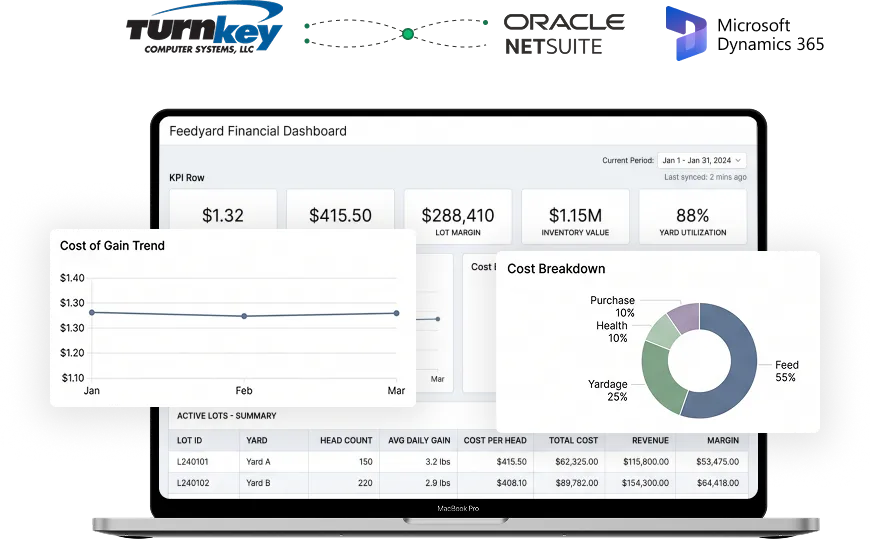
Bring Turnkey AMS with Oracle NetSuite or Microsoft Dynamics 365 ERP to translate feedyard performance into structured financial data, enabling consolidation, standardized reporting, and financial control across complex, multi-entity feedlot operations.


Performance inside the yard is well tracked, but turning those numbers into consistent, report-ready financial outputs remains a challenge within Turnkey AMS workflows.
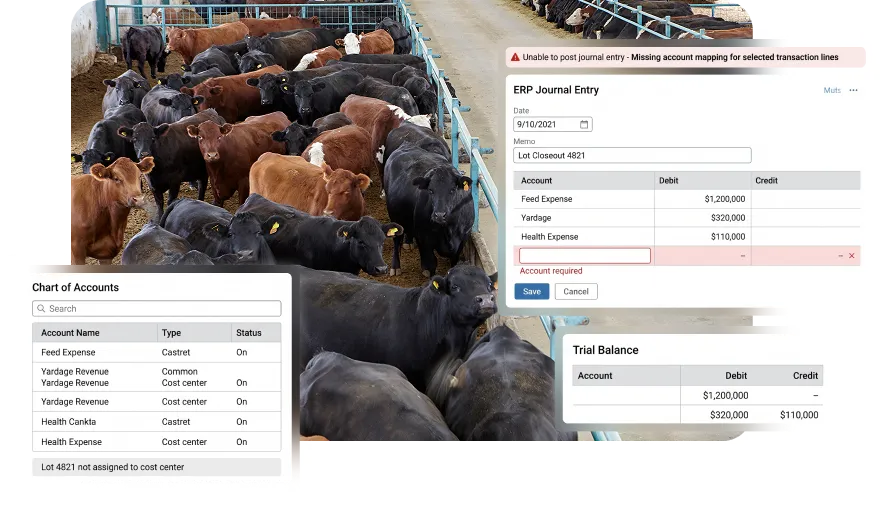
Turnkey AMS captures detailed lot closeouts, feed costs, and cattle performance metrics, but finance teams still spend time restructuring that information for ERP journals, account mapping, and consolidated reporting.
Turnkey provides strong operational cost tracking across feed, treatment, and yard activity, but enterprise finance teams often lack the structured cost breakdowns needed for consolidated margin analysis and financial reporting.
Feed deliveries, cattle movements, treatments, and yard activity recorded inside Turnkey AMS do not automatically generate synchronized ERP financial transactions across accounting and reporting systems.
Turnkey AMS organizes operational and financial activity around lots and yard workflows, while ERP systems require reporting aligned by entity, department, business unit, and corporate financial hierarchy.
Commodity usage and feed consumption tracked daily inside Turnkey often remain disconnected from ERP inventory valuation and enterprise financial reporting processes.
Separate Turnkey environments across multiple yards often create inconsistent reporting structures, fragmented financial visibility, and spreadsheet-heavy consolidation workflows for corporate finance teams.
Bring Turnkey AMS operational and transaction data into ERP with structured financial mapping, automated posting workflows, and enterprise-ready reporting alignment.
Allocate feed, yardage, animal health, and purchase costs from Turnkey closeouts to the correct lot and reflect them in ERP accounts.
Convert Turnkey lot closeouts into ERP journal entries, including total cost, revenue, and profit or loss per lot.
Capture ration deliveries recorded and assign feed costs to the correct lots and ERP expense accounts.
Transfer treatment records and drug usage from Animal Management Studio into categorized health expense entries.
Push yardage charges, feed billing, and owner settlements into accounts receivable with accurate financial records.
Track feed and commodity usage from Turnkey, including adjustments and shrink, and reflect it in ERP inventory and cost records.
Align feed inventory levels between Turnkey and ERP by syncing consumption, purchases, and adjustments.
Map Turnkey outputs, such as feed cost, yardage, and treatments, to the ERP chart of accounts and reporting dimensions.
Generate financial entries automatically from activities like feed delivery, treatments, cattle receiving, and lot closeouts.
Stop rebuilding numbers across systems by connecting every Turnkey module directly to your financial structure.
Connect lot closeouts, cost of gain, and billing outputs directly into structured financial records.
Consolidate multi-site feedlot accounting, commodity inventories, and billing data into a single ERP financial record.
Transfer cattle movements, weights, and ownership data into financial tracking and reporting structures.
Capture treatments, processing activity, and health costs as structured financial expense entries.
Align drug inventory usage and purchases with financial inventory valuation and expense tracking systems.
Extend Insights analytics by pushing financial KPIs, cost-of-gain, closeout margins, and per-head performance into your ERP reporting layer.
Extend feedyard financial outputs into standardized reporting structures required for enterprise-level accounting and consolidation.
Our step-by-step approach connects Turnkey modules with ERP systems, ensuring accurate financial data flow without disrupting feedyard operations.
We identify which Turnkey modules are live, FAMS, AMS, FY3000, PICS, and how lot charges, closeouts, and commodity activity flow across your yards.
We break down cost of gain, feed usage, yardage, and settlements into structured financial components aligned with your accounts and reporting model.
Each Turnkey transaction type, lot charges, cattle receivings, ration costs, vendor bills, is configured to post automatically into the correct ERP financial record.
Turnkey lot closeouts, commodity balances, and cost-per-head figures are reconciled against ERP outputs to confirm financial accuracy before go-live.

Controllers, yard managers, and finance teams go live together, with proactive monitoring ensuring sync stability as Turnkey releases updates.
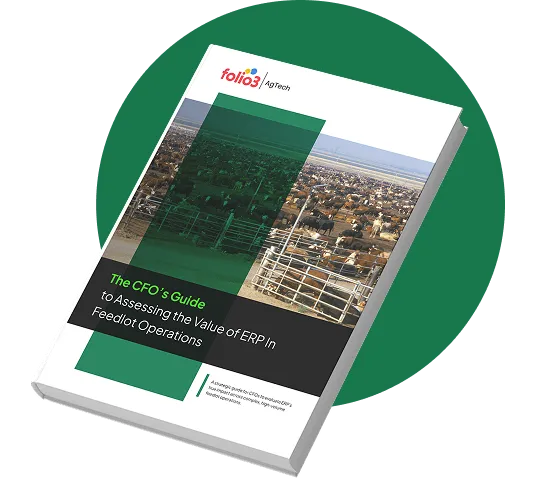
A strategic guide for CFOs to evaluate ERP’s true impact across complex, high-volume feedlots.
Because we connect what happens in your yard to what matters in your financials, accurately, consistently, and in real time.
20+ years of solving real feedlot challenges.
Purpose-built to manage feedlot operations efficiently.
Industry-certified team ensuring seamless software performance.

Connects smoothly with ERP, accounting, and inventory systems.
Access anywhere with secure, future-ready cloud technology.

Managing millions of cattle for industry leaders.
With certified expertise across Microsoft Dynamics, NetSuite, and cloud platforms, we build integrations that work the way your financial systems expect.
Discover how we empower businesses to achieve remarkable growth, streamline operations, and enhance sustainability across the agricultural landscape.
Read what our clients say about their experiences and the difference our solutions have made for them.
Vice President Information Technology
VP of Operations
IT Project Manager
Systems Administrator
Product Manager
Turnkey is built around feedyard operations, closeouts, feed costs, cattle activity, and yard workflows. ERP systems are built for structured accounting, consolidation, audit readiness, and enterprise-level reporting across entities and locations. Most growing feedlots need both to work together.
Yes. Turnkey software can integrate with ERP systems to automatically transfer closeouts, commodity costs, feed charges, settlements, receivings, and other operational financial data into structured ERP records.
Most integrations include:
Not always. Many feedlots continue using Turnkey for operational workflows while ERP handles accounting, consolidation, reporting, and financial controls. Some operations eventually migrate accounting fully into ERP while keeping operational Turnkey modules active.
ERP systems are stronger at:
Yes. Most feedlots keep operational systems like AMS, trucking workflows, inventory systems, and cattle tracking exactly as they are while integrating financial activity into ERP.
Instead of manually rebuilding numbers from spreadsheets, financial entries flow directly from Turnkey into ERP. That reduces reconciliation work, shortens close cycles, and improves consistency across yards and entities.
The biggest value usually appears in operations managing:
Yes. Integration allows operational metrics from Turnkey systems, like cost-of-gain, feed efficiency, and closeout margins, to appear alongside ERP financial reporting for better decision-making.
No. Integration is typically configured around existing Turnkey workflows, so feed deliveries, closeouts, treatments, and receivings continue operating normally during deployment.
Get a Free Consultation Within 24 Hours, with a No-Obligation Ballpark Estimate
Error: Contact form not found.