


You are doing everything right. The seeds went in on time, the irrigation schedule is solid, and your fields look fine from a distance. But then you spot it: yellowing leaves, scorched edges, stunted plants. Something is off, and it is not pests or disease.
What you are likely dealing with is a plant nutrient deficiency, and it is one of the most common yet misdiagnosed problems in commercial agriculture. According to a 2025 FAO report, yield gaps for major crops reach up to 70% below potential levels in regions where low soil fertility and nutrient depletion are widespread.
The tricky part? Nutrient deficiencies rarely announce themselves clearly. Symptoms overlap, multiple deficiencies stack on top of each other, and the real cause often hides underground in your soil chemistry, not in your fertilizer bag.
This guide breaks down everything you need to know about plant deficiencies: what causes them, how to spot them in the field, and exactly how to fix them. Whether you are managing row crops, greenhouse operations, or specialty produce, the diagnostic framework here will save you time, money, and yield.
What Are Plant Nutrient Deficiencies?
A nutrient deficiency means your plants are not getting enough of a specific element they need to grow. Understanding which nutrients matter and why is the first step toward fixing the problem.
Plants need 17 essential elements to complete their lifecycle. Three of them, carbon, hydrogen, and oxygen, come from air and water. The remaining 14 must come from your soil or nutrient solution.
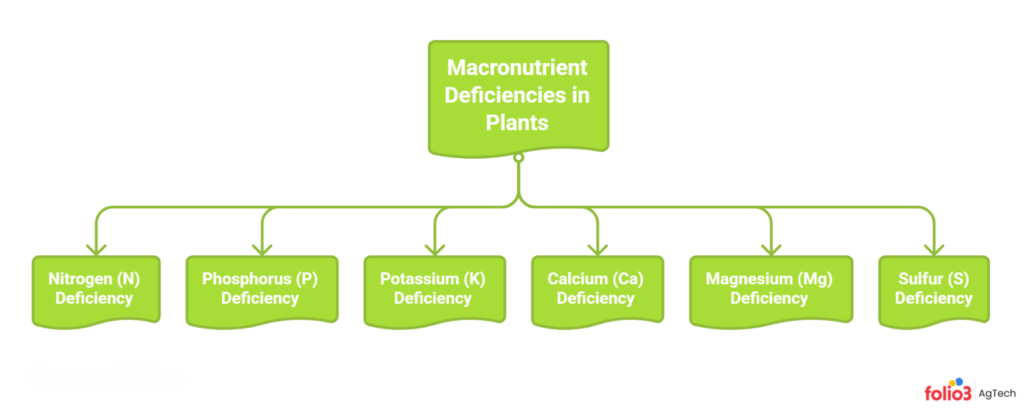
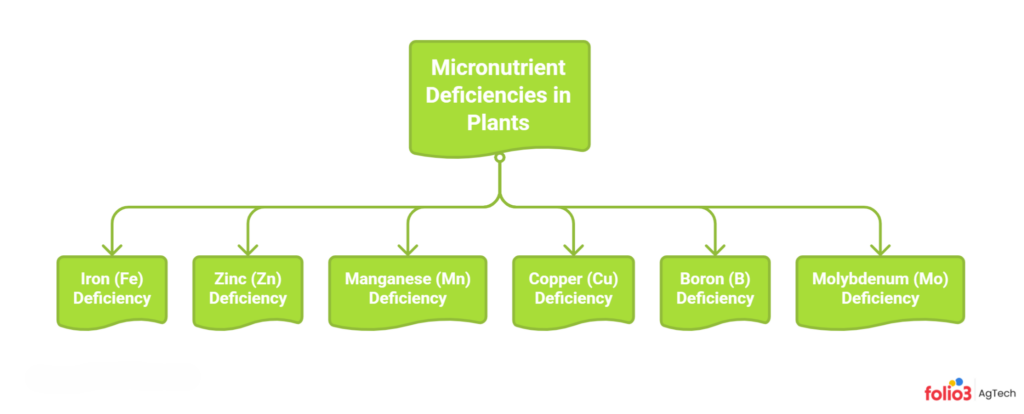
These 14 are split into two groups. Macronutrients (nitrogen, phosphorus, potassium, calcium, magnesium, and sulfur) are needed in larger quantities. Micronutrients (iron, zinc, copper, manganese, boron, molybdenum, chlorine, and nickel) are needed in trace amounts but are just as critical.
Here is a concept most growers overlook: Liebig’s Law of the Minimum.
It states that your yield is not determined by total nutrients available. It is limited by whichever single nutrient is in shortest supply. Think of it like a barrel with uneven staves. The shortest stave determines how much water the barrel holds. The same applies to your crop. Even if nitrogen, phosphorus, and potassium are abundant, a shortage of zinc or boron alone can cap your entire yield.
That is why balanced nutrition, not just heavy fertilization, drives results.So, learning to identify which nutrient is lacking matters more than simply adding more of everything. For a deeper look at how inputs interact with soil biology, check out this guide on agricultural inputs for agribusinesses.
Mobile vs. Immobile Nutrients: The Key to Accurate Diagnosis
Not all nutrients move the same way inside a plant. Some are mobile, meaning the plant can pull them from older tissues and redirect them to new growth. Others are immobile, meaning once they are deposited in a leaf, they stay there.
That’s why symptom location matters so much:
- Mobile nutrients (N, P, K, Mg): When these run low, the plant salvages them from older, lower leaves and ships them to younger growth. So you will see yellowing, purpling, or necrosis on the bottom of the plant first.
- Immobile nutrients (Ca, S, Fe, Zn, Cu, Mn, B): These cannot be relocated. When they are deficient, the newest leaves and growing tips suffer first because there is no internal supply to draw from.
Before you reach for a fertilizer bag, ask yourself one question: Are symptoms showing up on old leaves or new growth? That answer alone narrows your list of suspects by half and helps you avoid the expensive mistake of treating for the wrong deficiency.
How to Identify Macronutrient Deficiencies in Plants
Macronutrients do the heavy lifting in plant growth. When any of these six elements run short, your crops show visible symptoms fast.
Nitrogen (N) Deficiency
Nitrogen fuels chlorophyll production and drives vegetative growth. When it runs low, your plants literally cannot stay green.
Symptoms: Uniform yellowing that starts from the oldest, lowest leaves and moves upward. Overall, pale green color across the plant, stunted growth, and thin stems. In severe cases, older leaves drop early.
Common causes: Heavy rain leaching nitrate from the root zone, low organic matter, cold soils slowing microbial nitrogen release, or simply not enough fertilizer for the crop stage.
How to fix it: Apply a nitrogen-specific supplement like urea, ammonium nitrate, blood meal, or fish emulsion. Avoid over-applying a complete fertilizer, as that can create secondary imbalances. For long-term correction, build soil organic matter through compost or nitrogen-fixing cover crops.
Phosphorus (P) Deficiency
Phosphorus powers energy transfer within cells and is critical for root development, flowering, and seed formation.
Symptoms: Older leaves turn dark green or develop a purple, reddish, or bronze tint. Maturity is delayed, root systems are weak, and overall growth is stunted.
Common causes: Cold or waterlogged soils (phosphorus uptake drops sharply below 50°F), extremely acidic or alkaline pH, and excess iron or aluminum locking phosphorus into unavailable forms.
How to fix it: Apply bone meal, superphosphate, or rock phosphate. Improve drainage and adjust pH to the 6.0–7.0 range where phosphorus availability peaks.
Potassium (K) Deficiency
Potassium regulates water movement, enzyme activation, and disease resistance. It is a workhorse nutrient that keeps your crops resilient under stress.
Symptoms: Brown, scorched leaf edges (marginal necrosis) on older leaves. Weak stems, increased susceptibility to disease, and poor fruit quality.
Common causes: Sandy soils with high leaching, heavy crop removal without replenishment, and pH imbalances that reduce availability.
How to fix it: Apply sulfate of potash, muriate of potash, or wood ash. Seaweed extract works well for organic operations. Correct pH and reduce excessive watering to minimize leaching losses.
Calcium (Ca) Deficiency
Calcium builds cell walls and supports new tissue development. Unlike most nutrients, the plant cannot redistribute it, so new growth suffers first.
Symptoms: Tip burn on new leaves, twisted or distorted growth, and the well-known blossom-end rot in tomatoes and peppers.
How to fix it: Apply lime, gypsum, or calcium nitrate. Critically, maintain consistent soil moisture because calcium travels with water through the xylem. Erratic watering is one of the top triggers.
Magnesium (Mg) Deficiency
Magnesium sits at the center of the chlorophyll molecule. Without it, photosynthesis slows down, and leaves lose color in a distinctive pattern.
Symptoms: Interveinal chlorosis on older leaves, where the tissue between veins turns yellow while the veins themselves stay green. In severe cases, leaves curl upward and develop necrotic spots.
How to fix it: Foliar spray of diluted Epsom salts (magnesium sulfate) gives fast relief. For long-term correction, apply dolomitic lime to soils that are also low in pH.
Sulfur (S) Deficiency
Sulfur is a building block for amino acids and enzymes. It often gets confused with nitrogen deficiency because both cause yellowing, but the key difference is where symptoms appear.
Symptoms: General yellowing of new, upper leaves (not old leaves like nitrogen). Stunted growth and sometimes a faint purple tint.
How to fix it: Apply sulfate-based fertilizers such as ammonium sulfate or sulfate of potash. Composted organic matter, like mushroom compost, also releases sulfur gradually.
Spotting Micronutrient Deficiencies in Plants
Micronutrients are needed in tiny amounts, but their absence causes outsized problems. Many share similar symptoms, which makes an accurate diagnosis critical.
Iron (Fe) and Zinc (Zn) Deficiency
Iron and zinc deficiencies both show up as interveinal chlorosis on new leaves, which makes them easy to confuse. The key distinction is leaf size.
Iron deficiency: New leaves turn yellow between the veins while the veins stay sharply green. In severe cases, leaves whiten entirely. Leaf size stays normal. This is common in blueberries, citrus, and azaleas growing in high-pH soils.
Zinc deficiency: Similar interveinal chlorosis on young leaves, but with noticeably smaller leaves (called “little leaf”), rosetting, and sometimes necrotic spots. Common in corn, rice, and pecans on alkaline or heavily phosphorus-fertilized soils.
Fixes: Chelated iron or foliar ferrous sulfate for iron. Zinc sulfate foliar spray for zinc. In both cases, correct soil pH toward the slightly acidic range to improve long-term availability.
Manganese (Mn), Copper (Cu), and Boron (B) Deficiency
Manganese: Interveinal chlorosis on new leaves, but with a distinctive checkered or speckled pattern of tan or brown specks between veins. This is the key feature that separates manganese from iron. Common in soybeans and oats on high-pH soils. Fix with manganese sulfate.
Copper: New growth appears stunted or wilted with a bluish-green tint. Flowers may drop without setting fruit. Common in wheat and citrus on sandy or alkaline soils. Fix with a diluted copper sulfate foliar spray. Use caution because copper is toxic at high rates.
Boron: Brittle new growth, hollow or cracked stems, thick roots with swollen tips, and sometimes a bushy cluster of stunted shoots known as “witch’s broom.” Common in beets, broccoli, and apples. Fix with borax at very low rates since the line between deficiency and toxicity for boron is narrow.
Molybdenum (Mo) Deficiency
Molybdenum is unique among micronutrients for two reasons. First, it is essential for nitrogen fixation in legumes, so a molybdenum-deficient bean or clover field often mimics nitrogen deficiency. Second, it is the only micronutrient that becomes more available as pH increases, the opposite of iron and zinc.
Symptoms: Yellowed older leaves with necrotic, curling edges. Leaves may look scorched or deformed.
How to fix it: Apply sodium molybdate or ammonium molybdate. Often, simply liming an acidic soil to raise pH above 6.0 resolves molybdenum availability without any direct application.
Iron vs. Manganese: How to Tell Them Apart
This is one of the most common mix-ups in field diagnosis. Both cause interveinal chlorosis on new leaves. Here is the practical breakdown:
- Iron: Veins remain sharply green against uniformly yellowed tissue. The pattern is clean and distinct.
- Manganese: Green margins remain, but the tissue between veins develops tan or brown specks, giving the leaf a checkered or speckled look.
A soil pH test helps confirm. High pH (above 7.0) strongly suggests iron lockout. Neutral pH (around 6.5–7.0) points toward manganese. If you rely on smart farming technology like handheld soil sensors, you can run this check in seconds right in the field.
Plant Nutrient Deficiency Identification Cheat Sheet
Use this quick-reference table to narrow down deficiencies fast. Bookmark it or print it for field use.
| Nutrient | Mobility | Symptoms On | Key Visual Signs | Crops at Risk | Quick Fix |
| Nitrogen (N) | Mobile | Older leaves | Uniform yellowing, stunted growth | Corn, wheat, leafy greens | Urea, blood meal |
| Phosphorus (P) | Mobile | Older leaves | Dark green/purple leaves, delayed maturity | Corn, tomatoes, beans | Bone meal, superphosphate |
| Potassium (K) | Mobile | Older leaves | Scorched leaf edges, weak stems | Potatoes, tomatoes, fruit trees | Potash, wood ash |
| Calcium (Ca) | Immobile | New growth | Tip burn, blossom-end rot | Tomatoes, peppers, lettuce | Lime, gypsum |
| Magnesium (Mg) | Mobile | Older leaves | Interveinal chlorosis, veins stay green | Citrus, grapes, potatoes | Epsom salts, dolomite |
| Sulfur (S) | Immobile | New leaves | Yellowing of new growth | Brassicas, canola, alfalfa | Sulfate fertilizers |
| Iron (Fe) | Immobile | New leaves | Interveinal chlorosis, may whiten | Blueberries, citrus, roses | Chelated iron spray |
| Zinc (Zn) | Immobile | New leaves | Little leaf, rosetting, spots | Corn, rice, pecans | Zinc sulfate spray |
| Manganese (Mn) | Immobile | New leaves | Checkered chlorosis, tan specks | Soybeans, oats, wheat | Manganese sulfate |
| Boron (B) | Immobile | Growing tips | Brittle tissue, hollow stems | Beets, broccoli, apples | Borax (low rates) |
| Copper (Cu) | Immobile | New leaves | Wilting, bluish tint, flower drop | Wheat, citrus, sunflowers | Copper sulfate spray |
| Molybdenum (Mo) | Mobile | Older leaves | Yellowed margins, deformed leaves | Legumes, brassicas | Sodium molybdate, lime |
Note: This table covers all 12 plant nutrients you are most likely to encounter in the field. For a deeper dive into how soil fertility shapes these outcomes, explore this resource on practical ways to improve soil fertility.
Why Do Nutrient Deficiencies Happen? (Root Causes Beyond Fertilizer)
This is the part that surprises many growers. Your soil test might show adequate phosphorus, potassium, and micronutrients, yet your plants are still starving. The problem is not supply. It is access. Here are the six most common blockers:
- pH lockout: This is the number one culprit. When soil pH drifts too high or too low, nutrients become chemically unavailable. Iron locks out above pH 7.5. Phosphorus locks out below 5.5 and above 7.5. Adjusting pH often solves a “deficiency” without adding a single gram of fertilizer.
- Soil compaction and poor drainage: Compacted soils restrict root growth and reduce oxygen in the root zone. Roots that cannot breathe cannot absorb nutrients. Waterlogging has a similar effect, especially on phosphorus and iron uptake.
- Nutrient antagonism: Excess of one mineral blocks the uptake of another. Too much potassium locks out magnesium. Excess phosphorus suppresses zinc absorption. This is why balanced fertilization matters more than heavy application. The concept ties directly into how soil health and regenerative soil practices create resilient nutrient cycling.
- Weather extremes: Cold soils inhibit phosphorus uptake even when phosphorus levels are adequate. Drought reduces nutrient transport to roots. Prolonged wet periods leach mobile nutrients like nitrogen and potassium out of the root zone.
- Growth stage mismatch: Nutrient demand shifts throughout the season. Plants need more nitrogen during vegetative growth and more phosphorus and potassium during flowering and fruiting. A fertilizer program that ignores this timing creates predictable gaps. Fertigation systems help match nutrient delivery to crop stage in real time.
- Root damage: Nematodes, root rot, and physical damage from cultivation all reduce the root surface area available for nutrient uptake. Even in nutrient-rich soil, damaged roots cannot absorb enough. Integrated pest and disease management protects this critical interface.
6 Steps to Diagnose Plant Nutrient Deficiencies in the Field
Jumping straight to a fertilizer application without proper diagnosis is a common and costly mistake. This six-step process, adapted from university extension research, gives you a reliable field protocol:
- Rule out pests and diseases first. Nutritional disorders typically affect plants uniformly across a field or bed, not in isolated patches. If damage is spotty, insects or pathogens are more likely culprits. Check stems, roots, and the undersides of leaves before assuming a nutrient issue.
- Test soil pH and electrical conductivity (EC). Use a pour-through or saturated media test. pH tells you what is chemically available. EC tells you the total dissolved salt concentration. Calibrate your instruments before testing. These two numbers eliminate a large percentage of guesswork.
- Identify where symptoms appear. Old leaves, new leaves, or the whole plant? This single observation narrows the suspect list to mobile or immobile nutrients, cutting your possibilities roughly in half.
- Match symptom patterns to the deficiency key. Use the cheat sheet table above. Look for specific cues: uniform yellowing vs. interveinal chlorosis, leaf edge burn vs. tip burn, purpling vs. speckling. Each pattern points to a different nutrient.
- Send samples to a lab. Visual diagnosis gets you about 80% of the way. Soil and tissue analysis closes the gap andpreventst costly misapplication. Tissue testing reveals what the plant has actually absorbed, while soil testing shows what is available. Both together give the full picture.
- Consult local extension agents or agronomists. They know your region’s soil profiles, common deficiencies, and what has worked for other growers nearby. This step is especially valuable when symptoms overlap or lab results are ambiguous.
How to Fix Nutrient Deficiency in Plants: Short-Term and Long-Term Strategies
Effective treatment is a two-phase approach. Fast-acting fixes stop the damage now. Long-term strategies prevent it from coming back.
Short-Term Fixes for Immediate Relief
When your crop is actively showing deficiency symptoms mid-season, you need solutions that work within days, not weeks:
- Foliar feeding: Spraying nutrients directly onto leaves bypasses soil lockout entirely. Chelated iron, zinc sulfate, and magnesium sulfate are all effective as foliar applications. Absorption happens within hours. This is especially valuable when soil pH is the bottleneck and cannot be changed mid-season.
- pH flushing: In fertigation or hydroponic systems, flushing the root zone with a pH-adjusted nutrient solution can shift availability quickly. Target pH 5.8–6.5 for most crops.
- Targeted single-nutrient application: When you have confirmed a specific deficiency, apply that nutrient alone. Adding a complete fertilizer when only zinc is low risks creating a potassium or phosphorus excess that triggers new problems.
Long-Term Agronomic Solutions
Short-term fixes address symptoms. Long-term strategies fix the system:
- Soil amendments: Lime raises pH and adds calcium. Gypsum adds calcium without changing pH. Organic matter improves cation exchange capacity (CEC), which is your soil’s ability to hold and release nutrients on demand.
- Adjust base fertilizer programs: Match nutrient applications to crop demand at each growth stage. This is where precision farming software adds real value, helping you apply variable rates based on field-level data rather than flat-rate guesswork.
- Crop rotation and cover crops: Rotating deep-rooted and shallow-rooted crops improves soil structure. Legume cover crops fix nitrogen naturally. Diverse rotations break pest cycles and improve nutrient cycling. These are foundational sustainable crop production practices that pay dividends across seasons.
- Regular soil testing: Test annually, and test by management zone, not just field average. Monitoring pH, EC, and organic matter trends over time reveals problems before they become visible in the canopy.
Using AgTech for Early Deficiency Detection
By the time you see yellow leaves, your yield has already taken a hit. That is why forward-thinking growers are shifting from reactive symptom-chasing to proactive monitoring with technology:
- NDVI mapping via drones and satellites: Normalized Difference Vegetation Index (NDVI) maps highlight areas of plant stress across your field before symptoms are visible to the naked eye. This does not tell you which nutrient is lacking, but it tells you where to scout and sample first.
- Smart soil sensors: Real-time NPK, pH, and moisture sensors let you monitor root-zone conditions continuously. When pH drifts or moisture drops below a threshold, you get alerted before the plant reacts. Learn more about the role of IoT sensors in agriculture and how they integrate into modern farm operations.
- Sap analysis: Unlike traditional dry tissue testing, sap analysis measures nutrient concentrations in plant fluids in near real-time, giving you a snapshot of what the plant is absorbing right now rather than what has accumulated over weeks.
- AI-powered smartphone apps: Several platforms now let you photograph symptomatic leaves and receive a probable deficiency match. These are getting better each year, though lab confirmation is still the gold standard. Explore how AI crop disease detection works alongside these diagnostic tools.
The bottom line: technology does not replace your eyes or your agronomist. But it dramatically shortens the gap between a problem starting underground and you noticing it in the canopy.
Conclusion and Next Steps for Growers
Plant deficiencies do not have to catch you off guard. The difference between a yield loss and a quick correction comes down to how early you spot the problem and how accurately you diagnose it.
Use the mobile vs. immobile framework to narrow symptoms. Follow the six-step diagnostic process to avoid treating the wrong deficiency. Plus, invest in proactive monitoring, through soil testing, sap analysis, or sensor technology, so you can act before visible damage costs you yield. If you are ready to bring data-driven precision to your nutrient management, consult with our AgTech experts who are helping growers move from reactive corrections to proactive, season-long optimization.
FAQs
What Is the Fastest Way to Correct a Nutrient Deficiency in Plants?
Foliar feeding is the fastest method. Spraying a water-soluble nutrient solution directly onto leaves delivers absorption within hours, bypassing soil lockout. For root-zone corrections, fertigation with pH-adjusted solutions is the next fastest option, typically showing improvement within 5 to 10 days.
Can Overwatering Cause Nutrient Deficiency Symptoms?
Yes. Overwatering saturates the root zone, reducing oxygen and limiting root function. It also leaches mobile nutrients like nitrogen and potassium out of the soil profile. Waterlogged conditions can trigger iron toxicity in some soils while simultaneously causing calcium and boron deficiency in new growth.
How Often Should You Test Soil to Prevent Nutrient Deficiencies?
At a minimum, test annually before planting. For high-value crops or intensive production systems, test twice per season: once pre-plant and once mid-season. Zone-based sampling gives more accurate data than whole-field composites, especially on variable terrain.
Do Organic and Conventional Crops Experience Different Deficiencies?
The same deficiencies affect both systems, but the triggers differ. Organic operations rely on slower-release nutrient sources like compost and cover crops, which can create temporary gaps during peak demand. Conventional systems risk antagonism from concentrated synthetic applications. Both benefit from regular soil and tissue testing.
Why Do Nutrient Deficiency Symptoms Look Similar to Pest Damage?
Both nutrient stress and pest damage trigger similar plant defense responses, including chlorosis, necrosis, and stunted growth. The distinguishing factor is the pattern. Nutrient deficiencies appear uniformly across a field, while pest damage tends to cluster in patches. A systematic diagnostic approach and lab testing eliminate guesswork.
Is It Possible to Fix Nutrient Deficiencies Without Adding Fertilizer?
In many cases, yes. Correcting soil pH alone can unlock nutrients already present in the soil. Improving drainage, breaking compaction, and managing irrigation more carefully also restores uptake without additional inputs. Addressing root health through organic pest control methods further improves absorption from existing soil reserves.