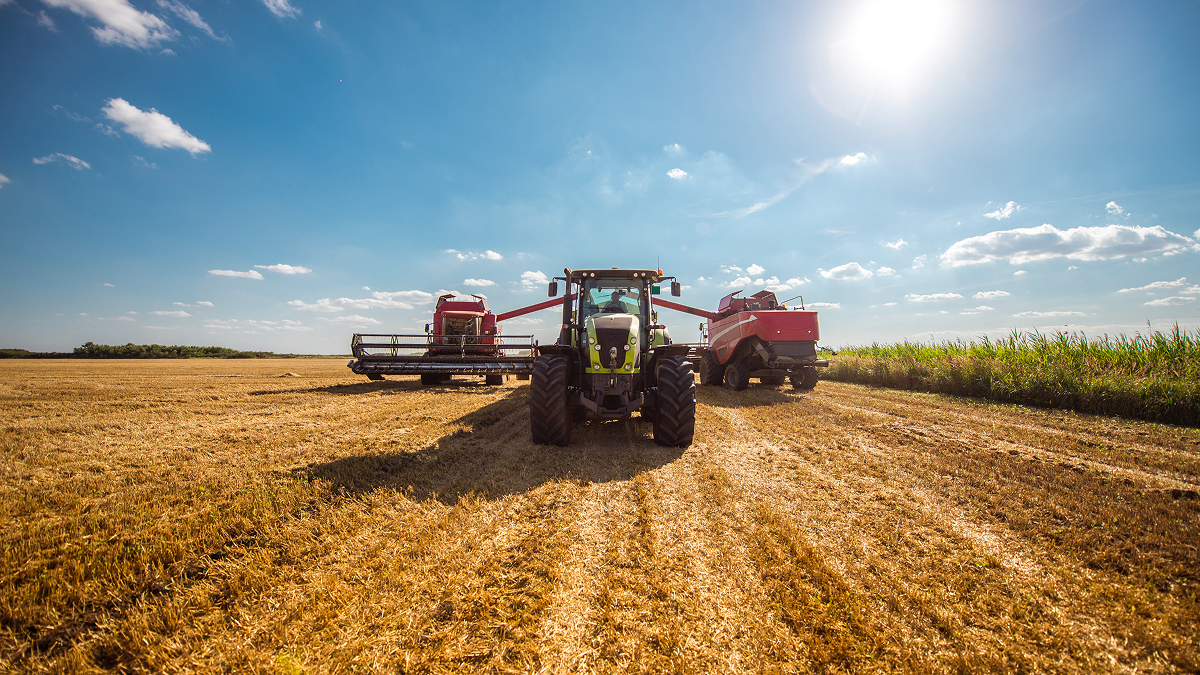

Modern farming has moved well past the days of a single tractor doing everything. Today, your equipment fleet is the backbone of your operation, and the right types of farm equipment can make the difference between barely breaking even and running a profitable, scalable farm. With the global farm equipment market valued at roughly $199 billion in 2026 and growing at a 6.5% annual rate, the machinery available to you is more capable, more connected, and more specialized than ever before.
What are the different types of farm equipment? Modern farm equipment falls into six operational categories: tractors (prime movers), tillage and soil preparation implements, planting and seeding machinery, crop protection and nutrient application equipment, harvesting and threshing machines, and material handling and storage systems.
This guide is built for farm owners, operations heads, and cooperative managers who need a clear, practical breakdown of equipment capabilities, uses, and the precision agriculture technology upgrades that drive efficiency gains at every stage of the production cycle.
Understanding Modern Farm Equipment Types: An Operational Lifecycle Approach
Choosing the right farming equipment starts with how you think about it. Here is why organizing machinery by workflow beats every other approach and leads to better farm equipment maintenance.
Most lists of different types of farm equipment sort by brand or alphabetical order. That approach looks clean on paper, but it tells you nothing about how machinery actually fits into your daily work. A better way is to organize equipment by operational workflow: tillage, planting, crop care, and harvesting. It lets you see where each machine sits in the production cycle and spot gaps or overlaps in your fleet.
At the center of every workflow sits your tractor, the prime mover. Every implement you pull, power, or mount connects back to it. That is why understanding the relationship between tractors and the specialized tools they drive is critical for making smart buying decisions.
One thing that has changed the game for fleet flexibility is ISOBUS (ISO 11783) compatibility. It is the industry standard that allows electronic communication between your tractor and any ISOBUS-compliant implement, regardless of manufacturer. It means you are not locked into a single brand ecosystem. You can mix and match planters, sprayers, and guidance systems while keeping everything talking to one display in the cab. For operations serious about digital transformation in agriculture, ISOBUS is the starting point. Leading agricultural technology solutions providers are already building their platforms around this standard.
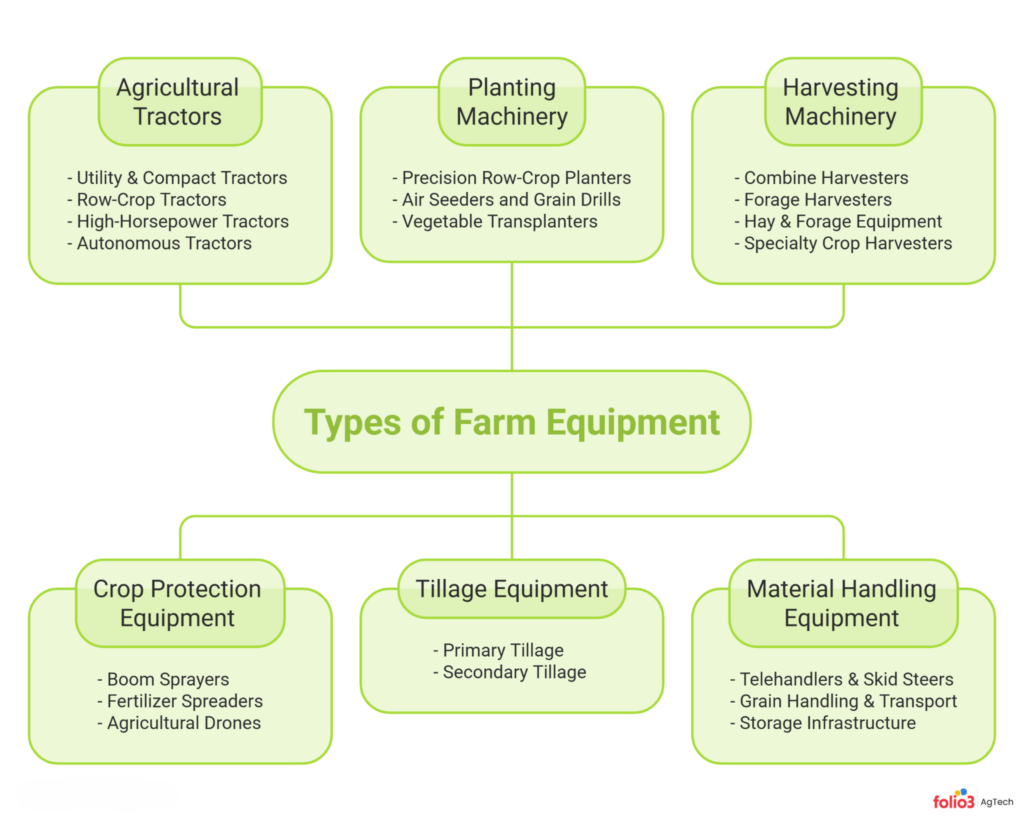
1. Agricultural Tractors: The Prime Movers of Farm Machinery
Tractors are the foundation of every farm machinery lineup, and they do far more than pull implements. They power PTO-driven attachments, run hydraulic systems, and increasingly serve as the data hub for your entire field operation. The key is matching the right tractor class to your operational needs, because the tools farmers use every day are only as effective as the prime mover behind them.
Utility & Compact Tractors (35-85 HP)
These are the workhorses of smaller operations and the support units on larger farms. You will use them for material handling with front-end loaders, barnyard maintenance, mowing, and light livestock work like moving hay bales or running feed wagons. Operations that pair a utility tractor with livestock management software get a solid foundation for both fieldwork and herd tracking. They are nimble, affordable, and easy to operate. If you are running a small commercial operation or managing a homestead, a utility tractor in the 45-65 HP range covers most of your needs without the overhead of a larger machine.
Row-Crop Tractors (95-350 HP)
This is where most mid-size commercial farms live. Row-crop tractors handle precision planting, inter-row cultivation, spraying, and general field production. The defining features are adjustable tread widths (so you can match your row spacing), high-capacity PTO for driving planters and grain carts, and compatibility with auto-steer guidance systems. According to USDA data, 70% of large-scale U.S. crop farms now use auto-steer guidance on their tractors, and 52% of midsize farms have adopted it as well.
High-Horsepower 4WD & Track Tractors (350-650+ HP)
These are built for large-scale operations and cooperatives that need to cover serious acreage. You will find them doing heavy primary tillage, pulling large air seeders, and running high-capacity grain carts at harvest. Track systems (like articulated Quadtrac designs) reduce soil compaction significantly compared to wheeled units of the same power class. If you are farming 1,500 acres or more, your primary tillage and seeding pass likely depends on a machine in this range.
Autonomous & Electric Tractors
The newest frontier in types of farm machinery. Autonomous tractor systems are moving from demonstration to scaled commercial use. Over 1 million acres in North America were reportedly operated using autonomous tractor systems by 2026, primarily for tillage and field-mapping applications. Battery-electric prime movers are emerging for specialty crop operations where lower noise, zero emissions, and reduced operating costs matter. These technologies are still early-stage for broad-acre row cropping, but they are worth watching closely if you are planning fleet upgrades over the next 5 to 10 years.
2. Tillage Equipment and Soil Preparation Tools
The tillage conversation has shifted dramatically. Where conventional inversion tillage used to be the default, more growers are now weighing conservation tillage and no-till systems, especially as soil health practices gain importance in carbon credit programs and sustainability benchmarks. Your tillage equipment choices should reflect both your soil conditions and your long-term management goals.
Primary Tillage Implements
- Moldboard Plows: Complete soil inversion and residue burial. Best suited for heavy clay soils or when you need full incorporation of crop residue. They create a clean seedbed but increase erosion risk and moisture loss.
- Chisel Plows & Deep Rippers: Break up hardpan layers at depths of 12 to 24 inches without destroying surface structure. These are a good fit for operations transitioning toward conservation tillage, since they leave more residue on top.
- Disk Plows: Designed for rocky, heavy, or virgin soils where moldboard plows struggle. They handle tough conditions where other primary tillage implements would sustain damage.
Secondary Tillage & Seedbed Preparation
- Disk Harrows & Field Cultivators: Handle clod breaking, surface leveling, and chemical incorporation before planting. These are the most common secondary tillage tools on mid-size and large operations.
- Power Harrows & Rotary Tillers: PTO-driven implements for intensive seedbed preparation. You will find these primarily in vegetable and specialty crop operations where a fine, uniform seedbed is critical.
- Land Rollers & Cultipackers: Firm the soil surface to ensure optimal seed-to-soil contact. They are especially useful after planting small-seeded crops and for pushing rocks below combine header height.
Whether you lean toward minimum tillage or still run conventional passes, effective soil erosion control should factor into every tillage decision you make.
3. Planting, Seeding, and Transplanting Machinery
The transition from mechanical seed metering to pneumatic and electric-drive systems has been one of the biggest shifts in farm equipment over the past decade. Today’s planters do not just drop seed. They meter it precisely, control depth automatically, and map every row for downstream analysis.
Precision Row-Crop Planters
Vacuum and pressure seed meters handle corn, soybeans, and cotton with singulation rates above 98%. High-speed planting technologies now allow you to plant at speeds of 10 mph or more without sacrificing singulation accuracy. Section control on the planter shuts off individual row units automatically when the GPS detects overlap (like in point rows or headlands), eliminating double-planted seed and the input costs that go with it.
Downforce automation adjusts pressure on each row unit in real time, keeping uniform planting depth across variable terrain. If you are still running a mechanical planter without section control, you are likely wasting 3 to 5% of your seed investment on overlap alone. Pairing your planter with the right seed selection practices sets the foundation for maximizing your yield potential.
Air Seeders and Grain Drills
For small grains like wheat, barley, and oats, plus cover crops, air seeders and grain drills are the standard. Pneumatic distribution systems deliver seed from a central commodity cart through hoses to individual openers, covering 40 to 80 feet of width in a single pass. These machines are built for high-acreage operations where speed and coverage matter. Modern grain drills now offer independent depth control and the ability to apply fertilizer in a separate band at seeding, which is a significant upgrade over traditional box drills.
Specialized Vegetable Transplanters
For high-value horticultural operations, semi-automated and fully automated plug transplanters handle seedlings at speeds that would be impossible by hand. These are niche machines, but they are essential for commercial vegetable growers scaling beyond hand-labor planting.
4. Crop Protection and Nutrient Management Equipment
This category of farm tools and equipment is evolving faster than almost any other, driven by the push to optimize every dollar you spend on fertilizer and crop protection products. The goal is simple: put the right amount of the right product in the right place at the right time.
Self-Propelled and Pull-Type Boom Sprayers
High-clearance self-propelled sprayers with booms spanning 120 feet or more are the standard for large row-crop operations. The real upgrades are in nozzle control. Pulse Width Modulation (PWM) systems maintain consistent droplet size across variable speeds, which means better coverage and less drift. Direct-injection systems let you switch products on the go without contaminating your main tank.
The latest AI-powered camera systems identify individual weeds in the field and spot-treat them in milliseconds, reducing herbicide use by up to 77% compared to broadcast application. Variable-rate technology is increasingly standard on sprayers, letting you adjust rates zone-by-zone based on prescription maps.
Fertilizer and Nutrient Spreaders
- Broadcast Spinners: The workhorse for dry granular fertilizer application. Simple, reliable, and fast, but less precise than newer alternatives.
- Pneumatic Drop Spreaders: Deliver granular fertilizer through individual tubes to each row, reducing overlap and improving placement accuracy.
- Liquid Manure Injectors & Anhydrous Ammonia Applicators: Place nutrients directly below the soil surface, reducing volatilization losses and improving nitrogen efficiency. For operations focused on improving fertilizer efficiency, subsurface placement is a proven upgrade.
Agricultural Drones (UAVs) in Crop Protection
Payload-carrying drones with 10 to 50-liter tanks are gaining traction for spot-spraying fungicide and micronutrients, especially in situations where ground equipment cannot access the field. Wet fields, steep terrain, and mature crops that would suffer mechanical damage from a ground rig are all ideal use cases. For a deeper look at how drones are used in agriculture, including scouting and mapping, the technology is maturing rapidly.
5. Harvesting and Threshing Machinery
Harvesting machinery has come a long way from separate reapers, binders, threshers, and winnowers. Today’s machines combine all of those functions into a single pass, and the best ones give you real-time data on yield, moisture, and grain quality as you go.
Combine Harvesters (The Multi-Crop Workhorses)
Combines are the most complex and expensive single machines on most farms. The two main threshing designs are rotary and conventional cylinder systems. Rotary combines handle higher throughput and are generally more forgiving with varying crop conditions. Conventional cylinder machines can be gentler on grain but require more adjustment.
What makes a combine truly versatile is its header. Draper headers work best for cereal grains (wheat, barley, canola), corn heads with stalk rollers handle corn, and flex headers adjust to ground contours for low-podded crops like soybeans. Real-time yield mapping and grain loss sensors are now standard on most mid-range and higher combines, feeding data directly into your farm management system for post-harvest analysis.
Forage Harvesters (Silage Choppers)
Self-propelled forage harvesters chop corn silage and alfalfa to precise particle lengths. Kernel processor (KP) integration is critical for livestock operations because it improves the digestibility of corn silage, directly impacting animal performance. If you are running a feedlot or dairy and making your own silage, the quality of your forage harvester has a direct line to your feed conversion outcomes. Integrating silage data with a dedicated feed management system helps you track costs per ton and optimize rations downstream.
Hay & Forage Equipment Suite
- Mower Conditioners: Available in roller and flail configurations. Roller conditioners crack stems for faster dry-down in hay crops. Flail conditioners work better for crops that need aggressive conditioning.
- Rotary Rakes & Tedders: Manage swath width and speed up moisture evaporation. Tedders are especially useful after rain delays when you need to re-spread and dry cut forage.
- Round & Large Square Balers: High-density compression systems produce bales ready for storage or sale. ISOBUS integration with the tractor automates stop, tie, and eject functions, reducing operator fatigue and speeding up baling.
Specialty Crop Harvesters
Cotton strippers and pickers, potato and sugarbeet diggers, and mechanical tree-nut shakers are all highly specialized machines designed for single-crop harvesting. These are high-capital investments, which is why many smaller operations hire custom harvesters rather than owning this equipment outright.
6. Material Handling, Storage, and Barnyard Equipment
Material handling equipment often does not get the attention it deserves, but downtime here costs you just as much as a breakdown in the field. This category covers everything from the loaders you use daily to the bins that protect your harvest.
Telehandlers, Skid Steers, and Wheel Loaders
Articulated telehandlers and skid steers have largely replaced traditional tractor-mounted front-end loaders in commercial grain and livestock operations. The reasons are practical: better lift height, stronger breakout force, and tighter maneuverability in confined spaces like feed alleys and commodity buildings. For day-to-day tasks from moving round bales to loading trucks, these machines see more hours than almost any other equipment on the farm.
Grain Handling & Transportation
- Grain Carts (Chaser Bins): High-capacity carts with flotation tires or tracks designed to keep your combine running continuously during harvest. They shuttle grain from the combine to trucks on the field edge, reducing compaction in the harvest zone.
- Augers & Portable Conveyors: Move grain into bins efficiently while minimizing kernel damage. Belt conveyors are gentler on grain than traditional auger systems, which matters for seed corn and specialty crops where quality premiums are at stake.
On-Farm Storage Infrastructure
Corrugated steel grain bins with automated aeration and moisture-monitoring cables are the standard for commercial grain storage. Proper grain storage practices can make the difference between capturing a premium and taking a dockage hit. Bunker silos and silage bagging systems serve livestock operations that need to store large volumes of fermented feed efficiently.
Farm Equipment Selection Matrix: Match Machinery to Operational Scale
Choosing different farm equipment is ultimately about matching your operational scale to the right tier of machinery. Overbuying leads to high depreciation and underused assets. Underbuying means bottlenecks at critical field windows. The table below gives you a practical starting point for evaluating your fleet.
| Operational Scale | Primary Tractor Tier | Key Tillage & Seeding Setup | Core Harvesting Machinery | Priority Agtech Upgrade |
| Small Commercial (50-250 Acres) | Utility Tractor (45-85 HP) | 3-Point Hitch Disk Harrow, 4-6 Row Mechanical Planter | Pull-Type Forage Harvester or Custom-Hired Combine | GPS Lightbar Guidance, Aftermarket Auto-Steer |
| Mid-Size Commercial Farm (250-1,500 Acres) | Row-Crop Tractor (125-250 HP) | Chisel Plow, 12-16 Row Vacuum Planter, Folding Grain Drill | Class 5-6 Combine Harvester, Standard Draper Header | RTK GPS Auto-Steer, Section Control Sprayer Booms |
| Large Enterprise & Co-op (1,500-10,000+ Acres) | 4WD / Track Prime Mover (350-650+ HP) | High-Speed Disk, 24-36 Row High-Speed Electric Planter | Multiple Class 8-10 Combines, High-Capacity Grain Carts | Autonomous Tillage/Seeding, AI Spot-Spraying, Telematics |
The right agtech upgrade at each scale level can dramatically improve your farm efficiency and lower your cost per acre. Start with guidance and section control, then build toward full-fleet telematics and data integration.
Conclusion: Future-Proofing Your Agricultural Fleet
Selecting the right types of farm equipment is about more than horsepower. It is about building a connected, data-driven operational ecosystem where every machine works together to reduce input costs, increase throughput, and scale your operation sustainably. Focus on fleet ROI, input reduction, and scalability as your guiding principles.
Ready to take the next step? See how real operations have modernized their workflows in our agtech case studies, then contact our agtech experts to schedule a fleet optimization audit and explore how smart farming technology can work for your operation.
FAQs
How Often Should You Service Farm Equipment To Avoid Breakdowns?
Schedule preventive maintenance at least twice per year, before planting and before harvest. Critical items include hydraulic fluid checks, filter changes, bearing greasing, and tire or track inspections. A solid farm equipment maintenance plan helps avoid costly downtime during peak field windows.
What Size Tractor Do You Need for a 500-Acre Grain Farm?
A row-crop tractor in the 150 to 200 HP range typically covers a 500-acre grain operation well. This gives you enough power for a 12 to 16-row planter, a mid-size chisel plow, and standard grain cart work at harvest without excessive depreciation.
Can Small Farms Benefit From Precision Agriculture Technology?
Yes. Aftermarket GPS lightbar systems and basic auto-steer kits start under $5,000 and reduce overlap on every field pass. Even on 100 to 250 acres, you can recover that investment within one to two seasons through lower seed, fertilizer, and fuel costs.
What Is the Difference Between a Planter and a Grain Drill?
Planters meter individual seeds at precise spacing for row crops like corn and soybeans. Grain drills distribute seed continuously in narrow rows for small grains like wheat, barley, and cover crops. Planters offer higher singulation accuracy, while drills cover more width at faster speeds.
How Do Autonomous Tractors Work in Real Field Conditions?
Autonomous tractors use a combination of GPS positioning, AI-powered computer vision, multi-camera sensing, and path-planning software to navigate fields without a driver in the cab. Most current systems handle repetitive tasks like tillage and field mapping, with a remote operator monitoring multiple units.
What Farm Equipment Should You Lease vs. Buy?
Lease or custom-hire equipment you use less than 200 hours per year, such as specialty harvesters and large combines. Buy equipment that sees daily or weekly use, like tractors, loaders, and sprayers. The breakeven point depends on your acreage, usage hours, and how quickly the technology evolves in that equipment category.