
Your soil is under pressure from two directions at once. Extreme weather events are hitting harder and more often, while your profit margins keep getting squeezed. The old playbook of reacting to erosion after the damage is done no longer works.
Modern soil erosion control has shifted from reactive sediment containment to proactive precision conservation. If you are still relying on the same practices your grandfather used, your topsoil is likely disappearing faster than you think. According to the USDA’s 2017 National Resources Inventory, U.S. cropland loses an average of 4.63 tons of soil per acre every year. At a minimum topsoil value of $7.50 per ton, that translates to roughly $12.75 billion in annual economic losses across American farmland.
This guide covers everything you need to build a precision soil erosion control plan: agronomic methods, structural techniques, and the data-driven tech stack that ties them together. Executing these strategies at scale requires more than field-level knowledge. It demands an integrated Agtech ERP platform that connects your physical soil management with day-to-day crop planning, irrigation scheduling, and harvest analytics.
Decoding Soil Erosion: Meaning, Types, and Financial Realities
Understanding soil erosion starts with knowing what it actually is and what it costs your operation. This section breaks down the causes, types, and financial impact of topsoil loss on commercial farms.
What Is Soil Erosion?
Soil erosion is the displacement of the upper layer of soil, known as topsoil, by water, wind, or tillage activity. This topsoil layer contains the highest concentration of organic matter, microbial life, and plant-available nutrients on your farm.
Losing this layer directly destroys your crop yield potential. Topsoil is where your Cation Exchange Capacity (CEC) lives, where water is stored, and where roots access the nutrients that drive bushel-per-acre performance. Roughly one pound of soil is lost for every bushel of corn produced, and soil rebuilds at less than a tenth of a millimeter per year. It means what took nature thousands of years to build can vanish in a few seasons of neglect.
The Core Causes of Soil Erosion on Commercial Farms
Several key practices accelerate soil erosion on working farmland:
- Aggressive deep tillage that pulverizes soil aggregates, breaking apart the natural structure that holds topsoil in place and making it vulnerable to wind and water transport.
- Leaving fields bare during off-season weather. Exposed soil without crop residue or cover has zero protection from intense rainfall or sustained wind events.
- Overgrazing and poor livestock rotation strip vegetative cover down to bare ground, removing the root systems that anchor topsoil.
- Removing natural windbreaks such as tree lines, hedgerows, and field borders that once intercepted wind energy before it reached open crop fields.
Understanding the Types of Soil Erosion: Water vs. Wind
Soil moves across your landscape through two primary physical drivers, and each has distinct stages of severity.
Water-Driven Erosion:
- Splash erosion occurs when individual raindrops strike bare soil with enough kinetic energy to dislodge particles. It is the starting point of all water erosion.
- Sheet erosion removes a thin, uniform layer of topsoil across the entire field surface. It is the hardest type to spot because the damage looks even.
- Rill erosion creates small, well-defined channels where concentrated water flow carves shallow grooves into the soil surface.
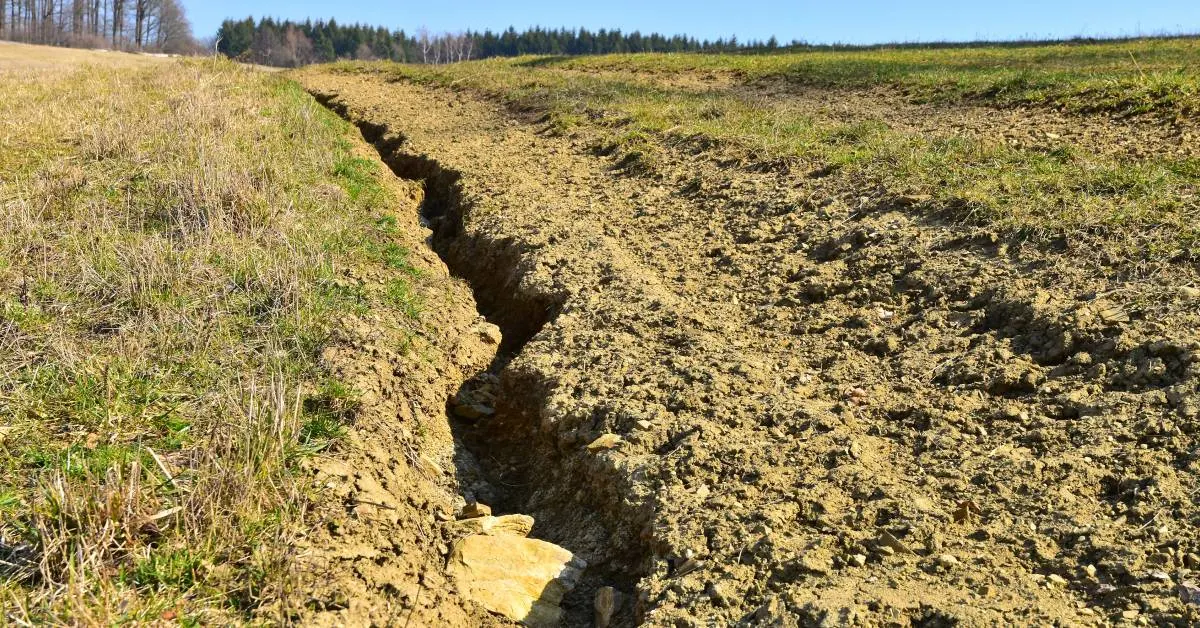
- Gully erosion is the most severe form. It cuts deep ravines into the landscape that can swallow equipment, disrupt drainage, and permanently reshape field topography.
Wind-Driven Erosion:
- Suspension lifts the finest dust particles high into the atmosphere, carrying them miles from the source field.
- Saltation bounces medium-sized grains along the surface in short hops, damaging young seedlings in the process.
- Surface creep rolls the largest particles slowly across the ground, gradually shifting soil from exposed ridges to low-lying areas.
The Compounding Effects of Soil Erosion on Crop Yields and ROI
Soil erosion is not an environmental abstraction. It is an agronomic math problem that directly hits your bottom line.
- Lost Cation Exchange Capacity (CEC): As organic-rich topsoil disappears, your soil’s ability to hold and release nutrients drops. You end up applying more fertilizer for the same yield, or worse, applying the same amount for a declining yield.
- Reduced water-holding capacity: Eroded soils hold less moisture. Bare soil holds only 1.7 inches of water, while soil under continuous living cover holds 4.2 inches. That difference directly affects crop survival during dry spells.
- Fertilizer runoff waste: Applied nutrients leave the field with eroded soil instead of feeding your crops. This is money washing downhill.
- Compounding land degradation: Research shows that corn yield losses range from 8.8% with moderate topsoil loss to 19.6% with severe erosion. These losses stack up every year, making restoration progressively more expensive.
Over a 10-year period, even moderate erosion of just 0.37 inches of topsoil can cost roughly $12,225 in lost yield and nutrients on just 40 acres. Scale that across your operation, and erosion becomes one of the highest hidden costs on your books.
7 Ways to Control Soil Erosion: Agronomic and Biological Methods
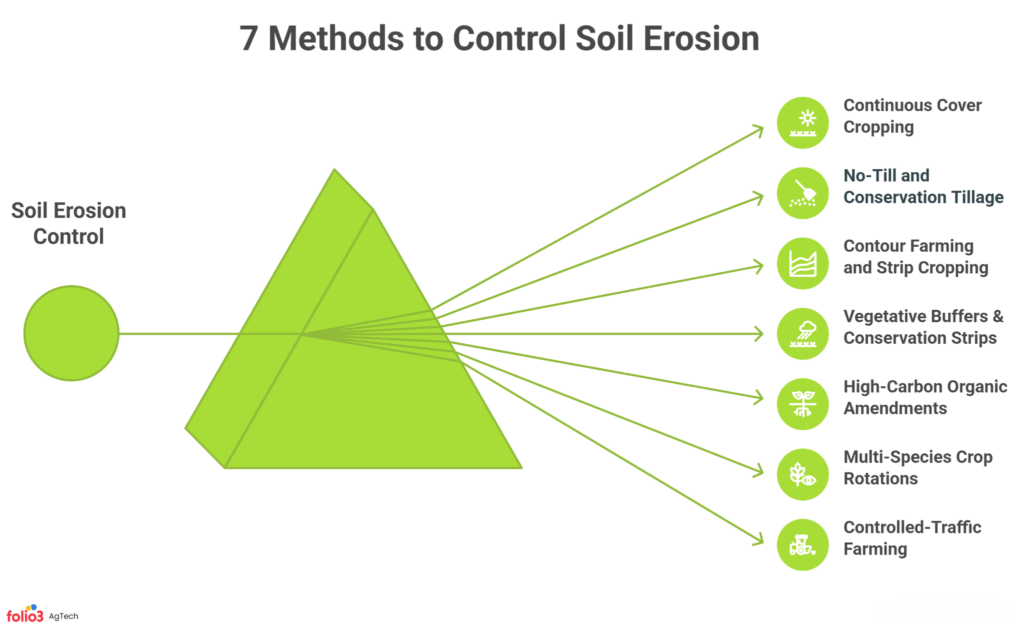
Effective soil erosion control starts with agronomic practices you can implement within your existing operation. Here are seven proven methods to control soil erosion, each with execution details you can put to work this season.
1. Continuous Cover Cropping and Precision Species Selection
Living roots physically bind soil aggregates together. When you keep something growing in your fields year-round, you create an anchoring system that holds topsoil in place during intense weather events. Cover crops can decrease soil erosion by up to 90%, reduce sediment loading by 75%, and cut nutrient runoff by 50% or more.
The key is selecting the right soil erosion control plants for your conditions. Deep-rooted cereal rye works well for winter coverage and weed suppression. Tillage radishes (daikon types) punch through compaction layers and create natural drainage channels. Crimson clover fixes nitrogen while providing dense ground coverage. Match your species to your soil type, climate zone, and cash crop rotation for the best return. For more on improving your soil foundation, explore these practical ways to improve soil fertility.
2. Shifting to No-Till and Conservation Tillage Frameworks
Every pass of a moldboard plow destroys soil structure and leaves bare ground exposed to erosion. Switching to strip-till or pure no-till keeps crop residue on the surface, where it acts as a physical shield against raindrop kinetic energy and wind.
That residue layer does more than just cover the soil. It breaks the energy of falling rain before it can dislodge particles, slows surface water flow so it has time to infiltrate, and feeds the microbial communities that build long-term aggregate stability. When no-till is paired with cover crops, erosion drops to a fraction of what you would see in a conventional tillage system. Farmers adopting proven crop management practices consistently see the compounding benefits of reduced tillage on their soil health scores.
3. Contour Farming and Strip Cropping on Variable Slopes
When you plant rows up and down a slope, every furrow becomes a channel for runoff. Contour farming flips the orientation: you plant across the slope, following the natural contour of the terrain.
Each row then acts as a micro-dam, slowing overland water flow and giving it time to soak into the soil instead of running off. Strip cropping takes this further by alternating bands of dense cover (like grass or small grains) with row crops. The strips catch sediment and slow water velocity between the more vulnerable crop rows. This is especially effective on slopes between 3% and 8%, where sheet and rill erosion are your primary threats.
4. Establishing Permanent Vegetative Buffers and Conservation Strips
Edge-of-field practices catch what gets past your in-field defenses. Native perennial grasses planted along field borders intercept sediment-laden water before it leaves your property. Riparian buffers along waterways filter runoff and stabilize stream banks.
Windbreaks (rows of trees or tall shrubs on the windward side of fields) reduce wind speed across exposed surfaces, cutting wind erosion significantly. These are not wasted acres. They are working investments that protect productive ground and can also serve as habitat for beneficial insects that support your integrated pest management strategy.
5. High-Carbon Organic Amendments: Biochar and Managed Mulching
Applying high-quality mulch and integrating biochar into your soils changes their physical structure at a fundamental level. Biochar’s porous carbon framework increases aggregate stability, creates pore space for water infiltration, and provides long-term housing for beneficial soil microbes.
Managed mulching with crop residues, wood chips, or composted organic material shields the surface from erosion while feeding biological activity underneath. The result is a soil that absorbs water faster, holds it longer, and resists displacement by wind and rain. These amendments pair well with regenerative soil practices that build organic matter over multiple seasons.
6. Multi-Species Crop Rotations to Improve Aggregate Stability
Monoculture farming creates predictable root patterns that leave certain soil layers compacted and others biologically inactive. Multi-species rotations break this cycle by alternating deep-taproot crops (like alfalfa or sunflowers) with fibrous-root crops (like wheat or grasses).
Deep taproots fracture compaction layers and create macropores for water movement. Fibrous roots knit the upper soil profile into a dense, erosion-resistant matrix. Over multiple rotations, this builds a resilient soil structure that resists both wind and water forces. Thoughtful crop rotation is one of the most cost-effective erosion control strategies available.
7. Controlled-Traffic Farming (CTF) to Eliminate Widespread Compaction
Every time heavy equipment rolls across your field, it compacts the soil underneath, destroying pore structure and reducing infiltration rates. Controlled-Traffic Farming confines all machinery tires to permanent, tracked lanes that never change.
The result: compaction is isolated to roughly 15-20% of your field area (the permanent lanes), while the remaining 80-85% maintains optimal structural integrity. Uncompacted soil absorbs water quickly rather than sheeting it off, which directly reduces runoff-driven erosion. CTF is especially valuable on operations running large-scale equipment where random traffic patterns can compact entire fields over the course of a single season.
Structural and Mechanical Soil Erosion and Sediment Control Techniques
When slope, soil type, or rainfall intensity exceeds what agronomic methods alone can handle, you need physical structures. These techniques are essential for high-risk terrain and severe erosion zones.
Engineering Permanent Terraces on High-Slope Terrains
Terracing breaks a long, steep slope into a series of shorter, flatter steps. Each terrace reduces the length of the slope that water travels, which directly reduces its speed and erosive force. Broad-based terraces work well on slopes where you need machinery clearance for planting and harvesting. Steep-stoned terraces suit more extreme gradients where equipment access is secondary to structural stability. Proper terrace design requires surveying the slope and calculating the spacing needed to match your soil type and typical rainfall intensity.
Designing and Maintaining Grassed Waterways
Natural drainage in your fields is an erosion magnet. Formatting these low points into broad, shallow channels lined with permanent, dense vegetation turns a problem into a managed solution. Grassed waterways allow heavy runoff to flow across the farm without cutting new gullies. The vegetation slows water velocity, filters suspended sediment, and protects the channel bottom from scouring. Regular maintenance (reseeding thin spots, removing debris) is critical to keep them functional.
Temporary vs. Permanent Sediment Basins and Check Dams
In active erosion channels, rock check dams slow water flow just enough to drop sediment out of suspension before water exits your property. Small rock dams built across gullies at intervals create a stepped profile that breaks the water energy. Sediment basins serve a similar function at larger scale, collecting eroded material in a designed containment area. Temporary basins work well during construction or intense weather seasons. Permanent structures suit ongoing problem areas. Both require periodic cleanout to maintain capacity.
The AgTech Edge: Building a Data-Driven Soil and Erosion Control Plan
Technology transforms erosion management from guesswork into precision. Here is how to use data to build and execute your soil and erosion control plan across every acre.
1. Macro-Targeting: Satellite Remote Sensing and Topographical GIS Mapping
Walking thousands of acres to scout for erosion damage is slow, expensive, and reactive. By the time you spot a problem, it has often progressed beyond a quick fix. Digital Elevation Models (DEM) and satellite vegetation indices like NDVI let you remotely identify high-risk slopes, low-canopy zones, and natural runoff pathways without setting foot in the field.
Folio3 AgTech’s Crop Management Software integrates live satellite imagery feeds directly into its ERP dashboard. Farm operations managers can view real-time biomass variations across every field and build a preventative erosion control plan based on spatial topography data, all from a single screen. For more on how smart farming technology is changing operations, explore how precision data is replacing manual field walks.
2. Precision Ground-Truthing: Digital Crop Scouting for Rapid Erosion Assessment
Satellite warnings need boots on the ground for validation. Minor rills spotted from space can turn into machinery-breaking gullies within a single storm season if not addressed quickly. Traditional paper-and-pen scouting creates communication lags between the field team and management, delaying critical stabilization work.
Folio3 AgTech’s Crop Scouting Software lets agronomists be dispatched directly to satellite-flagged coordinates using GPS-enabled mobile apps. Scouts log geotagged photos of early soil crusting, windward drift, or micro-rills, and the system automatically generates a high-priority maintenance ticket within the ERP. That ticket triggers immediate deployment of erosion control techniques like mulching or silt fencing before the damage compounds.
3. Preventive Hydrology: IoT Soil Sensors and Precision Irrigation Scheduling
Over-irrigation or poorly timed water applications create artificial runoff events. When soil hits its maximum saturation capacity, additional water cannot infiltrate. Instead, it sheets across the surface, washing away topsoil and expensive fertilizer inputs.
Folio3 AgTech’s Irrigation Management links real-time IoT soil moisture probes and local evapotranspiration (ET) data into the central ERP. The system automatically optimizes water delivery based on soil type and water-holding capacity. This prevents soil saturation entirely, eliminating irrigation-induced runoff before it starts. For operations running center pivots or drip systems, precision scheduling also reduces water costs and protects downstream water quality.
4. Automated Execution: Variable-Rate Seeding for Targeted Cover Crops
Blanket-applying cover crops across an entire operation can be cost-prohibitive. True efficiency lies in dynamically increasing plant density only where the soil is most vulnerable.
Data from the Folio3 Crop Management Module can be exported as prescription maps directly into smart tractors and variable-rate seeders. It enables automatic seeding rate adjustments on the fly. Heavier, denser populations of soil erosion control plants (like deep-rooted rye or clover) go directly onto vulnerable hillsides and low-biomass zones, while stable ground gets lighter seeding rates. The result is targeted protection where it matters most and optimized seed costs everywhere else.
5. Forensic Agronomy: Post-Harvest Yield Mapping to Pinpoint Topsoil Loss
The true impact of erosion often stays hidden until harvest. Soils stripped of organic matter and nutrients show up as persistent low-performing zones on a yield map. Reviewing multi-year yield data reveals historical erosion scars that need long-term structural or biological remediation.
Folio3 AgTech’s Harvest Management cross-references multi-year yield data with spatial field maps to isolate localized “cold spots” driven by topsoil degradation. Agronomists can then target exact coordinates for intensive off-season compost applications, biochar integration, or permanent terracing. This closed-loop approach turns harvest data into next season’s erosion prevention plan.
Operational Decision Matrix: Selecting Your Soil Erosion Control Measures
Not every field needs the same approach. Your erosion control strategy should match your specific slope, soil type, and primary erosion threat. Use this decision matrix to select the right combination for your operation.
| Field Slope (%) | Primary Soil Type | Main Erosion Threat | Optimal Control Combination | Implementation Cost | ROI Timeline |
| 0% – 3% | Sandy / Light Loam | Wind / Surface Creep | Cover Crops + Cover Strips + Biochar | Low | 1 – 2 Seasons |
| 3% – 8% | Silty / Clay Loam | Sheet & Rill Water Erosion | No-Till + Contour Strip Cropping | Medium | 2 – 3 Seasons |
| 8%+ | Any Class | Severe Gully / Heavy Runoff | Terracing + Grassed Waterways + Perennial Buffers | High | 3 – 5 Seasons |
Start with your highest-risk fields and work outward. Low-cost agronomic methods should cover your flat to moderate ground, while high-slope areas justify the investment in permanent structural controls. Layering multiple methods creates redundancy. If one system gets overwhelmed during an extreme event, others stay in place to limit damage.
Safeguard Your Farm’s Future Asset Value!
Managing soil erosion is a continuous operational practice, not a one-time project. Every season you delay action, the cost of restoration climbs. And every inch of topsoil lost takes decades, if not centuries, to rebuild.
The most effective approach combines agronomic best practices with structural defenses and technology-driven precision. Moving away from siloed spreadsheets and reactive fixes means running your operation through an integrated, data-driven system that connects every field to every decision.
Ready to protect your most valuable asset? Explore how the Folio3 Agtech ERP unifies crop management, irrigation scheduling, and harvest analytics into one platform, helping you build long-term soil health and farm profitability from the ground up.
FAQs
How Long Does It Take to Rebuild Lost Topsoil?
Natural topsoil formation is extremely slow, averaging less than a tenth of a millimeter per year. Rebuilding just one inch of topsoil can take 500 years or more under natural conditions. That is why prevention through active soil erosion control is far more cost-effective than restoration.
Can Soil Erosion Be Completely Stopped on a Working Farm?
Zero erosion is not achievable, even on fields in perennial grass. The goal is to reduce erosion below the soil tolerance (T) level, which the USDA sets at 4 to 5 tons per acre per year. Combining no-till, cover crops, and structural controls can bring your fields well below this threshold.
What Is the Single Most Cost-Effective Erosion Control Method?
Cover cropping consistently delivers the highest return relative to cost. It can reduce soil erosion by up to 90% while also improving soil organic matter, water-holding capacity, and nutrient cycling. It is the foundation of any serious erosion control plan.
How Does Irrigation Scheduling Affect Soil Erosion?
Poorly timed or excessive irrigation pushes soil past saturation, triggering surface runoff that carries topsoil and nutrients off the field. Precision irrigation tied to real-time soil moisture data prevents this by delivering only what the soil can absorb, when it can absorb it.
Do I Need an ERP System to Manage Soil Erosion Effectively?
For small operations, manual planning may be sufficient. But as acreage scales beyond a few hundred acres, tracking satellite imagery, scout reports, irrigation data, and yield maps across multiple fields becomes unmanageable without a centralized platform. An Agtech ERP gives you the single-screen visibility needed to act on erosion risks before they turn into losses.