
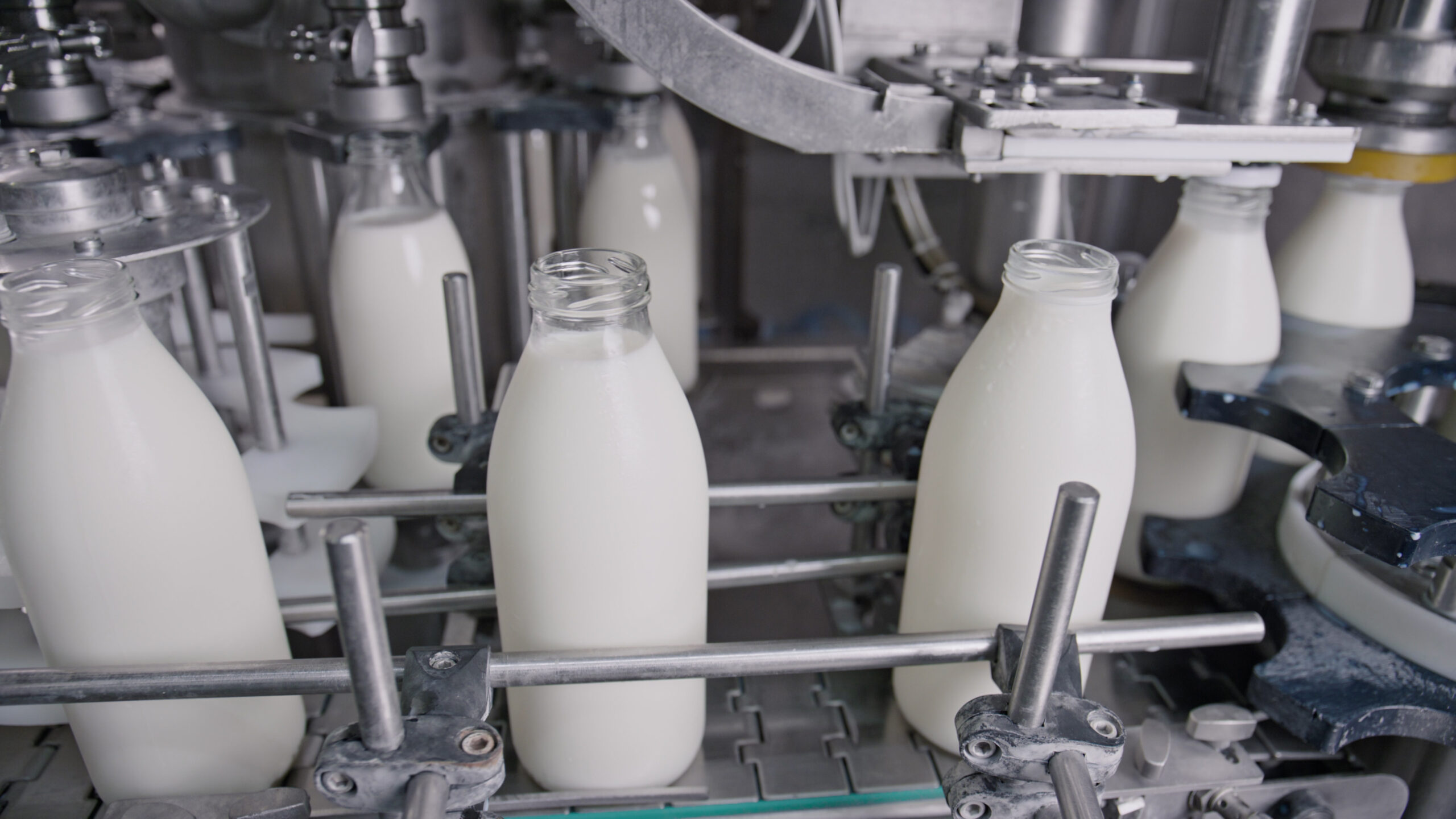

Every consistent carton of milk that leaves your plant relies on one critical step. Milk homogenization is the mechanical process that prevents fat separation, stabilizes your emulsion, and ensures your product holds up across the entire distribution chain.
For dairy processors and plant managers, mastering homogenization means knowing more than just what it does. It means knowing how to run it efficiently, how to match pressure settings to each product type, and how to catch the subtle issues that erode product quality before they reach your customer.
This guide walks you through the full picture: the science behind the homogenization of milk, the exact process stages, the pressure settings that matter by product type, the techniques and equipment decisions you face on the floor, and the plant-level best practices that protect both your product and your margins.
What is Milk Homogenization? Beyond the Basics
Raw milk is an oil-in-water emulsion. Fat globules in bovine milk range from 1 to 10 micrometers in diameter, with an average of around 3.5 micrometers. Left untreated, those globules rise to the surface within a matter of hours, forming a cream layer. This process, called creaming, is not just a visual inconvenience for the consumer. It creates inconsistent fat distribution across your batches, unpredictable flavor profiles, and reduced shelf-life stability.
The homogenization of milk is the mechanical process of forcing milk through a precision-engineered valve under high pressure, reducing fat globule diameter to below 1 to 2 micrometers. At that size, the globules are immediately coated by a membrane composed of casein micelles and whey proteins. This membrane prevents re-coalescence, creating the stable, permanent emulsion we call homogeneous milk.
How Does Homogenization of Milk Work? The Core Process
The milk homogenization process combines three simultaneous mechanical forces inside a precision valve gap to break fat globules into stable submicron particles. Here is how each stage works in your processing line.
The Physics at Play: Shearing, Cavitation, and Turbulence
Three forces operate in tandem inside the homogenizing valve to disrupt fat globules:
- Shear forces: As milk passes through the valve gap, approximately 0.1 mm or the width of a human hair, intense velocity gradients pull fat globules apart across multiple axes simultaneously.
- Turbulence: Rapid changes in fluid velocity create eddies and vortices that fragment globules from multiple directions at once.
- Cavitation: Micro-bubbles form and collapse violently as pressure drops sharply past the valve, generating localized shockwaves that further disrupt the fat structure.
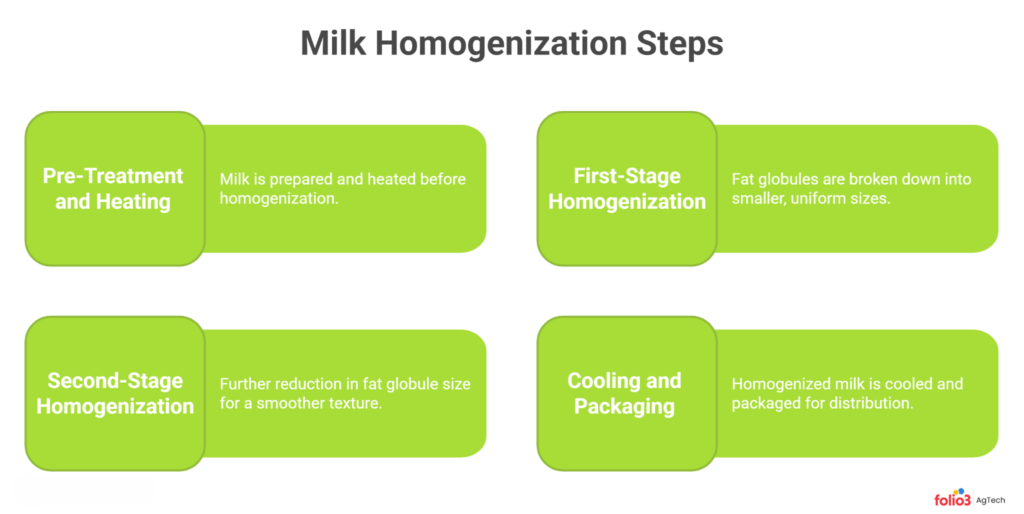
1. Pre-Treatment and Heating
Before milk enters the homogenizer, it must be at the right temperature. The optimal range is 55 to 80°C, with most operations targeting 60 to 71°C. At this range, fat is fully liquid, allowing complete and uniform globule disruption. Below 55°C, fat begins to partially solidify, resulting in incomplete breakdown and poor emulsion stability. In most continuous processing lines, pasteurization precedes homogenization. It delivers the milk pre-heated at the right temperature, which is why understanding the milk pasteurization process on your line is critical before making any homogenization adjustments.
2. First-Stage Homogenization
This is where the core work happens. A high-pressure piston pump drives milk through the homogenizing valve, and Stage 1 is responsible for the majority of fat globule size reduction. Research on homogenization efficiency shows that most dairy operations achieve optimal results at first-stage pressures between 2,500 and 3,000 PSI (172 to 207 bar). The freshly disrupted globules are immediately coated with casein micelles and whey proteins, forming the interfacial membrane that holds the emulsion stable.
3. Second-Stage Homogenization
After Stage 1, newly disrupted globules tend to re-cluster before their protective membranes fully stabilize. Stage 2 operates at approximately 20% of the first-stage pressure, and its job is not further globule reduction. It is dispersion. It breaks apart clusters that formed during Stage 1 and ensures even fat distribution throughout the liquid. Two-stage homogenization consistently delivers better emulsion stability, reduced creaming during shelf life, and a more uniform texture compared to single-stage processing. For processors running retail or export dairy products, the two-stage process is the industry standard.
4. Cooling and Packaging
Immediately after homogenization, milk moves to cooling and then packaging. In an integrated HTST or UHT line, the homogenizer sits between the regeneration section and final heating. Rapid cooling prevents bacterial growth and oxidation of the newly exposed fat surfaces. In aseptic processing, the homogenizer must be sterile-grade to avoid post-treatment contamination.
Optimal Homogenization Pressure for Milk and Dairy Products
One of the most expensive mistakes you can make is running a single pressure setting across all product types. Standard homogenization pressure for milk and most dairy products typically falls between 15 and 30 MPa, though machines operating at pressures exceeding 100 MPa are classified as ultra-high-pressure homogenizers. The table below gives you a practical reference for your line:
| Dairy Product Type | First Stage Pressure | Second Stage Pressure | Processing Note |
|---|---|---|---|
| Whole Milk (3.25% fat) | 2,000–2,500 PSI (138–172 bar) | 400–500 PSI (28–34 bar) | Standard two-stage for stable drinking milk |
| Skim / Low-Fat Milk | 1,500–2,000 PSI (103–138 bar) | 300–400 PSI (21–28 bar) | Lower pressure needed due to reduced fat content |
| Half & Half / Light Cream | 1,000–1,500 PSI (69–103 bar) | 300 PSI (21 bar) | Avoid over-homogenization, which causes feathering in coffee |
| Yogurt / Cultured Dairy | 2,500–3,000 PSI (172–207 bar) | 500 PSI (34 bar) | Higher pressure improves protein matrix and curd texture |
| UHT Long-Life Milk | 2,500–3,600 PSI (172–250 bar) | 500–600 PSI (34–41 bar) | Must withstand ultra-high temperature without fat separation |
Higher fat content demands higher pressure because more fat surface area requires casein and whey protein coverage during disruption. Running insufficient pressure on high-fat products causes visible cream separation during shelf life. Running excessive pressure causes re-clustering when there are not enough membrane-forming proteins to coat all the newly generated globule surfaces.
Key Milk Homogenization Techniques and Equipment
Technique selection and line integration are both decisions that affect your product quality and your energy bill. Getting them right from the start prevents costly retrofits down the line.
Partial vs. Full Homogenization
Not every dairy plant needs to homogenize the entire milk stream. Partial homogenization is a technique where you separate the cream fraction first, homogenize only the cream, and then blend it back into the skim milk. Because the homogenizer only processes a fraction of the total volume, energy consumption drops significantly. For large-volume fluid milk operations where energy costs are a major overhead item, partial homogenization delivers meaningful savings without compromising final product stability. The blended product achieves the same uniform fat distribution as fully homogenized milk.
Integrating with Thermal Processing
Where the homogenizer sits in your line determines what products you can produce and what quality guarantees you can make. In a standard HTST setup, homogenization happens after regeneration heating but before the final high-temperature holding step, keeping the milk warm enough for effective fat disruption. For UHT products, you need an aseptic homogenizer because the milk has already been sterilized. Any non-sterile contact after UHT treatment risks contamination and defeats the shelf-life benefit. Understanding the full picture of dairy processing operations helps you make those line architecture decisions with confidence.
Homogenized vs. Non-Homogenized Milk and Other Milk Types
The choice between homogenized and non-homogenized milk is not just a consumer preference question. It has real implications for shelf life, downstream functionality, and how you position your product in the market.
Texture and Taste
Homogenized milk delivers a smooth, consistent mouthfeel with no cream layer and no need for the consumer to shake the carton before pouring. Non-homogenized milk, often called cream-top milk, has a visible cream layer and a richer taste at the top. Some artisanal dairies deliberately produce non-homogenized milk because intact fat globules produce a softer curd structure during cheesemaking and a different flavor profile during ripening.
Nutritional Similarities
Nutritionally, homogenized and non-homogenized milk are identical. Both retain all essential nutrients, including calcium, protein, vitamins D and B12, and phosphorus. Homogenization is a purely mechanical process that changes nothing about the nutritional composition of milk. Whole milk, 2%, and skim milk can all be homogenized. The fat percentage is determined through standardization before homogenization, not by the homogenization step itself.
Raw vs. Pasteurized and Ultra-High-Temperature (UHT)
Raw milk cannot be safely homogenized. The enzyme lipoprotein lipase, which remains active in raw milk, causes rapid fat rancidity under high mechanical pressure. Pasteurization deactivates this enzyme first, which is why only pasteurized milk should be homogenized. UHT milk combines homogenization with ultra-high temperature treatment, typically 135 to 150°C for 2 to 4 seconds, to produce a shelf-stable product that requires no refrigeration. The milk pasteurization process and homogenization must be properly sequenced on your line for both safety and quality.
| Milk Type | Cream Layer | Mouthfeel | Typical Use |
|---|---|---|---|
| Non-homogenized (cream-top) | Visible cream rises to top | Creamy at top, thinner at bottom | Artisanal dairies, cheesemaking |
| Homogenized whole milk | No cream layer | Smooth and uniform | Everyday drinking and cooking |
| Homogenized low-fat / skim | No cream layer | Less viscous but uniform | Diet-focused retail products |
What Does Homogenization Do to Milk? Operational and Consumer Benefits
Homogenization creates measurable ROI across your operation and on your consumers’ experience. Here is how those benefits break down.
Operational Benefits:
- Batch-to-batch consistency: Uniform fat distribution eliminates variability from natural fat separation, making batch scaling predictable across large production runs.
- Pipeline protection: Cream plugs form in holding tanks and pipelines when fat is not properly homogenized. Homogenized milk flows cleanly and consistently throughout your system.
- Better cultured product stability: Homogenized milk produces a finer, more uniform protein matrix in yogurt, kefir, and fermented dairy products, which directly improves gel strength and texture. For processors working with fermented dairy, the connection between homogenization settings and final product texture is covered in depth in the guide to commercial milk fermentation.
- Improved ingredient functionality: Homogenized milk performs more consistently as a base for flavored milks and fortified beverages because the stable emulsion interacts more uniformly with added ingredients.
Sensory Benefits:
- Whiter, more appealing color: Smaller fat globules scatter light more uniformly, producing the characteristic bright white appearance consumers expect from quality milk.
- Fuller mouthfeel: Even in low-fat variants, homogenization improves perceived creaminess by distributing fat evenly across the palate.
- Reduced oxidation sensitivity: The casein-and whey-membrane coating of each fat globule provides a physical barrier against lipid oxidation, a primary cause of off-flavors and shortened sensory shelf life.
Does Milk Homogenization Extend Shelf Life?
Homogenization does not reduce microbial load; that is, pasteurization’s job. However, homogenization significantly extends the physical and sensory shelf life of milk by reducing the lipid oxidation and fat separation that degrade product quality over time.
When fat globules are disrupted, casein micelles and whey proteins coat their surfaces, forming a protective interfacial membrane. This membrane limits direct oxygen contact with the fat, reducing the oxidation reactions that produce rancid and stale off-notes during storage.
The real shelf-life gains come when you combine homogenization with the right thermal treatment:
- Pasteurized homogenized milk: Typically achieves 14 to 21 days of refrigerated shelf life, depending on packaging and cold chain management.
- UHT homogenized milk: Achieves 6 to 12 months of ambient shelf life. Two-stage homogenization before UHT treatment is critical because the stable emulsion must survive ultra-high temperatures without fat separation or texture breakdown.
Robust milk quality control protocols alongside your homogenization settings are what lock in those shelf-life gains batch after batch.
Busting Consumer Myths: The Truth About Homogenized Milk
Processors increasingly face pushback from consumers who have encountered alarming claims online. Here is the science on the two most common myths.
Myth 1: Homogenization destroys nutrients
Homogenization is a purely mechanical process. No heat beyond pasteurization is applied, and nothing is added to or removed from the milk. Calcium, protein, vitamins, and all other essential nutrients remain fully intact. The process modifies only the sensory properties of milk, not its nutritional composition.
Myth 2: Homogenized milk is harder to digest
The scientific evidence points in the opposite direction. Smaller fat globules have greater surface area exposed to digestive enzymes, meaning they are broken down more efficiently. Protein and fat in homogenized milk are digested at least as rapidly as in non-homogenized milk, with some in vitro studies indicating faster digestion rates. Claims linking homogenized milk to cardiovascular disease, diabetes, or allergies have been reviewed in the scientific literature and found to lack support from good-quality human studies.
Best Practices for Dairy Plants to Ensure Optimal Homogenization of Milk
Consistent high-quality homogenization does not happen by setting the right pressure once. These plant-level practices protect your product integrity and reduce the risk of unplanned line shutdowns.
Energy Efficiency
Newer homogenizing valve designs can reduce operational pressure requirements by 15 to 20% compared to older flat-valve configurations, cutting electricity consumption significantly on high-volume lines. If your facility is running a homogenizer more than 10 years old, an equipment audit frequently reveals savings available without any compromise in product quality.
Preventative Maintenance
Cavitation wear on pistons, valve seats, and forcers is cumulative and often invisible until a sudden efficiency drop or line shutdown occurs. Schedule quarterly inspections for valve seat condition, piston seal integrity, and pressure gauge calibration. Track pressure readings over time to catch a gradual drift that signals wear before it becomes a failure event.
Automation and Real-Time Monitoring
Integrating your homogenizer into a dairy management system enables real-time pressure monitoring, automated alerts for pressure drift, and data logging for traceability and quality audits. Automated monitoring also catches temperature fluctuations at the homogenizer inlet that degrade performance before they affect your finished product. Advanced processing operations are increasingly pairing homogenization monitoring with technologies like dairy membrane filtration for a fully integrated, data-driven production line.
Conclusion
Milk homogenization is not a passive step; you set it once and forget. It is an active lever for product consistency, shelf-life performance, operational efficiency, and consumer trust. Getting it right means understanding the physics, matching pressure settings to each product type, maintaining your equipment on a scheduled basis, and integrating the process intelligently with your full production workflow.
The difference between a dairy plant that manages homogenization and one that truly optimizes it shows up in product consistency, reduced waste, lower energy costs, and stronger margins over time. If you are ready to audit your current setup or build a smarter processing line from the ground up, reach out to our dairy technology specialists to explore where targeted improvements can make the biggest difference for your operation.
FAQs
What Is the Difference Between Homogenization and Pasteurization in Milk?
Pasteurization is a heat treatment that kills pathogens and extends microbial shelf life. Homogenization is a mechanical process that breaks fat globules for emulsion stability. They are separate processes, though pasteurization typically precedes homogenization on most commercial processing lines.
What Happens to Fat Globules During the Milk Homogenization Process?
Fat globules are forced through a narrow valve gap under high pressure, reducing their diameter from an average of 1 to 10 micrometers down to less than 1 to 2 micrometers. Casein micelles and whey proteins immediately coat the new globule surfaces, forming a stable membrane that prevents re-clustering and keeps the emulsion permanently stable.
Does Homogenization Affect the Nutritional Value of Milk?
No. Homogenization is a purely mechanical process that does not alter the protein, calcium, vitamin, or mineral content of milk. The only changes are to sensory properties, including texture, color, and mouthfeel. All essential nutrients remain fully intact after homogenization.
Can Raw Milk Be Homogenized?
Raw milk should not be homogenized. The enzyme lipoprotein lipase, which remains active in raw milk, causes fat rancidity when exposed to the high mechanical pressure of homogenization. Only pasteurized milk, where this enzyme has been deactivated by heat, should be homogenized.
How Do You Verify That Homogenization Is Working Correctly on Your Line?
The primary quality indicator is fat globule size distribution. Properly homogenized milk should show average globule diameters below 1 to 2 micrometers, with no visible cream layer forming during shelf-life testing. Laser diffraction analysis and the NIZO method are the standard tools for verifying homogenization efficiency in a dairy lab.
Does Higher Homogenization Pressure Always Produce Better Results?
Not necessarily. Excessive first-stage pressure can cause fat globule re-clustering when there are insufficient casein micelles and whey proteins available to coat all the newly generated globule surfaces. Most operations find optimal results within defined product-specific pressure ranges, making regular calibration and product-specific pressure settings essential for consistent quality.