
Feed formulation is the science of blending raw ingredients into a balanced ration that meets the exact nutritional needs of your livestock. Whether you are a nutritionist designing diets for a 50,000-head feedlot, a dairy manager pushing for peak milk yield, or a mill operator running least-cost batches, getting your animal feed formulation right is the single biggest lever you have over profitability and herd health.
With feed expenses making up roughly 60% to 70% of total livestock production costs, even a small improvement in your livestock feed formulation strategy can mean thousands of dollars saved per cycle.
This guide walks you through every step of the modern feed formulation process, from understanding ingredients and ration balancing to leveraging AgTech software that automates and optimizes your operation.
What is Animal Feed Formulation and Why Does It Drive Livestock Efficiency?
Animal feed formulation is the backbone of productive livestock operations. Here is why precision nutrition matters more now than ever.
For decades, feeding livestock was largely a guesswork exercise. Ranchers relied on whatever forages were available locally, supplemented by a handful of grains when budgets allowed. The results were inconsistent weight gains, unpredictable milk yields, and frequent metabolic issues.
Modern animal feed formulation changed all of that. It is the practice of selecting, proportioning, and blending feed ingredients to deliver the precise nutrients an animal needs at every stage of its life. Think of it as a custom recipe, tailored by species, age, weight, and production goal.
The Shift from Traditional Foraging to Precision Nutrition
The shift from open-range foraging to precision nutrition was not overnight. It accelerated as researchers learned more about ruminant physiology and as computing power made complex ration balancing accessible to everyday producers. Today, livestock feed formulation relies on lab-tested ingredient profiles and software-driven optimization rather than gut instinct.
This matters because the margin for error keeps shrinking. Commodity prices swing, consumer demands shift, and environmental regulations tighten. If your ration is not dialed in, you are leaving money on the table or, worse, creating health problems in your herd.
How Formulated Feeds Improve Average Daily Gain (ADG) and Feed Conversion Ratios (FCR)
When nutrients are matched to requirements, animals convert feed into meat, milk, or eggs more efficiently. This shows up directly in two metrics every operator watches: Average Daily Gain (ADG) and Feed Conversion Ratio (FCR).
A well-formulated ration does three things at once:
- Reduces nutrient waste. Over-formulating protein, for example, leads to excess nitrogen excretion, which increases your environmental footprint and wastes expensive ingredients. Under-formulating causes metabolic diseases like acidosis or ketosis.
- Improves economic ROI. Every percentage point improvement in FCR translates to lower cost per pound of gain. For a feedlot running 10,000 head, that can mean six-figure annual savings.
- Supports animal welfare and environmental goals. According to the FAO, livestock production accounts for an estimated 14.5% of global greenhouse gas emissions. Optimized rations have been shown to lower methane and nitrogen excretion, directly cutting your operation’s environmental footprint.
The bottom line: animal feed formulation is not just a nutritional exercise. It is a business strategy.
Understanding Livestock Feed Ingredients: The Building Blocks of a Balanced Ration
Every ration starts with raw materials. The challenge for nutritionists is evaluating these ingredients on a dry matter (DM) basis, so you can manage feed rations, regardless of moisture content. Corn silage testing at 35% DM delivers very different nutrition per pound than dry-rolled corn at 88% DM.
Roughages vs. Concentrates for Balancing Fiber and Energy
Roughages (forages like alfalfa hay, corn silage, and pasture grass) supply the fiber that drives healthy rumen function. Without enough effective NDF (Neutral Detergent Fiber), ruminants cannot form the fibrous mat in the rumen that stimulates cud chewing and saliva production, which naturally buffers rumen pH.
Concentrates (grains like corn, barley, and sorghum) supply the starch and energy that push growth and milk production. The balancing act is critical. Too much concentrate without adequate fiber leads to subacute ruminal acidosis (SARA), one of the most expensive and common feedlot health issues.
The Critical Role of Vitamins, Minerals, and Synthetic Amino Acids
Even though they make up less than 5% of most rations, vitamins, minerals, and amino acids play outsized roles. Calcium and phosphorus drive skeletal development. Trace minerals like zinc, copper, and selenium support immune function. Ionophores like monensin improve feed efficiency by modifying rumen fermentation.
Getting your livestock feed ingredients right at this level separates average operations from top performers.
Nutrient Matrix and Operational Limits of Key Livestock Feed Ingredients
| Skeletal development, metabolic regulation, and ionophore efficiency | Example Ingredients | Primary Nutritional Value | Maximum Inclusion Rate and Constraints |
| Forages / Roughages | Alfalfa hay, Corn silage, Pasture grass | Effective NDF (Fiber), Rumen mat formation | Varies by life stage; high moisture can limit total Dry Matter Intake (DMI) |
| Energy Concentrates | Yellow corn, Barley, Sorghum | Starch, Non-Structural Carbohydrates (NSC), Net Energy for Gain (NEg) | Up to 70-80% in finishing feedlots; risk of SARA if unbuffered |
| Protein Sources | Soybean meal, Distillers Dried Grains (DDGS) | Crude Protein (CP), Rumen Degradable Protein (RDP) | DDGS limited to 20-30% due to high sulfur and oil content |
| By-Products / Co-Products | Beet pulp, Wheat middlings | Digestible fiber, cost-effective energy | Highly variable nutrient profiles; requires routine NIR testing |
| Mineral and Vitamin Premixes | Calcium carbonate, Dicalcium phosphate, Monensin | Skeletal development, metabolic regulation, ionophore efficiency | Typically less than 5% of ration; strict regulatory compliance required |
Step-by-Step: The Modern Animal Feed Formulation Process Explained
Gone are the days of hand-calculating rations on a notepad. Today’s feed formulation process leverages laboratory analysis, cloud-based software, and real-time herd data to build rations that are nutritionally precise and economically optimized.
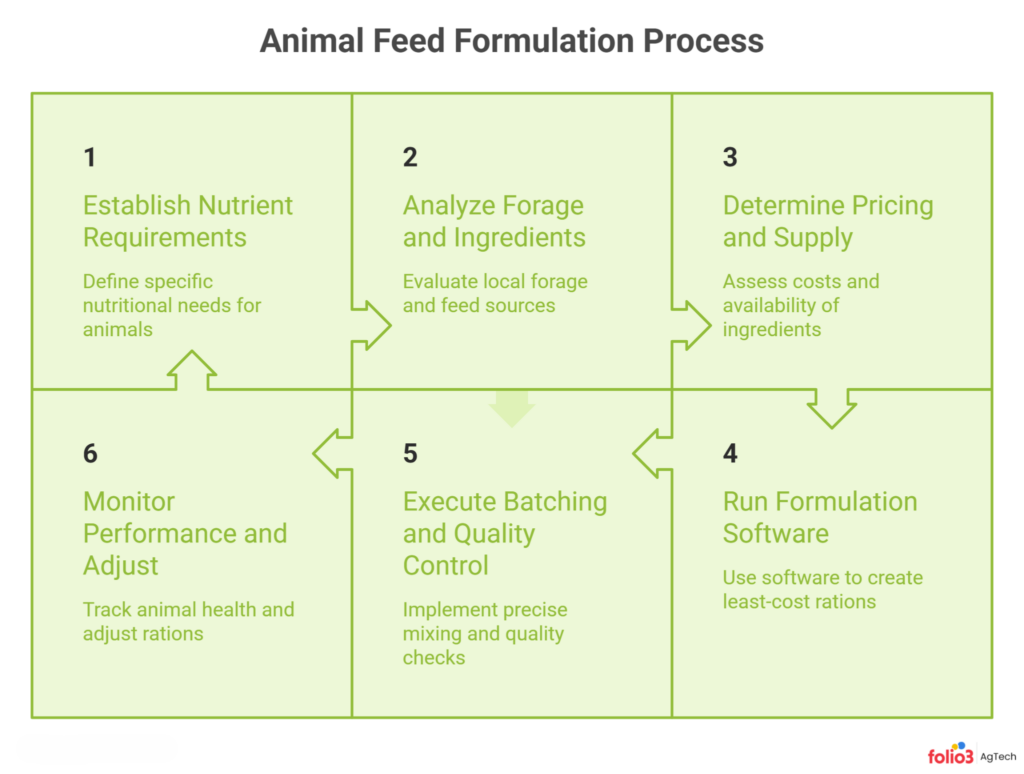
Step 1: Establish Animal Nutrient Requirements
Everything starts with the animal. A 600-pound growing steer has very different nutrient demands than a finishing steer at 1,300 pounds. A fresh cow in early lactation needs a dramatically different energy density than a dry cow. You need to define target ADG, milk yield, or egg production first, then work backward to nutrient requirements using published tables like the NRC (National Research Council) standards.
Step 2: Analyze Local Forage and Available Feed Ingredients
Never formulate based on “book values” alone. Your alfalfa hay will not match a textbook average. Send samples to a certified lab or use on-farm NIR (Near-Infrared Reflectance) technology to get real-time nutrient profiles. This step alone can prevent thousands of dollars in over- or under-supplementation.
Step 3: Determine Ingredient Pricing and Supply Chain Availability Constraints
A ration that looks perfect on paper is useless if you cannot source the ingredients affordably. Lock in commodity prices, evaluate local by-product availability (like DDGS from a nearby ethanol plant), and build constraints into your formulation model.
Step 4: Run Least-Cost Feed Formulation Software
This is where modern feed formulation software earns its keep. Linear programming finds the combination of ingredients that meets all nutrient constraints at the lowest possible cost. More advanced stochastic models account for the natural variability of nutrient content in raw ingredients, ensuring you do not accidentally fall below nutritional minimums even when ingredient quality fluctuates.
Step 5: Execute Precision Batching, Mixing, and Pellet Quality Control at the Mill
Once your formula is set, the mill takes over. Precision batching systems weigh each ingredient to exact specifications. Mixing protocols ensure uniform distribution, especially for micro-ingredients. If you are pelleting, quality control checks like the Pellet Durability Index (PDI) verify that pellets hold together during transport and feeding.
Step 6: Monitor Herd Performance and Adjust Feed Rations in Real-Time
Formulation does not stop when the ration hits the bunk. You need to track ADG, FCR, milk yield, dry matter intake, and health events continuously. If the livestock management software you are using connects feed data to performance metrics, you can adjust rations dynamically rather than waiting for the next monthly review.
Feed Formulation for Beef Cattle and Feedlots
Commercial beef production operates on thin margins. The difference between profit and loss often comes down to how efficiently you convert feed into pounds of gain. Your feed formulation for beef cattle needs to account for the entire production arc, from the stress of receiving freshly weaned calves to the final push for marbling in the finishing pen.
Designing Step-Up Rations for Receiving and Growing Cattle
When cattle first arrive at a feedlot, they are often stressed, dehydrated, and immunocompromised. Jumping them straight onto a high-energy finishing ration is a recipe for acidosis and respiratory disease. Instead, step-up rations gradually increase concentrate levels over 3 to 4 weeks, allowing the rumen microbial population to adapt.
Start with a ration that is 50% to 60% roughage and step up the energy concentration by 5% to 10% per week until you reach your target finishing ration. This approach protects animal health while keeping cattle gaining.
Maximizing Marbling While Preventing Acidosis
Finishing rations for beef cattle typically run at 70% to 80% concentrate. The goal is to push energy intake high enough to deposit intramuscular fat (marbling) that drives carcass quality grades. But high-starch diets carry a constant risk of SARA.
Buffers like sodium bicarbonate and ionophores like monensin are standard tools for managing rumen pH. Feed bunk management also plays a role. Consistent feed delivery times, proper bunk space per head, and avoiding slug feeding all help stabilize intake patterns.
Utilizing Net Energy (NEm and NEg) Targets for Predictable Weight Gain
Net Energy for Maintenance (NEm) covers the animal’s basic metabolic needs. Net Energy for Gain (NEg) is what is left over for growth. By formulating to specific NEg targets, you can predict weight gain with reasonable accuracy, which is essential for projecting closeout dates and marketing windows.
Key considerations for your beef cattle feed ration formulation include:
- Critical micronutrients: Zinc and copper support immune function. Vitamin E improves meat shelf-life and color stability at retail.
- Bunk management: Target 50% to 60% dry matter for optimal palatability. Regular feed push-ups reduce waste and encourage consistent intake.
- Water quality: Often overlooked, high-sulfate water can interact with DDGS sulfur levels to cause polioencephalomalacia (PEM). Test water regularly.
Dairy Cow Feed Formulation Strategies To Maximize Peak Milk Yield
Dairy cows have an almost unforgiving set of nutritional demands. A high-producing Holstein can yield over 100 pounds of milk per day, requiring massive energy and protein intake. The margin between peak performance and metabolic disaster is razor-thin, which makes dairy cow feed formulation a discipline where details matter enormously.
Managing DCAD to Prevent Milk Fever
The three weeks before and after calving, known as the transition period, are the most critical window in a dairy cow’s lactation cycle. Metabolic disorders like milk fever (hypocalcemia) can cascade into displaced abomasums, retained placentas, and lost production.
Managing Dietary Cation-Anion Difference (DCAD) in pre-fresh rations is a proven strategy. By feeding anionic salts to create a slightly negative DCAD balance, you stimulate calcium mobilization from bones before calving, reducing the risk of clinical and subclinical hypocalcemia.
Balancing RDP and RUP for Peak Lactation
Not all protein is created equal in dairy nutrition. Rumen Degradable Protein (RDP) feeds the rumen microbes that digest fiber and produce microbial protein. Rumen Undegradable Protein (RUP), also called bypass protein, passes through the rumen intact and is digested in the small intestine.
Peak lactation cows typically need a higher proportion of RUP to meet their amino acid demands. Common RUP sources include blood meal, fish meal, and heat-treated soybean meal.
Optimizing TMR to Eliminate Feed Sorting
A Total Mixed Ration (TMR) blends all forages, concentrates, and supplements into a uniform mix so every bite delivers balanced nutrition. But if particle size is not managed correctly, cows will sort through the ration, picking out energy-dense grains and leaving behind fiber. This leads to inconsistent nutrient intake across the herd and individual animal metabolic problems.
Using a Penn State Particle Separator to check TMR particle distribution is a simple, effective quality control step. Your dairy management software should also track daily milk production by individual cow, enabling you to correlate ration changes with yield responses.
Key dairy formulation strategies include:
- Protected fats: Calcium salts of fatty acids increase energy density without depressing rumen fiber digestion, a critical tool for early-lactation cows in negative energy balance.
- Automated feed management: Modern systems integrate with robotic milking parlors to deliver individualized feed drops based on each cow’s daily production, stage of lactation, and body condition score. That’s where precision dairy technology really pays off.
The AgTech Edge to Enhance and Automate Feed Formulation
The global animal feed market was valued at approximately USD 542 billion in 2025 and continues to grow as global protein demand increases. In a market this large and this competitive, the operators who leverage technology gain a measurable edge.
Linear vs. Stochastic Programming
Most feed mills use linear programming (LP) to formulate least-cost rations. LP works well when ingredient nutrient values are known and consistent. But in reality, the crude protein in your soybean meal shipment today might be 47.5% while last week’s load tested at 46.1%.
Stochastic programming accounts for this variability by incorporating the standard deviation of nutrient values into the model. Instead of formulating to meet a minimum nutrient level at the mean, it formulates to meet the minimum at a specified confidence level (for example, 95%). This prevents your ration from accidentally falling below biological or regulatory thresholds without over-formulating.
The result: your feed ration meets guarantees consistently, your feed costs stay lower because you are not adding unnecessary safety margins, and your feed mill operations run more efficiently.
Integrating ERP Systems and Feed Mill Automation with Formulation Software
Formulation does not exist in a vacuum. The real power comes when your formulation software talks to your ERP system, inventory management, and mill automation.
When a formulation is finalized, it should automatically generate purchase orders for ingredients running low, push batch instructions to the mill’s PLC (Programmable Logic Controller), and update inventory counts in real time. This integration eliminates manual data entry errors and accelerates the time from formulation to feed delivery.
Operations using agricultural ERP software that connects formulation to financial reporting can also track cost-per-ton and cost-per-pound-of-gain at the lot level, giving managers the visibility they need to make faster decisions.
Reducing Methane Emissions with Smart Additives
Sustainability is no longer optional. Feed additives like 3-nitrooxypropanol (3-NOP) and bromoform-based compounds have been shown to reduce enteric methane emissions by 30% to 50% in controlled studies. The FAO actively supports research into feed-based methane mitigation strategies as part of the Global Methane Pledge.
As carbon markets mature and consumers demand verifiably sustainable products, formulating for lower emissions will become a competitive advantage, not just a compliance checkbox.
Future-Proof Your Operation with Advanced Feed Formulation
The operators who thrive in the coming decade will be the ones who treat feed formulation as a dynamic, data-driven discipline rather than a static recipe card. Every concept we covered in this guide, from understanding your livestock feed ingredients on a dry matter basis to running stochastic models that account for real-world variability to integrating formulation software with your ERP and mill automation, adds up to a measurable competitive advantage.
Here is a quick audit checklist for your current feed program:
- Are you testing forages and ingredients with NIR or lab analysis, or relying on book values?
- Is your formulation software using linear programming, or have you upgraded to stochastic models?
- Do your feed costs flow automatically into your farm record keeping and financial reporting?
- Are you tracking ADG, FCR, and milk yield at the individual animal or pen level?
- Have you evaluated methane-reducing feed additives for your operation?
If you answered “no” to any of those, you have room to improve. Consult with Agtech experts and explore modern, automated least-cost formulation software to protect your profit margins against volatile commodity markets.
FAQs
How Often Should You Reformulate Livestock Feed Rations?
You should review and adjust your feed ration at least monthly, or whenever ingredient prices, forage quality, or herd performance metrics change significantly. Operations using real-time feedlot management software can make adjustments even more frequently.
What Is the Difference Between Least-Cost and Least-Risk Feed Formulation?
Least-cost formulation minimizes ingredient expense using average nutrient values. Least-risk (stochastic) formulation also factors in nutrient variability, ensuring your ration consistently meets minimum requirements even when ingredient quality fluctuates.
Can Small-Scale Farmers Benefit from Feed Formulation Software?
Yes. Cloud-based formulation tools have become affordable and accessible even for smaller operations. Even a 50-head cattle farm can see meaningful feed cost savings by switching from manual calculations to software-driven ration balancing.
How Does Feed Formulation Impact Meat and Milk Quality?
Ration composition directly affects marbling scores in beef, milk fat and protein percentages in dairy, and egg quality in poultry. For example, increasing bypass protein in dairy rations can raise milk protein yield, while adjusting energy levels in finishing rations influences USDA carcass quality grades.
What Role Does Water Quality Play in Feed Formulation?
Water quality is often the most overlooked factor in livestock nutrition. High sulfate, nitrate, or total dissolved solids in drinking water can reduce feed intake, interfere with mineral absorption, and even cause neurological issues. Always test water as part of your overall feed ration evaluation.