
Most conversations about agricultural productivity stop at the farm gate. But if you’re a plant manager, QA lead, or supply chain head, you already know the story doesn’t end there. What happens on the farm directly shapes what happens on your processing floor. Raw material quality, harvest timing, chemical residues, and supply consistency all start upstream.
This guide is built for the downstream buyer. It covers what agricultural productivity actually means, which on-farm methods deliver the most reliable outcomes for processors, how increased farm efficiency translates into plant-level gains, and how AgTech ERPs tie the whole system together. You’ll also find a forward-looking look at the macro pressures shaping supply chains through 2026 and beyond.
What is Agricultural Productivity and Why Does It Matter Downstream?
Agricultural productivity is not just a farming metric. It is a direct input into your operations, your compliance posture, and your cost structure.
Most people define agricultural productivity as a simple ratio: how much output do you get per unit of input? But that misses the business nuance. The better frame is agricultural total factor productivity (TFP), a measure of how efficiently all inputs (land, labor, water, capital, and materials) are converted into output across all agricultural commodities. TFP growth is what separates farms that scale intelligently from those that just expand acreage.
Agricultural production and productivity are not the same thing. Production refers to the total volume of how many tonnes of wheat or soybeans were harvested. Productivity refers to efficiency, as to how much of that volume was extracted per unit of input, without degrading the resource base. You can have record production and falling productivity at the same time, which is exactly what’s happening globally.
That slowdown matters to you directly:
- Raw material consistency for food processors: When farms are genuinely productive (not just growing more), they produce more uniform crop grades, more consistent moisture levels, and more predictable nutritional profiles. That consistency reduces rework, line stoppages, and QA rejections at intake.
- Optimized farm inputs ease compliance and sustainability reporting: Farms that use precision inputs with less water, fewer chemicals per unit of output generate cleaner raw materials. That matters if your team manages pesticide Maximum Residue Level (MRL) compliance or sustainability audits for retail buyers.
- Yield predictability supports plant scheduling: An unpredictable harvest window forces you into reactive mode: over-ordering, holding excess inventory, or scrambling when volumes drop short. Productive farms with reliable yield forecasts let you plan intake, labor, and storage weeks.
That’s why agricultural productivity is not a farming problem you can outsource to your suppliers. It is a supply chain variable you need to actively manage.
5 Proven Methods to Improve Agricultural Productivity at the Source
The most effective methods to improve agricultural productivity are not just good for farmers. When implemented well, they deliver measurable downstream benefits for processors and food manufacturers. Here is what you need to know about each one.
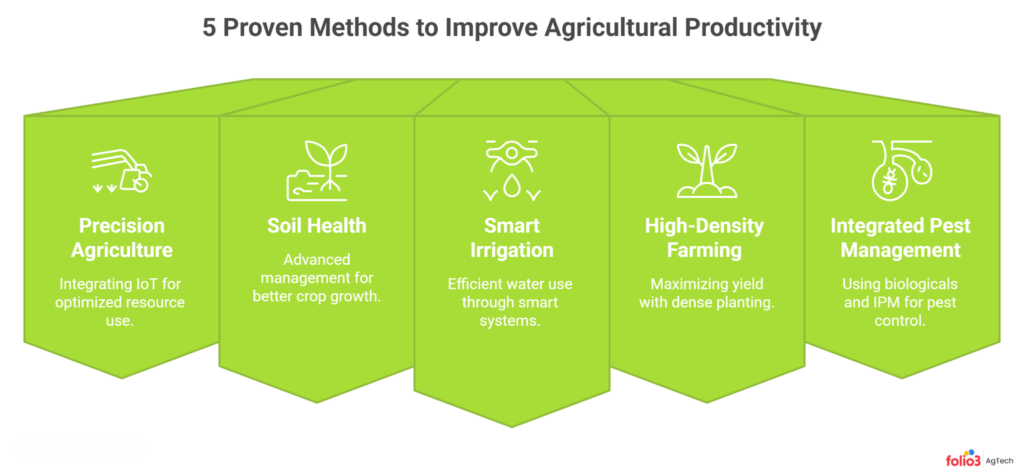
Precision Agriculture and IoT Integration
Precision agriculture uses GPS, sensors, drones, and IoT-connected devices to monitor field conditions and apply inputs only where and when needed. The result is more predictable yields and far better traceability.
Precision agriculture using GPS, drones, and IoT improves yields by 20 to 30% and cuts input waste by 40 to 60%. For food processors, that means two things: more consistent raw material volumes and digital lot-level traceability from field to intake dock.
When your supplier uses IoT-connected farm monitoring, you can access harvest data, environmental logs, and input records in near real time. That data becomes the backbone of your farm-to-fork compliance documentation. You can also explore variable rate technology as a specific precision agriculture tool that adjusts fertilizer, seed, and chemical application rates by zone, reducing input overuse and improving crop uniformity.
Advanced Soil Health and Nutrient Management
Soil health is the single biggest driver of nutritional consistency in raw materials. Degraded soils produce nutritionally variable crops, which creates problems for formulation-dependent processors.
Currently, 33% of global soils are unproductive due to degradation from overuse of agrochemicals, erosion, and deforestation. Farms that invest in practical soil fertility improvements, such as cover cropping, composting, and precision fertilization, deliver more consistent nutrient profiles in the crops they sell.
For QA teams, this translates to lower variability in protein, starch, and moisture content at intake. It also supports sustainability reporting by demonstrating reduced synthetic fertilizer use per unit of output.
Smart Water and Irrigation Systems
Water stress is one of the most common drivers of yield variability. When irrigation is inconsistent or poorly timed, crop maturity becomes irregular, and harvest windows compress unpredictably.
Smart irrigation systems use soil moisture sensors and weather data to deliver water precisely when crops need it. According to the same research, smart irrigation can boost water efficiency by 40 to 60%. For plant operations, drought-resilient farms with modernized crop irrigation systems are supply chain stable farms. They are far less likely to call a force majeure on a contracted delivery because of a dry spell.
High-Density Farming and Crop Diversification
High-density planting combined with strategic crop diversification allows farms to maximize output per acre without degrading soil or water resources. For food manufacturers that source multiple crop types, a diversified supplier base that practices rotational or multi-crop systems offers resilience against single-crop failures.
From a plant scheduling perspective, a supplier growing two or three complementary crops on the same acreage can smooth out your intake calendar across different growing seasons, reducing storage pressure and improving raw material freshness at processing.
Integrated Pest Management (IPM) and Biologicals
This is the method that matters most to your Food Safety team. Conventional pesticide-heavy crop protection leaves chemical residue risks that directly impact compliance. Integrated pest management replaces blanket chemical applications with targeted, data-driven interventions and biological controls.
Farms using Bt technology and targeted biocontrol have seen pesticide application drop significantly. Research published in Frontiers in Plant Science cited Bt cotton in India as an example where pesticide use fell by 50% without sacrificing yield. For food safety managers, lower chemical inputs at the farm level mean fewer residue exceedances at intake, less rework, and cleaner compliance records for retail and export customers. Explore how fresh produce quality control practices connect directly to what your growers are doing in the field.
The Ripple Effect: How Increased Agricultural Productivity Drives Plant Efficiency
Your plant does not operate in isolation. Every efficiency win or loss at the farm level ripples directly into your operations. Increasing agricultural productivity is not just a sourcing decision; it is a plant efficiency strategy.
Consider the most common pain points on a processing floor: intake scheduling chaos, high spoilage rates during peak harvest, inconsistent raw material specs causing formulation failures, and reactive compliance paperwork. All of these trace back to farm-level productivity gaps.
When you work with producers who have invested in supply chain tracking and modern productivity tools, those pain points shrink. Here is how the connection works in practice:
The Farm-to-Plant Connection
| Farm-Level Productivity Win | Manufacturing / Plant-Level Benefit |
| AI-optimized harvest timing via IoT sensors | Reduced spoilage, smoother intake scheduling, less storage overload |
| Precision nutrient management and soil health programs | Consistent raw material specs, fewer formulation failures, lower QA rejection |
| Smart irrigation and drought-resilient crop varieties | Supply chain continuity, reduced force majeure risk, predictable intake volumes |
| IPM and reduced chemical applications | Lower MRL exceedance risk, faster customs clearance for export, cleaner audit trails |
| Digital field records and GPS-tagged lots | Faster farm-to-fork trace recalls, automated compliance documentation |
| Crop diversification and rotational planning | Smoothed intake calendar, reduced storage pressure, better labor planning |
The business case is straightforward. When your upstream partner has strong agricultural productivity, your plant spends less time firefighting and more time operating at designed capacity.
Plant managers and operations heads should treat supplier agricultural productivity as a KPI in their own scorecard, not just a procurement criterion. The farms that invest in productivity tools today are the partners that will keep your lines running reliably tomorrow.
Core Ways to Increase Agricultural Productivity Through AgTech ERPs
Technology alone does not bridge the farm-factory gap. The missing piece is a system that connects farm data to your manufacturing workflows in real time. That is exactly what AgTech ERPs are designed to do.
Think of an AgTech ERP as the central nervous system of your agribusiness. It does not just store records. It turns raw field data into operational intelligence that your plant managers, compliance officers, and finance teams can actually act on.
Unifying Farm Data With Manufacturing Workflows
A well-implemented agricultural ERP creates a single source of truth that spans both sides of your operation. Here is what that looks like in practice:
- Real-time yield visibility: Plant scheduling teams can see projected harvest volumes weeks out, not days. That enables smarter labor planning, storage allocation, and intake staging.
- Automated raw material specs: Field sensor data, soil test results, and input logs flow directly into intake QC checklists. Your QA team stops chasing paper and starts making data-driven release decisions.
- Integrated procurement and logistics: Purchase orders, contracted delivery volumes, and transport logistics update automatically as field conditions change. Less scrambling when yields shift.
- Batch traceability from field to finished goods: Every production batch links back to a specific field, harvest date, and input record. That level of traceability is table stakes for most large retail and food service customers today.
Empowering Compliance and Regulatory Affairs Teams
The benefits of ERP for the agriculture industry extend well beyond operational efficiency. For compliance and regulatory affairs teams, integrated farm-factory data delivers:
- Automated sustainability and Scope 3 reporting: Farm-level input data feeds directly into emissions calculations, reducing the manual effort required for carbon disclosure reports.
- FSMA 204 traceability readiness: With geo-tagged harvest records and digital custody chains, you can produce a full traceability report within hours, not days.
- Audit-ready yield documentation: Transparent yield records with supporting sensor data satisfy buyer audits, organic certification reviews, and government inspection requirements.
- Residue compliance tracking: Chemical application logs from the farm sync with your MRL testing data, giving Food Safety teams an early warning system rather than a reactive one.
The farms and processors that will win in the next decade are those treating data integration as a core capability, not an IT project.
Key Factors Affecting Agricultural Productivity in 2026 and Beyond
Supply chain planning cannot happen in a vacuum. These macro-level forces are actively reshaping what you can expect from agricultural productivity in the years ahead.
Climate Change and Extreme Weather Volatility
Climate volatility is no longer a long-term projection. It is a current operational risk, and climate change has already reduced crop yields by up to 30% in the most vulnerable regions through rising temperatures, erratic rainfall, and extreme weather events.
For QA managers and operations heads, this means yield predictability is declining at the same time that consumer and regulatory expectations are rising. The farms best positioned to weather this are those investing in climate-smart practices: drought-resistant varieties, soil carbon improvements, smart irrigation, and risk-diversified crop portfolios. The importance of climate-smart agriculture is no longer theoretical for food manufacturers. It directly affects your intake reliability.
Labor Shortages in Agriculture and Processing
This is a compounding problem. According to data reported by FTI Consulting, there were an estimated 2.4 million open agricultural jobs in the United States in 2024, with 56% of farmers reporting labor shortages. In food manufacturing specifically, 74,000 positions went unfilled in 2024 alone, and unit labor costs rose 7.5% in the same period.
Labor shortages affect productivity in two ways. On the farm, they slow the harvest timing and increase post-harvest losses. In your plant, they force line slowdowns and increase dependence on expensive contract labor. Farms and processors that have invested in automation, robotics, and labor-reducing technologies are building a structural advantage that their competitors will struggle to close.
Shifting Global Sustainability Mandates (Scope 3 Emissions)
Scope 3 emissions, those that occur in your supply chain before materials reach your facility, are increasingly subject to regulatory and buyer scrutiny. In Europe, supply chain due diligence regulations already require food companies to document and reduce upstream emissions. North American markets are moving in the same direction.
Farm-level productivity improvements directly reduce Scope 3 emissions per unit of output. Farms using precision inputs, smart irrigation, and IPM generate significantly less agricultural greenhouse gas per tonne of food produced. If your sustainability team is building a net-zero roadmap, your upstream agricultural productivity strategy needs to be part of that conversation, not a footnote.
Realizing the Benefits of Improved Agricultural Productivity
When agricultural productivity improves at the source, the gains flow through your entire business. Here is where the impact lands most clearly:
- Cost reduction through input efficiency: Less water, fertilizer, and chemical use per unit of output means lower raw material cost volatility. Farms with strong TFP growth absorb input price shocks better, which gives you more pricing stability in long-term supply contracts.
- Stronger brand reputation: Consumers and retail buyers increasingly want transparent, sustainably sourced ingredients. Suppliers with documented productivity improvements, low chemical use, and verified traceability give your brand a defensible story.
- Improved food safety outcomes: Farms using IPM, precision inputs, and digital record-keeping generate raw materials with fewer residue risks and stronger documentation. That directly supports your FSMA, HACCP, and GFSI compliance posture.
- Meeting consumer demand for sustainable sourcing: Retail and food service buyers are demanding Scope 3 transparency, regenerative sourcing claims, and farm-level sustainability data. Improved agricultural productivity, documented through integrated ERP systems, gives you the data to meet those demands with evidence.
The business case for investing in upstream productivity, whether through supplier development programs, contract requirements, or integrated technology, is no longer optional. It is a competitive requirement.
Conclusion
Improved agricultural productivity is not just a farming ambition. It is the foundation of a resilient, compliant, and profitable food manufacturing operation. The farms and processors that treat productivity as a shared goal, connected through data, technology, and integrated systems, are the ones best positioned to weather market volatility, tighten margins, and meet rising sustainability expectations.
If your supply chain still runs on disconnected data and reactive planning, the gap between you and your most competitive peers is widening every season. Now is the time to close it. Ready to connect your farm data with your plant operations? Consult with our Agtech experts to see how integrated technology transforms agricultural productivity into plant-level performance.
FAQs
What Is the Difference Between Agricultural Production and Agricultural Productivity?
Agricultural production measures total output volume, such as tonnes of grain harvested. Agricultural productivity measures how efficiently output is achieved relative to inputs like land, water, labor, and capital. You can increase production by simply farming more land, but genuine productivity growth means getting more output from the same or fewer resources.
How Does Farm-Level Productivity Affect Food Processing Operations?
Higher farm productivity leads to more consistent raw material quality, more predictable harvest timing, and lower chemical residue risks. These improvements reduce QA rejections, optimize intake scheduling, and cut spoilage rates inside processing facilities.
What Role Does IoT Play in Improving Agricultural Productivity?
IoT sensors monitor soil moisture, temperature, crop health, and weather conditions in real time. This data allows farmers to apply inputs more precisely, reducing waste and improving yield consistency. For food processors, IoT-connected farms also generate digital audit trails that support traceability and compliance documentation.
Can an ERP System Really Bridge the Farm and the Factory?
Yes. An AgTech ERP creates a shared data layer that connects field-level yield forecasts, input records, and harvest timing directly to plant scheduling, procurement, and compliance workflows. It eliminates the information lag that causes intake disruptions, formulation errors, and compliance gaps.
How Are Labor Shortages Affecting Agricultural Productivity?
Labor shortages reduce the speed and quality of harvests, increasing post-harvest losses and disrupting supply volumes. Farms are responding by adopting automation, robotics, and precision management tools. For food processors, this trend makes it even more important to work with technologically advanced suppliers whose operations are less vulnerable to workforce gaps.
What are Scope 3 Emissions and Why Does It Matter for Food Manufacturers?
Scope 3 emissions are the greenhouse gas emissions that occur in your supply chain before materials reach your facility. For food manufacturers, this includes emissions from farming, transportation, and raw material processing. Retailers and regulators are increasingly requiring food companies to measure and reduce Scope 3 emissions, making upstream agricultural productivity data an essential part of your sustainability reporting.