
According to the Food and Agriculture Organization (FAO), around one billion hectares of degraded farmland worldwide could benefit from the strategic planting of trees. That is a staggering number, and it points to a reality many farmers already sense: the way we use land needs to change. Agroforestry benefits go far beyond planting a few trees on field edges. This practice of combining trees and shrubs with crops or livestock can improve soil, increase income, and make your operation more resilient to weather extremes.
In this guide, you will learn about the key agroforestry benefits that matter most to working farms. We cover how agroforestry protects soil, pulls carbon from the atmosphere, conserves water, supports wildlife, and opens new revenue channels. Whether you run a cattle ranch, a row crop operation, or a mixed farm, understanding agroforestry benefits can help you make smarter land-use decisions that pay off now and for the long run.
What Is Agroforestry and Why Does It Matter?
Agroforestry is the practice of deliberately growing trees and shrubs alongside crops, pasture, or livestock on the same piece of land. It is not a new concept. Farmers across the tropics and subtropics have used tree-crop combinations for generations. What is relatively new is the growing body of science that shows just how significant the agroforestry benefits are for soil, water, climate, biodiversity, and farm profitability.
The USDA recognizes five main agroforestry practices: windbreaks, silvopasture, alley cropping, riparian forest buffers, and forest farming. Each one addresses different challenges, but all of them deliver overlapping agroforestry benefits that single-practice farming cannot.
Why does this matter to you? Because modern agriculture faces a squeeze from multiple directions: rising input costs, unpredictable weather, shrinking margins, and increasing pressure to meet sustainability standards. Agroforestry gives you a way to address several of those pressures at once.
Agroforestry Benefits for Soil Health and Fertility
Healthy soil is the foundation of a profitable farm. One of the most documented agroforestry benefits is the positive impact on soil structure, organic matter, and nutrient cycling. When trees are part of the farming system, their roots break up compacted layers, allowing water and air to move more freely through the soil profile.
How Trees Build Organic Matter
Trees and shrubs constantly shed leaves, twigs, and small roots. This organic material decomposes on the surface and within the soil, feeding bacteria, fungi, and earthworms. Over time, this process raises organic matter levels, which directly improves your soil’s ability to hold water and nutrients. If you are working with degraded fields, this is one of the fastest agroforestry benefits you will notice.
Tree roots also support mycorrhizal fungal networks. These networks transfer nutrients between plants and store carbon deep in the ground. The connection between regenerative soil practices and agroforestry is direct: trees are one of nature’s most effective soil builders.
Reduced Erosion and Nutrient Runoff
Soil erosion costs farmers billions of dollars in lost productivity each year. Tree roots anchor topsoil in place, and the canopy above slows the impact of rainfall on bare ground. Windbreaks along field edges reduce wind erosion, while riparian buffers trap sediment and nutrients before they reach waterways. If soil erosion control is a concern on your land, the agroforestry benefits for erosion prevention are worth a serious look.
The result is healthier fields that hold on to the nutrients you apply, reducing your need for chemical fertilizers over time. That is a real cost saving, especially when fertilizer prices are volatile.
Carbon Sequestration: One of the Biggest Agroforestry Benefits
If you have been following conversations around livestock farming and climate change, you already know that agriculture is under scrutiny for its carbon footprint. Here is where agroforestry environmental benefits stand out: trees absorb carbon dioxide from the air and lock it away in their wood, roots, and the soil around them.
Perennial tree crops are especially powerful carbon sinks because they grow larger each year, deepening their root systems and increasing carbon storage. Unlike annual crops that are tilled and replanted each season, trees in an agroforestry system remain in place for decades. This uninterrupted growth means continuous carbon capture.
Agroforestry also reduces the need for nitrogen-based fertilizers, which are a major source of nitrous oxide, a greenhouse gas far more potent than CO2. According to the U.S. Environmental Protection Agency, nitrous oxide is roughly 265 to 270 times more effective at trapping heat compared to carbon dioxide over a 100-year period. By building self-fertilizing systems through leaf litter and nitrogen-fixing trees, agroforestry cuts your dependence on synthetic inputs and lowers overall farm emissions.
For farmers thinking about carbon credit programs, the agroforestry benefits related to carbon storage are becoming increasingly relevant. Trees on your land represent measurable carbon assets that could eventually translate into additional income.
How Agroforestry Benefits Water Conservation on Your Farm
Water is becoming a limiting factor for agriculture in more regions every year. Agroforestry benefits for water management are practical and measurable. Trees and shrubs slow down rainfall before it hits the ground, giving the soil more time to absorb moisture. Their root systems create channels that improve water infiltration, reducing surface runoff and the flooding risk that comes with it.
Improved Groundwater Recharge
When rain falls on a bare field, much of it runs off the surface. In agroforestry systems, tree canopies intercept rainfall, and the rest filters through leaf litter on the ground. Root channels from decaying roots act as natural drainage pipes, moving water deeper into the soil profile and supporting groundwater recharge. If you manage a farm in a drought-prone area, understanding how agricultural water management connects to trees is essential.
Shade and Moisture Retention
In hot climates, exposed soil can lose moisture rapidly through evaporation. Tree shade lowers soil surface temperatures, which reduces water loss and keeps the root zone cooler for the crops growing underneath. This is a key agroforestry benefit during long, dry summers when every inch of stored moisture counts. The mulch created by falling leaves adds another layer of protection against moisture loss.
Agroforestry Benefits for Biodiversity and Pollinator Support
Monoculture farming simplifies the landscape, leaving little room for insects, birds, and other organisms that play a vital role in crop production. One of the often-overlooked agroforestry benefits is the habitat it creates for pollinators and beneficial predators. Trees and shrubs flower at different times of the year, providing food for bees, butterflies, and other pollinators when row crops cannot.
Birds and predatory insects that nest in agroforestry plantings help control pests naturally. Fewer pesticide applications save money and protect soil biology. For operations committed to sustainable agriculture practices, the biodiversity-related agroforestry benefits are a practical way to reduce chemical inputs without sacrificing yields.
Genetic diversity also improves when you introduce multiple tree species. A diverse farm system is less vulnerable to a single pest outbreak wiping out an entire season. This built-in resilience is something monoculture systems simply cannot offer.
The Economic Side of Agroforestry Benefits: Income Diversification
For many farmers, the most compelling agroforestry benefits are financial. A single tree can produce timber, fruit, nuts, firewood, or fodder, sometimes all at once. That means your land is generating income from multiple products instead of relying on a single crop harvest.
Diversified Revenue Streams
Consider silvopasture, where cattle graze under managed tree cover. The trees provide shade for livestock (reducing heat stress and improving weight gain), while also producing timber or fruit. Meanwhile, the pasture itself benefits from improved soil fertility thanks to the leaf litter and root activity. It is a system where each component supports the others.
Forest farming is another example. Growing high-value crops like mushrooms or ginseng under a tree canopy uses land that might otherwise sit idle. Alley cropping lets you harvest two product types from the same field. These diversified income streams are agroforestry benefits that reduce your exposure to price swings. If improving your overall farm efficiency is a priority, agroforestry gives you more value per acre.
Lower Input Costs Over Time
Agroforestry systems with nitrogen-fixing trees (like acacia or locust species) can reduce your fertilizer bills significantly. Windbreaks lower crop water demand by cutting wind speed and evapotranspiration. Over several years, these reduced input costs compound into meaningful savings. The upfront investment takes time to pay back, but the long-term agroforestry benefits on the cost side are well documented.
Building Climate Resilience Through Agroforestry
Extreme weather events are no longer occasional disruptions; they are becoming a regular part of farming. Droughts, heavy rainfall events, heat waves, and late frosts all threaten yields. What are the benefits of agroforestry when it comes to climate adaptation? Trees buffer your land against these extremes in several ways.
Deep-rooted trees are more drought-tolerant than annual crops. During dry spells, they continue functioning, providing shade and ground cover when everything else is stressed. Their roots access moisture from soil layers that shallow-rooted crops cannot reach. During intense rainfall, the same root systems and canopy reduce flooding, protecting your topsoil from being washed away.
For livestock operations, silvopasture provides natural shade that reduces heat stress in cattle during extreme summer temperatures. Animals under tree cover drink less water, maintain better body condition, and show improved weight gain compared to those on open pasture. Adopting climate-smart agriculture principles alongside agroforestry creates a combined approach that strengthens your operation against unpredictable seasons.
Diverse agroforestry systems also spread your risk. If a heatwave damages your field crops, the tree products (fruit, nuts, timber) may still be harvestable. This built-in safety net is an agroforestry benefit that becomes more valuable as climate variability increases.
Five Agroforestry Practices and Their Specific Benefits
Not all agroforestry looks the same. Each of the five recognized practices delivers specific agroforestry benefits suited to different farm types and goals. Understanding which practice fits your operation helps you capture the right advantages.
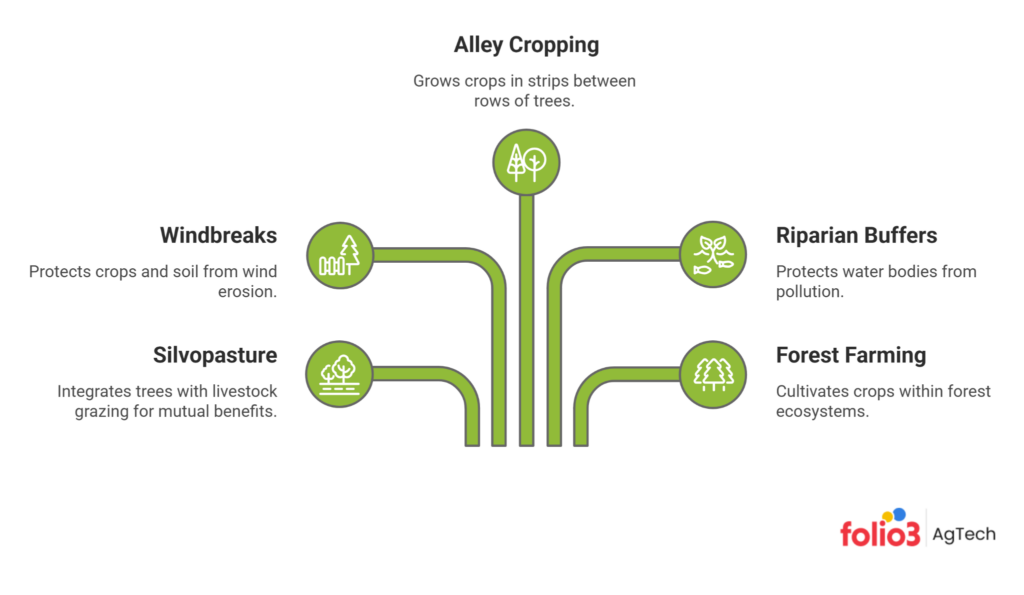
Silvopasture
Silvopasture combines trees with livestock grazing on the same land. The trees provide shade and shelter for animals, reducing heat stress and lowering veterinary costs. Meanwhile, the pasture benefits from improved soil fertility. For ranchers exploring better ways to manage their herds, pairing silvopasture with livestock management software can help you track how pasture quality and animal performance improve over time.
Windbreaks and Shelterbelts
Rows of trees planted along field edges reduce wind speed, cut crop water loss, protect against wind erosion, and create wildlife corridors. On the Great Plains and other wind-prone regions, the agroforestry benefits from windbreaks include measurable yield increases in the sheltered zone behind the trees.
Alley Cropping
Alley cropping plants rows of trees with rows of annual or perennial crops growing in between. The trees produce long-term income (timber, fruit), while the crops generate short-term revenue. This dual-income model is one of the most practical agroforestry benefits for farmers who need cash flow while waiting for trees to mature. If you are interested in crop rotation benefits, alley cropping pairs well with rotational strategies.
Riparian Forest Buffers
Planting trees along streams and waterways filters runoff, protects water quality, stabilizes banks, and reduces flooding. These buffers also provide habitat for fish and wildlife. For farms near water bodies, this is one of the agroforestry benefits that can also help with regulatory compliance.
Forest Farming
Forest farming grows specialty crops (mushrooms, medicinal herbs, decorative plants) under the canopy of a managed forest. It turns wooded areas into productive land without clearing trees. The economic agroforestry benefits here can be significant: high-value crops like shiitake mushrooms or ginseng can bring premium prices at local and specialty markets.
How to Start Capturing Agroforestry Benefits on Your Land
Getting started with agroforestry does not require a complete overhaul of your farming system. Many farmers begin with a single practice, such as a windbreak or a small silvopasture trial, and expand as they see results. Here are a few practical steps:
First, assess your land and identify the challenges you want to address: erosion, low fertility, water loss, or income concentration. Match those needs to the right agroforestry practice. Second, start small with a trial plot. Third, choose native species wherever possible since they establish faster and support local wildlife better.
The USDA and state extension services offer cost-share programs for agroforestry. Check with your local NRCS office to see what support is available. Tracking results is equally important. Recording changes in soil health, yields, and animal performance helps you measure how agroforestry benefits show up on your operation. If you already track soil fertility improvement or pasture quality data, adding agroforestry metrics to your records is a natural next step.
Agroforestry Benefits for Long-Term Farm Sustainability
The benefits of agroforestry compound over time. Young trees take a few years to establish, but once they do, the gains accelerate. Soil organic matter increases year after year. Carbon storage grows as trees mature. Biodiversity deepens as the habitat becomes more complex. And the economic returns from tree products often increase as trees reach productive maturity.
Sustainability is not just a buzzword for farmers managing generational land. It is a financial strategy. A farm with trees is more resilient to market shocks, weather events, and regulatory changes. The agroforestry benefits here include preserving soil productivity, maintaining clean water, and creating a farm that supports the next generation without major restoration costs.
As consumer demand for sustainably produced food grows, farms with verifiable environmental practices gain market access advantages. Agroforestry gives you a credible story backed by measurable data. Using a livestock management platform alongside your agroforestry practices helps you document performance improvements and sustainability metrics that buyers and certification programs value.
Conclusion
Agroforestry benefits touch every part of a farming operation: soil, water, climate, income, and long-term viability. Healthier soils hold more water and nutrients, reducing input costs. Carbon capture positions your farm favorably in a world moving toward sustainability standards. Diversified income reduces dependence on any single market. And the climate resilience from trees on your land is something no amount of crop insurance can fully replace.
The agroforestry benefits outlined in this guide are not theoretical. Farmers and ranchers worldwide are putting these practices to work. The key is to start with the practice that addresses your most pressing challenge, track results, and scale from there. Agroforestry is not a silver bullet, but it is one of the most practical approaches to building a farm that stays productive for decades ahead.
FAQs
What Are The Main Benefits Of Agroforestry For Small Farms?
Small farms benefit from agroforestry through diversified income streams, reduced input costs, and improved soil health. Trees can produce fruit, nuts, timber, or fodder while the land between them grows crops or supports grazing. Over time, this multi-product approach lowers financial risk and makes small operations more profitable per acre.
How Does Agroforestry Help With Soil Erosion?
Tree roots hold soil in place, preventing it from being washed away by rain or blown away by wind. The canopy above slows the speed of rainfall before it hits the ground, reducing its erosive force. Riparian buffers and windbreaks are two agroforestry practices specifically designed to stop erosion in vulnerable areas like slopes and stream banks.
Can Agroforestry Increase Farm Income?
Yes. Agroforestry adds income sources like timber, fruit, nuts, and specialty crops to your existing revenue. Silvopasture systems can improve livestock performance through shade and forage, translating to better weight gain and higher sale prices. Reduced input costs for fertilizer and water also boost profitability over time.
What Is The Difference Between Agroforestry And Reforestation?
Reforestation focuses on restoring forest cover on land that was previously forested. Agroforestry, on the other hand, integrates trees into active agricultural systems where crops and livestock continue to be produced. The goal of agroforestry is to make farming more productive and sustainable, while reforestation primarily aims to restore ecosystems.
How Long Does It Take To See Agroforestry Benefits?
Some agroforestry benefits, like reduced wind erosion from windbreaks and improved shade for livestock, show up within the first one to three years. Soil health improvements typically become noticeable within three to five years as organic matter builds up. Tree-based income from fruit or timber takes longer, often five to fifteen years depending on the species, but the cumulative benefits grow significantly over time.
Does The USDA Offer Financial Support For Agroforestry?
Yes. The USDA offers several programs including the Environmental Quality Incentives Program (EQIP), Conservation Stewardship Program (CSP), and Conservation Reserve Program (CRP). These provide cost-share funding, technical assistance, and annual payments for establishing agroforestry practices on your land.