
Rising consumer pressure, tightening environmental regulations, and increasingly volatile climate conditions are pushing the dairy industry toward a fundamental shift. Retailers are hardening supplier requirements. Investors are asking pointed ESG questions. And on the farm, climate disruptions are making the old “business as usual” model more expensive every season.
Sustainable dairy farming is the response to all of this, and it goes well beyond planting cover crops or switching to LED lighting. For plant managers and operations heads overseeing dairy supply chains, sustainability is fast becoming the price of market access, not just a brand talking point.
This guide breaks down what sustainable dairy farming actually means, where your biggest emissions and cost risks sit from hoof to cooler, and what a practical path forward looks like for processing facilities today and in the years ahead.
What Is Sustainable Dairy Farming?
Sustainable dairy farming balances today’s production demands with long-term environmental and economic health. It’s built on a triple bottom line that connects your operation to the planet and the people around it.
Sustainable dairy farming is defined as producing milk and dairy products in a way that meets today’s food demands without depleting the environmental, economic, and social resources future generations will need. The triple bottom line sits at its core: ecological health, economic viability, and social responsibility.
In practice, that means managing land, water, animals, and energy in ways that preserve productivity over time. Conventional dairy farming optimizes for short-term output, higher yields, lower feed costs, and maximum throughput. Sustainable dairy farming takes a longer view. It emphasizes continuous improvement and circular resource flows, where by-products become inputs, waste becomes energy, and carbon is tracked rather than simply emitted.
One fact worth noting: approximately 95% of U.S. dairy farms are family-owned. Sustainability isn’t a corporate reporting exercise for most producers; it’s a multigenerational commitment. The land that feeds today’s herd needs to feed the next generation’s herd, too.
For plant managers, that context matters. Your supply chain partners aren’t just chasing certifications. They’re making long-term investments, and the support you provide in data sharing, premium pricing, or technical assistance directly shapes how fast and how deeply that transition happens.
Why Sustainability Matters in the Dairy Industry
The dairy industry’s environmental footprint is real, measurable, and increasingly scrutinized by regulators, investors, and the retailers that control your market access.
The Environmental Footprint of U.S. Dairy
- Greenhouse gas emissions: U.S. dairy operations contribute approximately 2% of total U.S. GHG emissions, with methane from enteric fermentation and manure management carrying the largest share.
- Water consumption: Dairy accounts for roughly 5.1% of U.S. agricultural water use.
- Land footprint: The industry occupies approximately 3.7% of U.S. farmland.
These numbers tell only half the story. Producing a gallon of milk in 2017 required 30% less water, 21% less land, and generated a 19% smaller carbon footprint compared to 2007. That’s efficiency improvement at scale driven by better practices, not by shrinking output.
Dairy farmers are already managing methane through feed additives and by repurposing manure into biogas. Whey and other processing by-products are moving into animal feed, protein concentrates, and pharmaceutical ingredients rather than going down the drain.
Why Dairy Industry Sustainability Is Now Strategic
- Regulatory pressure: Carbon reporting requirements are expanding across states. Processing plants face increasing direct emissions reporting obligations.
- Investor expectations: ESG frameworks now demand Scope 3 supply chain data, making dairy plants accountable for upstream farm emissions.
- Consumer demand: Premium and retail consumers increasingly factor sustainability into purchasing decisions, with purchasing behavior shifting accordingly.
- Market access: Major Tier 1 retailers and foodservice operators have begun formalizing supplier sustainability standards. Missing them means losing shelf space or contract renewals.
For plant managers, this is precisely where top agriculture issues like climate compliance and market access converge. Sustainability isn’t a values statement anymore; it’s a business resilience play.
Quantifying the Dairy Carbon Footprint: From Hoof to Cooler
Understanding your dairy carbon footprint means looking at the full value chain, not just what happens inside your plant walls. Most processing operations underestimate their Scope 3 exposure and pay for it in regulatory and market risk.
Breaking Down Scope 1, 2, and 3 Emissions
- Scope 1 (direct): On-farm combustion from equipment, boilers, and generators; refrigerant leaks from cold storage; processing energy at the plant.
- Scope 2 (indirect): Purchased electricity at both the farm and the processing facility.
- Scope 3 (value chain): This is where the majority of dairy’s footprint lives: feed crop production, enteric fermentation, manure management, packaging, transportation, and end-of-life waste.
For a typical dairy processing plant, Scope 3 emissions can account for 80–90% of total lifecycle emissions, according to FAO lifecycle analyses. If you’re only measuring what happens inside your four walls, you’re managing a fraction of your actual carbon exposure.
Enteric Fermentation and Manure Management: The Farm Gap
Enteric fermentation, the digestive process in ruminant cattle, is the single largest source of methane in U.S. agriculture. It represents over 26% of all agricultural GHG emissions nationally.
Manure management adds more, particularly from liquid storage systems that release both methane and nitrous oxide. Without intervention, a 1,000-cow dairy operation can generate emissions equivalent to several hundred tons of CO₂ annually from manure alone.
For supply chain managers, this “farm gap” is both the biggest liability and the biggest opportunity. Farms that adopt methane inhibitors, covered lagoon digesters, or solid-liquid manure separation can cut manure-related emissions by 50–80%.
Energy Intensity in Processing: The Plant Reality
Dairy plants are energy-intensive by nature. Pasteurization, homogenization, evaporation, spray drying, and refrigeration all draw heavily on electricity and heat. Industry benchmarks place dairy processing energy consumption at approximately 0.5–2.5 MJ per kilogram of milk processed, depending on product type and equipment age.
Cheese and milk powder plants carry the highest energy burden. Fluid milk and yogurt operations tend to be more efficient, but still carry meaningful room to improve through heat recovery and variable-speed drives.
Average Carbon Intensity: Conventional vs. Transitioning Dairy Systems
| Metric | Conventional System | Transitioning (Sustainable) System |
| GHG per kg of milk (kg CO₂eq) | 3.2 – 4.5 | 1.8 – 2.6 |
| Water use per liter of milk (L) | 1,000 – 1,500 | 600 – 900 |
| Energy intensity (MJ/kg processed) | 1.8 – 2.5 | 0.8 – 1.4 |
| Manure methane capture rate | <10% | 50–80% |
Source: FAO Livestock Environmental Assessment and Performance (LEAP) Partnership; IEA Industrial Energy Efficiency data
7 Strategic Pillars for Sustainable Dairy (Supply Chain Integration)
Sustainable dairy supply chain integration requires coordinated action across seven technical pillars from the feed trough to the cold room. Each pillar reduces your emissions exposure while improving operational efficiency.
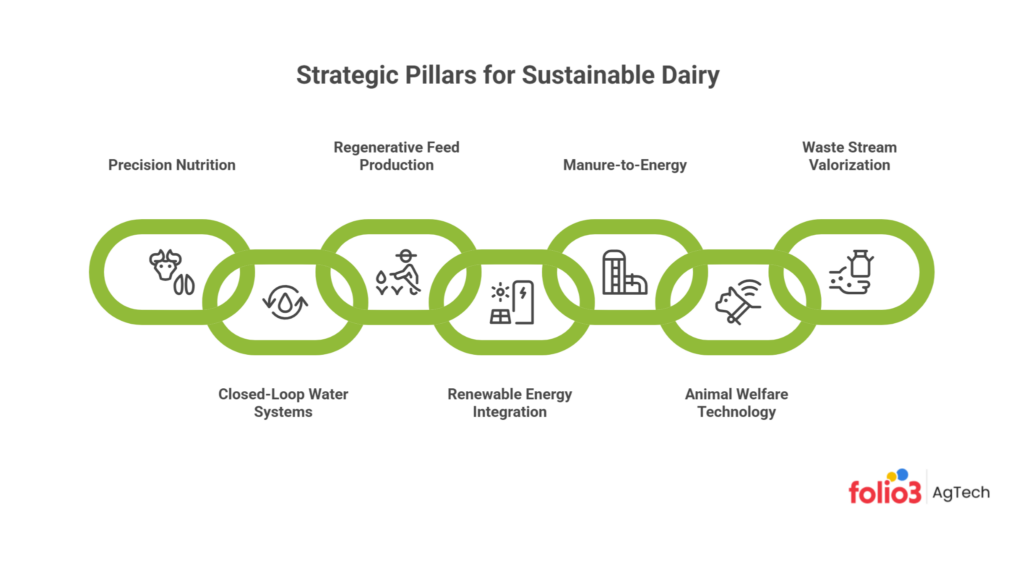
These pillars aren’t standalone checkboxes. They’re interconnected levers that compound when you apply them together, reducing your dairy industry sustainability exposure while building a more resilient supply chain at the same time.
1. Precision Nutrition: Lowering Methane Through the Feed Ration
What a cow eats determines a significant share of how much methane she produces. Feed additives like 3-NOP (commercially available as Bovaer) have shown methane reductions of 20–30% per animal in peer-reviewed trials. Balancing rations to reduce fermentable carbohydrates and optimize rumen efficiency also improves feed conversion, which directly lowers cost per hundredweight.
If your supply contracts don’t yet account for feed quality data, it’s worth revisiting. Farms with precision cattle feeding systems can share ration records that help you model Scope 3 emissions far more accurately than industry averages.
2. Closed-Loop Water Systems: Reclaiming “Cow Water”
Dairy cows exhale and transpire significant volumes of moisture. In milking parlors, evaporative cooling systems can capture and recondense this water for reuse in cleaning operations. Closed-loop systems also recirculate water used in plate coolers and CIP (clean-in-place) circuits, reducing freshwater draw by 30–60% on well-optimized plants.
3. Regenerative Feed Production: Reducing Scope 3 Fertilizer Emissions
The feed crops going into dairy rations, corn silage, soybeans, and alfalfa carry embedded emissions from synthetic fertilizer application and tillage. Transitioning your feed supply chain toward sustainable crop production practices, cover cropping, reduced tillage, and precision nutrient management cuts the Scope 3 footprint of every ton of feed entering your operation. Processors with preferred supplier programs are beginning to incentivize these transitions directly through premium pricing.
4. Renewable Energy Integration: Beyond Solar
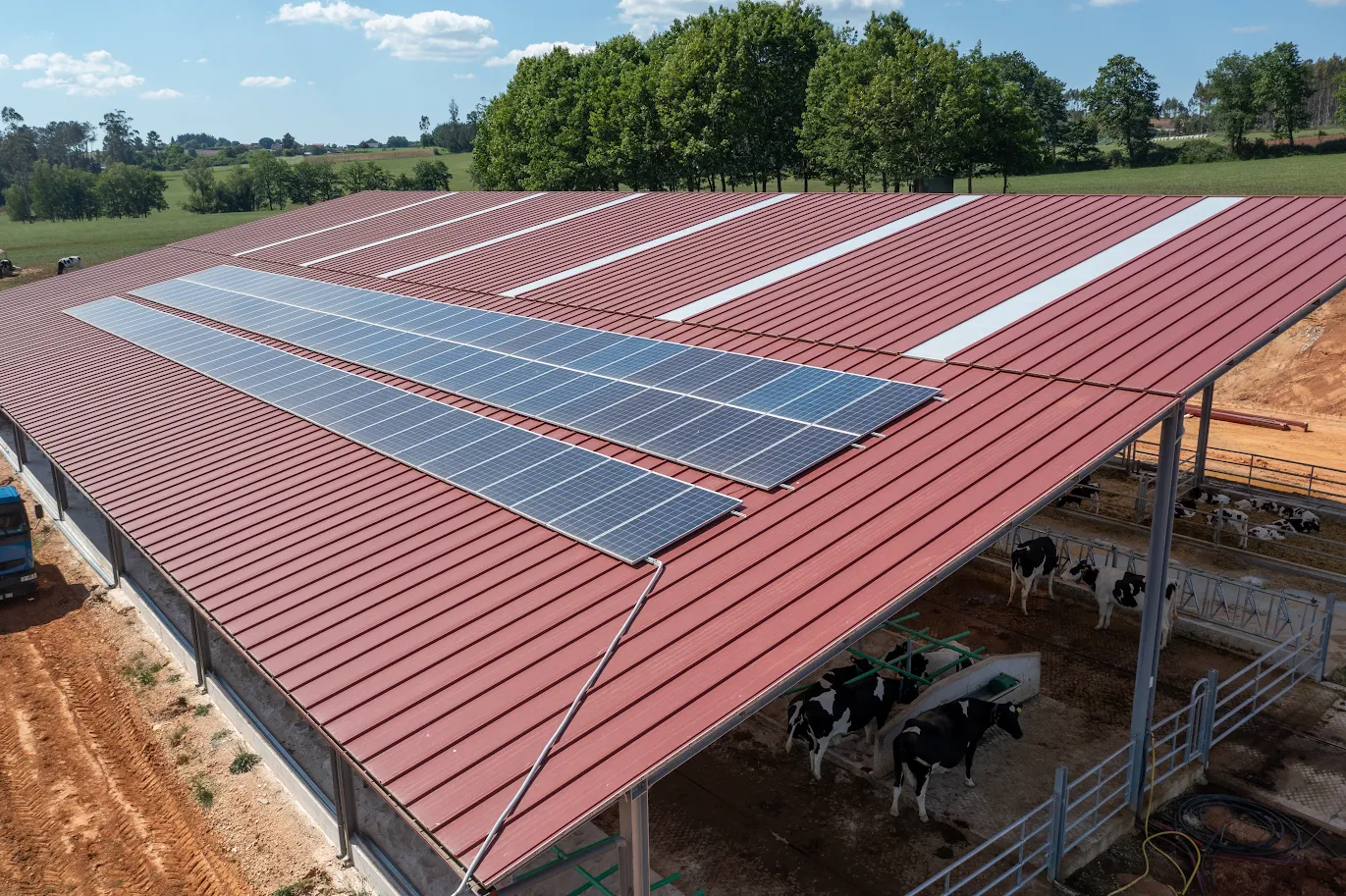
Rooftop solar gets the most attention, but it’s only one option. Biogas from anaerobic digesters, fed by manure and processing waste, can generate electricity and heat that directly displaces fossil fuels at the plant level. Combined heat-and-power (CHP) systems recover waste heat from biogas engines for pasteurization and drying, pushing overall thermal efficiency above 80%.
This is one of the core mechanisms behind climate-smart agriculture adoption in dairy: on-site renewable generation reduces both cost and carbon exposure simultaneously.
5. Manure-to-Energy (RNG): Supply Chain ROI That’s Bankable
Dairy manure is one of the highest-methane waste streams in agriculture. Covered lagoon digesters or plug-flow systems capture that methane and convert it into renewable natural gas (RNG), which can be sold to utilities or used on-site. For a 3,000-cow operation, RNG revenue can reach $1–2 million annually, depending on current carbon credit markets and utility off-take agreements. Sourcing electricity or thermal energy from farm digesters in your supply chain doesn’t just reduce emissions, it creates shared economic incentives that deepen supplier relationships.
6. Animal Welfare Technology: The Health-Carbon Efficiency Link
Healthier cows produce more milk per unit of feed, directly reducing the emissions footprint per kilogram of output. Animal health monitoring platforms that track rumination, activity, and body temperature enable early intervention on health events, reducing treatment costs, maintaining production consistency, and lowering replacement rates. Farms using precision welfare tools also tend to maintain lower mastitis incidence and better somatic cell counts, which affects your processing yield and quality costs in a very direct way.
7. Waste Stream Valorization: Turning Whey Into Value
Acid whey from Greek yogurt production, sweet whey from cheese-making, and permeate from ultrafiltration are increasingly finding markets in sports nutrition, infant formula, and animal feed. Rather than treating by-product disposal as a line-item cost, progressive processing facilities are building reverse logistics systems that route waste streams back to farms as supplemental feed or compost, closing the loop, reducing haul-away costs, and strengthening supplier ties.
The Roadmap to Climate Neutral Dairy Production
Climate neutral dairy production requires a structured, data-backed approach that goes beyond carbon credits. Understanding what neutrality actually means for your facility is the essential first step.
What “Climate Neutral” Actually Means for Your Plant
A climate-neutral dairy operation has reduced its emissions as far as technically and economically feasible, then offset or inset the remainder. Most sustainability-focused processors are shifting from offsets toward insetting, and that distinction is critical.
Carbon Offsets vs. Carbon Insets
- Offsets purchase emissions reductions from projects outside your value chain, such as wind farms in another state or forestry credits abroad. They’re a valid short-term bridge, but don’t reduce your supply chain risk or improve your milk’s sustainability profile.
- Insets fund emissions reductions inside your own supply chain, a farm installing a digester, transitioning to regenerative feed production, or adopting methane inhibitors. Insetting directly improves the sustainability performance of the milk you buy, generates verifiable carbon reductions tied to your product, and builds farmer loyalty through shared investment.
Major processors in the EU and increasingly in the U.S. are structuring inset programs with farm-level co-investment. If you haven’t yet mapped your supply chain’s mitigation potential, that’s where the roadmap starts.
Monitoring, Reporting & Verification (MRV): The Agtech Stack Needed for Compliance
Climate-neutral claims require verifiable data, not estimates. An effective MRV stack at the farm level typically includes:
- IoT sensors for real-time manure gas monitoring and energy metering
- RFID/EID-linked herd management platforms that capture feed inputs, animal performance, and health events and output emission-relevant data on demand
- Carbon accounting platforms that aggregate farm-level inputs into standardized GHG reports aligned with GHG Protocol, ISO 14064, or SBTi methodologies
- Third-party verification to meet credentialing requirements for retail sustainability claims, carbon credit markets, or ESG disclosures
Dairy milk management software that integrates production, health, feed, and compliance data is the foundation of any credible MRV system at scale. Without that data infrastructure, climate neutrality remains an aspiration rather than a verifiable target.
Operational Benefits for Plant Managers & Operations Heads
Sustainability investments in your dairy supply chain generate measurable financial returns — in your operating budget and your long-term contract security. Here’s where the numbers add up.
Cost Reduction Through Energy and Water Efficiency
Energy typically represents 5–8% of a dairy processing facility’s total operating cost. Plants that implement heat recovery systems and variable-speed drives on refrigeration compressors report energy savings of 15–25% per unit of output, based on U.S. Department of Energy industrial efficiency benchmarks. At a mid-size cheese plant processing one million pounds of milk per day, that’s a material bottom-line improvement.
Water is equally addressable. Closed-loop CIP systems and condensate recovery can cut freshwater consumption by 20–40%, reducing both utility costs and wastewater treatment loads.
Risk Mitigation Against Carbon Taxes and ESG Regulations
Carbon pricing mechanisms are expanding. California’s cap-and-trade program already affects some processing operations, and federal-level carbon pricing frameworks continue to develop. Facilities that have mapped and reduced their Scope 1 and 2 emissions are positioned to absorb those costs from a fundamentally stronger position.
On the ESG side, your largest retail and foodservice customers are already requesting supply chain emissions data. Facilities that can’t provide it, or whose suppliers can’t, face real contract risk as these standards formalize over the next three to five years.
Market Access to Tier 1 Retailers
Walmart’s Project Gigaton, Target’s climate commitments, and similar retailer sustainability programs now include supply chain requirements for dairy suppliers. Meeting those requirements is becoming the price of doing business with major national accounts. Facilities with verifiable, third-party-certified sustainability data have a distinct advantage in contract negotiations and new business development.
Sustainable Dairy Farming Implementation Blueprint for Plant Managers
A practical, step-by-step framework to help plant managers move from sustainability strategy to on-the-ground action. Each phase builds on the previous one, creating a compounding improvement cycle.
Assess and Plan
Start with a baseline Life Cycle Assessment (LCA) covering your plant’s energy, water, waste, and supply chain emissions using GHG Protocol methodology and including Scope 3 farm inputs. Set SMART targets, specific, measurable, achievable, relevant, time-bound, aligned with your company’s sustainability strategy and industry programs like the Innovation Center for U.S. Dairy’s Net Zero Initiative.
Integrate Renewable Energy
Explore power purchase agreements (PPAs) with farms operating anaerobic digesters. Evaluate rooftop solar and combined heat-and-power systems powered by biogas. These aren’t only sustainability investments; they stabilize your energy cost base against utility price volatility.
Optimize Resource Use
Deploy heat recovery on pasteurizers, spray dryers, and refrigeration systems. Audit your water circuits and install closed-loop CIP systems where feasible. Source feed by-products from your processing operations, like wet whey, citrus pulp, soy hulls, back to farms as supplemental feed or compost, connecting your sustainable agriculture practices with your waste reduction goals.
Improve Logistics
Optimize milk collection routes using route planning software to reduce transport emissions. Where volumes justify it, evaluate CNG or electric tankers for short-haul collection routes. Small improvements in load efficiency compound across hundreds of collection trips annually.
Enhance Animal Welfare and Product Quality
Work with your key supply farms to support the adoption of livestock management software that tracks cow health, nutrition, and production data. Healthier cows produce milk with more consistent composition, improving your processing yield and reducing quality-related losses alongside real carbon intensity gains.
Engage Your People
Sustainability performance is a team outcome. Train plant staff on energy and water stewardship, create cross-functional sustainability KPI ownership, and report progress internally on the same cadence as financial metrics.
Conclusion
The window to get ahead of sustainable dairy farming requirements is narrowing, but it’s still open. Plant managers who treat dairy farm sustainability as a supply chain and operational priority now will be better positioned to meet retail requirements, absorb regulatory costs, and attract premium customers demanding verified sustainability credentials. If you’re ready to assess your operation’s sustainability gaps and build a credible, data-backed action plan, our AgTech consulting team can help. Schedule a discovery call today, or request a copy of our Sustainability Audit Checklist to get started.
FAQs
Is Climate-Neutral Dairy Production Actually Possible?
Yes, but it requires both technical and structural changes. The most credible pathway combines deep operational emission reductions through energy efficiency, methane inhibitors, and renewable energy with high-quality carbon insets within the value chain. Full climate neutrality is achievable for committed operations over a 15–20 year horizon.
How Does Sustainable Dairy Impact the Cost Per Hundredweight (CWT)?
In the short term, some sustainability investments increase cost per CWT. Over a 3–5 year horizon, energy efficiency gains, lower input costs from precision nutrition, and premium market access typically offset those initial outlays. Operations that track sustainability alongside production metrics consistently find positive ROI beyond year three.
What Is the Biggest Contributor to a Dairy Plant’s Carbon Footprint?
For most processing facilities, Scope 3 farm emissions, particularly enteric fermentation and manure management, account for 80–90% of total lifecycle carbon. Inside the plant, refrigeration and thermal processing are the largest direct contributors within Scope 1 and 2.
What Certifications Should a Dairy Processing Plant Target for Sustainability Credibility?
The most recognized frameworks include the GHG Protocol, ISO 14064, and the Science-Based Targets initiative (SBTi). For retail market alignment, programs like the Innovation Center for U.S. Dairy’s Net Zero Initiative and Walmart’s Project Gigaton provide structured, verifiable pathways. Third-party verification is essential before making any public sustainability claim.
How Can Smaller Farms in the Supply Chain Afford to Participate in Sustainability Programs?
Co-investment models where processors partially fund farm-level improvements in exchange for long-term supply agreements or shared carbon credit revenue are the most effective mechanism. Group purchasing of methane inhibitors, shared digester infrastructure, and cooperative MRV platforms can substantially reduce the cost of entry for smaller operations.
What Role Does Animal Genetics Play in Dairy Sustainability?
Genomic selection for feed efficiency means cows produce more milk per unit of feed consumed, directly lowering carbon intensity per kilogram of output. Selecting for health traits, lower somatic cell count, better fertility, stronger feet and legs, also reduces treatment costs and replacement rates, both of which affect the per-unit carbon footprint of your milk supply.