
A single frost event can wipe out months of planning overnight. In 2024, freezes and frost caused $854 million in U.S. crop damage, and a January 2026 freeze in Florida resulted in $3.1 billion in agricultural losses.
Whether you manage row crops, produce, or nursery stock, understanding frost damage on plants is a business requirement. This guide covers the science, crop-specific impacts, temperature thresholds, and commercial prevention strategies you can act on today.
Understanding Frostbite on Plants: The Science Behind the Chill
Frost damage may look simple on the surface, but the real destruction happens at the cellular level. Knowing what happens inside your plants helps you respond faster and smarter.
The Cellular Level
When temperatures drop, water between plant cells (extracellular spaces) freezes first. These ice crystals pull water out of the cells through osmosis, causing dehydration and shrinkage. Plants can sometimes recover from this extracellular freezing if the cold is brief.
The real destruction starts with intracellular freezing. When temperatures drop fast or stay cold long enough, ice forms inside the cells, puncturing membranes and rupturing cell walls. The damage is irreversible. Cell contents leak out, tissue collapses, and that is why frosted leaves look water-soaked before turning dark and mushy.
Advective vs. Radiative Frost
Not all frost events are equal. Your prevention strategy depends on which type you are dealing with:
- Radiative Frost: This happens on calm, clear nights when heat escapes from the soil surface into the atmosphere. Temperatures drop near the ground while warmer air sits above (a temperature inversion). This is the most common and most manageable type. Wind machines, overhead irrigation, and row covers work well against it.
- Adiabatic Frost: This occurs when a large cold air mass moves into a region, often with wind. There is no warm inversion layer to tap into, making it harder to fight. Active protection measures are less effective against advective frosts.
Early Warning: Signs of Frost Damage on Plants
Catching frost damage early saves you from misdiagnosing it as a disease or chemical burn. Here is what to look for on your frosted plants.
Immediate Visual Cues
These symptoms appear within hours of the frost event:
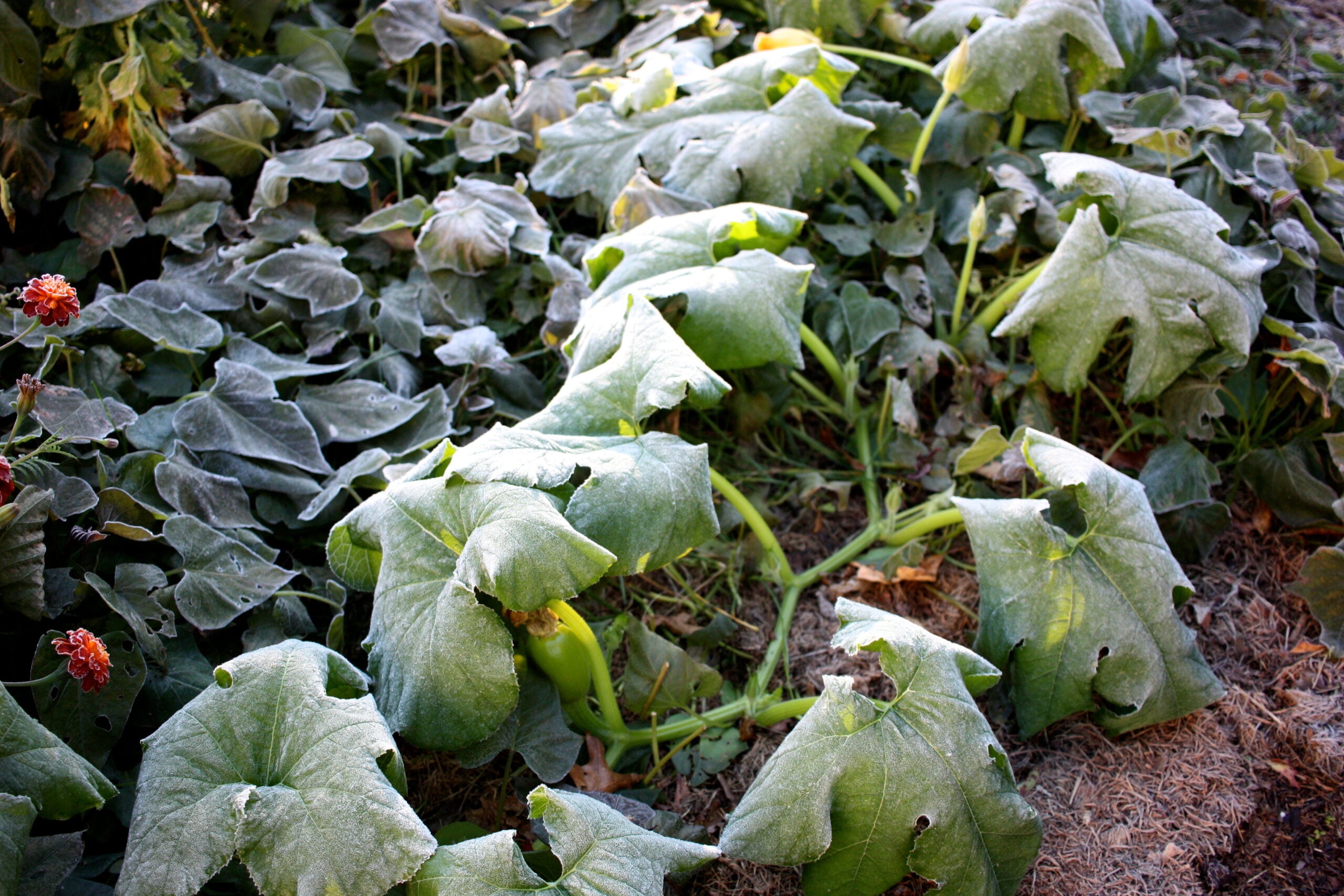
- Water-soaked foliage: Leaves look dark, wet, and translucent. It is the first sign of cell membrane rupture.
- Dark green or black discoloration: Stems and leaves turn an unnaturally dark shade as cellular fluids leak and oxidize.
- Limp, drooping stems: Damaged tissue loses turgor pressure and cannot support its own weight.
- Curled or wilted leaves: Leaf edges curl inward, or the entire leaf hangs limp, even if soil moisture is adequate.
Delayed Visual Cues
Some frost damage takes 48 to 72 hours (or longer) to fully reveal itself:
- Crispy, brown necrotic tissue: Once the water-soaked appearance dries out, affected areas turn papery brown; it is dead tissue.
- Stem splitting or bark cracking: In woody plants, expanding ice can crack bark and split stems, often not visible for days or weeks.
- Crown and root damage in perennials: Below-ground injury may show up as delayed spring growth or uneven emergence weeks later.
Do not rush your assessment. Waiting at least 3 to 5 days before making replanting or pruning decisions gives you a more accurate picture.
Crop-Specific Impacts: How Frost Affects Major Agricultural Yields
Frost does not treat all crops equally. Your response plan should be built around the specific vulnerabilities of what you grow and how common crop diseases and prevention strategies intersect with frost risk.
Agronomic Row Crops: Frost Damage on Corn and Soybeans
Corn and soybeans respond to frost damage very differently due to one key anatomical distinction: the location of their growing point.
Corn frost damage depends heavily on the growth stage. The growing point stays below the soil surface until about V5 to V6, roughly 3/4 inch underground. Early-season frost damage to emerged leaves is usually cosmetic since the plant can regrow as long as the growing point is intact. Corn younger than V5 can tolerate significant aboveground frost damage from single events.
Once the growing point rises above the soil at V6 and beyond, frost can be fatal. Late-season frost during grain fill (R5) halts starch accumulation and reduces test weight. As per reports, frost damage to plants shorter than 6 inches can reduce yield by 9 to 15%.
Frost damage in soybeans is a different story. The soybean growing point is exposed above the soil the moment cotyledons emerge. Studies suggest that soybeans at VE to VC can tolerate 29 to 30°F briefly, but once trifoliate leaves emerge (V1, V2), damage occurs at or below 32°F.
Soybeans do have multiple axillary buds. If the main growing point dies but tissue above the cotyledonary node survives, new shoots can emerge. However, this regrowth delays maturity and cuts yield.
Key takeaway: For corn, early frost is usually survivable. For soybeans, even minor frost at emergence demands a stand assessment 3 to 5 days later.
High-Value Produce: Tomatoes and Frost Damage
Tomatoes are among the most frost-sensitive commercial crops you can grow. Understanding tomato frost damage thresholds is critical for both open-field and high-tunnel operations.
As a warm-season nightshade, tomatoes have zero tolerance for freezing. Tomatoes do not tolerate freezing below 32°F and can show damage from frost at temperatures as high as 36°F. A hard freeze at 28°F or below for more than a couple of hours kills the plant outright.
Even non-lethal cold stress below 50°F causes stunted growth, blossom drop, pitted fruit, and blotchy ripening that makes produce unmarketable. High-tunnel operations offer some protection but are not immune on clear, calm nights. Layering row covers inside tunnels and using soil thermal mass helps. For growers looking to leverage technology, IoT-powered crop health monitoring can provide real-time temperature alerts before damage occurs.
Commercial Nurseries: Frost Damage on Trees and Shrubs
Nursery stock faces unique frost risks that can cause losses you will not see for weeks or months.
Bark splitting in saplings is one of the most costly forms of tree frost damage. When water in the bark and cambium freezes, it expands and cracks the trunk. Young trees with thin bark (maples, cherries, ornamental pears) are especially vulnerable. The crack may not appear until the bark dries and separates in spring.
Bud kill in fruit trees can wipe out an entire season’s production without killing the tree. Apple and stone fruit buds are most vulnerable during the pink-to-bloom stage, when temperatures below 28°F destroy open flowers. The timing of frost relative to bud development matters enormously.
Boxwood frost damage is a particular concern for ornamental nurseries. Evergreens do not drop their leaves, so damage shows up as delayed foliar bronzing or tip dieback weeks later. The foliage turns reddish-brown as cells die, and heavily damaged branches may not leaf out the following spring.
For nursery managers tracking large inventories of freeze-damaged plants, digital record keeping in agriculture helps document damage by block, species, and severity for insurance claims and replanting planning.
Critical Temperature Thresholds for Crops
Knowing the exact lethal temperature for your crop at its current growth stage is essential for making real-time frost protection decisions. Here is a quick-reference table based on university extension data.
| Crop Type | Growth Stage | Critical Temperature |
| Corn | V2 (two visible leaf collars) | 28°F (-2°C) for several hours |
| Corn | R5 (dent stage/grain fill) | 28°F (-2°C) |
| Soybeans | VE to VC (emergence) | 29-30°F (-1 to -2°C) |
| Soybeans | V1-V2 (trifoliate stage) | 32°F (0°C) |
| Field Tomatoes | Any stage | 32°F (0°C); hard freeze at 28°F (-2°C) |
| Orchard Blooms | Full bloom | 28°F (-2°C) |
| Boxwood | Active growth/winter exposure | 0 to -10°F (-18 to -23°C) depending on cultivar |
Note: These thresholds assume sustained exposure (typically 2+ hours). Brief dips may not cause lethal damage, but can still reduce yield or compromise quality. Cross-reference with your local extension office for region-specific guidance.
Proactive Agronomy: How to Prevent Frost Damage on Plants
You cannot control the weather. But you can control how prepared your operation is when frost hits. Here is how to prevent frost damage on plants on a commercial scale.
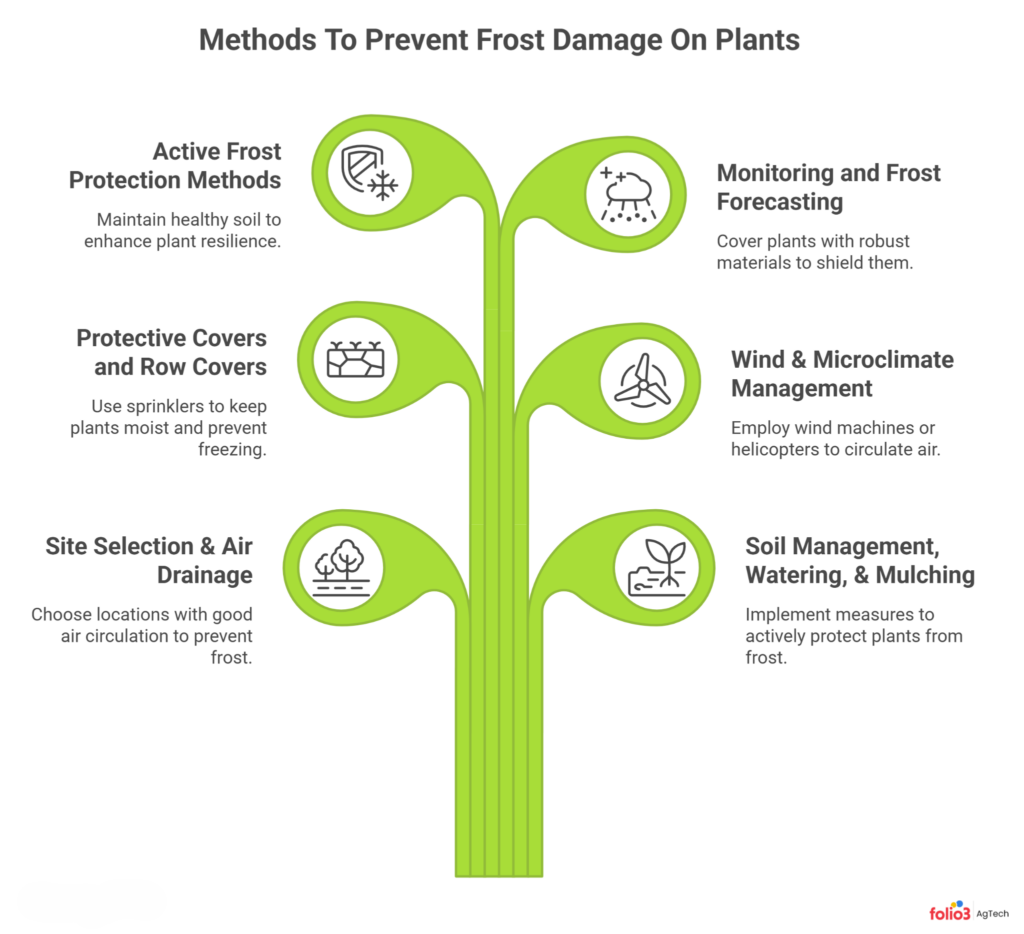
Site Selection and Air Drainage
Prevention starts before you plant. Cold air is denser than warm air, so it flows downhill and pools in low-lying areas called “frost pockets.” Avoid these depressions when selecting field sites. Slopes with good air drainage let cold air move away naturally. Even a 2 to 3% grade makes a real difference.
Use farm mapping software to identify elevation changes and historically cold zones across your operation.
Soil Management, Watering, and Mulching
Your soil is a heat battery. Bare, moist soil absorbs more solar energy during the day and radiates it back at night, keeping the air near your crops warmer. Weed-covered or heavily mulched soil does the opposite by insulating the surface and trapping less heat.
Before a forecasted freeze, irrigate fields to increase thermal mass. Temporarily pull back heavy mulch from frost-sensitive crops. For row crops, a clean, compact soil surface provides a few extra degrees of ground-level warmth. These practical ways to improve soil fertility also strengthen long-term soil health alongside frost resilience.
Protective Covers and Row Covers
Floating row covers made from spunbond polypropylene are among the most cost-effective frost protection tools available. Depending on fabric weight, they provide 2 to 8°F of insulation by trapping radiated heat near the canopy.
For large-scale specialty vegetable growers, heavy-duty covers work well over high-value crops like tomatoes, peppers, and strawberries. Deploy them before temperatures drop and secure edges tightly so cold air cannot seep underneath. In greenhouse farming and high-tunnel operations, adding an internal row cover layer doubles protection on the coldest nights without major added cost.
Windbreaks and Microclimate Management
Strategic windbreaks, whether tree lines, hedgerows, or engineered barriers, reduce wind speed and modify field-level microclimates. This is especially valuable against advective frosts where cold air moves horizontally across open terrain.
Windbreaks need careful planning. A barrier at the bottom of a slope traps cold air and worsens frost pockets. Position them perpendicular to prevailing cold winds and leave gaps for drainage. Over time, use field temperature data to refine placement and maximize the warming effect on vulnerable blocks.
Active Frost Protection Methods
When passive strategies are not enough, these commercial-grade systems deliver direct crop protection:
- Overhead Sprinkler Irrigation: As water freezes on plant surfaces, it releases latent heat (about 144 BTUs per pound). That energy holds tissue at or near 32°F even as air drops below freezing. Continuous application is critical, as stopping before the ice melts triggers evaporative cooling that worsens damage.
- Wind Machines and Helicopters: On radiative frost nights, a warm inversion layer sits 30 to 50 feet above ground. Wind machines pull warmer air down, raising surface temperatures by 2 to 4°F. Helicopters cover more area but suit only the highest-value crops.
For operations managing crop stress factors across multiple fields, combining sprinklers with wind machines gives layered protection against both radiative and moderate advective events.
Monitoring and Frost Forecasting
The best protection system is useless if you activate it too late. Modern agriculture sensors placed at the canopy level across your fields tell you exactly when and where cold air settles. Pair that data with automated alerts, and you can trigger sprinklers or wind machines before temperatures hit critical thresholds.
Go beyond basic weather station readings. Ground-level temperatures can run 3 to 5°F colder than stations measure at 4 to 5 feet. Canopy-level monitoring gives you the real numbers your crops experience. Integrating sensor data with smart farming technology platforms lets you automate responses and build historical frost maps that improve planning season after season.
Post-Freeze Triage: Managing Freeze-Damaged Plants
The frost has hit. Now what? How you respond in the first few days determines whether you salvage a partial crop or compound your losses.
Patience Is Key
Do not walk your fields the morning after and make snap decisions. According to Iowa State University Extension, you should wait 48 to 96 hours before assessing plant stand survival. Tissue that looks dead on Day 1 may recover by Day 3, and tissue that seems okay initially may turn necrotic as cells collapse.
Replanting Decisions for Row Crops
Before you replant, do the math. Not every damaged stand justifies the cost:
- Assess stand counts: Walk multiple transects across the field, especially in low spots where frost damage is worse. Count surviving plants per row.
- Calculate the yield potential of the existing stand vs. replanting: A late-planted crop may yield less than a damaged but partially surviving early-planted stand. Good yield potential (roughly 90%) still exists when stands are reduced by up to 20%, as long as surviving plants are somewhat uniformly distributed.
- Factor in replanting costs: Seed, fuel, labor, and the yield penalty of later planting all add up. Keeping a damaged stand with 75 to 80% survival is often the better economic choice.
For growers who rely on data-driven decisions, crop yield prediction using AI can help model the yield impact of a damaged stand vs. replanting scenarios.
Pruning Rules for Trees and Nursery Stock
For nursery owners and orchardists, resist the urge to prune right away:
- Wait until spring growth resumes before cutting dead wood. New growth shows you exactly where living tissue ends.
- Premature pruning exposes fresh cuts to further cold events, compounding the damage.
- Boxwood frost damage requires patience. Foliar bronzing may look severe, but many cultivars push new growth from interior buds once temperatures stabilize.
Document all damage with photos, dates, and GPS locations for crop insurance claims and future agricultural productivity planning.
Conclusion and Next Steps for Growers
Frost damage on plants is one of the few risks where proactive planning directly translates into dollars saved. You cannot stop a cold front, but you can choose better sites, deploy monitoring technology, have protection systems ready, and make smart recovery decisions.
Start by reviewing your operation’s frost risk profile, identifying vulnerable crops and fields, and building a response plan before the next freeze forecast hits.
Ready to take the next step? Explore our crop management software to track field conditions and frost risk across your operation, or book a free consultation with our experts for a personalized farm risk assessment powered by data-driven Agtech solutions.
FAQs
Can Frost Damage Occur Above 32°F?
Yes. Ground-level frost can form even when air temperature readings (measured at 4 to 5 feet) show 35 or 36°F. Cold air settles near the soil surface, so canopy-level temperatures are often several degrees colder than what weather stations report.
How Does Frost Damage Differ From Herbicide Injury?
Frost damage appears overnight and affects the entire exposed canopy uniformly, with water-soaked tissue as the hallmark. Herbicide injury develops gradually, often shows cupped or twisted leaves, and affects specific plant parts rather than everything at once.
Is Frost Damage Covered by Federal Crop Insurance?
Most federal crop insurance policies through the USDA Risk Management Agency cover frost and freeze losses. Between 2001 and 2022, freeze-related indemnity payments in the U.S. totaled $4.7 billion. Coverage depends on your policy type and level, so verify details with your crop insurance agent.
Do Row Covers Work for Large-Scale Field Crops Like Corn?
Row covers are generally not practical for large-acreage commodity crops like corn and soybeans due to deployment cost and labor. They work best for high-value specialty crops like tomatoes, peppers, and strawberries, where per-acre revenue justifies the investment.
How Soon After a Frost Can You Apply Foliar Fertilizers or Pesticides?
Wait until damaged tissue has fully dried and new growth is visible. Applying chemicals to water-soaked or necrotic tissue wastes product and can cause phytotoxicity. A minimum wait of 5 to 7 days is generally recommended.