

The agriculture industry is at a crossroads. From volatile weather and declining soil health to crippling labor shortages and rising input costs, the issues in agriculture today are more complex and more urgent than at any point in modern history. Whether you’re managing a 50-acre family operation or steering a large-scale agribusiness, these agriculture problems don’t just affect your bottom line; they shape the future of global food security.
But here’s the good news: for every challenge, there’s a proven or emerging solution. This guide walks you through the most pressing current issues in agriculture, breaks down the environmental, economic, and ethical dimensions of each. For solutions, we show you exactly how integrated technology and smarter management practices are helping forward-thinking producers stay ahead. Let’s dig in.
The Current State of the Industry: Why Agriculture Issues Today Matter More Than Ever
The agricultural sector is under immense, compounding stress. Shifting demographics, geopolitical instability, trade disruptions, and unpredictable climates are converging in ways that directly threaten farm-level profitability and global food production.
The U.S. farm sector debt was forecast to rise to $386.4 billion in 2025, with farm bankruptcies accelerating; 181 cases were filed in just the first half of 2025. Meanwhile, two years of declining commodity prices combined with stubbornly high production costs have squeezed profit margins for staple crops like corn, soybeans, and wheat.
Meanwhile, input costs, especially for fertilizer and energy, have remained elevated even as farm gate prices have softened. Trade tensions have disrupted key export markets, particularly with China. Historically, the top buyer of U.S. soybeans was purchasing no soybeans at all from the United States in September 2025.
At the macro level, agriculture, forestry, and other land use account for roughly 22% of total global greenhouse gas emissions, which puts the sector squarely at the center of climate policy debates.
For producers, investors, and policymakers alike, ignoring these ag issues isn’t a viable strategy. The question is no longer whether agriculture must change; it’s how fast you can adapt.
What Are the 10 Problems of Agriculture?
Every farming operation faces unique hurdles, but certain agricultural problems cut across regions and scales. Here are the 10 most critical problems in agriculture today:
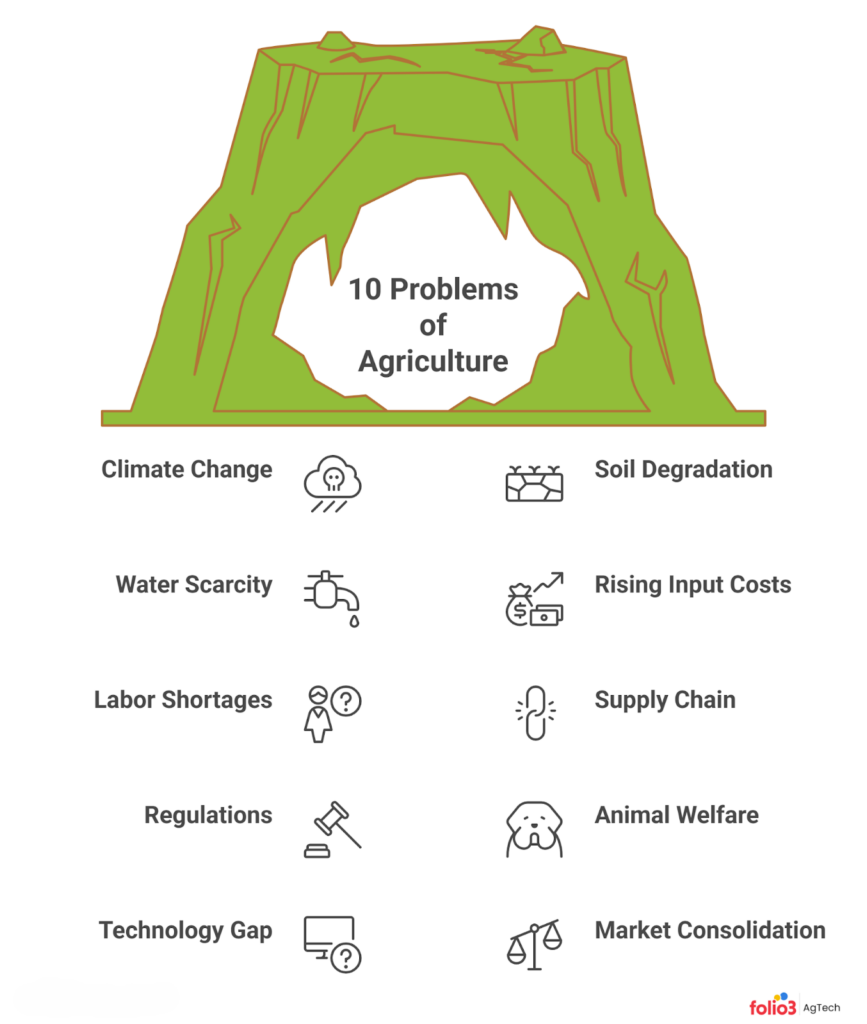
1. Climate Change and Extreme Weather
Unpredictable weather patterns, such as droughts, floods, and unseasonal frosts, are disrupting planting schedules and decimating yields worldwide. Moderate drought stress alone can reduce wheat yields by 50–60%.
2. Soil Degradation and Erosion
The FAO estimates that 33% of global soils are already moderately to highly degraded, with the planet losing an estimated 24 billion tons of fertile soil every year. Without intervention, over 90% of the Earth’s soils could be degraded by 2050.
3. Water Scarcity and Drought Management
Agriculture accounts for approximately 70% of all global freshwater withdrawals, yet water availability is declining in many key producing regions due to overuse and climate variability.
4. Rising Input Costs (Fertilizers, Energy)
From fertilizer to fuel to machinery parts, production expenses remain elevated. U.S. agriculture experienced a 25.5% decline in net farm income in 2023, largely driven by record-high production costs.
5. Severe Farm Labor Shortages
The average age of the U.S. farmer is now 58.1 years, according to the 2022 Census of Agriculture. There are four times as many producers aged 65+ as there are under 35, and an estimated 40% of the farm workforce lacks legal work authorization.
6. Supply Chain Volatility and Food Waste
Trade disputes and climate events worsened disruptions to logistics, cold chains, and distribution networks. It led to significant post-harvest losses and retail food price spikes.
7. Stricter Government Regulations and Policies
Evolving EPA mandates, Farm Bill complexities, and new environmental compliance requirements burden producers. It especially impacts small and mid-sized operators, with rising administrative costs.
8. Animal Welfare and Ethical Scrutiny
Consumer demand for transparency and humane farming practices is reshaping livestock production. It is pressuring producers to move away from confined animal feeding operations (CAFOs).
9. The Technology Integration Gap
Despite proven ROI, many farms, particularly smaller operations, lack the capital, infrastructure, or technical know-how to adopt precision agriculture tools effectively.
10. Market Consolidation and Farm Debt
Large corporate operations increasingly dominate market share, while family farms face mounting debt. Total farm sector debt was projected at $386.4 billion in 2025, with interest costs rising over 17% since 2023.
Environmental Issues in Agriculture: Battling the Elements
The environmental toll of modern farming is real, but so are the solutions. Here’s how agricultural environmental issues break down across the three biggest fronts.
Water Scarcity and Drought
Water is the lifeblood of every agricultural operation, and it’s becoming scarcer by the season. According to the U.S. Drought Monitor (drought.gov), drought conditions continue to affect major agricultural regions across the western and southern United States, with devastating consequences for crop irrigation and livestock watering. Globally, agriculture consumes about 70% of all freshwater withdrawals, and in many regions, aquifers are being drawn down faster than they can recharge.
For you as a producer, this means investing in smart irrigation technologies is no longer a luxury; it’s a survival strategy. IoT-enabled soil moisture sensors paired with AI-driven scheduling can cut water use by up to 50% while maintaining or improving yields.
Soil Health and Biodiversity Loss
Healthy soil is the foundation of productive agriculture, but decades of intensive monoculture, over-tillage, and chemical-heavy management have taken a toll. A landmark 2025 FAO State of Food and Agriculture report found that 1.7 billion people worldwide live in areas where crop yields are 10% lower due to human-induced land degradation. The UN Convention to Combat Desertification (UNCCD) reports that the world loses at least 100 million hectares of healthy, productive land each year, an area twice the size of Greenland.
The shift toward regenerative agriculture practices like cover cropping, reduced tillage, and diverse crop rotations is gaining momentum. Producers who invest in soil health today are building the biological capital that will sustain yields for decades. Integrating data analytics into your soil management strategy can help you monitor organic carbon levels, detect nutrient imbalances, and tailor interventions field by field.
Greenhouse Gas Emissions
Agriculture’s carbon footprint is significant and growing more scrutinized. The agriculture sector accounted for 10.5% of total U.S. greenhouse gas emissions in 2022, with enteric fermentation from cattle representing over a quarter of that total. Globally, agriculture, forestry, and other land use contribute roughly 22% of total emissions.
Methane from livestock operations and nitrous oxide from synthetic fertilizer application are the two largest agricultural contributors. However, the same data shows that U.S. dairy farmers have increased milk output by 53% since 1990 while cutting enteric emissions per unit of production by 26%. It is proof that productivity and sustainability can go hand in hand. Climate-smart agriculture strategies such as precision fertilization, improved manure management, and methane-capture technologies offer clear pathways to reduce your operation’s footprint.
Economic and Social Issues in Agriculture: The Human Element
Behind every yield statistic is a farmer making tough decisions under pressure. Here’s how economic and social issues in agriculture are reshaping the business of farming.
The Labor Crisis and Aging Farmers
The farm labor shortage is one of the most pressing agricultural problems faced by farmers today. The 2022 USDA Census of Agriculture reveals that the average age of U.S. producers is 58.1 years, with four times as many farmers over 65 as under 35. The workforce pipeline is drying up: younger generations are gravitating toward urban careers. An estimated 40–45% of the farm labor force consists of undocumented workers whose availability is increasingly uncertain under tighter immigration enforcement.
Labor costs have surged correspondingly, forecast to exceed $53 billion across the U.S. agriculture industry in 2025. For specialty crop producers, labor can consume up to 40% of total production expenses. Autonomous tractors, robotic harvesters, and AI-powered agricultural solutions are emerging as essential tools to bridge the labor gap, not as replacements for your team, but as force multipliers.
Profit Margin Squeeze
If you’re a crop farmer, you’ve likely felt the pain firsthand: commodity prices have dropped roughly 40% from their 2022 peaks. Yet, input costs for fertilizer, fuel, seed, and interest on operating loans have remained stubbornly high. The average effective tariff rate on agricultural inputs jumped from 1% to 12% by August 2025, with pesticides, tractors, and machinery facing the steepest increases.
The net result? Net farm income excluding government support was essentially flat in 2025, and only disaster relief authorized by Congress prevented a sharper decline. For many producers, choosing the right financial management tools has become just as critical as choosing the right seed variety.
Rural Infrastructure and Connectivity
The promise of precision agriculture falls flat without reliable internet connectivity, and that’s the reality for many rural producers. The digital divide prevents farms in remote areas from leveraging cloud-based analytics, real-time sensor data, or even basic online market access.
When 68% of large-scale farms are already using precision ag technologies but rural broadband remains spotty, the gap between early adopters and those left behind only widens. Investments in rural broadband infrastructure and offline-capable farm management platforms are essential to ensuring that the benefits of agricultural technology reach every operation, regardless of zip code.
The Ethical Frontier: Animal Issues in Agriculture
Consumer expectations are evolving fast, and animal welfare is no longer a niche concern. Here’s what’s driving the ethical shift in animal agriculture.
Rising Consumer Demand for Transparency
Today’s consumers, especially Millennials and Gen Z, want to know where their food comes from and how animals were treated. Retail trends show that products labeled free-range, grass-fed, or humanely raised consistently command premium pricing. For livestock producers, this isn’t just a moral imperative; it’s a market opportunity.
The Shift Away from CAFOs
Confined animal feeding operations are facing increasing regulatory pressure and public backlash. Several states have enacted or proposed legislation restricting gestation crates, battery cages, and other intensive confinement practices. The push for cage-free, pasture-raised, and certified-humane standards is accelerating, and the market is following.
Traceability in the Livestock Supply Chain
From farm to fork, stakeholders demand full visibility into the lifecycle of animal products. Smart collars, biometric monitoring, and predictive AI now enable producers to track individual animal health in real time. They help detect disease early and demonstrate welfare compliance with verifiable data. Implementing integrated livestock management solutions positions you to meet these expectations while simultaneously improving herd health and operational efficiency.
Antibiotic Stewardship
The overuse of antibiotics in livestock is under heavy scrutiny from both regulators and consumers. Proactive health monitoring through wearable sensors, predictive analytics, and a reliable reading trauma service helps you reduce reliance on antibiotics. These solutions catch health issues before they become outbreaks, protecting both your herd and your market access.
Navigating Red Tape: Agriculture Policy Issues
Policy complexity is a silent cost center for producers. Here’s where the regulatory landscape stands and how it’s affecting your operation.
The Farm Bill and Subsidy Distribution
The Farm Bill remains the single most consequential piece of legislation for U.S. agriculture. It governs everything from commodity support and crop insurance to conservation programs and nutrition assistance. Ongoing debates over funding allocation, eligibility criteria, and subsidy caps create prolonged uncertainty for producers trying to plan multi-year investments. Therefore, staying informed and engaged in the legislative process is essential for protecting your interests.
Environmental Compliance Burden
New and evolving EPA regulations around nutrient runoff, pesticide use, greenhouse gas reporting, and water quality standards impose significant compliance costs on small-to-medium operators who lack dedicated regulatory teams. The complexity of overlapping federal, state, and local requirements can make compliance feel like a moving target. To navigate this, agriculture regulatory compliance software is helping crop input companies manage everything from EPA registrations to state licensing under one roof. To navigate this, agriculture regulatory compliance software is helping crop input companies manage everything from EPA registrations to state licensing under one roof.
Trade Policy and Tariff Volatility
Effective tariff rates on agricultural inputs have increased dramatically from near-zero to 16% on tractors and 20%+ on pesticides and herbicides. Retaliatory tariffs from trading partners further disrupt export markets, creating a policy environment where your cost structure can shift overnight.
The challenges of contemporary agriculture demand that producers become as literate in policy as they are in agronomy. Engaging with industry associations, leveraging compliance management tools built into modern agriculture ERP systems, and building flexibility into your business plan are non-negotiable strategies for navigating the regulatory maze.
Agricultural Problems and Solutions: How Agtech Is Bridging the Gap
Technology won’t solve everything, but it’s the closest thing to a force multiplier that modern agriculture has. Here’s how the right agricultural problems and solutions match up.
While the challenges of precision agriculture are real, including high initial costs, data silos, interoperability issues between equipment brands, and a steep learning curve for some operators, the return on investment increasingly justifies the leap. The farms that thrive in 2026 and beyond will be those that treat technology as a strategic asset, not an afterthought. The key is starting with the problems that cost you the most and matching them with proven technology solutions for agriculture that deliver measurable ROI.
| Agriculture Problem | Traditional Impact | Agtech / Modern Solution | Expected Benefit & ROI |
| Water Scarcity | Blanket irrigation, water waste, lower yields | IoT soil moisture sensors, AI-driven drip irrigation | Up to 30% water savings, optimized crop health |
| Labor Shortages | Unharvested crops, operational bottlenecks | Autonomous tractors, robotic harvesters | Reduced reliance on manual labor, 24/7 operations |
| Rising Input Costs | Over-application of expensive fertilizers | Precision agriculture (Variable Rate Technology) | Lower chemical costs, reduced environmental runoff |
| Animal Welfare | Reactive health management, disease spread | Smart collars, biometric monitoring, predictive AI | Early disease detection, improved herd welfare |
| Supply Chain | High spoilage rates, lack of traceability | Blockchain tracking, cold-chain IoT sensors | Farm-to-fork transparency, reduced food waste |
Table: Mapping Modern Problems to Agtech Solutions
Why Integrated AgTech Drives Smarter Decisions
What sets successful operations apart isn’t just adopting individual tools; it’s integrating them into a connected ecosystem. When your IoT sensors feed data into your farm management platform, and that platform connects to your financial software and compliance records, you stop managing by instinct and start managing by insight. Moreover, precision agriculture isn’t a product; it’s a mindset shift. The role of drones in modern farming, paired with satellite imagery and big data analytics, exemplifies how these tools work best when deployed as an interconnected system.
How VRT Delivers Measurable ROI
Consider the practical example of a mid-sized grain operation struggling with rising fertilizer costs. By deploying Variable Rate Technology (VRT) guided by soil sampling data, the operation can apply nutrients precisely where needed. It reduces over-application in high-fertility zones and boosts inputs in depleted areas. The result is often a 15–20% reduction in fertilizer spend with no yield penalty. Multiply that across thousands of acres, and the savings dwarf the initial technology investment.
Using Data to Shift from Reactive to Proactive Operations
The same principle applies to livestock operations. Producers using biometric sensors and predictive health analytics report earlier disease detection, lower veterinary costs, and reduced mortality rates. When these animal health data feeds integrate with your breeding, feeding, and compliance records through a unified agriculture software platform, you gain operational visibility that transforms reactive management into a proactive strategy.
Looking Ahead: Agriculture Industry Major Issues for 2026 and Beyond
Adaptability is the new currency in farming. The producers who will lead in 2026 and beyond are those who treat data as a strategic asset and invest in workforce development alongside automation. They build operations that can flex with volatile markets and shifting policy landscapes. The convergence of AI, IoT, robotics, and sustainable crop production practices is creating opportunities for those willing to move decisively.
For agribusiness decision-makers and investors, the window to adopt integrated technology solutions is narrowing. Operations that digitize now will be positioned to outperform those still relying on disconnected spreadsheets and gut decisions. The cost of inaction isn’t stagnation; it’s falling behind in a sector where margins reward the efficient and punish the slow. Ready to automate and digitize your farm operations with a single use case of a full-fledged ERP deployment? Book a free consultation with our Agtech experts to discover how you can overcome the current Ag issues.
FAQs
How Is Climate Change Expected to Impact Global Crop Yields by 2030?
Climate projections indicate that rising temperatures and erratic rainfall could reduce yields of staple grains by 10–25% in vulnerable regions by 2030. Producers investing in drought-tolerant varieties and precision irrigation are better positioned to mitigate losses.
What Role Does Blockchain Play in Solving Agriculture Supply Chain Issues?
Blockchain creates an immutable, transparent ledger of every transaction from field to consumer. It eliminates traceability gaps, reduces fraud, and enables producers to demonstrate compliance with sustainability and food safety certifications at the click of a button.
Can Small Farms Afford Precision Agriculture Technology?
Yes. Entry-level precision tools like soil sensors, weather-tracking apps, and cloud-based farm management platforms start at modest price points. Government grants, equipment-sharing cooperatives, and subscription-based software models are making adoption increasingly accessible.
How Are Tariffs Currently Affecting U.S. Agriculture in 2025–2026?
Effective tariff rates on agricultural inputs have jumped from 1% to 12% on average, with herbicides and machinery hit hardest. Retaliatory tariffs from trading partners have disrupted soybean and grain export markets, adding cost pressure on both sides of the ledger.
What Is Regenerative Agriculture and How Does It Address Soil Degradation?
Regenerative agriculture focuses on rebuilding soil organic matter through practices like cover cropping, no-till farming, and diverse rotations. These methods restore soil structure, improve water retention, and sequester atmospheric carbon, reversing decades of degradation.
How Are Autonomous Farming Machines Addressing Labor Shortages?
Autonomous tractors and robotic harvesters use GPS, computer vision, and AI to operate continuously without human operators. These machines don’t replace your team; they allow fewer workers to manage larger acreages while handling repetitive, physically demanding tasks.
What Upcoming Policy Changes Should Farmers Prepare for in 2026?
Producers should monitor Farm Bill reauthorization timelines, potential H-2A visa program reforms, evolving EPA greenhouse gas reporting requirements, and trade policy shifts that could alter export market access and input costs.