
The feedlot industry operates on a delicate balance of efficiency, animal welfare, and environmental responsibility. Yet, numerous challenges threaten to disrupt this equilibrium. Feedlot operators face many hurdles, from managing vast herds to complying with stringent regulations.
Folio3 Agtech Feedlot Management Software offers a comprehensive platform to tackle these challenges head-on. Through data-driven insights and automation, Folio3 empowers feedlot management to make informed decisions, optimize resource utilization, and achieve operational excellence.
Keep reading this blog to explore the top 10 challenges confronting feedlot operators and how Folio3 Agtech feedlot management software can provide solutions.
Overview of Feedlot Management
Feedlot management is the systematic oversight of cattle during their finishing phase before slaughter. It involves a complex interplay of factors, including animal nutrition, health, and welfare, as well as operational efficiency and environmental stewardship.
Feedlot managers are responsible for optimizing cattle growth, maximizing weight gain, and ensuring the production of high-quality beef. This entails meticulous planning, execution, and monitoring of various aspects, such as feed formulation, herd health, and facility maintenance.
The modern feedlot industry has witnessed significant advancements in technology and management practices. While traditional methods still form the foundation, the integration of data-driven insights and automation is becoming increasingly prevalent. This shift towards precision agriculture and digital tools is transforming how feedlots operate.
The Role of Feedlots in the Beef Supply Chain
Feedlots sit between the cow-calf or stocker phase and the packing plant. Calves typically arrive weighing 600 to 900 pounds and spend 120 to 200 days on feed, depending on frame size and genetics.
During this finishing phase, cattle in a feedlot consume a high-energy, grain-based total mixed ration (TMR) designed to add muscle and intramuscular fat (marbling) that determines USDA quality grades like Choice and Prime.
Grass-Fed vs. Grain-Finished
Most beef cattle in the U.S. are technically grass-fed for the majority of their lives, since calves spend months on pasture before entering a feedlot. The distinction lies in the finishing phase.
Grain-finished cattle receive a ration heavy in corn, barley, or sorghum during the final months, which accelerates fat deposition and produces the consistent marbling and tenderness consumers expect.
Grass-finished cattle remain on forage through harvest, often resulting in leaner carcasses with a different flavor profile. Feedlots exist because grain finishing is the most efficient way to bring cattle to market-ready condition in a predictable timeframe.
Core Cattle Feedlot Requirements and Facility Design
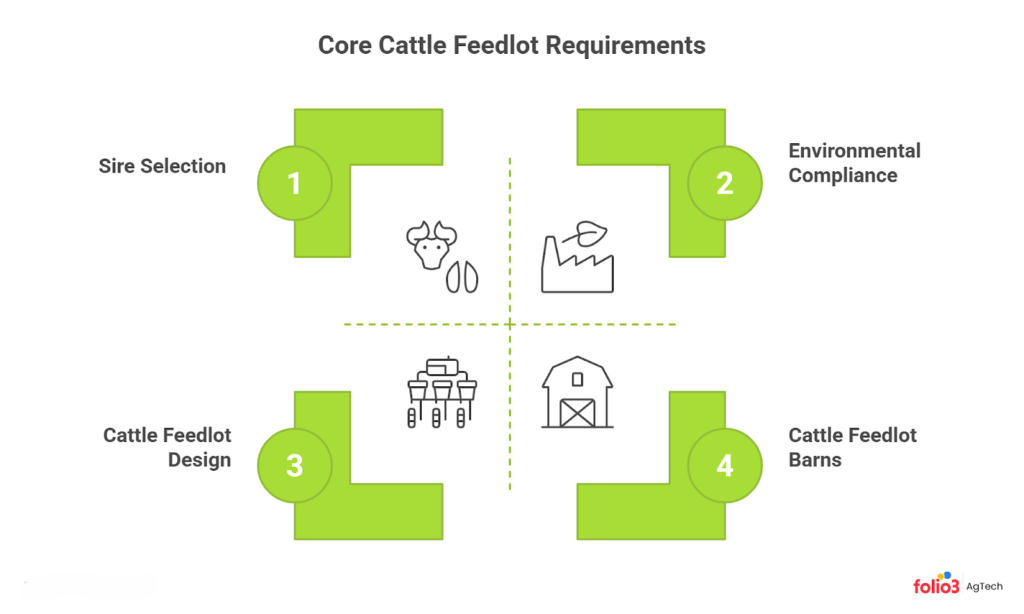
Getting your infrastructure right from the start prevents costly fixes later. Whether you are building new or retrofitting an existing operation, your cattle feedlot design should prioritize animal comfort, operational flow, and environmental compliance. If you are evaluating the full scope of challenges in feedlot management, facility design is where many of them either start or get solved.
Site Selection and Environmental Compliance
Your site is the foundation of everything. Choose a location with natural drainage away from pens, a slope of 4% to 6%, and adequate separation from residences and waterways to meet state environmental regulations. Meanwhile, feedlots with 300 or more animal units generally must register with their state environmental agency. Larger operations may need a National Pollutant Discharge Elimination System (NPDES) permit.
Use catch drains, diversion banks, and retention basins to control stormwater runoff. Poor drainage is the single biggest infrastructure failure in feedlots; it creates mud, increases disease risk, and tanks performance. For more on environmental stewardship in your feedyard, explore practical manure management strategies that keep you compliant and your pens clean.
Small Cattle Feedlot Design vs. Commercial Scale
A small cattle feedlot design for 500 head looks different from a 10,000-head commercial feedyard. Smaller operations often use simpler pen layouts with shared alleys, manual feeding with a mixer wagon, and portable panels. A commercial feedlot requires dedicated feed roads, multiple-row pen designs, large-capacity feed mills, and heavy equipment for daily pen maintenance.
However, the core cattle feedlot requirements remain the same regardless of scale: adequate pen space, sufficient bunk space, clean water, proper drainage, wind shelter, and a functional handling facility. Getting these fundamentals right is also the starting point for maximizing feedlot efficiency once cattle are on feed.
Cattle Feedlot Barns: Indoor vs. Outdoor Setup
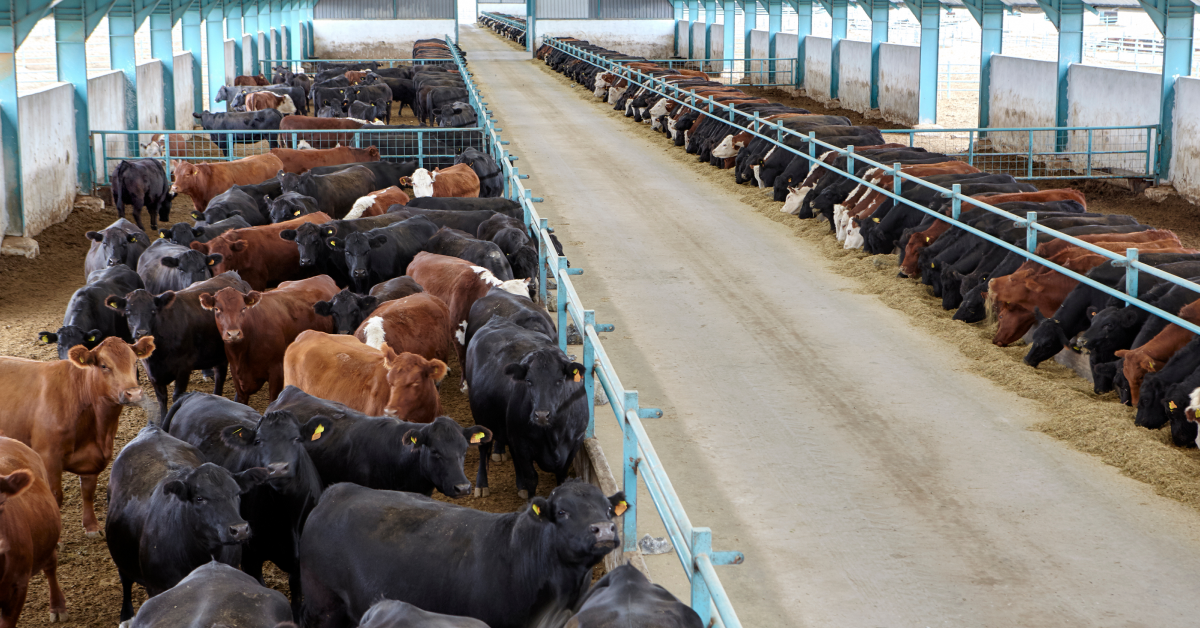
Open-air dirt lots with mounds and windbreaks are the most common feedlot setup in the Southern Plains and drier climates. They cost less to build, but performance suffers when mud accumulates. Indoor cattle feedlot barns, including slatted-floor confinement facilities, are more common in the Upper Midwest. They keep cattle cleaner, but come with higher construction costs and require careful ventilation.
Enclosed barns for finishing cattle should provide a minimum of 35 square feet per head, while open lots with good drainage typically require 250 to 350 square feet per head. The right choice depends on your climate, budget, and long-term operational goals.
Standard Feedlot Space Allocation Metrics
| Metric | Calves (500–700 lbs) | Yearlings (700–1,300 lbs) |
| Pen Space (Open Lot) | 250 sq ft/head | 250–350 sq ft/head |
| Pen Space (Enclosed Barn) | 20–25 sq ft/head | 30–35 sq ft/head |
| Bunk Space | 18–24 in/head | 24–30 in/head |
| Water Trough Space | 1–2 linear in/head | 1–2 linear in/head |
Top 10 Challenges in Feedlot Management and How Feedlot Software Can Solve Them
Managing feedlots involves navigating complex challenges that impact operational efficiency and profitability. Folio3 Agtech Feedlot Management Software provides a comprehensive suite of tools to address these critical challenges. The software integrates various features to streamline operations, improve efficiency, and enhance productivity.
Here’s how it tackles each of these challenges in feedlot management:
1. Data Management and Record Keeping
Challenge
Feedlots generate vast amounts of data daily, including information on animal health, feed usage, and financial transactions. Manually tracking and managing this data can lead to inaccuracies and is time-consuming.
Solution
The Folio3 Agtech software offers a robust digital record-keeping system that eliminates the need for manual data entry. Centralizing data collection and storage ensures accuracy and reduces human error.
Users benefit from easy data retrieval and improved decision-making capabilities. The integration of automated data management simplifies complex tasks and enhances overall operational efficiency.
Benefits
By automating data management, businesses achieve improved accuracy in record-keeping, which enhances decision-making. Quick and reliable data retrieval becomes possible, streamlining operations and ensuring that information is readily available for analysis and reporting.
2. Feed and Nutrition Management
Challenge
Optimizing feed composition and ration distribution is essential for animal health and cost efficiency. Incorrect feed ratios can lead to poor growth rates and increased costs.
Solution
Folio3 AgTech’s advanced feed management tools allow precise ration formulation and monitoring. The software provides real-time feed composition and distribution data, ensuring that each animal receives optimal nutrition. This precision leads to better feed efficiency, reduced waste, and significant cost savings.
Benefits
Its enhanced feed efficiency results in better animal growth and reduced feed costs. Accurate rationing helps avoid overfeeding or underfeeding, leading to cost savings and improved overall productivity.
3. Animal Health Monitoring
Challenge
Early detection and management of health issues are crucial for maintaining herd productivity. Delays in identifying diseases can result in higher mortality rates and increased veterinary costs.
Solution
The software includes integrated health management modules that facilitate early detection and management of health issues. Built-in cattle health and treatment tracking lets you log indicators and treatment histories so you can intervene proactively, reduce mortality rates, and stay compliant with health regulations.
Benefits
Real-time monitoring allows proactive health management, allowing timely intervention and treatment. This approach reduces mortality rates, improves compliance with health regulations, and ensures overall herd health.
4. Inventory Management
Challenge
Accurate tracking of feed, medicine, and other inventory items is essential but challenging. Manual inventory management often leads to discrepancies and inefficiencies.
Solution
Folio3’s digitized inventory tracking system provides accurate and real-time updates on feed, medicine, and other inventory items. This automation helps manage inventory levels effectively, minimizes wastage, and controls costs, enhancing overall operational efficiency.
Benefits
Accurate inventory management reduces the risk of stockouts and overstocking, minimizes wastage, and helps control costs. Tracking inventory levels in real time enhances operational efficiency and ensures that resources are always available when needed.
5. Labor Management
Challenge
Efficiently managing labor resources is critical to maximizing productivity and minimizing costs. Poor task allocation and performance monitoring can lead to inefficiencies.
Solution
The labor management features within Folio3 Agtech software optimize task assignments and monitor employee performance. This functionality improves productivity, reduces labor costs, and ensures efficient human resource allocation.
Benefits
Improved labor management leads to increased productivity and reduced labor costs. By optimizing task assignments and monitoring performance, feedlot operations can run more smoothly and efficiently.
6. Compliance with Regulations
Challenge
Navigating and following industry regulations requires constant vigilance and documentation. Compliance in feedlots can be complex and varies by region and regulation.
Solution
The software helps manage compliance with industry regulations by automating reporting and tracking requirements. This streamlines the compliance process, reduces the risk of fines and legal issues, and ensures that all regulatory obligations are met efficiently.
Benefits
Streamlined compliance processes reduce the risk of fines and legal issues. Automated reporting ensures that all regulatory requirements are met efficiently, saving time and reducing the administrative burden.
7. Cost Management
Challenge
Controlling and reducing operational costs is essential for maintaining profitability. Detailed financial insights make it easier to identify areas for cost reduction.
Solution
Folio3’s cost analysis and management tools provide detailed financial insights, enabling businesses to monitor expenses and identify cost-saving opportunities. This leads to better financial planning and increased profitability.
Benefits
Enhanced financial planning and cost control lead to improved profitability. Businesses can make informed decisions that impact their bottom line by analyzing costs and identifying inefficiencies.
8. Environmental Management
Challenge
Managing the climate impact of feedlot operations and ensuring sustainability is increasingly important. Compliance with environmental regulations adds another layer of complexity.
Solution
The software includes features for monitoring and reporting environmental metrics, which support sustainability practices and compliance with environmental regulations. It helps manage the ecological impact of feedlot management operations effectively.
Benefits
Improved sustainability practices and compliance with environmental regulations are achieved. Monitoring and reporting capabilities support efforts to reduce the ecological footprint and enhance environmental stewardship.
9. Market Fluctuations
Challenge
Feedlots must navigate market volatility and fluctuating prices for feed and livestock. Predicting market trends and adjusting strategies accordingly is challenging.
Solution
With market analysis tools and predictive analytics, Folio3 Agtech software provides valuable insights into market trends and price movements. This enables informed decision-making and effective risk mitigation, helping businesses adapt to market volatility.
Benefits
Accurate market insights enable informed decision-making and effective risk mitigation. Businesses can better anticipate market changes, adjust strategies proactively, and stabilize operations.
10. Integration of New Technologies
Challenge
Adapting to and integrating new livestock technologies can be complex and disruptive. Feedlot operations need scalable solutions that evolve with technological advancements.
Solution
Folio3’s scalable and flexible software solutions are designed to integrate new technologies seamlessly. This ensures feedlot management operations can evolve with technological advancements, staying competitive and future-proofing the business.
Benefits
Future-proofing of the feedlot operation will be achieved by adopting scalable technologies. Staying competitive and continuously improving through technology integration in feedlots enhances efficiency and long-term success.
How Folio3 Agtech Helped Progressive Beef to Improve Its Operations?
Progressive Beef, a leading USDA-certified beef marketing program, partnered with Folio3 to digitize its feedlot management and compliance processes. With cumbersome manual workflows, they sought a solution to enhance productivity and streamline operations.
Folio3’s tailored software solution transformed their processes, improving efficiency and ensuring regulatory compliance. Here’s how Folio3 Agtech Feedlot Management software helps them to navigate through:
Background
Progressive Beef, a leader in beef marketing with partnerships with major companies like Costco, Wendy’s, and Tyson Foods, faced significant challenges with manual and paper-based processes. They needed a solution to digitize their operations and improve compliance tracking.
Problem
Progressive Beef’s manual workflows were cumbersome, making managing compliance tasks and tracking productivity difficult. Paper-based documentation was challenging for field workers and auditors, and audits were time-consuming and costly.
Solution
Folio3 Agtech provided a comprehensive solution by developing audit and non-audit mobile apps alongside an admin web app: these tools automated data entry, streamlined compliance audits, and improved productivity. The solution eliminated paper-based processes, reducing errors and saving time.
Benefits
The transition to digital systems led to enhanced efficiency and transparency. Tasks were automated and assigned promptly, compliance audits were conducted smoothly, and real-time performance tracking became possible. The software’s offline support and biometric login features improved accessibility and security.
Result
Folio3’s solution transformed Progressive Beef’s operations by eliminating manual processes, increasing productivity, and enhancing compliance. The business experienced increased transparency, reduced missed tasks, and improved efficiency.
Conclusion
Managing feedlots involves tackling data management, feed efficiency, and compliance challenges. Folio3 Agtech Feedlot Management Software addresses these issues with integrated solutions for precise tracking, automation, and real-time insights, ultimately improving efficiency, reducing costs, and ensuring regulatory compliance.
FAQs
What Are The Critical Features of Folio3 Agtech Feedlot Management Software?
Folio3 software includes data management, feed tracking, health monitoring, and compliance tools to streamline feedlot management operations and improve efficiency.
How Does Folio3 AgTech Improve Feed and Nutrition Management?
It offers precise feed rationing, real-time monitoring, and optimized feed composition, enhancing feed efficiency and reducing costs.
Can Folio3 AgTech Help With Animal Health Monitoring?
Yes, it includes integrated health management modules for early detection, proactive treatment, and compliance with health regulations.
How Does Folio3 AgTech Assist With Compliance and Reporting?
The software automates compliance tracking and reporting, reducing the risk of fines and ensuring adherence to industry regulations.
What Are the Benefits of Using Folio3 AgTech for Inventory Management?
It provides automated, real-time inventory tracking, reducing waste, controlling costs, and ensuring accurate feed and medicine levels.
What Are The Basic Cattle Feedlot Requirements?
The basic cattle feedlot requirements include adequate pen space (250–350 sq ft per head in open lots), sufficient bunk space (18–30 inches per head), clean water, proper drainage with a 4–6% slope, a grain-based ration, windbreaks or shelter, and a handling facility for processing and veterinary care.
What Is The Average Feedlot Cattle Weight Gain Per Day?
Typical feedlot cattle weight gain per day (Average Daily Gain) ranges from 2.5 to 4.0 pounds, depending on genetics, stage of growth, ration energy density, and health status. Finishing yearlings on high-grain diets generally reaches the upper end of that range.