
Broiler chicken farming is one of the fastest-turnover livestock enterprises in commercial agriculture today. With the U.S. broiler industry valued at $45.4 billion in 2024 and global production exceeding 104 million metric tons, the scale of opportunity is real, but so is the operational complexity. This guide covers everything you need to set up a broiler farm, manage flocks for peak performance, control costs, and build a profitable operation using modern practices and AgTech tools.
What Is Broiler Chicken Farming?
Understanding broiler chicken farming starts with separating it from backyard poultry and layer operations. Here is what commercial broiler production actually involves.
What is Broiler Farming?
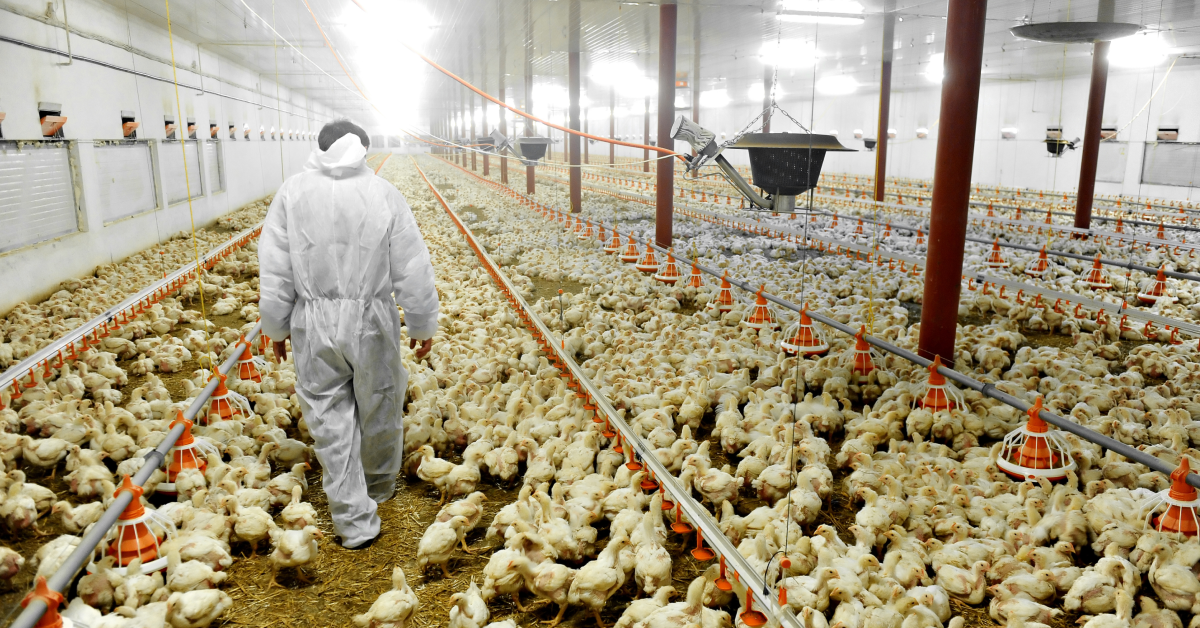
Broiler farming is the commercial rearing of chickens bred specifically for meat production. These birds, typically Cobb 500 or Ross 308 strains, are raised from day-old chicks to market weight, usually around 2.0 to 2.5 kg, within 35 to 42 days. The entire operation is built around fast, efficient growth supported by controlled nutrition, climate management, and strict biosecurity.
How Broiler Farming Differs From Layer Farming and Backyard Poultry
Broiler poultry farming focuses exclusively on meat yield within a short production cycle, whereas layer farming centers on egg production over 14 to 15 months. Backyard poultry typically involves dual-purpose breeds in low-density, uncontrolled environments. Commercial broiler farming demands precision in housing, feed formulation, and health protocols that backyard setups simply do not require.
Independent Farming Versus Integration Farming in Broiler Poultry
One of your first decisions is choosing between independent operation and contract integration. In integration farming in broiler poultry, an integrator owns the birds and feeds, while you provide the housing and labor. Independent farming gives you full ownership of birds, feed sourcing, and sales, but also full financial exposure. Here is a side-by-side comparison:
| Model | Who Owns Birds & Feed | What the Farmer Pays For | Margin Logic | Risk Exposure | Best Fit |
| Integration (Contract) | Integrator owns birds, feed, and veterinary inputs | Housing, utilities, labor, litter management | Per-bird fee; performance bonuses based on FCR and livability | Lower market price risk sits with integrator | New entrants, operators seeking predictable cash flow |
| Independent | Farmer owns everything from the chick to the carcass | Chicks, feed, medications, housing, marketing | Spread between live cost/kg and sale price/kg | Higher, full exposure to feed and market price swings | Experienced operators with established market channels |
Is Broiler Chicken Farming Profitable?
Profitability in broiler farming is not guaranteed; it is engineered. Your business plan must account for real cost drivers and revenue variables.
The Revenue Drivers That Shape Broiler Farm Profitability
In commercial broiler farming, your top-line revenue depends on three variables: live weight at sale, the price per kilogram you negotiate, and flock livability. Americans consumed 102.6 pounds of chicken per capita in 2024, and that demand is projected to hit another record in 2025. Strong domestic consumption and export markets create pricing support, but your realized margin ultimately comes down to on-farm execution.
Major Cost Heads: Feed, Chicks, Labor, Utilities, Litter, and Mortality
Feed is by far your largest cost, typically accounting for 40 to 70 percent of total production expense. Day-old chick procurement is your second-largest line item, followed by labor, electricity for ventilation and lighting, litter or bedding material, and mortality-related losses. Utilities can spike sharply in environmentally controlled houses during extreme weather, so factor seasonal energy costs into your broiler chicken farming business plan from the start.
A Simple Broiler Chicken Farming Business Plan Framework
A credible business plan for broiler farming does not begin with assumed margins. It begins with your local input costs.
First, map out the following:
- Planned flock size
- Cycles per year
- Projected feed conversion ratio
- Expected market weight
- Live-bird or dressed-bird price you can realistically achieve in your market.
Then layer in fixed costs, such as housing depreciation, loan servicing, insurance, and variable costs per cycle. Stress-test the model by adjusting the feed price by plus or minus 15 percent and mortality by plus or minus 2 points.
As a result, it reveals your breakeven point and your margin sensitivity, which is what an investor or lender actually needs to see. Tools like poultry management software can help you centralize this data across cycles for cleaner financial analysis.
How to Start a Commercial Broiler Farm
Starting a broiler farm requires matching your capital, labor capacity, and market access to the right production model. Here is how to plan your launch.
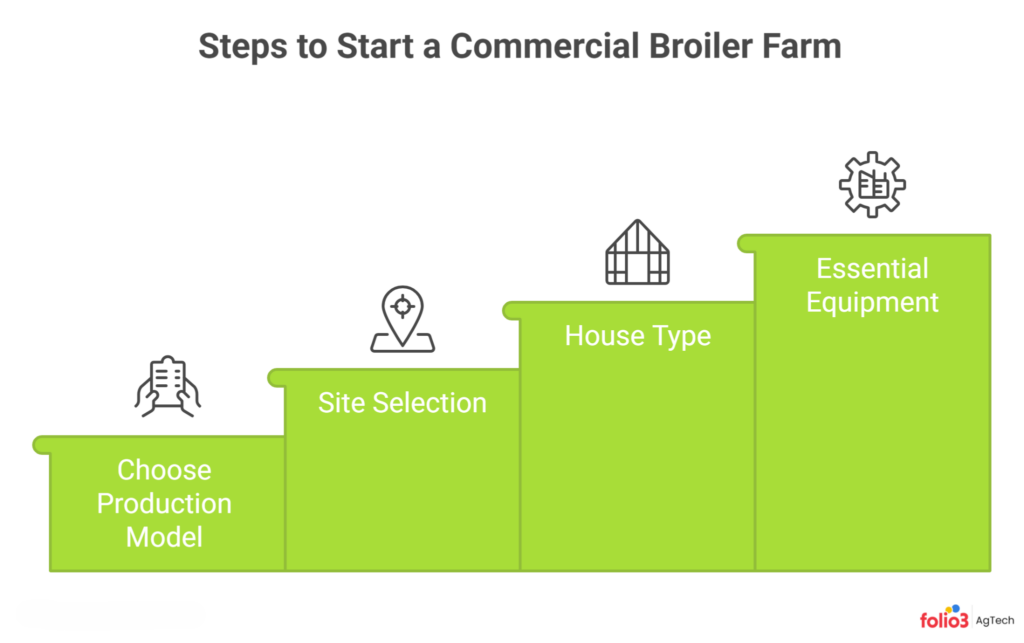
Choose Your Production Model, Flock Size, and Growth Plan
Before you break ground, decide whether you are going to be independent or contract with an integrator. Understanding the full startup costs for a commercial poultry farm is essential before your production model shapes your capital requirements and marketing responsibility. Start by defining your target flock size, as many first-time operators begin with 5,000 to 10,000 birds, and plan how many cycles per year your setup can handle.
Site Selection, Farm Layout, Drainage, Utilities, and Biosecure Access
Your farm site needs reliable electricity, a clean water source, and good drainage to prevent litter moisture problems. Position the broiler house on elevated, well-drained ground with prevailing wind flow away from neighboring operations. Plan a single controlled-access entry point for vehicles and visitors to support biosecurity measures. Proximity to your target market or processor matters too; transport costs and live-bird shrinkage both eat into your margin.
Open House Versus Environmentally Controlled House
Open-sided houses (curtain houses) rely on natural ventilation and are cheaper to build. However, they leave your flock exposed to temperature swings, wild birds, and airborne pathogens.
Environmentally controlled houses (ECH) use tunnel ventilation, evaporative cooling pads, and automated heating to maintain consistent temperature and air quality year-round. While the capital cost per house is significantly higher for an ECH, modern broiler poultry farming increasingly favors a controlled environment. They deliver better feed conversion, lower mortality, and more predictable growth, all of which improve your cost per kilogram of meat produced.
Essential Equipment: Feeders, Drinkers, Ventilation, Heating, and Automation
Your equipment selection directly affects daily labor requirements and flock performance, and pairing that infrastructure with animal welfare and care management software ensures every welfare event, treatment, and housing condition check is logged against the flock record for audit-ready traceability. Tunnel fans, inlet dampers, and evaporative cooling pads form your ventilation backbone. For heating, radiant brooders or forced-air heaters are standard in the brooding zone. Modern broiler poultry farming operations also incorporate IoT sensors in agriculture for automated temperature alerts, water flow monitoring, and feed bin level tracking.
Brooding and Day-One Management
The first hours and days of a chick’s life set the trajectory for the entire flock. Mistakes here are hard to recover from.
How to Select Healthy Day-Old Chicks
Your flock performance starts at the hatchery, not at the farm.
- Inspect day-old chicks for bright, clear eyes, clean navels, firm legs, and uniform size.
- Reject any shipments with more than 2–3 percent visible culls or chicks showing signs of dehydration (sunken eyes, dry shanks).
- Verify that the hatchery followed proper vaccination protocols (typically Marek’s disease and infectious bronchitis at the hatchery).
If you are working under a contract integrator, they supply the chicks, but you should still inspect them on arrival.
Temperature, Water, Feed Access, and Lighting in the First Days
- Preheat the brooding area to 90–95°F (32–35°C) at chick level before placement.
- Ensure drinkers are filled, and feeders are accessible within arm’s reach of every chick.
- Provide 23 hours of light for the first 48 hours, so chicks locate feed and water quickly.
- Monitor crop fill at 8 and 24 hours after placement; at least 80 percent of chicks should have palpably full crops within 8 hours.
- Gradually reduce brooding temperature by approximately 5°F (3°C) per week until you reach ambient levels around day 21.
The First 14 Days Checklist and Common Failure Points
Your first two weeks determine the flock’s lifetime performance. Keep these priorities front and center:
- Check brooding temperature at chick height twice daily (not at sensor height)
- Track daily mortality and investigate any spike above 0.5 percent per day
- Confirm water pressure and flow; low flow causes dehydration; high pressure causes wet litter
- Monitor litter condition daily; capped or wet litter signals ventilation or drinker problems
- Verify feed consumption against breed standard curves by day 7 and day 14
Common failure points include uneven floor temperature, blocked nipple drinkers, and delayed feed access. Each one compounds into reduced uniformity and higher mortality over the full cycle.
Feeding and Growth Management Across the Cycle
Feed is your highest cost and the biggest lever for controlling profit. Getting your feeding strategy right pays back on every cycle.
Starter, Grower, and Finisher Feed Strategy
Broiler chicken farming methods rely on a phased feeding program designed to match the birds’ changing nutritional requirements at each growth stage.
- The starter diet (days 0–10) is high in protein (typically 22–24 percent crude protein) to support rapid early growth.
- The grower diet (days 11–24) reduces protein slightly while increasing energy density.
- The finisher diet (day 25 to market) optimizes the energy-to-protein ratio for efficient weight gain with lower feed cost per kilogram.
Switching diets on time, not early or late, directly affects your feed conversion ratio and cost.
Feed Conversion, Water Intake, and Flock Uniformity
Feed conversion ratio (FCR) is the single most important performance metric in commercial broiler farming. A standard broiler reared in a controlled house typically achieves an FCR of 1.4 to 1.9, meaning 1.4 to 1.9 kg of feed produces 1 kg of live weight. Water intake should track at roughly 1.6 to 2.0 times feed intake by weight.
Meanwhile, Flock uniformity, measured as the coefficient of variation in body weight, should stay below 10 percent. Automated livestock counting and flock tracking gives you accurate headcount and weight distribution data without the labor overhead of manual sampling, helping you catch uniformity problems before they cost you at market.
Feed Storage, Feed Waste, and Quality Control
Store feed in clean, dry, sealed bins with regular rotation to prevent mold, rancidity, or mycotoxin contamination. Inspect feed lines and pan feeders weekly for blockages and spillage, as wasted feed is wasted margin. Run moisture and crude protein tests on incoming deliveries, especially if you source from multiple mills. Tracking feed inventory against consumption in your broiler management software will flag discrepancies before they become costly.
Biosecurity, Litter, Ventilation, and Flock Health
Disease outbreaks destroy margins faster than any other operational risk. Your biosecurity and environmental controls are your front line of defense.
Visitor, Vehicle, Rodent, and Wild Bird Controls
Establish a perimeter control zone. Every vehicle entering the farm should drive through a tire wash or disinfection station. Visitors must sign in, wear farm-provided footwear, and follow a designated path, no exceptions. Install rodent bait stations around every house and inspect them weekly.
Moreover, seal all wall and roof gaps to prevent wild bird entry; the USDA reported over 18 million poultry affected by Highly Pathogenic Avian Influenza (HPAI) in December 2024 alone, underscoring why wild bird contact is a non-negotiable control point. Digital visitor logs and vehicle tracking through livestock management software improve traceability during audits and outbreak investigations.
Litter Moisture, Ammonia Risk, and Between-Flock Cleanout
Target litter moisture between 20 and 30 percent. Above 35 percent, you face ammonia burns on foot pads, increased respiratory stress, and higher condemnation rates at the processor. Manage moisture through proper ventilation, nipple drinker height adjustments, and regular litter conditioning.
Meanwhile, Ammonia concentration at bird height should remain below 25 ppm. Between flocks, remove caked litter, disinfect surfaces, and allow a minimum downtime that your integrator or veterinarian recommends, typically 10 to 14 days.
Vaccination, Daily Checks, Mortality Response, and When to Call a Vet
Follow your veterinarian’s vaccination program, which typically covers Marek’s disease, Newcastle disease, infectious bronchitis, and Gumboro disease at scheduled intervals. Walk your houses at least twice daily. Check for abnormal sounds (respiratory rales), lethargy, droopy wings, or clustering near heat sources, signs that AI-powered poultry disease detection can flag between manual checks by cross-referencing behavioral and environmental sensor data.
Remove and record mortalities promptly. Continuous flock health monitoring surfaces mortality spikes and behavioral deviations in real time, giving you a head start on early intervention that waiting for the next manual walk simply cannot provide.
Daily SOPs and the KPI Dashboard Every Broiler Farm Should Track
Running a profitable broiler farm requires routine discipline and measurable performance indicators. Here is how to build that management layer.
Daily, Weekly, and Between-Flock Routines
Daily routines include house walks (twice minimum), mortality removal, water system checks, feed bin monitoring, temperature and humidity logging, and litter condition assessment.
Weekly tasks add equipment inspections, calibration of scales and sensors, rodent station checks, and fuel or propane inventory reviews.
Between flocks, execute a full cleanout, equipment maintenance, litter treatment, and biosecurity audit.
Documenting these routines with smart farming technology eliminates the paper trail problem and gives you audit-ready records.
KPIs That Actually Matter
Track these seven metrics on a per-flock dashboard to turn data into actionable decisions:
| KPI | Why It Matters | Review Frequency | Warning Sign | Corrective Action |
| Mortality (%) | Direct loss of revenue and a signal of health or environment issues | Daily | Above 0.5% in a single day or cumulative >5% at midcycle | Investigate cause; call vet if infectious origin suspected |
| Feed Conversion Ratio (FCR) | Largest cost driver; measures feed efficiency | Weekly | FCR rising above breed target for the corresponding age | Check feed quality, feeder calibration, and environmental stressors |
| Average Body Weight | Revenue is weight-based; tracking ensures market-readiness | Weekly | Body weight more than 5% below breed standard curve | Review feed access, stocking density, and disease pressure |
| Flock Uniformity (CV%) | Low uniformity reduces the average sale value | Weekly | Coefficient of variation above 10% | Evaluate feeder space, drinker access, and early brooding management |
| Water-to-Feed Ratio | Early indicator of health stress or equipment problems | Daily | Ratio falls below 1.6:1 or spikes above 2.5:1 | Inspect drinkers; evaluate flock for subclinical disease |
| Litter Condition | Affects foot pad health, ammonia levels, and condemnation rates | Daily | Capped, wet, or ammonia odor detectable at bird height | Increase ventilation, adjust drinker height, stir or condition litter |
| Temperature & Humidity Deviation | Stress from temperature swings reduces growth and increases mortality | Continuous (sensors) | More than ±3°F from setpoint or RH above 70% | Inspect ventilation, heating, and cooling systems immediately |
Harvest Planning, Sales Channels, and Market Strategy
A broiler farm is not just a husbandry operation; it is a business. Your harvest timing and market access directly determine your return.
When Broilers Are Market-Ready and How Timing Affects Returns
Most commercial broilers reach market weight between 35 and 49 days, depending on the target product (whole bird, cut-up, or further processed). Holding birds beyond their optimal harvest window increases your FCR without proportional weight gains, eroding margin per kilogram.
Processors, Wholesalers, Food Service, Retail, and Direct Sales
Your sales channel mix shapes your pricing power. Contract growers deliver to the integrator’s plant. Independent operators can sell to processors, wholesale distributors, food service buyers, retail chains, or direct-to-consumer outlets. Diversifying channels reduces your dependence on a single buyer.
When Integration Farming Makes Sense
Integration farming in broiler poultry is often the right entry point if you lack established market relationships, prefer lower financial risk, or are financing new construction. The trade-off is lower upside per bird in exchange for predictable per-cycle income and reduced capital exposure on feed and chick costs.
How Modern Broiler Poultry Farming Uses Data and Automation
Technology does not replace good husbandry; it amplifies it. Here is how data and automation are changing commercial broiler operations.
Sensors, Alerts, and Climate Control
Modern broiler poultry farming leverages temperature, humidity, ammonia, and CO₂ sensors connected to automated controllers. Computer vision for broiler house monitoring adds another layer, continuously scanning for bird behavior changes, clustering patterns, and mortality indicators between routine sensor checks. Real-time alerts sent to your phone reduce response time on critical events. Integrating these IoT systems into your agriculture operation creates a layer of protection that manual checks alone cannot match.
Record Keeping That Improves Margin Per Cycle
Every cycle generates data: feed consumption, water use, mortality curves, weight samples, medication records, energy costs, and sales results. AI tools for commercial poultry operations turn that data from a record-keeping burden into a predictive layer that surfaces patterns across cycles before they become systemic problems.
A dedicated agricultural ERP platform centralizes your flock records, links feed invoices to performance outcomes, and generates the KPI dashboards covered earlier in this guide. It gives you the visibility to improve margin per cycle, not just survive each one.
Automated Climate Control and Smart Ventilation
Evaporative cooling pads combined with tunnel ventilation fans are the standard climate control backbone in modern commercial broiler houses. IoT-enabled temperature monitoring systems continuously feed data to central controllers that modulate pad pump speed, fan staging, and inlet damper positions. This closed-loop approach maintains the tight temperature band broilers need for optimal feed conversion while reducing energy waste. Operations that adopt integrated poultry farm management systems report faster anomaly detection and fewer heat- or cold-stress events across flock cycles.
Future-Proof Your Commercial Poultry Operation!
Broiler chicken farming rewards operators who combine disciplined husbandry with sound business planning and modern technology. The fundamentals like biosecurity, nutrition, environment control, and accurate record keeping have not changed. What has changed is the availability of tools that let you measure, manage, and improve those fundamentals at scale. Whether you are planning your first flock or looking to optimize an established commercial broiler farming operation, the path forward runs through data-driven decision-making. If you want a custom assessment of where technology can improve your per-cycle profitability, contact our AgTech consultancy for a tailored farm audit and take the first step toward a more resilient, more profitable operation.
FAQs
How Much Space Does Each Broiler Chicken Need in a Commercial House?
Most commercial operations allocate 0.75 to 1.0 square feet per bird, depending on target market weight and housing type. Overcrowding reduces growth rates and increases leg problems, so matching stocking density to your ventilation capacity is essential for consistent results.
What Is the Average Mortality Rate in a Well-Managed Broiler Flock?
Well-managed commercial flocks typically achieve cumulative mortality below 5 percent over a full cycle. Anything consistently above that signals problems with chick quality, brooding management, disease control, or environmental conditions that need investigation.
How Many Production Cycles Can a Broiler Farm Run Per Year?
Most environmentally controlled operations complete five to seven cycles annually, depending on grow-out length and downtime between flocks. Shortening downtime without compromising cleanout quality is a common mistake that increases disease risk in subsequent cycles.
What Permits and Regulations Apply to Commercial Broiler Farming?
Requirements vary by state and municipality, but you typically need zoning approval, a nutrient management plan, water use permits, and compliance with EPA and state environmental agency guidelines for poultry litter disposal. Check with your local extension service before investing in construction.
Can Small-Scale Broiler Farming Be Profitable Without an Integrator Contract?
Yes, but it requires direct-to-consumer or specialty market channels where you capture a price premium. Small-scale independent operations often succeed through farmers’ markets, restaurant partnerships, or community-supported agriculture (CSA) models that value locally raised poultry.
How Does Climate Change Affect Commercial Broiler Farming Operations?
Rising ambient temperatures increase cooling costs and heat-stress risk, especially in open-sided houses. More frequent extreme weather events also disrupt supply chains for feed and day-old chicks. Investing in environmentally controlled housing and real-time climate monitoring is one of the most effective ways to future-proof your operation.