

Average daily gain (ADG) is the average weight a beef animal gains per day over a set period. The formula is simple: (Ending Weight – Starting Weight) / Days Between Weigh Dates = ADG. For example, a steer that enters a feedlot at 750 lb and weighs 1,100 lb after 100 days has an ADG of 3.5 lb per day.
But knowing how to calculate average daily gain is only half of it. What separates profitable cattle operations from the rest is what they do with that number. ADG tells you whether your cattle are on track for target sale weight, whether your ration is performing, and whether a health problem is quietly eating into your margins.
This guide walks you through the average daily gain formula, gives you a ready-to-use ADG calculator, breaks down realistic ADG benchmarks by production stage, and shows you how to troubleshoot and improve your results. Whether you run a cow-calf operation, a stocker program, or a finishing feedlot, the same metric drives your bottom line.
What Is Average Daily Gain (ADG) in Cattle?
Average daily gain measures how much weight your cattle put on per day during a specific time window. If a calf weighs 500 lb at weaning and 650 lb after 90 days on pasture, its average daily gain is 1.67 lb/day (or about 0.76 kg/day). It applies to every stage, from nursing calves through finishing.
Why Cattle Operations Track ADG
Your average daily gain for beef cattle directly controls how many days an animal needs to reach target sale weight, and every extra day on feed costs money. It also flags ration problems, health issues, and pen conditions before they become visible losses. Operations that track cattle performance with livestock management software use ADG alongside feed conversion, treatment rates, and cost of gain to make faster, more profitable decisions on sorting, marketing, and culling.
How to Calculate Average Daily Gain in Cattle
You only need three numbers to calculate ADG. Here is the formula and two worked examples.
The Average Daily Gain Formula
The standard average daily gain formula is:
ADG = (Ending Weight – Starting Weight) / Days Between Weigh Dates
Use “days between weigh dates” rather than just “days on feed.” ADG applies to nursing calves, stockers, backgrounding programs, and feedlot finishing, not only grain-fed cattle.
ADG Calculation Example for a Feedlot Steer
A steer enters the feedlot at 750 lb. After 100 days, it weighs 1,100 lb.
- Total gain: 1,100 – 750 = 350 lb
- ADG: 350 / 100 = 3.5 lb per day
That gain rate keeps the steer on track for a typical finishing program. If it drops below 3.0 lb per day, something in the feed ration, health protocol, or pen environment needs attention.
ADG Calculation Example for Backgrounding Calves
A weaned calf starts at 500 lb and weighs 650 lb after 90 days on pasture.
- Total gain: 650 – 500 = 150 lb
- ADG: 150 / 90 = 1.67 lb per day
That is a solid result for a forage-based program, and it tells you the pasture quality and supplement plan are working.
Average Daily Gain Calculator
To use an average daily gain calculator, you enter three fields:
- Starting weight (lb or kg)
- Ending weight (lb or kg)
- Days between weigh dates
The calculator divides total gain by the number of days and returns your ADG. You can build a basic version in any spreadsheet. But if you are tracking dozens or hundreds of heads, livestock record-keeping software automates this across your entire herd, pen by pen, and flags animals or groups that fall off target.
Ideal ADG Benchmarks for Cattle by Production Stage
There is an important qualifier before you compare your numbers to any benchmark table: your results depend on cattle age, sex, breed type, starting weight, ration, weather, health history, and market objective. The ranges below are planning guides, not pass-fail scores.
ADG Benchmark Table by Production Stage
| Production Stage | Useful Planning Range (lb/day) | What to Compare Before Judging Performance |
| Nursing beef calves | 1.5 to 2.5 | Dam milk production, pasture quality, calf age, breed, sex |
| Early weaned calves | 2.0 to 2.5 | Ration adaptation, intake, health status, frame size |
| Backgrounding calves | 1.5 to 2.5 | Forage quality, supplement program, weather, grazing pressure |
| Stocker cattle on pasture | 1.0 to 2.0 | Forage availability, pasture quality, parasite pressure |
| Preconditioned calves | 1.75 to 2.25 | Weaning stress, intake, vaccination plan, diet |
| Feedlot finishing cattle | 2.5 to 4.0 | Diet energy, days on feed, implant program, pen conditions |
These ranges draw on extension research. Note that adapted finishing calves can reasonably gain 2.5 to 4 lb per day, while its preconditioning guidance cites 1.75 to 2.25 lb per day for lighter calves transitioning after weaning.
Average Daily Weight Gain for Newborn Calves
The average daily weight gain for a newborn calf in the first month depends on the calf’s birth weight, the dam’s milk production, breed, and health, not a single industry number. Most healthy beef calves gain somewhere between 1.5 and 2.5 lb per day during the nursing phase, but that range varies widely.
If a young calf is weak, not nursing properly, scouring, or visibly failing to gain, the answer is not a benchmark table. Work with your veterinarian to identify the problem. Early intervention on calf health issues prevents losses that compound fast.
Why Breed-Specific ADG Tables Can Mislead
It is tempting to look up an ADG target for “Angus” or “Charolais” and measure your herd against it. But breed labels alone do not account for management conditions, weight range, sex, diet, or environment. A 600 lb Angus-cross steer on high-quality fescue-clover pasture will gain differently than the same cross on low-quality dormant winter range.
The Beef Improvement Federation (BIF) uses a within-group ADG ratio (ADGR) for this reason. It compares each animal to its peer group under the same test conditions, not to a breed average from a different operation. If you are using EPDs for genetic selection, this within-group comparison gives you a much cleaner signal than raw breed averages.
How to Get Accurate ADG Data
Your ADG number is only as good as the weights behind it. Here is how to avoid data that leads to bad decisions.
Weigh Cattle Under Comparable Conditions
Consistency matters more than frequency. Weigh at the same time of day, with similar gut fill, using calibrated scales, and record the exact dates. Individual weights are more useful than pen averages because they help you spot poor performers early, especially when paired with automated weighing systems and livestock identification tags.
For routine monitoring, weighing every 30 to 60 days gives you enough data points to identify trends without disrupting the cattle unnecessarily. More frequent weighing creates more handling stress with diminishing returns on data quality.
Account for Shrink, Weather, and Recent Stress
Shrink is the weight cattle lose from gut fill and water during sorting, handling, or transport. It can easily reach 3 to 5% of body weight, which means a 1,000 lb steer might “lose” 30 to 50 lb just from being worked through a chute. That is not real weight loss, and if you do not account for it, your ADG calculations will be misleading.
Beyond shrink, recent heat stress, a ration change, weaning, or an illness episode can distort a single weigh interval. Use enough days between weights (at least 30) to identify a true trend rather than reacting to a one-day fluctuation.
Why Average Daily Gain Falls Below Target
When ADG drops, do not guess. Five categories of factors influence average daily gain in cattle: genetics, nutrition, health, environment, and management. Walk through this checklist before making changes.
Check Intake and Ration Consistency
Low feed intake is the most common driver of below-target ADG. Look at feed access first. Are bunks empty for extended periods? Is water clean and available? Are you seeing variation in the ration mix across the bunk? Abrupt diet changes, poor-quality cattle feed ingredients, and inconsistent feeding times all suppress intake and gains.
Check Health Before Blaming the Ration
Bovine respiratory disease (BRD) is the biggest single health drain on ADG in the U.S. beef industry. Nearly 20% of beef cattle require BRD treatment, costing the industry approximately $1 billion annually in reduced production and treatment costs. Parasites, lameness, scours in young calves, and subclinical illness also suppress gains. If cattle are eating but not gaining, a health workup should come before a ration change.
Check Stress and Pen Conditions
Mud, extreme heat, extreme cold, crowding, aggressive handling, and social disruption all burn energy your cattle should be putting toward gain. Maintaining clean, dry pen conditions and following low-stress handling practices protects the gains your ration and genetics are designed to deliver. Fly pressure in summer months also reduces feeding time and increases bunching behavior, which can quietly cost you pounds. Implementing proper fly control in feedlots makes a measurable difference.
Check Whether the Benchmark Fits the Cattle
Before concluding that ADG is “too low,” make sure you are comparing to the right target. Backgrounding calves on native range should not be judged against feedlot finishing benchmarks. Compare by production stage, sex, weight range, and management conditions, not against a generic industry average.
How to Improve Average Daily Gain in Cattle
Improvement is not about one big change. It comes from stacking small, disciplined wins across nutrition, health, and management.
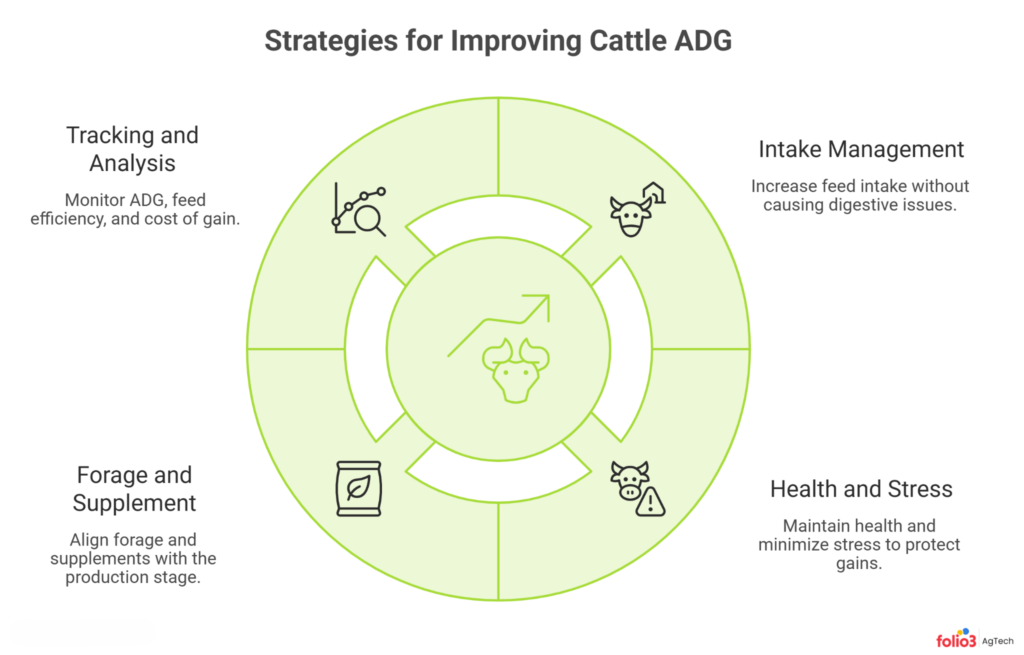
Improve Intake Without Creating Digestive Problems
Push feed intake gradually. Step up ration energy levels over 14 to 21 days to protect rumen health. Keep feeding times consistent. Provide clean water and adequate bunk space so smaller or timid cattle still get their share. Have a nutritionist review your rations at least once a season, and consider how different cattle nutrition strategies apply to each group on your operation.
Protect Gains Through Health and Low-Stress Handling
Build your arrival protocol with your veterinarian. Include a vaccination schedule, strategic deworming, and a plan for high-risk cattle. Use low-stress cattle handling at every touch point. Respond quickly when intake or gains drop in a pen or individual, as catching problems early prevents expensive treatment costs and lost growth days.
Match Forage and Supplement to the Production Stage
For stocker and backgrounding operations, forage quality is your ration. Test hay and pasture, manage grazing pressure with rotational grazing, and supplement strategically when forage alone cannot support your target ADG. Legume management in fescue pastures has been shown to improve stocker gain per acre significantly.
Track ADG Alongside Feed Efficiency and Cost of Gain
Higher ADG is not automatically better if it costs more per pound of gain than the market will pay. Always pair your average daily gain data with feed conversion ratio, death loss, treatment rate, and cost per pound of gain. This full picture tells you whether your gains are actually profitable. Feed management software can automate this tracking across pens and lots, so you spot margin problems before they compound.
Turn ADG Into a Better Marketing and Feeding Decision
ADG is most valuable when it drives a specific action. Here is a simple management workflow.
- Set a target sale weight and date for each pen or group.
- Calculate the required ADG to hit that target on time.
- Weigh at consistent intervals (every 30 to 60 days).
- Compare each pen or group to its own relevant target, not a generic industry number.
- Investigate any decline before it becomes expensive extra days on feed.
Here is what a small ADG difference means in practice: if your target is 1,300 lb and your steers are gaining 3.25 lb per day instead of 3.50 lb per day, that 0.25 lb difference adds roughly 11 extra days to reach target weight. Across 200 head, that is 2,200 additional head-days of feed, yardage, labor, and interest. Cattle reaching target end weight sooner can improve profitability, while feed efficiency directly affects cost of gain.
Operations that consistently turn ADG data into timely decisions on sorting, sale timing, ration adjustments, and effective cattle marketing strategies capture margins that operations relying on guesswork leave on the table. Tracking this data by pen and lot, not just as a yard-wide average, is what separates the top-performing operations in cattle ranching profitability.
FAQs
What is a Good Average Daily Gain for Beef Cattle?
It depends on the production stage. Feedlot finishing cattle typically gain 2.5 to 4.0 lb per day on high-energy rations. Backgrounding and stocker cattle on pasture usually range from 1.0 to 2.5 lb per day. Always compare against cattle of similar age, sex, breed, and management conditions.
How Do You Calculate Average Daily Gain in Cattle?
Use this formula: ADG = (Ending Weight – Starting Weight) / Days Between Weigh Dates. Weigh under consistent conditions, account for shrink, and use at least 30 days between weights for a reliable number.
What is the Average Daily Weight Gain for a Newborn Calf in the First Month?
Healthy nursing beef calves typically gain 1.5 to 2.5 lb per day, but this varies with breed, dam milk production, and calf health. If a calf is not nursing or gaining, consult your veterinarian rather than comparing to a benchmark.
What is a Good ADG for Backgrounding Cattle?
A planning range of 1.5 to 2.5 lb per day is common, depending on forage quality, supplement program, weather, and the animal’s frame size.
What is a Good ADG for Feedlot Cattle?
Most adapted feedlot cattle should gain 2.5 to 4.0 lb per day. Top-performing pens on optimized rations can exceed 4.0 lb per day under ideal conditions.
Is Average Daily Gain the Same as Feed Efficiency?
No. ADG measures weight gained per day. Feed efficiency (or feed conversion ratio) measures how much feed is required per pound of gain. A high ADG with poor feed efficiency can still lose you money. Track both together.
How often Should Cattle be Weighed for ADG?
For most operations, weighing every 30 to 60 days provides reliable trend data without excessive handling stress. Weigh more frequently during critical periods like receiving or when investigating a performance drop.