
Running an agricultural cooperative is not like running a typical business. You are balancing democratic member ownership with fierce market competition, all while managing perishable goods, seasonal cash flows, and thousands of stakeholders who each have a vote.
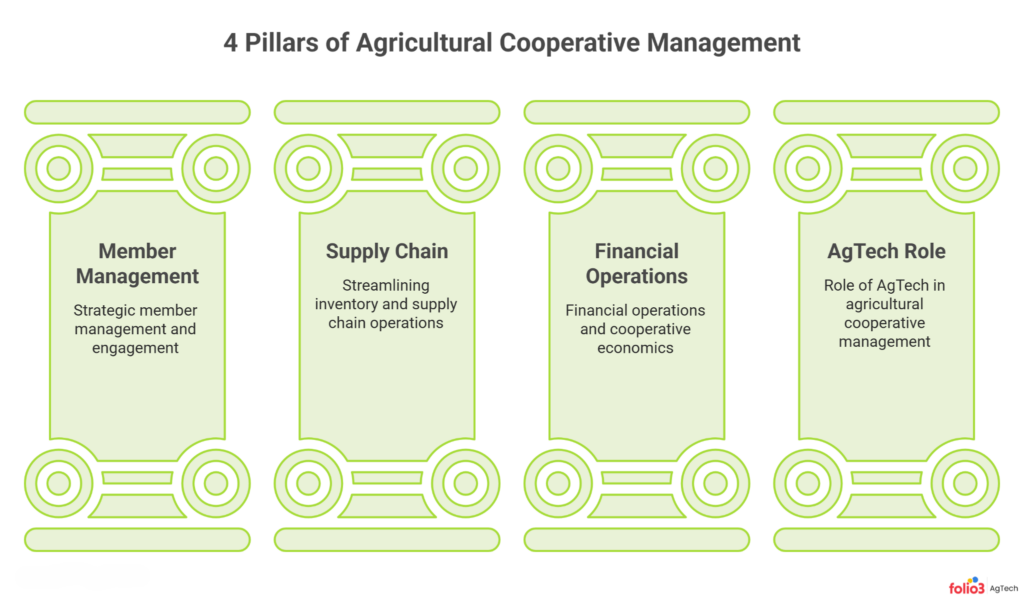
That balancing act is what makes agricultural cooperative management so complex. Your co-op must excel across three pillars: member engagement, inventory and supply chain operations, and financial management. Get any one of these wrong, and the entire structure weakens.
According to USDA’s 2024 annual survey, the nation’s 1,620 farmer, rancher, and fishery cooperatives generated $275.8 billion in revenues, with member equity reaching a record $60 billion. These numbers prove the model works. But staying competitive in 2026 requires more than tradition. It requires a modern, tech-forward approach to every part of your cooperative operation.
This guide breaks down each pillar so you can strengthen your cooperative from the inside out.
What Is Agriculture Cooperative Management in the Modern Era?
Modern co-ops have moved well beyond simple bulk buying. Here is what agriculture cooperative management looks like today.
Traditionally, agricultural cooperatives operate through a three-tier management structure. The General Body (all members) sets broad direction, the Managing Committee (elected board) makes governance decisions, and the Management Staff handles daily operations. This structure ensures democratic control while keeping the business running.
But the digital era has forced co-ops to evolve. What was once a straightforward bulk-purchasing club is now a sophisticated, data-driven supply chain hub. Today’s leaders use digital transformation tools for agricultural cooperatives to track inventory in real time, predict market demand, and communicate with thousands of members through digital portals rather than paper newsletters.
The global farm management software market is projected to reach $3.73 billion in 2026, growing at a 17.40% CAGR. Co-ops that fail to adopt these tools risk falling behind private competitors who are already operating on real-time data.
To understand where your co-op fits, it helps to know the three main types:
- Supply cooperatives focus on purchasing inputs like seeds, fertilizers, and fuel in bulk to lower member costs. Management here centers on procurement timing, storage logistics, and vendor negotiations.
- Marketing cooperatives aggregate member crops or livestock for collective sale, focusing on quality control, grading, and market access. Their edge is bargaining power.
- Service cooperatives provide shared resources like equipment, transportation, or technical assistance. Management priorities revolve around asset utilization and scheduling.
Each type demands a distinct management strategy, but all three share the same goal: delivering more value to members than they could achieve alone.
Pillar 1: Strategic Member Management and Engagement
Managing cooperative members goes beyond collecting dues and holding annual meetings. It means building genuine participation, clear communication, and long-term succession planning.
Cultivating Active Participation and Democratic Governance
Member apathy is one of the biggest threats to cooperative health. When only a handful of members show up to vote or attend board meetings, decisions end up reflecting a small group rather than the full membership.
The challenge is real, USDA research on member participation found a significant size bias in co-op engagement: farmers from larger operations tend to be more involved. At the same time, smaller producers often feel underrepresented and have less time to participate.
To combat this, structure your governance so both large and small farmers feel equally heard. Consider proportional voting on certain issues, regional representation on the board, or rotating meeting locations to reach different parts of your member base. Send pre-meeting briefings so members who cannot attend in person can still contribute informed input.
The goal is not just higher attendance. It is active, informed participation that reflects the will of your entire membership. Every cooperative member has a stake in the organization’s assets and is incentivized to promote good governance.
Digital Onboarding and Two-Way Communication Tools
Modern cooperatives are deploying digital portals where members can view their yields, track input costs, see their voting rights and equity positions, and communicate directly with management. These platforms turn passive members into active participants.
For IT Directors or digital leads within the cooperative, the transition does not have to happen overnight. Start with a simple member dashboard that shows account status, transaction history, and upcoming meeting dates. Then layer in tools for online voting, document sharing, and even farm data management integration.
Two-way communication is the key differentiator. Members should be able to raise issues, submit feedback, and access cooperative resources from their phones. It is especially critical for reaching younger, tech-savvy farmers who expect digital-first interactions.
Succession Planning and Member Education
Many cooperatives are facing a generational cliff. As long-time members retire, the next generation of farmers needs to understand cooperative bylaws, fiduciary responsibilities, and the business rationale behind collective action.
Do not wait until a leadership transition is underway. Build an ongoing education program that covers cooperative principles, financial literacy, and governance responsibilities. Host annual workshops or webinars for new and younger members. Partner with extension services or land-grant universities that offer cooperative education curricula.
The stronger your pipeline of informed, engaged future leaders, the more resilient your co-op becomes.
Pillar 2: Streamlining Inventory and Supply Chain Operations
Moving physical goods efficiently is the operational backbone of any cooperative. Breakdowns here cost members real money.
Whether you are distributing fertilizer to 500 farms or aggregating grain from 1,000 producers, your supply chain tracking systems determine whether you deliver value or create waste.
Optimizing Input Distribution (Supply Co-ops)
Supply cooperatives exist to give members better prices through bulk purchasing. But the savings only materialize if you manage procurement timing, storage, and distribution effectively.
Start by aligning your purchasing calendar with members’ planting seasons. Pre-season orders and forward contracts lock in prices before peak demand drives costs up. Invest in proper inventory management systems that track stock levels for fertilizers, seeds, fuel, and crop protection products in real time.
Waste elimination is another major lever. Expired chemicals, spoiled seed, and overstocked warehouses all eat into the savings you pass on to members. Use demand forecasting based on historical usage patterns and member pre-orders to right-size your inventory.
Enhancing Traceability and Quality Control (Marketing Co-ops)
For marketing cooperatives, traceability is not optional. Buyers, regulators, and consumers all demand to know where a product came from, how it was handled, and whether it meets food safety standards.
Your traceability system should track produce from individual member farms through aggregation, processing, and delivery to the end buyer. This is critical for meeting compliance requirements, whether that is FSMA 204 for U.S. produce or export regulations for international markets.
Strong traceability also unlocks premium pricing. When you can prove your cooperative’s commodities meet organic, non-GMO, or sustainability standards, you command higher prices that flow directly back to your members. Blockchain-based traceability is one emerging tool that co-ops are exploring to build buyer confidence.
Storage, Fleet Management, and Logistics
Shared assets like grain elevators, cold storage facilities, and transport fleets are where cooperatives create economies of scale. Meanwhile, they also represent significant capital investments that must be managed carefully.
Implement scheduling systems for shared equipment so that members get fair access during peak periods. Monitor fleet utilization rates and maintenance cycles to avoid costly breakdowns. For perishable commodities, ensure your cold chain infrastructure maintains proper temperatures from the farm gate to the buyer’s dock.
The co-ops that get logistics right do not just save money. They build member confidence that the cooperative can handle their products with the same care they would themselves.
Pillar 3: Financial Operations and Cooperative Economics
Understanding patronage dividends, equity structures, and cooperative-specific accounting is essential. These mechanisms are what separate your co-op from a traditional corporation and what keep members invested in the long term.
Patronage Dividends, Pooling, and Retained Earnings
Unlike corporate shareholders who earn returns based on investment size, cooperative members receive patronage dividends based on how much business they do with the co-op. It is the core economic principle that makes cooperatives fair.
Your finance team needs to manage two types of equity: allocated equity (assigned to specific members based on their patronage) and unallocated equity (retained by the cooperative for general use). The balance between distributing surplus back to members and retaining enough capital for operations is one of the most important financial decisions your board will make each year.
A well-run farm financial management system tracks patronage calculations automatically, ensuring that every member’s contribution is accurately reflected. Transparent communication about how dividends are calculated builds member trust and reduces disputes.
Risk Sharing and Access to Capital
Cooperatives have unique funding mechanisms that your CFO should be leveraging. Beyond member loans and retained earnings, co-ops can access Community Development Financial Institutions (CDFIs), USDA Rural Development grants, and cooperative-specific lending programs.
Risk sharing is another cooperative advantage. When market prices drop or a natural disaster hits, the collective absorbs the impact rather than individual farmers bearing it alone. But this only works if your risk management framework is robust. Diversify revenue streams, maintain adequate reserves, and consider hedging strategies for commodity price volatility.
Given that USDA data shows cooperative net income before taxes was $11 billion in 2024 (roughly a 10% decrease from 2023), active financial planning is more important than ever.
Ensuring Transparent Accounting and Audits
Cooperatives operate under public trust. Your members are also your owners, and they have every right to know exactly where their money is going.
Implement strict segregation of duties in your finance department. Maintain impeccable statutory registers. Commission annual independent audits and share results with your full membership, not just the board. Good farm bookkeeping and accounting practices are the foundation of this transparency.
Traditional Bookkeeping vs. Modern Cooperative ERPs
| Feature | Traditional Paper/Spreadsheets | Modern Co-Op ERP | Benefit to CFO |
| Patronage Tracking | Manual calculations, error-prone | Automated based on member transactions | Accurate dividends, fewer disputes |
| Financial Reporting | Quarterly at best, labor-intensive | Real-time dashboards | Faster decision-making |
| Audit Readiness | Weeks of preparation | Always audit-ready with digital trails | Reduced audit costs |
| Member Equity Management | Spreadsheet-based, hard to update | Centralized with member portal access | Full transparency for members |
| Regulatory Compliance | Manual tracking of deadlines | Automated alerts and filing support | Lower compliance risk |
| Multi-Entity Consolidation | Separate books, manual reconciliation | Unified view across entities | Clear financial picture across divisions |
Pillar 4: The Role of AgTech in Agriculture Cooperatives Management
Technology is the bridge between traditional cooperative values and modern operational demands. For IT leaders, this is where you make the biggest impact.
The cooperatives that thrive in 2026 and beyond are those that treat technology not as an add-on, but as core infrastructure.
Farm Management Software and Satellite Scouting
One of the most powerful services a cooperative can offer its members is access to precision agriculture technology that individual farmers could not afford on their own.
Satellite-based crop scouting, soil health mapping, and yield prediction tools help members optimize inputs and reduce losses. When a co-op provides these tools as a shared service, it creates value that goes beyond price negotiation. You are helping your members farm better.
The precision farming market is valued at roughly $11.05 billion in 2025 and is projected to grow at 10.1% CAGR through 2035. Cooperatives that invest in these tools now will attract and retain members who see the direct ROI in better yields and lower input waste.
Unifying Data Silos with Cooperative ERPs
Most cooperatives run on a patchwork of disconnected systems: one for accounting, another for inventory, a third for member records, and spreadsheets filling the gaps. This fragmentation creates blind spots.
A centralized ERP for agriculture brings all of these data streams into one platform. Your C-Suite can see inventory levels, member financial standing, and market prices in a single dashboard. Your operations team can coordinate procurement with distribution without calling three departments. And your members can access their own data through a self-service portal.
The benefits of ERP in agriculture extend beyond convenience. They include reduced data entry errors, faster reporting, better compliance tracking, and a more complete picture of cooperative health. If you are evaluating systems, start with a thorough ERP cost-benefit analysis to build the business case for your board.
Big Data and Collective Bargaining
Here is where cooperatives have a unique advantage that no individual farmer can replicate: aggregated data.
When you combine harvest data, input usage, and yield outcomes from hundreds or thousands of member farms, you create a dataset with real bargaining power. This data helps you negotiate better prices with buyers who value supply predictability. It also helps you optimize input recommendations across your member base using data analytics in agriculture.
Big data in agriculture is not just a buzzword for cooperatives. It is a structural advantage built into the model itself.
Top Challenges Facing Agricultural Cooperatives Today
Even the best-managed cooperatives face hurdles. Acknowledging them honestly is the first step toward solving them.
The biggest issues for farmers today often become the cooperative’s challenges too:
- Bridging the digital divide: Not every member is comfortable with new technology. Older-generation farmers may resist digital portals, precision ag tools, or online voting. Training, patience, and a phased rollout are essential.
- Market volatility and climate change: Commodity price swings and extreme weather events put pressure on cooperative finances and member livelihoods. Diversification and robust risk management are your best defenses.
- Capital constraints for modernization: Upgrading grain elevators, investing in cold chain infrastructure, or deploying a new ERP system requires significant capital. Many co-ops struggle to balance member dividend expectations with reinvestment needs.
Conclusion and Next Steps for Cooperative Leaders
True cooperative success requires balancing human relationships with operational technology. You need engaged members, efficient supply chains, transparent finances, and the right digital tools to tie it all together.
If you are a General Manager, CFO, or IT Director looking to modernize your cooperative, start by auditing where your biggest gaps are. Is it member engagement? Inventory visibility? Financial reporting speed?
Reach out for a consultation to explore how integrated AgTech solutions can support your cooperative’s growth. You can also explore real-world results from organizations that have already made the transition through our case studies.
FAQs
How Do Agricultural Cooperatives Differ From Private Corporations?
Cooperatives are owned and governed by their members, who share in the profits based on how much business they do with the co-op, not how much they invested. This patronage-based model ensures fair returns. Private corporations distribute profits based on share ownership, which benefits investors rather than users.
What Is the Biggest Financial Risk for Agricultural Cooperatives?
Commodity price volatility is the biggest risk. When prices drop sharply, co-op revenues fall while fixed costs remain constant. Building adequate reserves and diversifying revenue streams help cooperatives weather these cycles without cutting member dividends.
How Can Small Cooperatives Afford Modern ERP Systems?
Cloud-based ERP platforms have lowered the cost barrier significantly. Many providers offer subscription models that scale with your cooperative’s size. Start with core modules like accounting and member management, then expand as you see returns.
What Role Does USDA Play in Supporting Agricultural Cooperatives?
USDA’s Cooperative Programs office provides technical assistance, statistical research, educational resources, and funding through programs like the Rural Cooperative Development Grant. These resources are available to cooperatives of all sizes and types.
How Often Should a Cooperative Conduct Independent Financial Audits?
Best practice is an annual independent audit shared with the full membership. Quarterly internal reviews keep your finance team ahead of issues. Regular audits build member trust and ensure compliance with state cooperative statutes.
Can Cooperatives Use Precision Agriculture Tools for Collective Benefit?
Yes. Cooperatives can purchase satellite scouting, soil health mapping, and yield prediction tools at scale, then offer them as member services. This gives individual farmers access to technology they could not afford alone, while the cooperative benefits from better aggregate data for collective bargaining.