
Feed is the single biggest expense on any cattle operation. According to the USDA Economic Research Service, feed costs make up roughly 75% of total operating costs for cow-calf producers. When that much money sits on the line, getting your cattle nutrition right is not just about animal health. It is about the financial survival of your operation.
But proper cow nutrition goes well beyond throwing hay over the fence or filling a feed bunk with grain. It means understanding what your animals actually need at each stage of production, testing what your forages deliver, and filling the gaps without overspending. Whether you run a 40-head cow-calf outfit or manage a multi-thousand-head feedlot, the fundamentals stay the same.
This guide breaks down every pillar of nutrition for cattle. You will learn what nutrients drive performance, how beef and dairy diets differ, how to build a cattle diet plan from scratch, and how to avoid the mistakes that silently drain profitability.
The Core Pillars of Cattle Nutrition Requirements
Cattle are ruminants, meaning they rely on microbial fermentation in a four-compartment stomach to break down fibrous plant materials. This unique digestive system is what allows them to convert grass and forage into usable energy. But it also means that what you feed, when you feed, and how you transition diets directly impacts rumen health and, in turn, everything from weight gain to reproduction.
To stay productive, cattle require five essential nutrient categories: water, energy, protein, minerals, and vitamins. A deficiency in any one of these limits the performance of all others. Cattle require specific absolute amounts of nutrients, not just percentages. So even if a feed looks good on paper, its ability to meet requirements depends entirely on how much the animal actually consumes.
Water: The Most Critical Nutrient You Cannot Ignore
Water is the most overlooked and most important nutrient in a cow’s diet. A water deficit reduces feed intake, suppresses milk production, and limits fertility faster than any other shortfall.
As a general rule, cattle consume roughly 1 to 2 gallons per 100 pounds of body weight daily. That number climbs sharply in hot weather and during lactation. Water quality matters too. Preferred water temperature sits between 40 and 65°F, and contaminants like high total dissolved solids or elevated nitrate levels can reduce voluntary intake even when water is available. For dairy operations, plan for at least 4 inches of linear trough space per cow to avoid intake bottlenecks.
Energy and Protein: The Engines of Growth and Milk Production
Energy and protein are the two nutrients that most directly drive weight gain, milk output, and reproductive performance. Shortchanging either one shows up in your herd’s numbers quickly.
Energy comes from two main sources in a cow’s diet: structural carbohydrates (fiber from forages) and non-structural carbohydrates (starch from grains). Forages keep the rumen stable through slow, steady fermentation. Grains deliver concentrated energy but push starch too fast, and you get rumen acidosis, a condition that tanks feed intake and fiber digestion. Fats provide 2.25 times more energy per pound than carbohydrates or protein, but keep dietary fat below 5 to 6% of dry matter to protect rumen function.
On the protein side, you need to understand two types. Rumen Degradable Protein (RDP) is broken down by microbes and used to build microbial protein. Rumen Undegradable Protein (RUP) bypasses the rumen and gets absorbed in the small intestine. High-producing dairy cows may need 16 to 18% crude protein, while beef cows in late gestation typically need 8 to 12%, depending on forage quality. First-calf heifers need 10 to 15% more energy and protein than mature cows because they are still growing while supporting a calf.
Vitamins and Minerals: The Hidden Drivers of Reproduction and Immunity
Minerals and vitamins may not get the same attention as energy and protein, but deficiencies in these quietly wreck reproduction, immunity, and calf vigor.
Macrominerals like calcium, phosphorus, and magnesium support bone development, nerve function, and muscle contraction. For dairy cattle, the calcium-to-phosphorus ratio should stay near 2:1. When it falls off, you risk milk fever, a metabolic emergency around calving. Trace minerals including copper, zinc, selenium, and manganese drive enzyme activity and immune health. The forage mineral content varies significantly by region, with many Southern forages running low in sodium and magnesium.
Fat-soluble vitamins A, D, and E often need supplementation when cattle eat weathered or stored hay. Vitamin A deficiency in particular can cause poor night vision, weak calves, and reduced conception rates. Water-soluble B vitamins are typically synthesized by rumen microbes, so supplementation is rarely needed for cattle on a functional diet.
Beef Cattle Nutrition vs. Dairy Cattle Nutrition: What Sets Them Apart
Beef and dairy herds have different biological goals. Knowing the divide helps you avoid applying the wrong feeding rules to the wrong animals.
A beef cow’s diet centers on growth, reproduction, and carcass quality. A dairy cow’s diet is built around sustained milk output and metabolic stability. These are fundamentally different targets, and the rations that serve them look very different.
What Drives a Beef Cattle Diet
The primary goal of beef cattle nutrition is to maximize average daily gain while keeping costs tied to forage. In cow-calf operations, the foundation is pasture and hay. In the feedlot, it shifts to energy-dense grain rations designed for rapid, efficient finishing.
Beef cattle on grass-fed systems are frequently deficient in sodium, magnesium, and trace minerals. Free-choice mineral mixes tailored to your region’s forage profile are not optional. They are a baseline input. If you are starting a cattle farm business, getting your mineral program dialed in early pays dividends across every production cycle.
Feed efficiency is everything on the beef side. Even small improvements in feed conversion ratio translate directly to lower cost of gain and higher margins at sale time.
What Drives a Dairy Cattle Diet
Dairy cattle nutrition is driven by one overriding demand: sustaining peak lactation without breaking down the cow. High-producing dairy cows export massive amounts of calcium, phosphorus, and magnesium through milk. Mineral supplementation is not a suggestion. It is a requirement.
Post-calving, dairy cows almost always enter negative energy balance (NEB). Their intake cannot keep up with the energy they pour into milk. The goal is to minimize the duration of that deficit by rapidly ramping up energy-dense Total Mixed Rations (TMR). TMR is the standard in dairy operations because it allows precise nutrient delivery, reduces sorting behavior, and stabilizes rumen fermentation throughout the day.
Vitamin D and E supplementation supports immunity and has been shown to reduce mastitis incidence in high-producing herds. Operations focused on sustainable dairy farming build these supplements into the base ration rather than treating them as add-ons.
Beef vs. Dairy Nutrition Comparison Table
| Parameter | Beef Cattle | Dairy Cattle |
| Primary feeding goal | Average daily gain, body condition, marbling | Peak lactation, metabolic disease prevention |
| Dry matter intake (% of body weight) | 2.0 to 2.5% | 3.0 to 4.0% |
| Crude protein requirement | 8 to 14% (stage-dependent) | 16 to 18% (peak lactation) |
| Primary forage types | Native grass, hay, silage | Alfalfa, corn silage, TMR |
| Key mineral risk | Low sodium and magnesium (grass-fed) | Milk fever from calcium deficiency |
| Feed delivery system | Free-choice grazing, supplemental hay | Total Mixed Ration (TMR) |
| Fat-soluble vitamin priority | Vitamin A (breeding season) | Vitamin D and E (immunity) |
How to Build a Cattle Diet Plan That Actually Works
Building a profitable cattle diet plan means matching what your feed delivers against what your animals actually need. When those two sides are out of balance, you are either wasting money on over-supplementation or losing performance to hidden deficiencies.
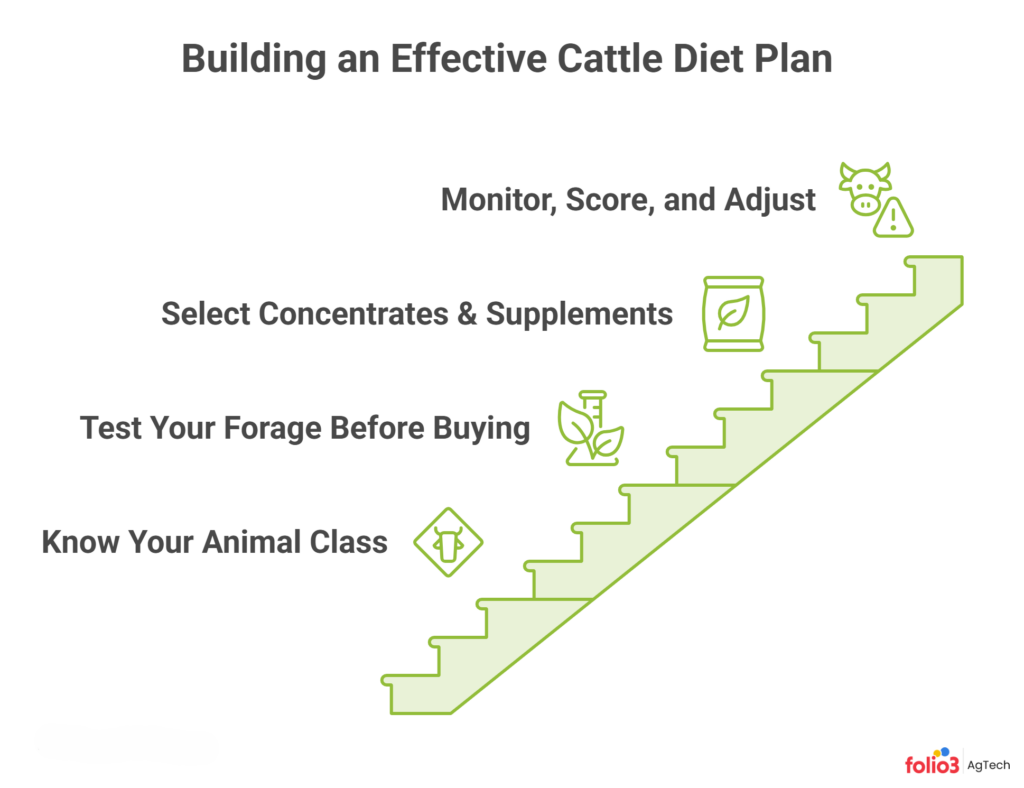
Step 1: Know Your Animal Class and Nutrient Requirements
Start by identifying the animal class you are feeding. A 400-pound weaned calf has completely different nutritional demands than a 1,300-pound cow in late gestation or a finishing steer 60 days from harvest.
Reference NRC guidelines or use cattle diet formulation software like CowCulator, CowBytes, or SPARTAN to pull daily requirements by body weight, production stage, and target gain. The key daily requirements to establish are water, total digestible nutrients (TDN) or net energy for maintenance and gain, crude protein or metabolizable protein, minerals, and vitamins.
One critical point: requirements are expressed as absolute amounts, not percentages. A feed showing 12% crude protein delivers a different amount of actual protein depending on how many pounds the animal eats. Intake drives everything.
Step 2: Test Your Forage Before Buying a Single Bag of Supplement
Forage is almost always your cheapest nutrient source. But if you do not test it, you are guessing. And guessing in cattle nutrition costs real money.
To get an accurate picture, take 15 to 20 core samples per hay lot and combine them into a single composite sample. Submit it to a lab for analysis of NDF (neutral detergent fiber), ADF (acid detergent fiber), crude protein, TDN, and a mineral panel. High NDF means slower digestibility and lower intake. High ADF correlates with lower energy content.
Match your lab results against the requirements for your specific animal class. The gap between what your forage delivers and what the animal needs is exactly what your supplement program should fill. No more, no less.
Step 3: Select Concentrates and Supplements to Fill the Gaps
Once you know where your forage falls short, you can choose the right supplements without overspending.
- Energy deficits: Corn, barley (higher protein than corn), oats (safer but lower energy), or distillers’ grains.
- Protein deficits: Soybean meal (high RUP, strong lysine profile), cottonseed meal, or distillers’ grains, which deliver both energy and protein.
- Feed additives: Ionophores improve feed efficiency by altering rumen fermentation. Buffers like sodium bicarbonate stabilize rumen pH in high-grain dairy diets. Prebiotics support microbial populations in the rumen.
The cardinal rule with grain: introduce it gradually over 2 to 3 weeks. Rumen microbes need time to adapt to high-starch diets. A sudden switch causes acidosis, diarrhea, and a crash in fiber digestion. In cow-calf systems, grain should always supplement forage, not replace it. Keeping adequate long-stem fiber in the diet supports rumination and saliva production, both of which buffer the rumen naturally.
If you want a deeper walkthrough ofhow to manage feed rations for cattle or need help with balancing cattle feed rations by stage, those resources cover the math and formulas in detail.
Step 4: Monitor, Score, and Adjust Continuously
Cattle diet formulation is not something you set once and walk away from. Conditions change. Forage quality shifts. Animals move through production stages. Your ration needs to move with them.
Track Body Condition Score (BCS) at three critical points: weaning, pre-breeding, and 60 days before calving. For beef cows, the target BCS at calving is 5 to 6 on a 9-point scale. Below 5, postpartum cycling delays and rebreeding rates drop. Above 7 to 8, dystocia risk climbs.
Monitor manure consistency as a daily indicator of rumen health. Loose, bubbly manure often signals excess starch or protein. Hard, dry pats indicate insufficient moisture or fiber. Resample stored forages every 60 to 90 days, because nutrient content shifts as hay matures and moisture moves in storage.
Using cattle management apps to track BCS, weights, and feeding records digitally takes the guesswork out of adjustments and keeps your cattle nutrition management data in one place.
Stage-by-Stage Cattle Nutrition Management: From Calving to Finishing
A cow’s nutritional needs are not static. They swing hard depending on whether she is in late gestation, peak lactation, or dry. Managing nutrition by stage, rather than by a single year-round ration, is what separates profitable operations from those that leak money through poor reproductive rates and weak calves.
Late Gestation
The last 60 to 90 days before calving is where roughly 70% of fetal growth occurs. So, underfeeding during this window reduces calf birth weight, weakens calf vigor, and lowers colostrum quality.
Energy and protein demands rise sharply in the final trimester. Cows entering this phase at a BCS below 5 are at serious risk of calving complications and delayed rebreeding. Supplement with quality hay, silage, or range cubes if pasture alone falls short.
First-calf heifers deserve their own feeding group. They need 10 to 15% more energy and protein than mature cows because they are still growing themselves while supporting a calf. Mixing them with the mature herd almost always means they get out-competed at the bunk.
Post-Calving and Rebreeding
This is peak nutritional demand. Even a beef cow producing just 1.5 gallons of milk per day has elevated energy and protein needs that forage alone may not cover.
The cattle partition nutrients toward their own survival first. Reproduction is the first function sacrificed when energy and protein fall short. For beef cows, the goal is to return to cyclicity within 60 to 80 days post-calving to maintain a 365-day calving interval. Cows at BCS below 4 at rebreeding will have significantly reduced conception rates.
Dairy cows face this even more intensely through negative energy balance. Rapid ramp-up of energy-dense TMR is non-negotiable to protect both milk output and body condition through the NEB window.
Weaning and Creep Feeding
Creep feeding or creep grazing gives calves supplemental nutrition when pasture quality is insufficient, especially during drought or on low-quality rangeland. Typical creep rations run 14 to 16% crude protein with moderate energy.
At weaning, calves face simultaneous stress from maternal separation and diet change. Keep weaning rations consistent and high quality to reduce performance dips during the transition. Operations that understand the full cattle operations lifecycle use this stage to set calves up for strong backgrounding performance.
Feedlot and Growing Cattle
The shift from forage-based backgrounding to a high-grain feedlot cattle diet must happen gradually. Plan a step-up program over 21 to 28 days, increasing grain in stages while maintaining fiber.
Finishing ration targets generally run 12 to 14% crude protein and 0.60 to 0.70 Mcal NEg per pound, built on a corn, barley, or distillers grains base with silage or hay for fiber. Bunk management and consistent feeding times reduce sorting and acidosis risk. If you are scaling a feedlot operation, investing in cattle feeding software that tracks pen-level intake and delivery accuracy makes this transition far more predictable.
Feeding Wagyu Cattle: A Specialized Nutrition Strategy
Wagyu cattle diets play by entirely different rules. The goal is not just to finish. It is to deposit intramuscular fat in precise layers over an extended timeline.
Standard feedlot logic does not apply to Wagyu. Where conventional finishing programs push for rapid average daily gain over 120 to 180 days, Wagyu operations slow things down to develop the marbling that defines premium grades of meat.
The Extended Feeding Program and Vitamin A Management
Wagyu cattle typically spend 300 to 600 days on feed. The early phase focuses on slow growth using moderate-energy roughage like grass hay or rice straw. The goal here is frame development before fat deposition begins. The finishing phase shifts to high-energy rations built on barley, corn, and oilseeds, with continued fiber inclusion.
A key differentiator in a Wagyu cattle diet is deliberate Vitamin A restriction during the finishing phase. Lower Vitamin A levels encourage fat cell proliferation within muscle tissue rather than under the skin. But this must be managed carefully. Drop below safe thresholds, and you risk night blindness and reproductive failure. Always work with a qualified nutritionist to set precise supplementation timelines.
Key Differences: Wagyu vs. Conventional Feedlot Cattle
A slower growth rate is intentional in Wagyu. Pushing rapid gain produces lean muscle, not the intramuscular marbling that commands premium pricing. The feeding period is 2 to 3 times longer than a conventional feedlot cattle diet. Feed conversion efficiency matters less than marbling score. Economic benchmarks shift accordingly.
Specialty grains like barley and rice bran are preferred over high-starch, corn-heavy diets. Regular ultrasound evaluation of backfat and ribeye area helps guide ration adjustments through the long feeding window.
Common Cattle Nutrition Mistakes and How to Fix Them
Most nutrition problems do not come from a lack of products. They come from using the wrong product at the wrong time, or skipping the diagnostic step entirely.
- Grass Tetany (Hypomagnesemia): High potassium in lush spring pasture blocks magnesium absorption. Fix: supplement magnesium oxide at a minimum of 1 ounce per head per day, starting two weeks before spring turnout.
- Acidosis: Happens when cattle move to high-grain diets without enough transition time or fiber. Fix: introduce grain over 21 or more days, keep at least 10 to 15% of dry matter as long-stem forage, and consider ionophore inclusion.
- Nitrate Toxicity: Drought-stressed forages like sorghum, sudangrass, and corn stalks accumulate dangerous nitrate levels. Fix: test suspect forages before feeding. Dilute high-nitrate feeds with low-nitrate roughage. Never feed untested drought-stressed forage to pregnant cows.
- Milk Fever (Hypocalcemia): Common in dairy cows at calving when calcium demand outpaces supply. Fix: feed anionic salts in late gestation to precondition calcium metabolism. Maintain the Ca:P ratio near 2:1.
- Blanket Mineral Programs: A one-size-fits-all mineral mix ignores regional forage deficiencies. Fix: test your forages, then build a targeted mineral program. What works in Kansas may leave critical gaps in Louisiana or the Southeast. Operations dealing with broader challenges in agriculture often find that mineral imbalances are one of the easiest problems to fix once diagnosed.
Conclusion
Balanced cattle nutrition is not a line item you set once a year. It is a living management system that responds to your animals, your forages, your environment, and the market.
Water, energy, protein, minerals, and vitamins each play a role. Miss one, and the rest underperform. Requirements shift with production stage, breed, season, and stress level. A static feeding program is a losing program.
Think of quality nutrition as leverage. Every dollar you invest in the right feed at the right time multiplies the return on genetics, health protocols, and land management. If you are looking to tighten your feeding program, a full forage and ration audit is the best place to start. Work with a qualified nutritionist, use data-driven livestock management software to track what is working, and adjust before problems show up on the scale or in your pregnancy check results.
FAQs
What Is the Most Important Nutrient for Cattle?
Water is the most critical nutrient. A deficiency reduces feed intake, milk production, and fertility faster than any other shortfall. Cattle typically need 1 to 2 gallons per 100 pounds of body weight daily, with needs rising sharply during hot weather or lactation.
How Often Should I Test My Forage for Nutrient Content?
Test hay or silage at least once per cutting or lot, and re-test every 60 to 90 days for stored feeds. Nutrient content changes as forage matures and during storage. Testing before buying supplements saves money and prevents over- or underfeeding.
What Body Condition Score Should Beef Cows Be at Calving?
Target a BCS of 5 to 6 on a 9-point scale for mature beef cows at calving. Cows below 5 take longer to return to estrus, reducing rebreeding rates. Cows above 7 to 8 face a higher dystocia risk. First-calf heifers should calve at BCS 6 to support their continued growth demands.
What Is the Difference Between RDP and RUP in Cattle Diets?
Rumen Degradable Protein (RDP) is broken down by rumen microbes and used for microbial protein synthesis. Rumen Undegradable Protein (RUP) bypasses the rumen and is absorbed directly in the small intestine. High-producing dairy cows and fast-growing calves benefit from RUP-rich feeds like soybean meal.
How Do I Transition Feedlot Cattle from Forage to a High-Grain Diet Safely?
Use a step-up ration program over 21 to 28 days, gradually increasing grain while maintaining adequate forage. Start with 50 to 60% forage and reduce to 10 to 15% at full finish. Introduce ionophores early to improve feed efficiency and reduce acidosis risk. Monitor bunk behavior and manure consistency daily.