
Soil is the foundation of every farm. Yet according to the Food and Agriculture Organization (FAO), around one-third of the world’s farmland is moderately to highly degraded, with erosion carrying away 25 to 40 billion tonnes of topsoil every year. For farmers, that is not just an environmental concern. It is a direct threat to yields, input costs, and long-term profitability.
If you have noticed declining productivity, higher fertilizer needs, or poor water retention on your land, chances are your soil is signaling a problem. The good news is that regenerative soil practices give you a clear, proven path to reverse that damage.
This blog covers the top regenerative soil practices that farmers are using today to restore soil health, cut input costs, protect against erosion, and build lasting productivity. Whether you are just getting started or looking to take your approach further, you will find practical, field-level guidance here.
What Are Regenerative Soil Practices?
Regenerative soil practices are farming and land management methods that rebuild soil biology, organic matter, and structure over time. Unlike conventional approaches that focus on short-term output, regenerative agriculture soil health principles aim to leave the land in better condition than you found it.
The core idea is simple. Healthy soil produces healthy crops. And healthy soil comes from biological activity: microbes, fungi, earthworms, and organic matter all working together to cycle nutrients, hold water, and keep structure intact.
Soil regeneration is not a single technique. It is a set of interconnected practices that work best when used together. Most farms start with one or two changes and build from there.
What makes these practices worth your attention is the business case. Farmers who apply regenerative practices consistently report lower fertilizer spend, better drought resilience, and more stable yields over time. That translates to better margins without relying on inputs that get more expensive every season.
Why Soil Health Matters More Than You Think
Before getting into the specific practices, it is worth understanding why regenerating soil is so important from a practical farming perspective.
Degraded soil holds less water, which hurts you in dry seasons. It compacts more easily under machinery and livestock, reducing root penetration. It has fewer microbes to break down nutrients, so you end up spending more on fertilizers that are less effective. And it erodes faster, meaning you permanently lose the most fertile top layer.
Soil generation is not just about ecology. It is about the long-term productivity and financial health of your operation. Farms that invest in soil restoration methods today are building an asset. Farms that ignore it are slowly depleting one.
The good news: soil can recover. With consistent application of the right soil regeneration techniques, you can see measurable improvement in organic matter, water retention, and yield stability within just a few seasons.
Top Regenerative Soil Practices to Improve Farm Productivity
1. Cover Cropping
Cover cropping is one of the most widely used and proven regenerative soil practices available to farmers today. It involves planting crops during the off-season or between cash crops to keep the soil covered and biologically active.
When soil sits bare, it loses structure from rain impact, bakes under the sun, and bleaches of organic matter. Cover crops solve all three of these problems at once.
The roots of cover crops hold soil in place, which is one of the most effective answers to the question of which practice helps reduce soil erosion. Above ground, their canopy breaks the force of rain before it hits the soil surface. Below ground, the roots create channels that improve water infiltration and loosen compacted layers.
When cover crops are terminated and worked into the soil or left as mulch, they decompose and feed soil microbes, adding organic matter that improves structure and nutrient availability.
Common cover crop choices include legumes like clover and vetch, which fix atmospheric nitrogen and reduce your fertilizer bill. Cereal rye, oats, and radishes are other popular options depending on your region and rotation goals.
From a cost-benefit standpoint, cover crops do require seed and sometimes termination costs. But the returns in reduced erosion, lower fertilizer use, and improved water-holding capacity pay back those costs across multiple seasons. You can read more about building the full context for this in our look at sustainable crop production.
2. Reduced and No-Till Farming
Conventional tillage breaks apart soil aggregates, kills off fungal networks, releases stored carbon into the atmosphere, and leaves soil vulnerable to erosion. It is one of the most damaging things a farm can do to its soil on a repeated basis.
Reduced tillage and no-till farming are soil regeneration techniques that minimize or eliminate mechanical soil disturbance. The goal is to preserve the existing structure, protect the microbial communities living in it, and keep organic matter intact.
When you stop tilling, a few things happen. The mycorrhizal fungi networks that connect plant roots and transfer nutrients stay intact. Worm populations increase, which naturally aerates the soil. Water infiltration improves because existing pore structures are not disrupted. And organic matter accumulates rather than oxidizing away.
No-till is not always a perfect fit for every operation from day one. You may need to invest in appropriate seeding equipment and manage weed pressure differently. But most farmers who transition report that after an adjustment period of one to three seasons, input costs drop and soil performance improves noticeably.
Reduced tillage is a good middle ground if you are not ready to go fully no-till. Even cutting the number of tillage passes per season produces measurable soil health benefits over time.
3. Crop Rotation
Planting the same crop in the same field year after year depletes specific nutrients, builds up crop-specific pests and diseases, and reduces microbial diversity. It is one of the fastest routes to declining soil fertility.
Crop rotation, the practice of alternating different crop types across seasons and fields, is a foundational soil regeneration farming method. Different crops draw on different nutrients, have different root depths, and leave behind different residue profiles. This variation keeps soil biology diverse and balanced.
Rotating between grains and legumes is one of the most effective approaches. Legumes fix nitrogen, which feeds the following grain crop with far less synthetic fertilizer input. Rotating deep-rooted crops with shallow-rooted ones breaks up hardpan layers and improves drainage.
Crop rotation also naturally breaks pest and disease cycles without relying on chemical inputs. If a pathogen is building up in the soil on a particular crop, rotating to a non-host crop starves that pathogen out over one to two seasons.
The financial case for crop rotation in your farming system is strong. It reduces fertilizer spend, cuts pesticide use, and protects yields against the yield drag that comes with monocropping over time.
4. Composting and Organic Matter Addition
One of the most direct soil restoration methods is adding organic matter back to the land in the form of compost, manure, or crop residue.
Organic matter is the engine of soil biology. It is what feeds bacteria, fungi, and other microorganisms that cycle nutrients and maintain structure. When organic matter levels fall below about 3 percent, soil function deteriorates rapidly. When you bring it back up, water-holding capacity, nutrient availability, and biological activity all improve together.
Compost can be made on-farm from crop residues, food waste, and manure, keeping costs low and creating a closed-loop nutrient system. Applied regularly, it builds soil organic carbon levels over time, which is the core goal of soil generation.
Livestock manure is another high-value organic amendment when managed correctly. It delivers nitrogen, phosphorus, and potassium alongside organic carbon, and it does so in a slow-release form that is far more efficient than synthetic fertilizer in reducing leaching losses. Our deep look at manure management strategies covers how to handle this effectively at farm scale.
One thing to note: raw manure applied incorrectly can cause nutrient runoff or introduce pathogens. Composting first, or timing applications to match crop uptake windows, eliminates most of these risks.
5. Rotational Grazing
If you run livestock, rotational grazing is one of the most powerful regenerative practices available to you. It is also one of the most misunderstood.
Continuous grazing keeps animals on the same land for too long, stripping vegetation, compacting soil under repeated hoof pressure, and degrading root systems to the point where the land cannot recover between seasons.
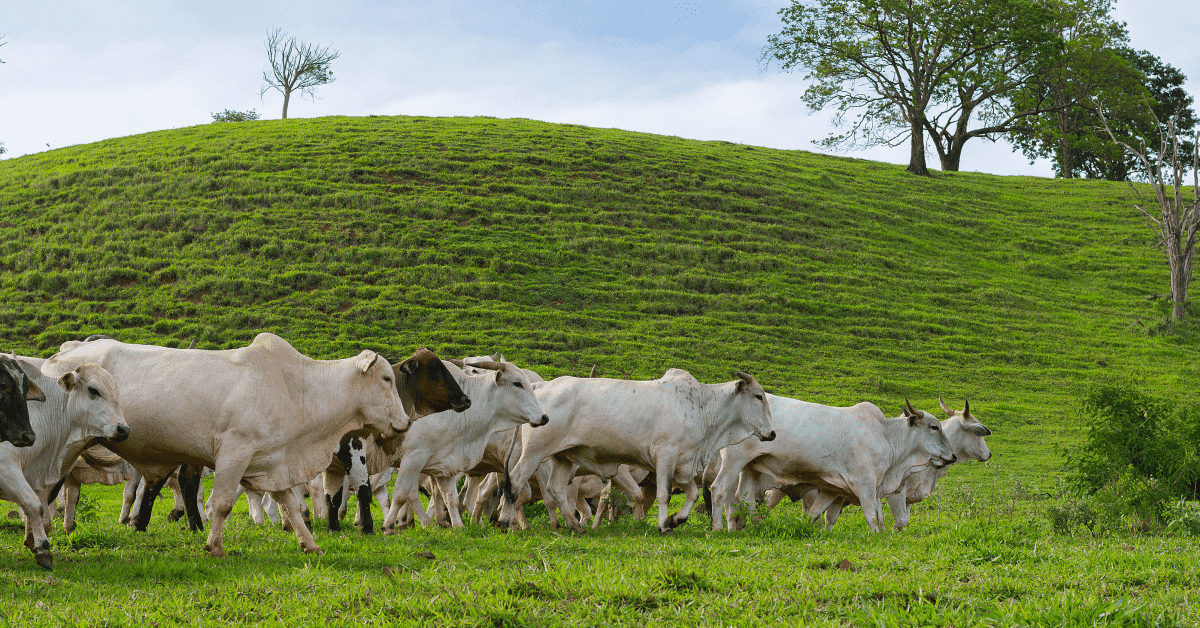
Rotational grazing moves livestock across a series of paddocks on a structured schedule. Each paddock gets grazed for a short period, then rested for long enough that vegetation fully regrows. This mimics the natural movement patterns of wild herds and produces a very different outcome for soil health.
When vegetation regrows fully before the next grazing cycle, roots deepen and die back in pulses that feed soil microbes with organic carbon. Hoof action during grazing breaks up surface crust and presses seeds into soil, improving germination. And because grazing pressure is concentrated and then completely removed, the land gets real recovery time.
The soil impacts are significant. Rotational grazing reduces compaction, increases organic matter, and improves water infiltration. Farms running structured rotational grazing schedules also tend to carry more animals per acre over time because the land stays more productive.
6. Mulching
Mulching is the practice of covering soil with organic material, including straw, wood chips, leaves, or compost, to protect the surface from direct sun, rain impact, and erosion.
It is one of the simplest and most accessible regenerative soil practices, particularly for vegetable growers, orchard operators, and smaller diversified farms.
A mulch layer does several things at once. It insulates soil from temperature extremes, keeping it cooler in summer and warmer in autumn. It retains moisture by reducing evaporation, which cuts irrigation requirements. And as it breaks down, it feeds surface-dwelling microbes and adds organic matter to the top layer of soil.
From an erosion standpoint, mulch absorbs the kinetic energy of rainfall before it hits bare soil. This prevents surface crusting, which is what causes runoff and erosion during heavy rain events.
For fruit and vegetable operations especially, consistent mulching builds what is sometimes called a “living skin” on the soil surface: a biologically active layer that processes organic matter, suppresses weeds, and maintains moisture with minimal additional inputs.
7. Agroforestry and Silvopasture
Most blogs on regenerative soil practices skip this section. That is a missed opportunity, because integrating trees into crop and livestock systems is one of the highest-impact soil restoration methods available at farm scale.
Agroforestry is the deliberate integration of trees and shrubs into crop and livestock systems. Silvopasture is a specific form that combines trees, forage, and grazing livestock on the same land.
Trees contribute to soil health in multiple ways. Their deep root systems pull water and nutrients from lower soil layers and cycle them to the surface through leaf litter. Their roots create stable, long-lasting channels through compacted subsoil. And the organic matter from leaf fall and root turnover adds significantly to surface and subsurface carbon levels.
For farms experiencing severe topsoil erosion, windbreaks and tree lines reduce wind erosion by physically blocking the flow of air across the land surface. This is especially relevant on open arable fields in dry climates.
The economic returns from agroforestry come from multiple sources: timber, fruit or nut crops, improved pasture productivity, and reduced fertilizer costs. It takes more planning to implement than a single-season practice, but the long-term returns per acre are among the highest of any regenerative approach.
8. Minimizing Synthetic Chemical Inputs
This is not about going fully organic overnight. It is about being deliberate with synthetic fertilizers, herbicides, and pesticides because their overuse actively undermines the soil biology you are trying to build.
Synthetic nitrogen applied at high rates disrupts the natural nitrogen-fixing bacteria in the soil, reducing the biological nitrogen supply that healthy soil naturally provides. Herbicides can kill off soil fungi, particularly mycorrhizal species that are critical for nutrient uptake. Pesticides reduce the invertebrate populations that aerate soil and break down organic matter.
Transitioning to more targeted, reduced-rate applications allows soil biology to recover and take over more of the nutrient cycling work. This reduces your input spend over time while improving soil function.
This does not mean going without inputs entirely. It means matching your fertilizer application strategy to what the soil actually needs, rather than applying flat rates based on convention.
Soil testing before each season, and tracking organic matter levels year over year, gives you the data to reduce inputs strategically rather than guessing.
9. Contour Farming and Erosion Control Structures
On sloped land, regenerative soil practices need to address the physical movement of water across the landscape. Contour farming, where you plant and till along the contour lines of a slope rather than up and down it, slows water flow and keeps topsoil in place.
Where contour farming alone is not enough, erosion control structures like grass waterways, check dams, and swales intercept runoff before it gains speed and carries soil off the field. These are especially valuable on farms where heavy rainfall events are common or where topsoil is already thin.
This is often the most direct answer to which practice helps reduce soil erosion at the field level. When water cannot run freely in channels down a slope, erosion drops sharply.
Implementing contour farming requires mapping your fields and adjusting your equipment and planting patterns. On highly erodible land, the investment in time and any earth-moving required pays back quickly through reduced topsoil loss and improved moisture retention across the slope.
How to Start Applying Regenerative Soil Practices on Your Farm
The biggest mistake farmers make when approaching soil regeneration is trying to change everything at once. That rarely works practically and often leads to more confusion and cost than benefit.
A more effective approach:
- Start with a soil test. Know your current organic matter levels, nutrient profile, and any compaction issues. This gives you a baseline and helps you prioritize which practice will have the biggest impact first.
- Pick one or two practices suited to your system. If you run livestock, rotational grazing and composting are natural starting points. If you run crops, cover cropping and reduced tillage are the lowest barrier entries. You can explore a broader set of approaches in our overview of regenerative agriculture practices for more context.
- Track what changes. Repeat soil tests every one to two years. Keep records of input costs, yields, and water usage. The data will show you where the returns are coming from and guide your next decisions.
- Scale up over time. Once you have a foundation of healthy soil practices in place, adding additional layers like agroforestry or more complex rotations becomes much more manageable.
Technology is also becoming an important part of this process. Precision agriculture tools, remote sensing, and a farm management platform helps you track soil health indicators across your entire operation, not just from manual tests. If you want to understand how technology is reshaping how farms manage this, our coverage of how agricultural technology is improving farm outcomes is a good starting point.
Common Mistakes Farmers Make with Soil Regeneration
Adopting regenerative practices takes some adjustment. Here are the most common mistakes to watch for:
- Expecting immediate results. Soil biology rebuilds slowly. Most practices show measurable improvements after one to three seasons. Stopping after the first year because you do not see instant gains will mean missing the payback entirely.
- Applying practices in isolation. Cover cropping alone will help. But cover cropping combined with no-till and reduced synthetic inputs compounds the benefit. These practices reinforce each other. Treating them as standalone fixes limits what you can achieve.
- Skipping soil testing. Without data, you cannot tell whether what you are doing is working. Regular testing is inexpensive and removes the guesswork from your investment decisions.
- Choosing the wrong cover crops for your climate or rotation. Not every species works in every environment. Research locally adapted options or consult an agronomist familiar with your region before committing to a species mix.
If you are working to improve your farm’s overall productivity alongside your soil health work, our guide to improving farm efficiency covers additional operational approaches that complement what you are building at the soil level.
Measuring Progress in Regenerative Agriculture Soil Health
You cannot manage what you do not measure. Tracking your soil’s improvement over time is what turns a collection of practices into a real land management strategy.
The most useful metrics to track:
- Soil organic matter (SOM): This is the single most important indicator of overall soil health. Aim to increase it by at least 0.1 to 0.2 percent per year with consistent practice application.
- Soil respiration: A proxy for biological activity. Higher respiration indicates more active microbial communities doing nutrient cycling work.
- Aggregate stability: Measures how well soil clumps hold together under water pressure. Better aggregation means better erosion resistance and water infiltration.
- Water infiltration rate: How fast water moves into the soil surface. Improving this reduces runoff, erosion, and drought stress simultaneously.
- Yield stability: Not just peak yield, but consistency across seasons, including dry years. Regenerative soil typically shows narrower yield variation over time as water and nutrient availability become more stable.
The broader shift happening in farming right now, toward data-driven smart farming technology, makes measuring these indicators more accessible than ever. Sensors, satellite imagery, and digital farm records can all feed into a clearer picture of where your soil is heading.
Conclusion
Regenerative soil practices are not a trend. They are a return to how productive land actually works, supported now by a strong and growing body of research and real-world results from farms around the world.
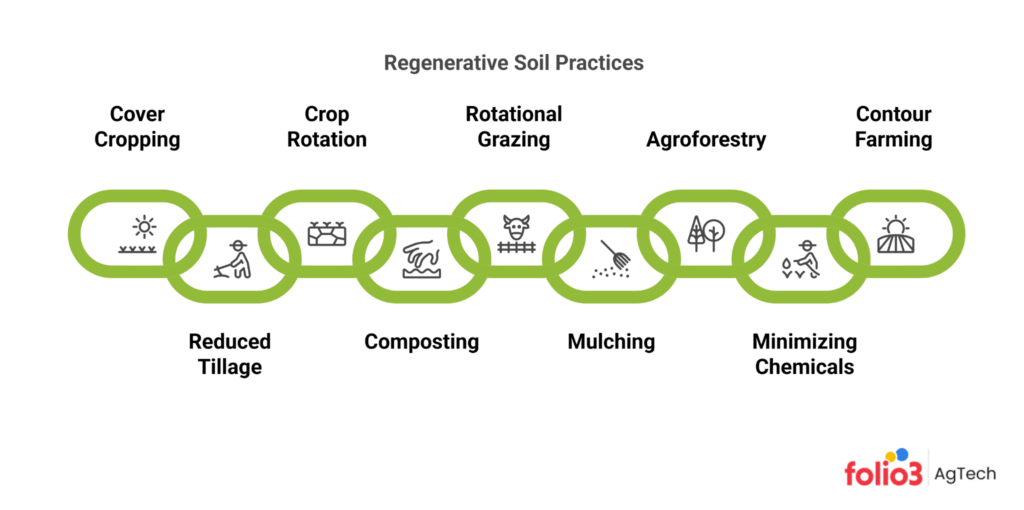
The practices covered in this blog, cover cropping, reduced tillage, crop rotation, composting, rotational grazing, mulching, agroforestry, reduced chemical inputs, and contour farming, each contribute to the same goal: soil that holds more water, cycles nutrients more efficiently, resists erosion, and supports stable, profitable yields season after season.
The financial case is real. Farms that invest in soil regeneration consistently see input costs fall and yield resilience improve over a three to five-year horizon. The starting point is often one or two changes made consistently, not a complete overhaul overnight.
Your soil is a long-term asset. The regenerative soil practices you put in place today determine what your land is capable of producing for the next decade and beyond.
FAQs
What Are The Most Effective Regenerative Soil Practices For Improving Crop Yields?
Cover cropping, crop rotation, composting, and reduced tillage are the most effective starting points for most farms. Together they rebuild organic matter, support soil biology, and improve water and nutrient availability, all of which directly support higher and more stable yields. The right combination depends on your crop system, climate, and current soil condition.
Which Practice Helps Reduce Soil Erosion The Most?
Cover cropping and contour farming are the two most effective individual practices for reducing soil erosion. Cover crops protect soil from rain impact and hold topsoil in place with their root systems. Contour farming slows water flow across sloped land so runoff cannot carry soil downhill. Used together, they provide strong erosion protection across most farm types.
How Long Does Soil Regeneration Take To Show Results?
Most farms see measurable improvements in soil organic matter, water infiltration, and microbial activity within one to three seasons of consistent practice application. Some benefits like reduced erosion and better moisture retention appear quickly. Others, like significant organic matter accumulation or restored microbial diversity, build over three to five years. Tracking soil test results annually helps you measure the progress as it happens.
Can Regenerative Soil Practices Work Alongside Conventional Farming Methods?
Yes. Most farms adopt regenerative soil practices gradually rather than switching all at once. Starting with cover crops or reducing tillage on part of the farm while maintaining existing practices elsewhere is a common and practical approach. Over time, as the data shows what is working, many farmers expand their regenerative practices further while maintaining the outputs they need from their operation.
What Is The Difference Between Regenerative Agriculture And Sustainable Agriculture?
Sustainable agriculture aims to maintain current productivity without depleting resources. Regenerative agriculture goes a step further: it actively restores and improves soil health, biodiversity, and ecosystem function over time. Sustainable is essentially neutral in its impact. Regenerative is intentionally restorative. For farmers dealing with degraded or declining soil, regenerative practices offer a path to recover productivity that sustainable practices alone may not provide.
Is Regenerative Agriculture Soil Health Improvement Possible On A Small Farm?
Absolutely. In fact, smaller farms often have an advantage because they can implement changes across their entire operation more quickly and observe results more directly. Cover cropping, composting, and rotational grazing all scale down effectively. The principles of soil regeneration farming apply regardless of farm size, and the financial benefits in reduced inputs and better yields are proportionally just as meaningful on a small operation.