
Water is getting harder to find, more expensive to pump, and more unpredictable every season. If you are growing crops in today’s climate, you already know the math: less water, rising costs, and a shrinking margin for error.
This guide connects the dots between smart agronomy and modern AgTech so you can stretch every drop further. Whether you are a farm manager, agronomist, or crop consultant, you will walk away with a clear plan to protect your yields and your bottom line through better agricultural water management.
What Is Agricultural Water Management and Why Is It Critical?
Agricultural water management is the process of controlling how water moves into, through, and out of your fields. It covers sourcing, scheduling, applying, and draining water so your crops get exactly what they need without waste. Think of it as a system-level approach that ties together irrigation, drainage, soil health, and weather data into one strategy.
The stakes are massive. Agriculture accounts for roughly 70% of all global freshwater withdrawals, and that number climbs to 90% in many low-income regions. At the field level, poor water management in agriculture triggers a chain reaction of problems that directly hit your wallet and your soil:
- Soil erosion: Excess runoff strips topsoil, carrying away your most productive layer and the nutrients you paid to put there.
- Waterlogging: Saturated root zones starve plants of oxygen, leading to stunted growth and root diseases.
- Salinity buildup: Without proper drainage, dissolved salts concentrate in the root zone, reducing water uptake and killing sensitive crops.
- Nutrient leaching: Over-irrigation pushes nitrogen, phosphorus, and potassium below the root zone, wasting inputs and contaminating groundwater.
Every one of these problems costs you money, whether through lost yield, wasted inputs, or degraded land value. That is why improving agricultural productivity starts with getting water right.
The 4R’s Framework of Irrigation Management
You have likely heard about the 4R framework in nutrient management. The same logic applies perfectly to agricultural water management techniques. Each “R” targets a specific decision point in your irrigation cycle. Get all four right, and you minimize waste while maximizing crop response.
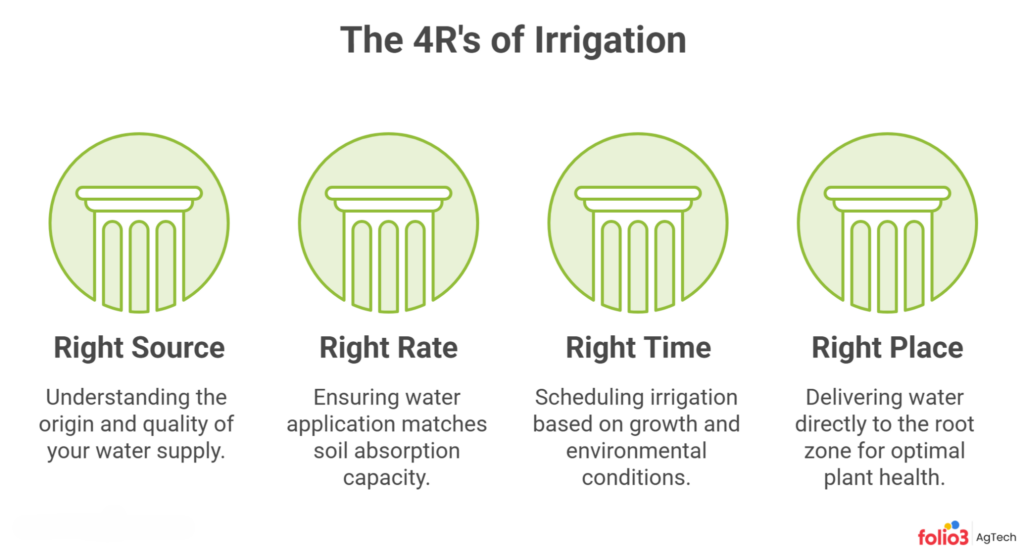
1. Right Source: Know Where Your Water Comes From
Before you schedule a single irrigation event, you need to understand your water supply. Are you pulling from groundwater wells, surface water reservoirs, or municipal supplies? Each source comes with its own quality profile and legal considerations.
Groundwater tends to be more consistent in supply but often carries higher dissolved salts, especially in arid regions. Surface water is typically lower in salinity but subject to seasonal fluctuations and competing demands. Always test your water for electrical conductivity (EC), sodium adsorption ratio (SAR), and bicarbonate levels. These numbers tell you whether your water will help or hurt your soil over time.
Do not overlook water rights and local allocation rules. In many western U.S. states, water rights are “use it or lose it,” which creates pressure to apply more water than your crops actually need. Understanding your legal entitlements keeps you compliant and helps you plan realistically.
2. Right Rate: Match Water to Soil Intake
Applying water faster than your soil can absorb it creates runoff. Applying too little leaves your crop stressed during critical growth stages. The goal is to match your irrigation rate to your soil’s infiltration capacity.
Sandy soils absorb water quickly but hold less of it. Clay soils absorb slowly but retain more. Loam sits in the middle. Run a simple infiltration test or check your NRCS soil survey data to understand how fast your specific field takes in water. Then set your irrigation system’s application rate to stay below that threshold.
Variable-rate irrigation (VRI) technology takes this further by adjusting water application across different zones within the same field. If one section is heavy clay and another is sandy loam, VRI applies the right rate to each, rather than overwatering one to adequately water the other.
3. Right Time: Schedule Based on Crop Demand
Timing irrigation around crop growth stages delivers the biggest return on every gallon you apply. Corn during tasseling, soybeans during pod fill, and wheat during heading all have peak water demands that directly impact yield.
Modern scheduling tools pull together soil moisture sensor data, evapotranspiration (ET) rates, and weather forecasts to tell you exactly when to irrigate. The old “calendar-based” approach, irrigating every Tuesday whether the crop needs it or not, leaves money on the table. Tools like IoT-powered crop health monitoring systems help remove guesswork and align irrigation events with actual plant stress signals.
4. Right Place: Get Water to the Root Zone
Even the best timing and rate mean nothing if water lands where roots cannot reach it. Uniform distribution across the active root zone is the final piece of the 4R framework.
Field audits reveal that many center pivot systems deliver 15-20% more water to some areas than others due to pressure variations, worn nozzles, or terrain changes. Regular maintenance and pressure regulation keep your system distributing evenly. For row crops, subsurface drip irrigation places water directly in the root zone, cutting evaporation losses to near zero.
Modern Agricultural Water Management Solutions and Technologies
The gap between a struggling farm and a thriving one often comes down to which water management technology in agriculture gets adopted. Today’s agricultural water management solutions combine hardware, software, and data science to give you field-level control that was not possible even a decade ago. Many growers are also leveraging agriculture software solutions to centralize irrigation data, monitor field conditions, and make more informed water management decisions across their operations.
Precision and Smart Irrigation Systems
- Variable-Rate Irrigation (VRI): VRI-equipped center pivots use GPS and prescription maps to adjust water application zone by zone within a single field. Instead of applying a blanket rate, you match water delivery to soil type, topography, and crop demand at each point. This technology alone can cut water waste by 15-20% on fields with significant variability.
- Automated Drip Irrigation Networks: Drip systems deliver water directly to the root zone through emitters spaced along tubing. Research shows drip irrigation can reduce field water consumption by 30-50% compared to traditional surface irrigation. When paired with automation controllers and soil moisture feedback, these systems run themselves, adjusting flow based on real-time conditions.
- Center Pivot Optimization: Modern center pivots integrate GPS guidance, end-gun control, and variable-speed drives to maximize uniformity while cutting energy use. Retrofitting an older system with smart controls is often more cost-effective than replacing it entirely.
If you are exploring how smart farming technology fits into your operation, irrigation upgrades typically deliver the fastest payback.
Remote Sensing and Satellite Analytics
- Evapotranspiration (ET) Monitoring: Satellite-derived ET data shows you exactly how much water each part of your field is losing to the atmosphere. When actual ET exceeds your irrigation plus rainfall, your crop is under stress. ET-based scheduling replaces guesswork with measurements.
- Normalized Difference Moisture Index (NDMI): NDMI maps use near-infrared and shortwave-infrared bands from satellite imagery to assess vegetation water content. This gives you a bird’s-eye view of stress patterns before they become visible to the naked eye, letting you target irrigation to specific zones rather than watering the entire field.
- Multispectral Drone Surveys: For field-level detail between satellite passes, drones in agriculture equipped with multispectral cameras identify problem areas in hours, not days. You can spot clogged emitters, ponding, or dry spots before they cost you yield.
Advanced Soil Sensors and IoT
- Capacitance Sensors: These measure soil moisture by detecting changes in the dielectric constant of the soil at multiple depths. They give you continuous, real-time data on water availability across the root zone, making them ideal for trigger-based irrigation scheduling.
- Tensiometers: Tensiometers measure soil water tension, telling you how hard your plants have to work to extract water. This is especially valuable in fine-textured soils where volumetric moisture readings alone can be misleading. They give you a direct indicator of plant-available water.
- Cosmic-Ray Neutron Probes: A newer technology gaining traction in research settings, cosmic-ray neutron probes measure area-averaged soil moisture over a radius of roughly 200-300 meters and a depth of up to 70 cm. Supported by international research bodies, these probes offer highly accurate, noninvasive root-zone monitoring that complements point sensors. For growers managing large fields, this technology fills the gap between a single sensor and satellite data.
These sensor networks feed data back into farm data management platforms, where it is combined with weather, crop management models, and historical performance to generate actionable recommendations.
Sustainable Practices: Bridging Soil Health and Water Conservation
Your soil is your biggest water storage system. Building it right means every rain event and irrigation cycle does more work.
The most expensive water management technology on the market still underperforms if your soil cannot hold water where roots can use it. Sustainable practices treat the soil itself as your primary agricultural water management resource, storing moisture, reducing evaporation, and buffering against drought.
Cover Cropping and Mulching
Cover crops do more than prevent erosion. Their root systems create channels that improve water infiltration, and their biomass shields the soil surface from direct sun, reducing evaporation. According to data from the USDA-NRCS Engineering Handbook, soils with continuous living cover can hold up to 4.2 inches of water compared to just 1.7 inches in bare soil. That is a 147% increase in water-holding capacity.
After termination, cover crop residue acts as a natural mulch layer. This slows surface evaporation, moderates soil temperature swings, and feeds soil biology that builds organic matter over time. Species like cereal rye, crimson clover, and radishes each bring different benefits. Rye produces heavy biomass for maximum ground cover, clover fixes nitrogen, and radishes break through compacted layers to improve deeper infiltration.
For growers interested in building long-term soil resilience, combining cover cropping with regenerative soil practices creates a compounding return on soil health and water retention year after year.
Conservation Tillage
Every pass with a moldboard plow breaks apart the soil aggregates that hold water and exposes moist subsurface soil to evaporation. Conservation tillage, whether no-till or strip-till, keeps the soil structure intact and residue on the surface.
No-till fields typically show higher infiltration rates and lower runoff than conventionally tilled fields. The soil surface stays armored with crop residue, so rainfall enters the profile rather than running off. Over time, undisturbed soils build stronger aggregate stability, better macropore networks, and more mycorrhizal fungi activity, all of which increase your soil’s ability to capture and hold water.
Strip-till offers a middle ground for growers who need a seedbed but want to preserve most of their residue. By tilling only a narrow strip where the seed goes, you maintain 60-70% of the benefits of full no-till while addressing specific planting challenges.
Dry Farming and Rainwater Harvesting
In regions where irrigation is limited or unavailable, dry farming techniques stretch stored soil moisture through the entire growing season. The approach depends on deep-rooted crop varieties, careful planting timing, and aggressive weed control to eliminate competition for moisture.
Rainwater harvesting complements this by capturing and storing seasonal precipitation for later use. Simple techniques like contour farming, terracing, and farm ponds slow runoff and direct water into the soil or storage. More advanced setups use lined reservoirs, check dams, and in-field water harvesting structures.
Selecting drought-tolerant native crop varieties is a cornerstone of dry farming. These varieties have been bred or selected for deep root systems, waxy leaf coatings, and other traits that reduce water loss. Combined with climate-smart agriculture practices, dry farming can sustain viable production where irrigation is simply not an option.
Overcoming Common Water Management Challenges
Knowing the science is one thing. Dealing with real-world conditions in your field is another. Here are the most common challenges growers face with water management in agriculture and the agricultural water management solutions that address each one.
| Challenge | Impact on Your Crop | AgTech/Agronomic Solution |
| Soil Salinity | Reduces root water uptake through osmotic stress, causing wilting even when soil appears moist. Yield losses can reach 25-50% in severely affected areas. | Apply calculated leaching fractions to flush salts below the root zone. Use drip irrigation to maintain a consistent low-salinity wetting zone. Monitor EC levels with soil sensors and select salt-tolerant crop varieties. |
| Waterlogging | Saturates the root zone, cutting off oxygen supply and causing root asphyxiation. Creates ideal conditions for root rot, Pythium, and Phytophthora. | Install subsurface tile drainage to remove excess water. Use soil moisture sensors to avoid over-irrigation. Implement controlled drainage structures that allow you to manage water table depth. |
| Drought and Scarcity | Triggers permanent wilting, especially during reproductive growth stages. Can collapse yields entirely if critical water windows are missed. | Deploy ET-based scheduling to prioritize limited water on high-value growth stages. Integrate organic matter through cover cropping to increase soil water-holding capacity. Consider deficit irrigation strategies that accept minor yield reductions to stretch limited water across more acres. |
| Nutrient Runoff | Carries nitrogen and phosphorus off fields and into waterways, wasting expensive inputs and creating environmental compliance risks. | Use precision fertigation through drip systems to place nutrients directly in the root zone. Pair with variable-rate technology and buffer strips to reduce edge-of-field losses. |
| Aging Infrastructure | Outdated pipes, canals, and pumps waste 20-30% of water before it ever reaches your field. | Audit your delivery system for leaks and inefficiencies. Retrofit with smart controllers, pressure regulators, and flow meters. Phase in drip or low-energy precision application (LEPA) systems where feasible. |
The ROI of Smart Water Management (Why It Pays to Upgrade)
Every improvement you make to your water management system shows up on your bottom line. Here is where the money is:
- Lower pumping costs: Irrigating less means running your pumps fewer hours. Energy is often the second-largest variable cost for irrigated farms. Switching to a precision system that cuts water use by even 20% translates directly into energy savings on every acre-foot you do not pump.
- Higher yield per drop: A 2025 study by the Association of Equipment Manufacturers (AEM) found that precision agriculture technologies have boosted annual U.S. crop production by 5%, with potential for an additional 6% gain through wider adoption. That same study documented 5% less water usage alongside 7% less fuel and 8% fertilizer optimization.
- Reduced input waste: When water goes where it should, nutrients stay in the root zone instead of leaching below it. Fertigation through drip systems can cut fertilizer use while improving uptake, because you are feeding the root, not the water table.
- Sustainability incentives and market access: Carbon credit programs, outcome-based funding, and buyer sustainability mandates all reward operations that demonstrate measurable water stewardship. Documenting your water management improvements through digital record-keeping and farm analytics platforms positions you to access these revenue streams.
If you are looking to quantify the impact of upgrading your water management, connect with our AgTech team for a consultation on how precision irrigation and data-driven water management can drive measurable ROI for your operation.
FAQs
How Does Soil Type Affect Irrigation Scheduling?
Soil texture directly controls how fast water enters the profile and how much it holds. Sandy soils drain quickly and need shorter, more frequent irrigations. Clay soils hold more moisture but absorb it slowly, requiring lower application rates to prevent runoff.
What Is the Difference Between Drip Irrigation and Sprinkler Irrigation?
Drip irrigation delivers water directly to the root zone through low-pressure emitters, achieving 90-95% application efficiency. Sprinkler systems distribute water overhead, typically reaching 60-80% efficiency due to evaporation and wind drift losses.
Can Small Farms Benefit From Precision Water Management?
Yes. Affordable soil moisture sensors, smartphone-based weather apps, and simple timer-controlled drip kits make precision water management accessible at any scale. Even basic scheduling improvements can cut water use by 15-20% without major capital investment.
How Do You Measure Water Use Efficiency on a Farm?
Water use efficiency (WUE) is typically calculated as crop yield produced per unit of water consumed, often expressed as bushels per acre-inch or kilograms per cubic meter. Tracking WUE over seasons using farm management software helps you benchmark performance and measure the impact of system upgrades.
What Government Programs Support Agricultural Water Conservation?
In the U.S., the USDA-NRCS offers cost-share programs through EQIP (Environmental Quality Incentives Program) and CSP (Conservation Stewardship Program) that help fund irrigation upgrades, cover cropping, and soil health improvements. State-level programs and regional water districts often provide additional grants or low-interest financing for efficiency retrofits.