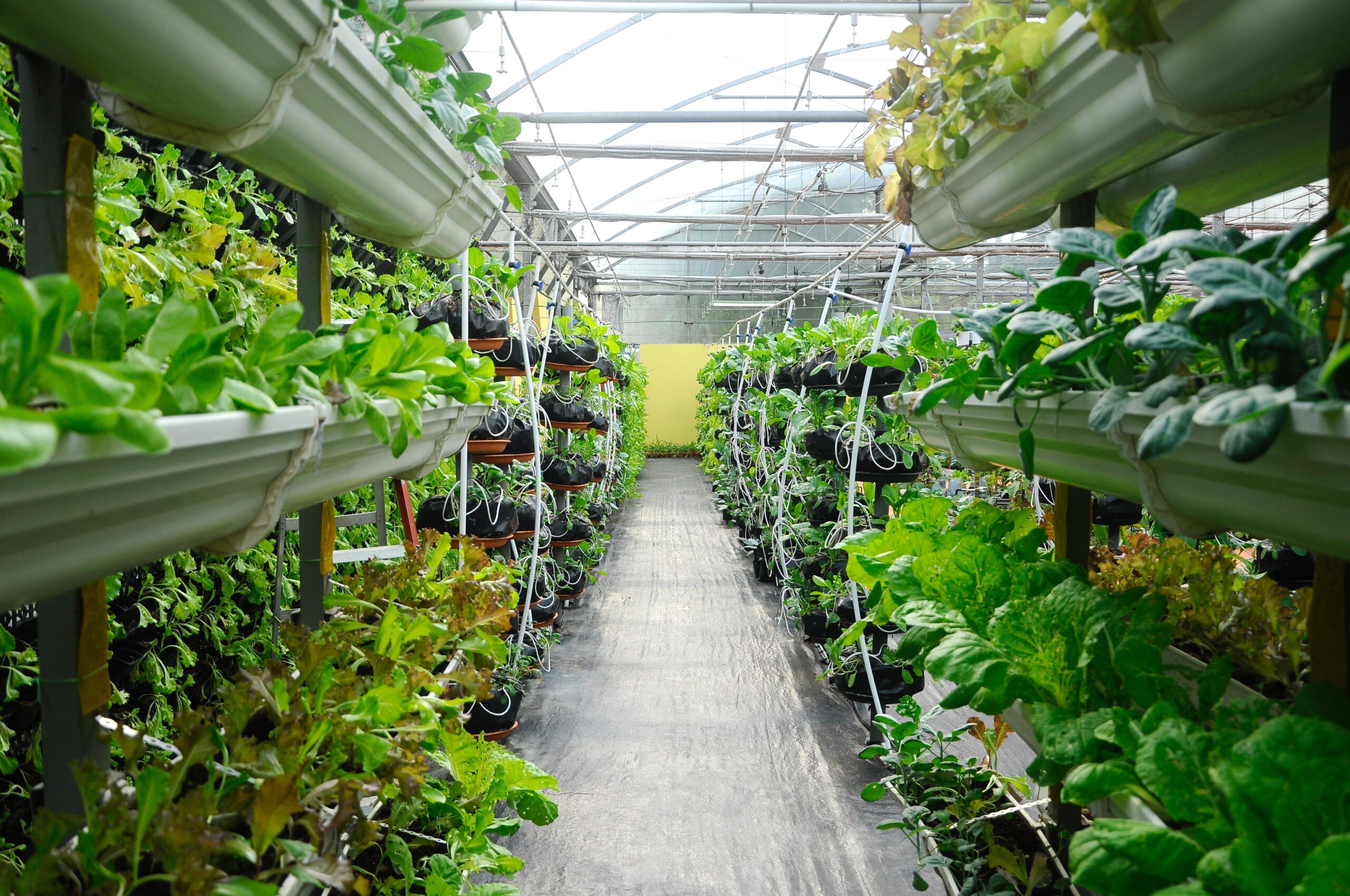

You’re spending more on fertilizer every season, and a big portion of it never even reaches your crops. Traditional broadcasting wastes nutrients through runoff, leaching, and uneven distribution. There’s a smarter way to feed your plants.
Fertigation combines irrigation and fertilization into a single, efficient process. It delivers dissolved nutrients directly to the root zone through your existing water lines. The result? Less waste, lower input costs, and healthier crops.
This guide walks you through everything you need to know, from basic definitions to advanced precision systems, so you can decide whether fertigation belongs in your operation.
Deciphering the Concept: What is Fertigation and Its Meaning in Agriculture?
Fertigation is one of the most talked-about shifts in modern nutrient delivery. Here’s what it actually means and why it matters for your bottom line.
What is Fertigation? Defining the Hybrid Technique
Fertigation is the practice of injecting water-soluble fertilizers directly into an irrigation system to deliver nutrients to crops through the water supply. The term comes from combining two words: fertilization and irrigation.
At its core, the fertigation definition describes a hybrid technique where your irrigation infrastructure doubles as a nutrient delivery system. Instead of making separate passes across the field with a spreader, you dissolve the fertilizer into your water line and let it flow to every plant simultaneously.
The Core Fertigation Meaning: How Liquid Delivery Changes Crop Nutrition
The real fertigation meaning goes beyond just mixing fertilizer and water. It’s about bioavailability at the root zone.
When you broadcast dry granules, those nutrients must dissolve in soil moisture before roots can absorb them. That process is slow and depends on rainfall, soil type, and microbial activity. With fertigation, nutrients arrive pre-dissolved and immediately available for plant uptake.
Research confirms this advantage. A study on tomato fertigation found a 19% increase in yield, a 36% reduction in water use, and a 46% improvement in water use efficiency compared to conventional methods. When nutrients are spoon-fed in liquid form directly where roots are active, absorption rates increase significantly.
Why Modern Farms Choose What is Fertigation in Agriculture
Understanding what fertigation is in agriculture starts with understanding the pain points it solves. Here’s why operations of all sizes are making the switch:
- Micro-dose efficiency: Small, frequent nutrient applications match crop demand throughout the growth cycle, reducing total fertilizer volume by 20% to 30%.
- Reduced nutrient leaching: Because you apply only what the plant needs when it needs it, far less nitrogen and phosphorus end up in groundwater.
- Lower fuel and labor costs: Fertigation eliminates multiple tractor passes for dry fertilizer spreading. That means fewer equipment hours, less fuel burn, and reduced soil compaction.
- Consistent feeding across the field: Unlike broadcasting, which creates hotspots and dead zones, fertigation distributes nutrients evenly through every emitter or sprinkler head.
If you’re already exploring ways to improve fertilizer efficiency, fertigation is the most direct path to measurable gains.
Industry Dynamics: The Rapid Evolution of the Global Fertigation Market
The global fertigation and chemigation market was valued at USD 55.4 billion in 2022 and is projected to reach USD 95.19 billion by 2030, growing at a CAGR of 7.0%. That growth rate outpaces the broader fertilizer market, which is projected at a 4.1% CAGR through 2030.
Several forces are driving this expansion:
- Water scarcity: Agriculture consumes roughly 70% of global freshwater. Fertigation through drip systems can cut water use by 20% to 40%, making it a necessity in arid regions across the Middle East, North Africa, and parts of the American West.
- Input cost inflation: Fertilizer prices remain volatile. Fertigation reduces total nutrient volume needed, delivering faster ROI on equipment investments, often within 2 to 3 seasons for commercial operations.
- Regional adoption surges: North America leads the fertigation system market with roughly 40% global share. The EU and the Middle East are seeing rapid adoption driven by climate resilience policies and government subsidies for water-efficient irrigation.
For operations looking to future-proof their infrastructure, the shift toward fertigation aligns directly with broader trends in precision agriculture technology.
Building Your Infrastructure: Commercial Fertigation Systems and Equipment
Your fertigation system is only as strong as the hardware behind it. Let’s break down what goes into a reliable setup.
Essential Components of Industrial Fertigation Systems
A complete fertigation system isn’t just a pump and a tank. Here are the core components you need to get right:
- Backflow preventer: It is non-negotiable as it stops fertilizer solution from siphoning back into your clean water supply. Most state and county codes require a reduced-pressure zone (RPZ) device on any chemical injection system.
- Stock/concentrate tanks: These hold your concentrated fertilizer solution before injection. Larger operations often run dual-tank setups (A and B tanks) to keep chemically incompatible nutrients separate until they enter the water stream.
- Filtration: Screen or disc filters downstream of the injection point catch undissolved particles before they reach your emitters. Clogged drip lines are the number one maintenance issue in fertigation systems.
- Injection device: The heart of the system. It controls how much concentrate enters the water flow. Options range from simple Venturi injectors to fully automated digital dosing pumps.
- Monitoring sensors: Inline EC (electrical conductivity) and pH meters let you verify nutrient concentration in real time. Without these, you’re essentially running blind.
Comparing Injector Hardware Across Modern Fertigation Equipment
Choosing the right injector is one of the biggest decisions you’ll make when building your fertigation equipment setup. Here’s how the three main types compare:
| Equipment Type | Operating Principle | Pros | Cons | Ideal Scale |
| Venturi Injectors | Pressure differential / vacuum suction | Low cost, no moving parts, highly reliable | Causes pressure drop, manual calibration required | Small to medium / static field setups |
| Proportional Injectors (e.g., Dosatron) | Hydraulic flow-driven piston | High accuracy, no electricity needed | Mechanical wear, higher upfront cost | Medium to large / greenhouses, orchards |
| Motorized Digital Dosing Pumps | Electric diaphragm or peristaltic pulsing | Maximum precision, software-automated | Requires power, complex setup | Enterprise / variable-rate precision ag |
For greenhouse operations specifically, integrating your injector with a greenhouse management software platform gives you centralized control over both climate and nutrient delivery.
Master the Chemistry: Selecting the Best Fertigation Fertilizers
Not every fertilizer works in a fertigation system. Choosing the wrong product can clog your lines and damage your crops.
Crucial Characteristics of an Optimal Fertigation Fertilizer
The most important trait for any fertigation fertilizer is complete water solubility. If it doesn’t dissolve fully, it will clog your emitters, screens, and injection lines.
Look for products labeled “100% water-soluble” or specifically marketed for drip and fertigation use. Cheap field-grade granular fertilizers often contain fillers and coatings that leave residue in your system. Greenhouse-grade or technical-grade products cost more per bag, but they protect your equipment and give you predictable nutrient concentrations.
Purity matters too. High-quality fertigation fertilizers have minimal insoluble content (typically below 0.5%) and low salt index values, which reduces the risk of root burn at higher concentrations.
Primary Macro and Micronutrients Explained
Here’s a quick breakdown of the major nutrient sources used in fertigation fertilizer programs:
- Nitrogen sources: Urea (46-0-0), UAN solution (28-0-0 or 32-0-0), and Ammonium Nitrate (34-0-0) are the most common. UAN solutions are already liquid and can be injected easily. Urea dissolves well but can raise pH in the line.
- Phosphorus: It is the trickiest nutrient in fertigation. Phosphoric acid is the preferred source because it stays soluble across a wide pH range. MAP (Mono-Ammonium Phosphate) works too, but phosphorus is highly prone to locking up in hard water, forming calcium phosphate precipitates.
- Potassium: Potassium Chloride (MOP) is cheap and soluble, but it adds chloride, which is harmful to sensitive crops like berries and tobacco. Potassium Nitrate (13-0-46) is a premium option that delivers both K and N without the chloride risk.
- Micronutrients: Iron, zinc, manganese, and boron are often delivered through chelated formulations (EDTA or DTPA chelates) that stay dissolved and available across varying pH levels.
The Chemical Cross-Compatibility Matrix: Preventing Clogs
This is where many first-time fertigation users run into trouble. Certain fertigation fertilizers react with each other when mixed in the same tank, forming insoluble precipitates that destroy drip emitters and block filters.
The golden rule: never mix Calcium Nitrate with sulfate or phosphate fertilizers in the same stock tank. Calcium reacts with sulfate ions to form gypsum (calcium sulfate) and with phosphate to create calcium phosphate sludge. Both are insoluble and will wreck your system.
Here’s a quick compatibility reference:
| Fertilizer Combination | Compatibility | Result |
| Calcium Nitrate + Ammonium Sulfate | INCOMPATIBLE | Gypsum precipitation |
| Calcium Nitrate + Potassium Nitrate | COMPATIBLE | No reaction |
| Potassium Phosphate + Magnesium Sulfate | INCOMPATIBLE | Magnesium phosphate precipitation |
| Urea + Potassium Nitrate | COMPATIBLE | No reaction |
| Calcium Nitrate + Potassium Phosphate | INCOMPATIBLE | Calcium phosphate sludge |
This is exactly why most commercial operations run dual A/B stock tanks. Tank A holds Calcium Nitrate and compatible nutrients. Tank B holds phosphates and sulfates. They only combine in the diluted irrigation stream where concentrations are too low to precipitate.
Step-by-Step Fertigation Fertilizer Application Methods
Knowing which fertilizers to use is half the battle. How you deliver them determines whether you get consistent results or patchy performance.
The 4 Primary Fertigation Methods Explained
There’s no single “best” way to run a fertigation cycle. The right fertigation method depends on your crop, soil type, and system setup. Here are the four main approaches:
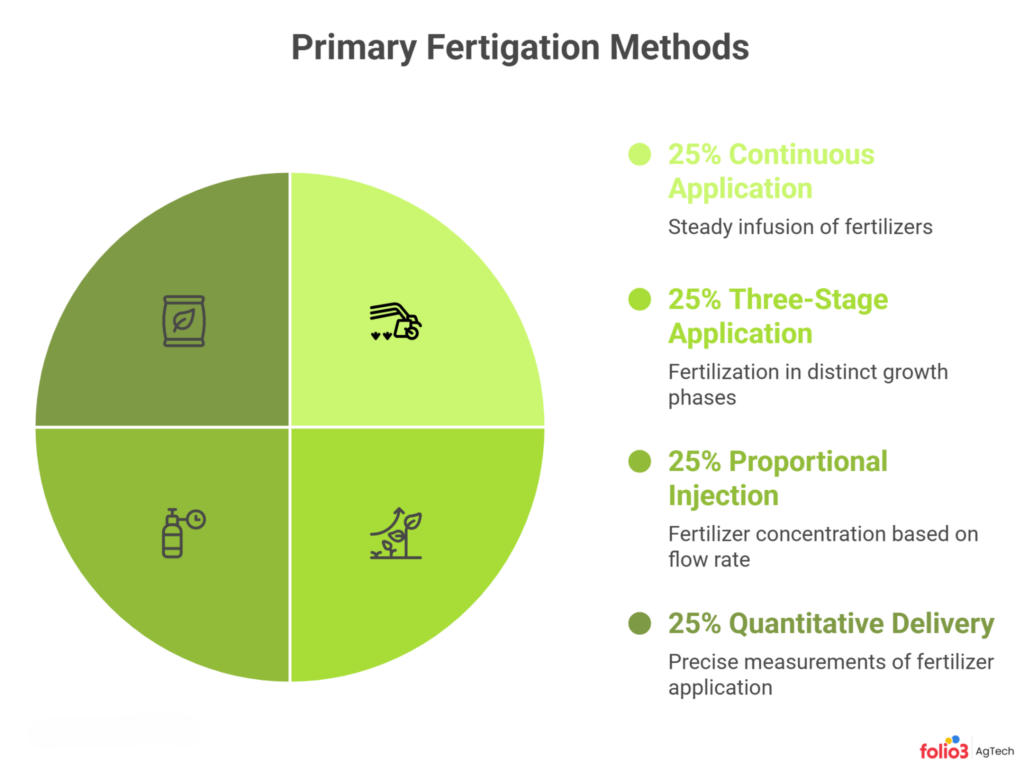
1. Continuous Application
Nutrients are injected at a low, steady rate throughout the entire irrigation run. It is the simplest approach and works well for long-duration drip systems on crops with consistent nutrient demand. The downside is that nutrient concentration varies as water pressure and flow rate fluctuate.
2. Three-Stage Application (Pulse Method)
It is the most widely recommended method for drip fertigation and a proven fertigation fertilizer application strategy:
- Stage 1: Run clean water for 10 to 15 minutes to wet the soil profile and fully pressurize the system.
- Stage 2: Begin the fertigation fertilizer application. Inject your nutrient solution for the planned duration.
- Stage 3: Flush with clean water for another 10 to 15 minutes to clear all fertilizer from the lines, preventing salt buildup and bio-clogging in emitters.
This three-stage approach protects your equipment and ensures nutrients reach the root zone rather than sitting in the drip lines.
3. Proportional Injection
The injector maintains a fixed ratio of concentrate to water flow. For example, a 1:100 ratio means 1 gallon of stock solution for every 100 gallons of water. This method automatically adjusts injection volume as flow rate changes, making it ideal for systems with variable pressure zones. Proportional injectors like the Dosatron are built specifically for this approach.
4. Quantitative Delivery
A calculated total volume or mass of fertilizer is injected into a specific zone, regardless of irrigation duration. This method is common in precision fertigation setups where each management zone has its own nutrient prescription.
Best Practices for Calculating Your Injection Rate
Getting the injection rate right prevents both under-feeding and nutrient burn. Here’s a simplified approach:
- Start with the crop recommendation: Your agronomist or extension service provides a target, for example, 150 lbs of nitrogen per acre for the season.
- Divide across irrigation events: If you irrigate 30 times per season, each event delivers roughly 5 lbs N/acre.
- Convert to liquid concentration: Determine how many gallons of stock solution deliver 5 lbs N based on your fertilizer’s guaranteed analysis.
- Set the injector ratio: Match your injector setting so the correct volume of stock enters the water flow per irrigation cycle.
- Verify with EC monitoring: Check your inline EC meter during each run to confirm nutrient concentration stays within the target range.
Accurate tracking of nutrient inputs is a core part of effective crop management software systems, especially for operations managing multiple fields and crop types.
The Precision Era: Maximizing Yield with Precision Fertigation
Precision fertigation takes standard fertigation and adds spatial intelligence. It’s where data-driven farming meets nutrient delivery.
Combining Satellite Telemetry and VRI for Precision Fertigation
Standard fertigation treats your entire field the same. Precision fertigation does not.
Using satellite or drone imagery, platforms like GeoPard and EOSDA generate multi-layered zoning maps based on soil Electrical Conductivity (EC) and vegetation indices like NDVI (Normalized Difference Vegetation Index) and NDRE. These maps reveal which areas of your field are thriving and which are nutrient-deficient.
When combined with Variable Rate Irrigation (VRI) technology, your system adjusts both water volume and nutrient concentration zone by zone. A sandy corner of the field might receive 20% more nitrogen than a clay-heavy section that retains nutrients naturally.
This level of precision fertilization can significantly cut input waste while boosting per-acre yield. Operations already investing in smart farming technology can integrate fertigation controls into their existing sensor and analytics workflows.
Automated Closed-Loop Systems
The most advanced precision fertigation setups run on closed-loop automation. Here’s how they work:
Inline sensors continuously measure EC and pH in the irrigation stream. When values drift outside the target range, the control system automatically adjusts the injection pump speed in real time. No manual intervention needed.
For example, if a sudden rain event dilutes your soil EC, the system detects the drop and increases nutrient injection for the next cycle. If pH spikes because of a water source change, the controller can inject acid to bring it back in line before nutrients lock out.
These automated systems represent the next frontier in fertigation, and they’re already standard on enterprise operations managing thousands of irrigated acres. When connected to IoT-enabled agriculture platforms, they deliver full visibility from sensor to spoon-feeding in a single dashboard.
Conclusion and Strategic Next Steps
Fertigation isn’t a luxury upgrade. It’s becoming a baseline requirement for competitive farming. Here’s how to move forward.
Whether you’re managing 50 acres or 5,000, the principles remain the same. Fertigation systems give you tighter control over nutrient delivery, reduce waste, lower labor costs, and drive measurable yield improvements.
The technology is proven. The market is growing at 7%+ annually. And the ROI timeline for most commercial operations is 2 to 3 seasons.
Here’s what your next steps should look like:
- Audit your current system: Evaluate your irrigation infrastructure, water source quality, and current fertilizer spend.
- Start simple: A Venturi injector with a basic stock tank is enough to test fertigation on a single zone before scaling.
- Invest in monitoring: EC and pH sensors pay for themselves by preventing costly mistakes in nutrient concentration.
- Plan for precision: As you scale, explore VRI and closed-loop systems that bring precision farming software into your fertigation workflow.
If you’re ready to modernize your nutrient delivery and need expert guidance, book a consultation with our Agtech experts to assess how fertigation fits into your roadmap.
FAQs
What Crops Benefit Most From Fertigation?
High-value crops like tomatoes, strawberries, citrus, and greenhouse vegetables see the biggest returns from fertigation. These crops have continuous nutrient demand and respond well to frequent, small doses delivered directly to the root zone.
Can Fertigation Work With Sprinkler Systems, or Only Drip?
Fertigation works with both drip and sprinkler irrigation systems. Drip provides better precision and less evaporation loss, but center pivot sprinklers with chemigation injection ports are widely used for field crops like corn and wheat.
How Much Does a Basic Fertigation Setup Cost?
A basic setup with a Venturi injector, stock tank, backflow preventer, and filter can cost between $500 and $2,000 for small operations. Enterprise-grade digital dosing systems with automation can run $10,000 to $50,000, depending on scale.
Is Fertigation Safe for Organic Farming?
Yes, fertigation can be used in certified organic operations. You need to use OMRI-listed (Organic Materials Review Institute) liquid fertilizers and follow your certifier’s guidelines for injection equipment and record-keeping.
How Often Should You Run a Fertigation Cycle?
Frequency depends on your crop, soil type, and growth stage. Most drip fertigation schedules run 2 to 5 times per week during peak growth. Sandy soils with low nutrient retention may need daily applications, while clay soils hold nutrients longer between cycles.