
Running a profitable dairy operation today means more than maximizing milk output. You’re also managing a growing environmental footprint. Every milking session, every equipment washdown, and every batch of spoiled product generates waste that carries real financial and regulatory consequences if handled incorrectly.
The good news? With the right dairy waste management systems in place, that “waste” becomes a resource. Think fertilizer, biogas, and even industrial biochemicals.
This guide covers everything you need to know: what dairy waste actually is, where it comes from, how to safely dispose of excess milk, and the six most effective dairy farm waste management methods available today. We also break down the regulatory landscape and help you figure out which system fits your operation.
Whether you’re running a 200-cow family dairy or managing a large processing facility, the information here will help you make smarter decisions, stay compliant, and improve your bottom line.
What Constitutes Dairy Waste and Why is its Management Critical?
Dairy waste covers any organic or inorganic material generated during milk production, processing, and distribution. It includes manure, milking wastewater, spoiled milk, whey, cleaning chemicals, and contaminated bedding.
What makes dairy industry waste management particularly urgent is the chemical load these materials carry. Raw dairy effluent has a biochemical oxygen demand (BOD) that can range from 1,000 to over 5,000 mg/L, and a chemical oxygen demand (COD) that often runs two to three times higher. For context, domestic sewage typically sits at 200 to 300 mg/L BOD. That is a significant gap.
When high-BOD dairy waste enters waterways untreated, it rapidly depletes dissolved oxygen. Also, it triggers algae blooms, suffocates aquatic life, and contaminates groundwater. The ecological damage can be severe and lasting.
Beyond environmental harm, improper disposal creates direct business risk. Non-compliance fines, permit violations, legal exposure, and reputational damage can cost operations far more than investing in proper systems upfront.
Primary Sources of Waste in Dairy Operations
Effective waste management in the dairy industry starts with understanding exactly where your waste is generated. It falls into two main categories.
Farm-Level Waste (Milking and Housing)
This is what most producers think of first. It includes:
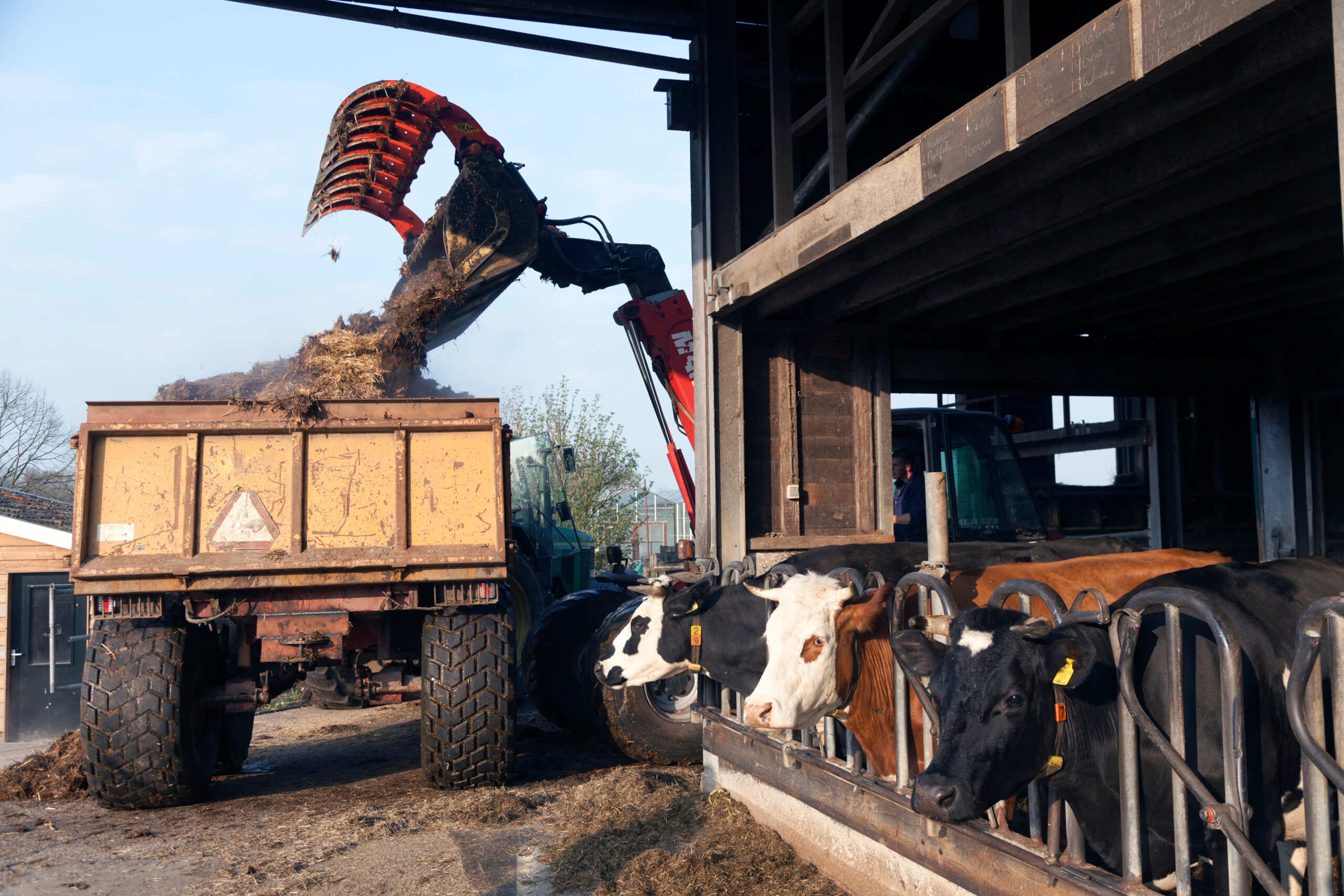
- Manure and urine: A single dairy cow produces 65 to 80 pounds of manure per day. For a 200-cow herd, that is between 13,000 and 16,000 pounds of manure generated every single day.
- Soiled bedding: Straw, sawdust, and sand bedding mixed with manure creates a high-nitrogen, high-moisture waste stream that requires structured handling.
- Spoiled feed: Leftover or fermented silage contains sugars and acids that sharply raise BOD levels if dumped improperly near water sources.
- Milkhouse wastewater: This includes residual milk, wash water from milking equipment, and soil particles. Even trace amounts of milk in rinse water significantly elevate BOD concentrations.
Dairy cow waste management at the farm level is foundational. If you do not control it at the source, everything downstream becomes harder and more expensive to manage.
Industrial-Level Waste (Processing Facilities)
Processing plants deal with a more complex waste profile. Common streams include:
- Cleaning solutions: Caustic and acid-based cleaning products used in clean-in-place (CIP) systems are highly alkaline or acidic and must be managed with treatment in mind.
- Condensates: Evaporation processes in cheese and butter production generate warm, organic-rich condensate streams that carry significant BOD loads.
- Cheese pressings: The liquid expelled during cheese making contains fat, protein, and lactose, all of which contribute to high organic loading.
- Acid whey: A byproduct of Greek yogurt and cottage cheese production, acid whey has a very low pH and extremely high BOD, making it one of the most challenging dairy effluents to treat. To understand what is happening inside your processing line, this overview of dairy processing provides a useful foundation.
How to Dispose of Milk Safely
This is one of the most common operational questions in dairy, and the answer carries serious legal weight.
Why you cannot dump milk down the drain or into storm sewers:
Raw milk has a BOD of approximately 100,000 to 140,000 mg/L. Even a small volume entering a waterway can deplete oxygen levels and kill aquatic life within hours. In the U.S., discharging milk into stormwater drains or any waterway without authorization violates the Clean Water Act and can result in substantial fines per day of violation.
Safe and legal disposal options for excess or old milk:
- Mix with liquid manure storage: Diluting milk into a large manure slurry reduces its effective BOD concentration and allows it to move through your existing manure management system. Limit additions to avoid overloading the system’s microbial balance.
- Feed to livestock: Small volumes of off-spec or surplus milk can be fed to calves or pigs on the same operation, provided it meets applicable animal health regulations.
- Land application (properly diluted): Milk can be applied to cropland as a soil amendment, but only at agronomic rates and never in quantities that would cause surface runoff. Always consult your local extension office or nutrient management plan before doing this.
- Anaerobic digestion: Large volumes of spoiled or outdated milk can be co-digested alongside other organic waste. It converts the high-energy content of milk into biogas rather than letting it become a liability.
- Licensed organic waste hauler: For large volumes or specialty products, a licensed hauler can transport the material to a permitted facility for treatment or composting.
Managing which milk is saleable and which is not becomes significantly easier when your entire operation runs on a centralized system. A dedicated milk management software can track withdrawal periods and flag treated cows at the parlor. It also segregates hospital pen milk automatically, removing the human error that turns disposal decisions into compliance violations.
6 Proven Dairy Farm Waste Management Methods You Should Implement
These are the methods that work at scale. Some recover nutrients, some produce energy, and some do both. Here is what each one involves and who it is best suited for.
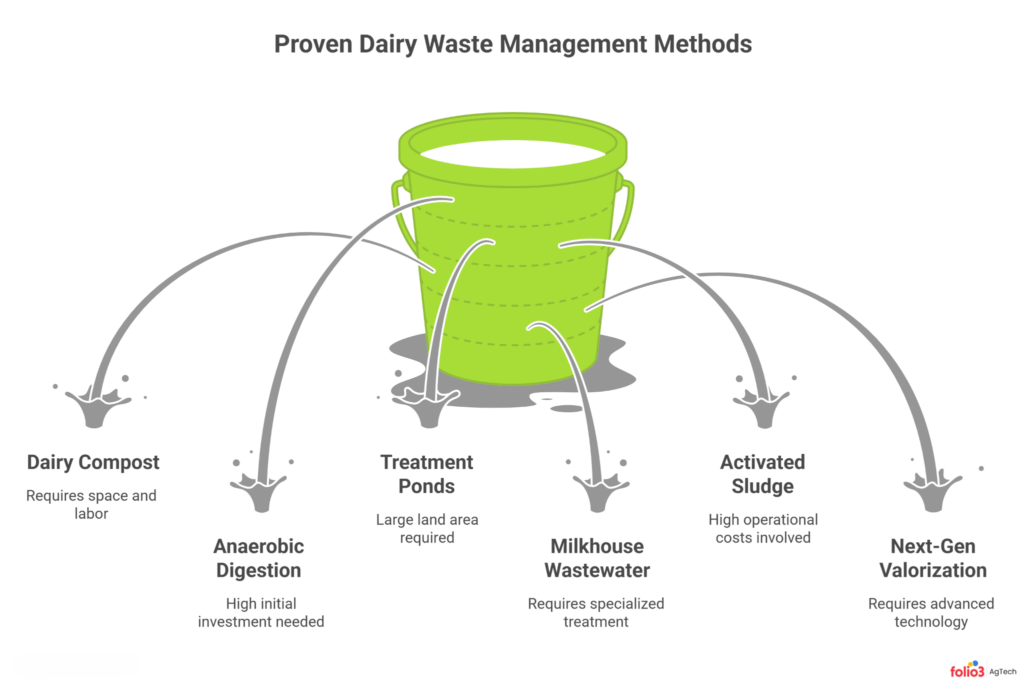
1. Dairy Compost (The Nutrient Recovery Blueprint)
Composting is the most accessible dairy farm waste management method for small to medium operations. It transforms manure, bedding, and other solid organics into a stable, marketable soil amendment.
Getting the process right requires attention to three variables:
- Carbon to Nitrogen (C:N) ratio: The ideal range is 25:1 to 30:1. Dairy manure alone tends to be too nitrogen-rich. Mixing it with carbon-heavy materials like dry straw, wood shavings, or corn stalks brings the ratio into range.
- Temperature: Active compost windrows must reach 131°F to 160°F (55°C to 71°C) to destroy pathogens and weed seeds, as required under EPA Part 503 biosolids rules. Monitor internal pile temperatures with a compost thermometer.
- Turning frequency: Windrows should be turned every five to seven days initially to maintain oxygen flow and manage moisture. This is what drives rapid, consistent breakdown.
Finished dairy compost can be sold to landscapers, turf managers, or used on your own fields to displace synthetic fertilizer costs. For a more detailed look at manure management strategies that complement composting, that resource covers nutrient planning in practical terms.
2. Anaerobic Digestion and Biogas
Anaerobic digestion (AD) is the process in which microorganisms break down organic matter in an oxygen-free environment. For dairy operations, it is one of the highest-value methods available today.
The two primary outputs are:
- Biogas: Primarily methane, which can be combusted to generate heat and electricity on-site. A dairy cow’s daily manure output can produce enough biogas to generate roughly 1.0 to 1.5 kWh of electricity. At scale, this can offset a meaningful share of a farm’s energy bill.
- Digestate: The nutrient-rich material remaining after digestion retains nitrogen, phosphorus, and potassium. It can be applied as a liquid fertilizer, often with better nutrient availability than raw manure.
AD systems require meaningful upfront capital, typically $400,000 to over $1 million for on-farm systems. But they make strong economic sense for large herds of 500 or more cows, or operations positioned near a shared community digester.
3. Treatment Ponds and Aerobic Lagoons
For high-volume liquid waste management, treatment lagoons are a time-tested solution. They rely on natural biological processes: bacteria, sunlight, and wind-driven aeration to break down organics over time.
Aerobic lagoons work by maintaining dissolved oxygen so aerobic bacteria can degrade BOD-laden wastewater. Facultative ponds use a two-zone approach, with aerobic decomposition at the surface and anaerobic breakdown in the lower layer.
The main advantages are low operating cost and scalability once built. The main limitations are significant land requirements, odor potential during high-loading periods, and long treatment cycles. Proper sizing is non-negotiable. An undersized lagoon will fail during peak seasonal loading events.
4. Milkhouse Wastewater Systems
Milkhouse wastewater is a distinct challenge that is often overlooked in farm planning. It contains residual milk solids, alkaline detergents, and acid sanitizers in relatively small but concentrated volumes. Standard manure storage systems are not engineered to handle it.
Effective localized treatment options include:
- Settling tanks: Allow suspended solids to settle before liquid moves to a filter strip or soil absorption system. A two-stage settling tank significantly improves solids removal.
- Bark beds (biofilter beds): Layers of wood chips or bark create a biological filtration medium where bacteria treat wastewater as it percolates through. These beds perform consistently year-round in most climates and require minimal maintenance once established.
- Grass filter strips: A vegetated buffer zone between the milkhouse discharge point and any waterbody. Effective for low-volume operations, but must be properly sized and managed to avoid overloading.
State environmental regulators typically require some form of milkhouse wastewater management for any operation that discharges outside a permitted manure storage system.
5. Activated Sludge and Biological Filtration
If you manage a dairy processing plant, your waste treatment requirements go well beyond what a farm lagoon can handle. Processing effluent tends to be much higher in strength and more variable in composition hour-to-hour.
Activated sludge systems work by aerating wastewater tanks and supporting dense populations of aerobic microorganisms that rapidly degrade BOD. The treated effluent is clarified, and the excess sludge is collected for further processing or land application under managed conditions.
Biological filtration using trickling filters or rotating biological contactors (RBCs) is an alternative approach. These systems pass wastewater over fixed media where a microbial biofilm does the treatment work continuously.
Both options are well-suited to plant-scale operations and are commonly required to achieve compliance with NPDES discharge limits. They represent higher capital investment but allow consistent performance against tight effluent standards.
6. Next-Gen Valorization (Milking Waste for Its Worth)
The most forward-looking development in dairy industry waste management is treating effluent streams as raw material rather than a disposal problem.
Several bioconversion technologies are gaining commercial traction:
- Whey and lactose fermentation: Acid whey, one of the hardest dairy waste streams to manage, can be bioconverted into lactic acid for bioplastic manufacturing, succinic acid for industrial chemical applications, and single-cell protein for animal feed.
- Struvite recovery: Phosphorus from dairy effluent can be precipitated as struvite, a slow-release fertilizer mineral. This removes phosphorus from the waste stream while creating a sellable agricultural product.
- Algae cultivation: High-nutrient dairy wastewater is being piloted as a growth medium for microalgae production, which can then be harvested for biofuels or nutraceutical markets.
These technologies are still scaling commercially, but early adopters are positioning themselves ahead of tightening phosphorus regulations and rising synthetic fertilizer prices. Pairing valorization with advances in dairy membrane filtration can further concentrate and separate valuable components before conversion.
Comparing Dairy Waste Management Systems: Which is Right for Your Operation?
Not every method fits every farm. Use this comparison to match the right system to your operation size, waste type, and available capital.
| Method | Ideal Operation Size | Primary Waste Treated | Upfront Cost | By-Product Value (ROI) |
| Composting | Small to Medium Farm | Manure and Bedding | Low | High (Marketable Soil Amendment) |
| Anaerobic Digestion | Large Farm (500+ cows) | Liquid Manure, Milk Waste | High | High (Biogas plus Liquid Fertilizer) |
| Treatment Ponds / Lagoons | Medium to Large Farm | Liquid Manure, Washwater | Low to Medium | Low (Nutrient Recycling) |
| Milkhouse Wastewater System | Any Farm with Milkhouse | Equipment Wash Water | Low | Low to Medium (Compliance) |
| Activated Sludge | Processing Plant | High-Strength Processing Effluent | High | Medium (Compliance plus Sludge Reuse) |
| Valorization Technologies | Large Plant or Cooperative | Whey, Lactose, Acid Whey | High | Very High (Bioproducts and Chemicals) |
The practical starting point is this: comply with what your permit requires, then layer in value-generating technologies where the ROI supports the investment.
Choosing the right waste system is easier when your production data is already organized. If you are still tracking milk output, quality events, and treatment records manually, a dairy milk management platform gives you the real-time visibility that makes waste management decisions faster and more accurate.
Navigating Federal Regulations and Compliance For Waste Management in the Dairy Industry
Dairy operations in the U.S. must navigate a layered set of environmental rules tied to waste management in the dairy industry. The core frameworks are:
- EPA Concentrated Animal Feeding Operation (CAFO) Rules: Under the Clean Water Act, dairies with 700 or more mature dairy cows qualify as large CAFOs and must obtain a National Pollutant Discharge Elimination System (NPDES) permit. Medium CAFOs (200 to 699 cows) may also require a permit depending on how and where waste is managed. These permits govern what you can discharge, how you store waste, and what your nutrient management plan must document. Full details are available via the EPA’s official CAFO page.
- Nutrient Management Planning: Many states require a certified nutrient management plan (NMP) for permitted operations. This plan governs land application rates for manure and digestate to prevent over-application of nitrogen and phosphorus that could reach groundwater.
- State-Level Regulations: State environmental agencies frequently impose stricter standards than federal minimums. Requirements vary significantly by state, particularly for milkhouse wastewater, runoff controls, and setback distances from waterways.
- Spill Reporting: Any unpermitted discharge, including a lagoon overflow or a milk spill reaching a waterway, may trigger mandatory reporting obligations under the Clean Water Act.
For a broader context on how environmental pressures are reshaping livestock production, this piece on livestock farming and climate change covers where regulations are likely heading in the years ahead.
Embracing a Circular Dairy Economy
The most profitable dairy operations of the next decade will not simply be the ones producing the most milk. They will be the ones who have figured out how to close the loop on every output their operation generates.
Manure becomes fertilizer or energy. Whey becomes biochemicals. Wastewater becomes a managed resource instead of a regulatory risk. That’s where dairy industry waste management is heading, driven by tighter regulation, rising input costs, and growing market demand for verifiably sustainable dairy products.
Start with what is required. Understand your CAFO obligations, get your permits in order, and build a baseline waste management system that keeps you compliant. Then identify one or two areas where a smarter approach can reduce costs or generate value from outputs you are currently treating as a problem. If you want to build a stronger, more efficient operation from the ground up, consult with our Agtech experts to see how a practical dairy management system can help you with waste management.
FAQs
Can Dairy Farm Waste Be Used as Fertilizer Directly?
Raw dairy manure can be applied to fields, but only at agronomic rates matched to your crop’s nutrient needs. Uncomposted manure must typically be incorporated before planting or applied in the off-season to reduce runoff risk and satisfy state nutrient management regulations.
How Long Does it Take for Dairy Manure to Compost?
With proper carbon-to-nitrogen ratios, adequate moisture, and regular turning, dairy manure compost typically reaches maturity in 60 to 90 days. Without active management, the process can take six months or longer, and the resulting material may not fully stabilize for safe field application.
Is Dairy Wastewater the Same as Milk?
No. Dairy wastewater is a diluted mixture of residual milk, cleaning chemicals, sanitizers, and equipment rinse water. It has a much lower solids content than raw milk, but still carries BOD levels high enough to require proper treatment before any discharge.
What Happens if Dairy Waste Enters a Local Waterway?
Dairy effluent with high BOD rapidly depletes dissolved oxygen in water bodies. It suffocates fish and other aquatic life, triggers algae blooms, and can compromise drinking water supplies downstream. It also exposes the operation to serious legal liability and potential civil penalties under the Clean Water Act.
Does Anaerobic Digestion Eliminate All Pathogens in Dairy Waste?
Anaerobic digestion significantly reduces pathogen levels, but complete elimination is not guaranteed. Thermophilic digesters, which operate at around 131°F to 140°F (55°C to 60°C), deliver better pathogen reduction than mesophilic systems. Some states require additional treatment of digestate before land application, particularly for operations near sensitive water sources.