
If you’re still betting your harvest on rain, you’re gambling with your bottom line. Unpredictable weather patterns, prolonged droughts, and shifting growing seasons have made reliance on natural rainfall a risky strategy for any serious farming operation. The reality of modern agriculture demands controlled, efficient water delivery, and that means understanding crop irrigation systems inside and out.
This guide is built for farm owners, agribusiness managers, and operations teams who want to go beyond the basics. We’ll walk you through the leading irrigation methods, break down the agronomic science behind crop yield, and show you how AgTech automation is transforming water management on farms of every size.
Whether you’re evaluating a system upgrade or planning a greenfield installation, this is the resource you need to make a confident, data-backed decision.
What Is Crop Irrigation and Why Is It Essential?
At its core, crop irrigation is the controlled application of water to land to support plant growth. The concept dates back thousands of years to ancient flood plains along the Nile and Indus rivers. However, today’s irrigation in crop field operations relies on highly engineered systems designed for precision, efficiency, and scalability.
Financial Impact of Irrigated Farming: The financial case is undeniable. According to the USDA Economic Research Service, farms with some form of irrigation accounted for over 50% of the total value of U.S. crop sales, while irrigated land occupied less than 17% of total harvested cropland. That’s a disproportionately high return from a relatively small share of acreage.
Irrigation and Freshwater Consumption: Agriculture is also the single largest consumer of freshwater in the United States. A U.S. Geological Survey report confirms that irrigation accounted for approximately 47% of the nation’s total freshwater withdrawals between 2010 and 2020.
Growth of Irrigated Acreage in America: In the U.S. alone, irrigated acreage has grown from fewer than 3 million acres in 1890 to over 54 million acres today. There is a transformation driven by federal water development projects, groundwater pumping innovations, and advances in crop management solutions that help farmers plan and optimize every drop.
How Does Irrigation Increase Crop Yield?
If you’ve ever watched a field recover within days of a well-timed watering, you already know the impact. But the agronomic science behind how irrigation boosts yield goes deeper than just “wet soil grows better crops.” Here’s what’s actually happening:
- Nutrient Transport: Water is the vehicle that moves essential soil nutrients like nitrogen, phosphorus, and potassium into the root zone. Without adequate moisture, even nutrient-rich soil can’t feed your crops.
- Photosynthesis Optimization: When plants aren’t under water stress, their stomata stay open longer, allowing for greater carbon dioxide absorption and more efficient photosynthesis. That translates directly to more biomass and higher grain fill.
- Temperature Regulation: Irrigation provides evaporative cooling during extreme heat waves, preventing thermal damage to reproductive tissues during critical growth stages.
- Consistency and Uniformity: Eliminating the unpredictable “drought and flood” cycle of rainfed farming ensures uniform crop sizing and quality. That consistency directly translates to higher market value and better grading outcomes at sale.
Understanding Soil Water and Scheduling Fundamentals
Before you choose an irrigation system, you need to understand your soil. These fundamentals drive every scheduling decision you’ll make.
Soil-Water Reservoir Terminology
Think of your soil as a water reservoir. Its capacity to hold and release water determines how often and how much you irrigate. Here are the four thresholds every farm operator should know:
- Saturation: All soil pores are filled with water. This condition is temporary and typically undesirable for most crops, as it suffocates roots.
- Field Capacity: The amount of water the soil holds after excess drainage. It is your ideal starting point, the soil’s “full tank.”
- Permanent Wilting Point: The moisture level at which plants can no longer extract water from the soil. If you hit this threshold, crop damage is already underway.
- Available Water Holding Capacity (AWC): The usable range between field capacity and permanent wilting point. It is the water your crops can actually access.
Knowing these thresholds is non-negotiable for effective irrigation scheduling. Get them wrong, and you’ll either waste water or starve your crop.
Soil Types and Available Water
Soil texture directly determines how much water your field can store. Fine-textured soils like clays and silts have smaller pores that grip water tightly, giving them a higher AWC. Coarse-textured sands drain fast and hold far less.
| Soil Texture | AWC (inches/ft of soil) | Irrigation Frequency |
| Coarse Sand | 0.5 – 1.0 | Very Frequent |
| Sandy Loam | 1.0 – 1.5 | Frequent |
| Loam | 1.5 – 2.0 | Moderate |
| Silt Loam | 2.0 – 2.5 | Moderate |
| Clay Loam | 1.8 – 2.3 | Less Frequent |
| Clay | 1.5 – 2.0 | Least Frequent |
Understanding your soil type is the starting point for designing a crop irrigation system that matches your field’s actual water-holding behavior. A loam soil, for example, will store roughly twice the available water of a sandy soil, which means your irrigation frequency and run times will differ significantly.
Management Allowable Depletion and Rooting Depth
Management Allowable Depletion (MAD) is the portion of available soil water you can safely use before crop stress begins. Most agronomists recommend depleting 40–60% of available water before triggering an irrigation event, though this varies by crop and growth stage. For instance, shallow-rooted vegetables may require a lower MAD (around 30–40%), while deep-rooted crops like alfalfa can tolerate higher depletion.
Keep in mind that irrigation typically targets the upper portion of the root zone, where the majority of active roots and nutrient uptake occur. It is especially important in precision farming operations where efficiency and data-driven scheduling are priorities.
Decoding the “Crop Ratio in Irrigation”
Crop ratio is a concept that separates efficient irrigators from those wasting water and money. Here’s how to use it.
The crop ratio in irrigation refers to the relationship between the volume of water a crop actually needs and the volume of water delivered through the irrigation system. Think of it as your farm’s “crop-per-drop” efficiency metric.
A crop ratio close to 1.0 means nearly all the water you apply is being used productively by the plant. A ratio well below 1.0 signals significant losses to deep percolation, runoff, or evaporation before the water ever reaches the root zone.
Why does this matter? Understanding your crop ratio helps you prevent over-watering, reduce pumping costs, and achieve maximum yield per unit of water applied. When paired with a modern irrigation management platform that tracks application rates, soil moisture, and evapotranspiration data. So, optimizing your crop ratio becomes a practical, measurable goal rather than an abstract concept.
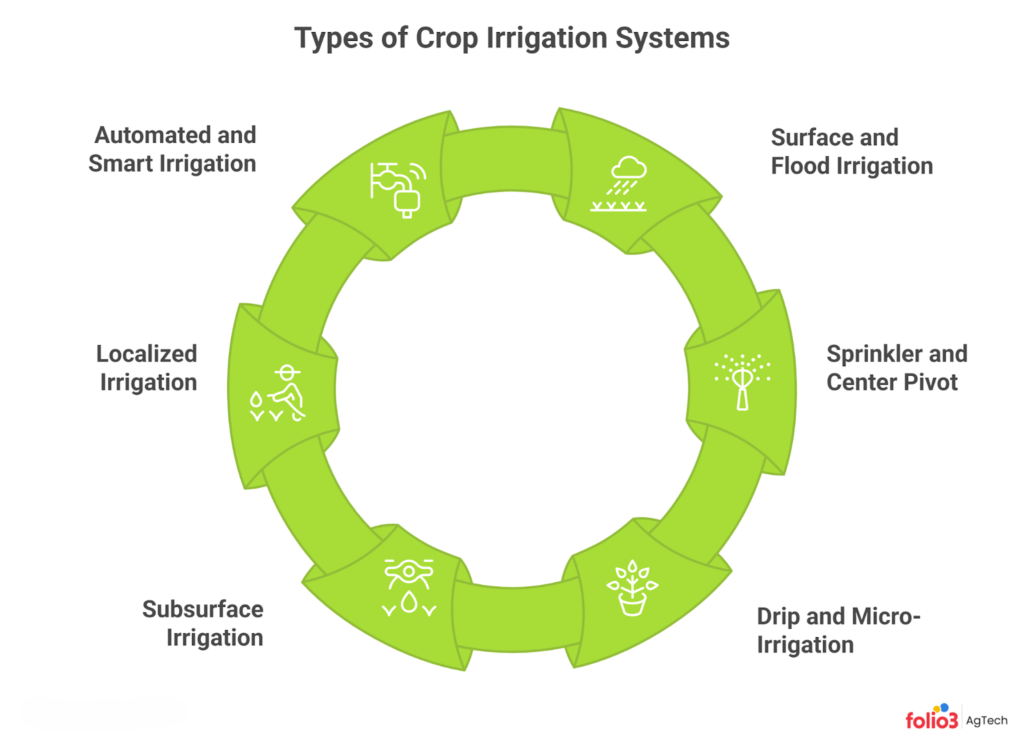
What are the Main Types of Crop Irrigation Systems
Irrigation technology has evolved from simple gravity-fed ditches to high-precision pressurized systems. Each method offers a different balance of cost, efficiency, and suitability depending on your crop, soil, and topography.
Surface and Flood Irrigation
Surface irrigation is the oldest and most widely practiced irrigation method globally. According to FAO AQUASTAT 2025 data, surface systems still account for roughly 77% of the world’s fully irrigated area. It’s inexpensive and simple, but it’s also the least water-efficient approach, often losing 35–50% of applied water to deep percolation and runoff.
Within surface irrigation, several sub-methods are worth understanding:
- Furrow Irrigation: Water flows through narrow channels dug between crop rows. More targeted than full flooding, but requires precise field leveling for uniform distribution.
- Basin Irrigation: Water is held within leveed enclosures. Best for crops like rice that tolerate standing water.
- Border Irrigation: Raised borders guide a shallow sheet of water down a gentle slope. Works well on flat, precision-graded fields and is commonly used for crops like soybeans.
- Surge Irrigation: A more advanced variant that uses timed valves to pulse water in intervals. This pulsing action improves infiltration uniformity and can reduce deep percolation losses by 20–30%.
- Levee (Flush) Irrigation: Used primarily for rice or poorly drained fields. Best practice is to begin irrigation before drought stress sets in and avoid standing water for more than two days to prevent root damage.
Sprinkler and Center Pivot Systems
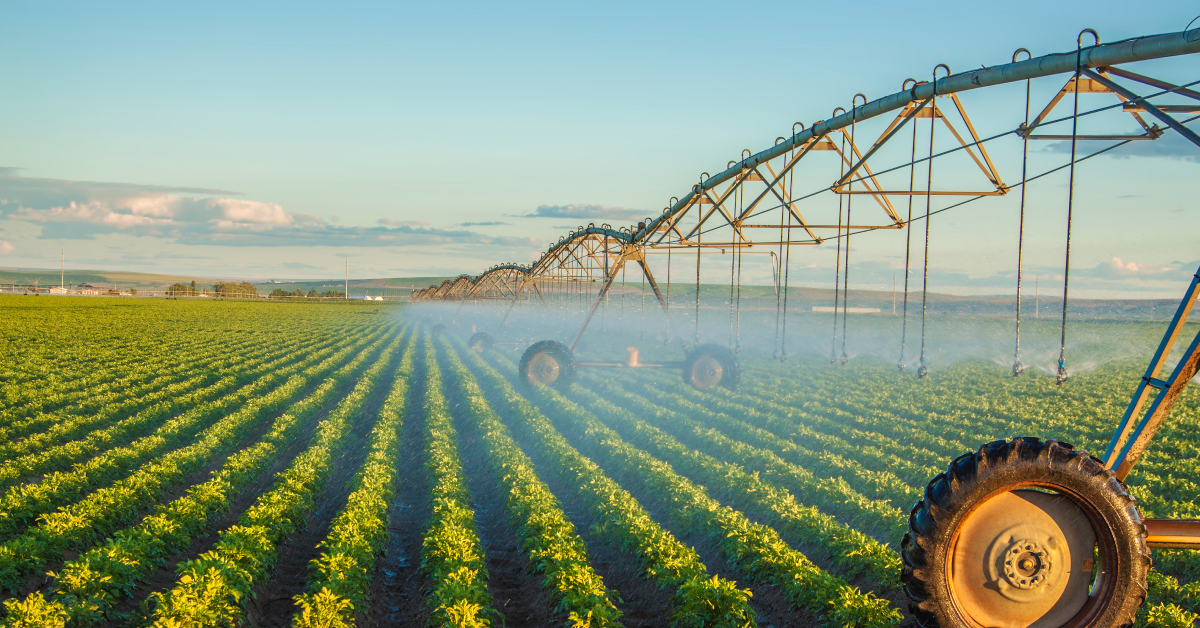
If you manage large-scale row crops like corn, soybeans, or alfalfa, center pivot and linear move sprinkler systems are likely already on your radar. These pressurized systems dominate mid-to-large acreage operations across the Great Plains and Midwest. For good reason: a single center pivot can cover 125–130 acres per circle with relatively uniform application.
The strengths are clear: massive coverage, relatively low labor requirements, and adaptability to variable rate irrigation (VRI) technology. However, sprinkler systems do come with trade-offs. Evaporation and wind drift can reduce efficiency, especially in arid, windy environments. Wet foliage also creates favorable conditions for fungal diseases like gray leaf spot in corn. LEPA (Low Energy Precision Application) drop nozzles are one way to mitigate these losses by delivering water closer to the soil surface.
Drip and Micro-Irrigation
Drip irrigation is widely considered the gold standard for water efficiency. Properly designed drip systems can achieve application efficiencies of 90–95%, compared to 60–80% for conventional sprinklers. Water is delivered directly to the root zone through drip tape or individual emitters, virtually eliminating evaporative and runoff losses.
It makes drip ideal for high-value specialty crops, orchards, vineyards, and greenhouse operations where every gallon counts. Plus, it integrates seamlessly with fertigation, allowing you to deliver water-soluble nutrients precisely when and where the crop needs them. The main consideration is maintenance, as drip emitters are susceptible to clogging from mineral buildup or biological growth, requiring regular flushing and filtration.
Subsurface Irrigation
Subsurface drip irrigation (SDI) takes the efficiency of drip a step further by burying drip lines below the soil surface. It is typically 8–14 inches deep within or just beneath the root zone. This virtually eliminates surface evaporation and significantly reduces weed germination, since the soil surface stays dry.
Moreover, SDI is gaining traction in water-limited regions, particularly for high-value row crops like cotton in the Texas High Plains. The trade-off is a higher initial capital expenditure and the need for careful system design to avoid rodent damage and root intrusion into emitters. When managed well, though, SDI delivers some of the highest water productivity ratios in commercial agriculture.
Localized Irrigation
Localized systems, including micro-sprinklers and bubblers, deliver water to specific plant zones rather than broadcasting it across the entire field. They’re a natural fit for orchards, vineyards, and nurseries where individual tree or vine spacing demands targeted application. These systems bridge the gap between full-field sprinklers and narrow-row drip. They are offering flexibility for perennial crop operations with diverse water needs across different zones.
Automated and Smart Irrigation
The latest evolution in crop irrigation systems is the integration of IoT sensors, automated controllers, and AI-driven scheduling. Smart irrigation systems pull real-time data from soil moisture sensors, weather station feeds, and satellite imagery. They then automatically adjust watering schedules, often without any human intervention.
Meanwhile, Variable Rate Irrigation (VRI) allows different nozzles on a single center pivot to apply different amounts of water based on soil variability or crop need within the same field. Remote sensing technologies, including agricultural drones equipped with thermal cameras, can detect water stress before it becomes visible. It allows for proactive scheduling adjustments. Smartphone-controlled valve systems let you manage entire irrigation networks from your phone, regardless of where you are.
System Selection Matrix
Use the System Selection Matrix below to narrow your options before we dive into each method.
| System Type | Upfront Cost | Water Efficiency | Best Suited Crops | Topography |
| Surface / Flood | Low | 40–65% | Rice, wheat, sugarcane | Flat, graded fields |
| Sprinkler / Center Pivot | Medium–High | 70–85% | Corn, soy, alfalfa | Flat to gently rolling |
| Drip / Micro | Medium–High | 90–95% | Orchards, vineyards, vegetables | Any terrain |
| Subsurface Drip | High | 92–97% | High-value row crops, cotton | Any terrain |
| Localized (Bubblers) | Medium | 85–90% | Tree crops, nursery stock | Variable |
| Smart / Automated | High | 90%+ | All (data-driven) | Any terrain |
Key Factors for Choosing the Right Irrigation System for Your Crop
Selecting the best irrigation system for your crop is about aligning the system with your unique field conditions, crop requirements, and budget. Here’s a practical checklist to guide your decision:
- Soil Type and Infiltration Rates: Sandy soils with high infiltration rates drain quickly and may benefit from frequent, short drip irrigation cycles. Clay soils with slow infiltration are prone to runoff, making low-pressure drip or LEPA sprinklers a better choice over high-output flood methods.
- Field Topography: Sloped fields generally require pressurized systems (drip or sprinkler with pressure regulation) to ensure uniform application. Flat, precision-graded fields can work with gravity-fed surface methods, though they’re still less efficient overall.
- Water Source and Quality: Groundwater sources may carry dissolved minerals that clog drip emitters, necessitating filtration. Surface water may carry sediment or biological matter. Farms in regions facing aquifer depletion should strongly consider high-efficiency methods to maximize every gallon pumped. Also watch for salinization risks, especially in arid regions.
- Crop Lifecycle and Root Structure: Deep-rooted crops like alfalfa and tree fruits tolerate less frequent, deeper irrigation. Shallow-rooted vegetables need more frequent, lighter applications. Match your system’s application rate to your crop’s active root zone for optimum uptake.
- Cost and Budget Considerations: Surface systems have the lowest upfront cost but the highest water waste. Drip and subsurface systems require greater capital investment but deliver superior long-term returns through water savings, yield improvements, and reduced energy costs. Consider lifecycle cost, not just installation price.
For a comprehensive approach to evaluating these factors in real time, crop management practices backed by field data and software can simplify what would otherwise be a complex, multi-variable decision.
The Role of AgTech: Irrigation Scheduling and Automation
The most advanced drip tape or center pivot in the world won’t deliver results if it’s running on guesswork. That’s where AgTech comes in. Modern irrigation scheduling relies on Evapotranspiration (ET) data, a measure of how much water your crop loses through transpiration and soil evaporation each day.
By combining ET data with soil moisture readings and weather forecasts, you can schedule irrigation events with surgical precision. This is exactly the kind of intelligence that a centralized crop management ERP can deliver.
Instead of treating irrigation as an isolated task, an ERP-connected platform integrates water management with planting schedules, input costs, labor allocation, and yield tracking. Hence, it gives you a complete operational picture from one dashboard.
Folio3 AgTech’s irrigation management software supports AI-driven scheduling that adapts to crop stage, soil type, and evapotranspiration rates. It integrates soil moisture sensor data, automates valve operations, and delivers zone-level insights that help you apply the right amount of water at the right time.
The bottom line: smart farming technology transforms irrigation from a reactive chore into a proactive, data-driven strategy. And that’s where the ROI really lives.
Current Challenges and Future Trends in Agricultural Water Use
The pressures on agricultural water are intensifying. Here’s what you should be watching and preparing for.
- Global Water Scarcity: According to FAO’s 2025 AQUASTAT data, renewable freshwater availability per person declined by 7% over the past decade. Over 60% of global irrigated land now lies in areas of high or very high water stress.
- Aquifer Depletion: In the U.S., regions like the Texas High Plains are experiencing steep declines in the Ogallala Aquifer, forcing farmers toward higher-efficiency systems and deficit irrigation strategies.
- Soil Salinization: Poor-quality irrigation water and over-application can concentrate salts in the root zone, degrading soil health and reducing yields over time.
- Variable Rate Irrigation (VRI): VRI technology enables farmers to apply different amounts of water across different zones within the same field, responding to variability in soil, slope, and crop condition.
- AI-Driven Water Distribution: Machine learning algorithms are now capable of predicting crop water demand days in advance by analyzing weather patterns, historical ET data, and real-time sensor feeds.
- Drone Thermal Imaging: Agricultural drones equipped with thermal cameras can detect water-stressed zones in a field before visual symptoms appear, enabling targeted irrigation responses that save water and protect yield.
Conclusion
Efficient crop irrigation isn’t just about picking the right hardware; it’s about pairing the right physical system with intelligent, data-driven management. From understanding your soil’s water-holding capacity to selecting between drip, sprinkler, or subsurface methods, every decision should be grounded in your field’s real conditions and your operation’s specific goals.
The farms that are winning today aren’t just investing in pipes and emitters. They’re investing in software that ties irrigation into a broader operational strategy, connecting water data with crop planning, input costs, and yield outcomes. Ready to digitize your farm’s water management and maximize your crop yield? Contact the AgTech experts at Folio3 for a custom software demo today.
FAQs
What Is the Most Water-Efficient Irrigation Method for Small Farms?
Drip irrigation is typically the most water-efficient option for small farms, delivering water directly to root zones at 90–95% efficiency. It minimizes evaporation and runoff, making it especially effective for vegetable gardens, specialty crops, and operations with limited water supply.
How Often Should I Irrigate My Crops?
Irrigation frequency depends on your soil type, crop growth stage, and local evapotranspiration rates. Sandy soils may require daily irrigation, while clay soils hold water longer. Using soil moisture sensors and ET-based scheduling tools provides the most accurate, field-specific guidance.
Can Irrigation Help Protect Crops During a Heat Wave?
Yes. Irrigation provides evaporative cooling that can lower canopy temperature during extreme heat events, protecting reproductive tissues and reducing thermal stress. Timed irrigation during peak afternoon heat is a common strategy for heat-sensitive crops like corn during tasseling.
What Role Does Software Play in Modern Irrigation Management?
Irrigation management software integrates soil moisture data, weather forecasts, and crop water demand models to automate scheduling and optimize application rates. It reduces guesswork, prevents over-watering, and provides zone-level insights that drive measurable water and cost savings.
Is Subsurface Drip Irrigation Worth the Investment?
For water-limited operations growing high-value crops, subsurface drip irrigation (SDI) often delivers the best long-term ROI. While initial installation costs are higher, SDI virtually eliminates evaporation, reduces weed pressure, and can lower labor and herbicide expenses over time.