
The world will need to produce 70% more food by 2050 to feed a population expected to reach 9.1 billion. At the same time, arable land is shrinking, freshwater is under pressure, and climate volatility is hammering traditional crop yields. Vertical farming has emerged as one of the most compelling responses to these converging pressures.
But here is the reality: no agricultural innovation is without trade-offs. If you are a commercial grower evaluating your next facility, an agribusiness investor running the numbers, or an executive exploring diversification, you need the full picture before committing capital.
This guide covers the top 10 benefits of vertical farming, its key disadvantages, and a head-to-head pros vs. cons comparison, all backed by credible data, so you can make an informed decision. Whether you are exploring the advantages and disadvantages of vertical farming for the first time or refining your investment thesis, this resource is built for your decision-making process.
Advantages of Vertical Farming at a Glance
Before we dive into the details, here is a quick-reference snapshot of the core benefits of vertical farming. If you are short on time, this table captures what you need to know about the advantages of vertical farming at a business level.
| Automation handles planting, monitoring, and harvesting | Advantage | What It Means for Your Business | Key Metric |
| 1 | Maximizes Land Use & Yield | Grow more per sq. ft. by stacking layers vertically | Up to 10–20x yield per acre vs. traditional farming |
| 2 | Year-Round Production | Eliminate seasonal dependency with continuous supply | 365-day harvest cycles |
| 3 | Reduces Water Use | Closed-loop systems recirculate water dramatically | Up to 95% less water than field farming |
| 4 | Pesticide-Free Food | Controlled environment eliminates pest pressure | Zero chemical pesticide residue |
| 5 | Energy & Resource Efficiency | Optimized LED, HVAC, and nutrient delivery | AI-optimized energy management |
| 6 | Shorter Supply Chains | Grow near consumers, reduce transport and spoilage | Significantly reduces food miles |
| 7 | Lower Labor Costs | Automation handles planting, monitoring, harvesting | Meaningful labor cost reduction |
| 8 | Climate Resilience | Immune to droughts, floods, and extreme weather | Zero crop loss from weather events |
| 9 | Environmental Sustainability | Reduced carbon footprint, no soil degradation | Smaller land footprint |
| 10 | Economic Opportunities | Creates high-tech jobs, revitalizes urban areas | Growing $9.6B+ global market |
What is Vertical Farming?
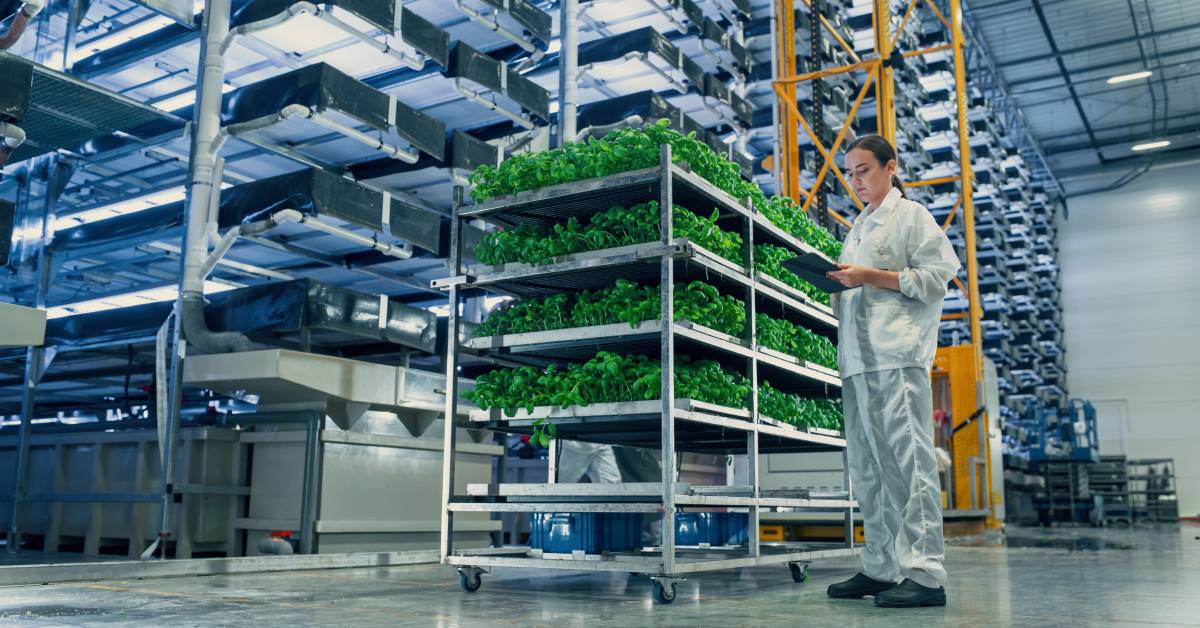
Vertical farming is a method of growing crops in vertically stacked layers within controlled indoor environments, using soilless techniques like hydroponics, aeroponics, or aquaponics instead of traditional soil-based agriculture. Think of it as building a farm upward rather than outward, maximizing production per square foot rather than per acre.
These facilities take many forms: repurposed warehouses, purpose-built commercial structures, shipping containers, and even urban rooftops. What they all share is a sophisticated technology stack that includes LED grow lights calibrated to specific crop needs, climate control (HVAC) systems, automated nutrient delivery, and IoT sensors for real-time monitoring. The goal is total environmental control, giving plants exactly the light spectrum, temperature, humidity, and nutrients they need at every growth stage, without any of the variability that nature introduces.
It is important to understand that vertical farming is not a replacement for traditional agriculture. You will not grow wheat or corn in a vertical farm any time soon. It is a powerful complement, especially for high-value crops in land-scarce, water-stressed, or climate-vulnerable regions where conventional farming faces structural limitations.
How Does It Work?
The seed-to-harvest cycle in a vertical farm follows a controlled, data-driven process. Seeds are planted in growing trays using one of three soilless methods:
- Hydroponics: Plant roots grow in nutrient-rich water solutions. This is the most widely adopted method, accounting for over 55% of the vertical farming market.
- Aeroponics: Roots are suspended in the air and misted with nutrient solutions. This approach uses even less water than hydroponics and promotes faster nutrient uptake.
- Aquaponics: A symbiotic system where fish waste provides nutrients for plants, and plants filter the water for fish. It is gaining traction for its circular-economy appeal.
LED lighting systems deliver specific light spectrums tailored to each crop’s photosynthetic needs, while smart farming technology monitors and adjusts temperature, humidity, CO₂ levels, and nutrient concentrations in real time. The result is a highly optimized, repeatable growing environment.
Why is Vertical Farming Important?
The numbers paint a clear picture of why vertical farming matters. Today, vertical farming is especially relevant given several global challenges. Here are a few key reasons why vertical farming is important now:
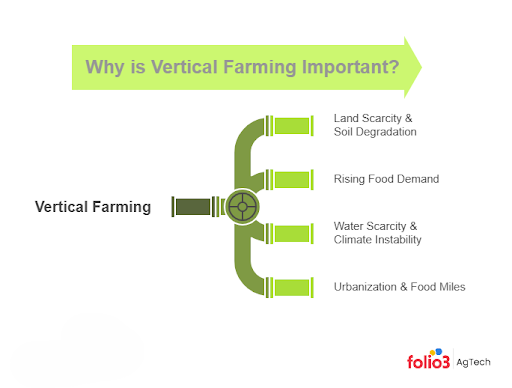
- Land scarcity & soil degradation: A third of the world’s farmable soil has been lost in just 40 years due to erosion and pollution. With fertile land disappearing, vertical farming offers a way to grow food on a minimal footprint without using soil, reducing pressure on the earth’s remaining farmland.
- Rising food demand: The food demand is projected to increase 60–100% over the next two decades. Traditional farming alone may struggle to meet this need. Vertical farming supplements food supply by stacking crops upward, ensuring reliable access to fruits and vegetables.
- Water scarcity & climate instability: Agriculture consumes about 70% of global freshwater. With droughts and extreme weather threatening yields, vertical farms recycle water and maintain steady production year-round. Climate-controlled systems protect crops from floods, frost, or heat waves.
- Urbanization & food miles: Over half the global population now lives in cities, often far from farms. Produce typically travels thousands of miles, losing freshness and adding emissions. Vertical farms can be built within or near cities, providing fresher food, cutting transport costs, and reducing waste.
These drivers have created an urgent need for solutions like vertical farming. That’s why the vertical farming benefits of high farm efficiency, climate resilience, and local production align perfectly with today’s food security needs.
Top 10 Benefits of Vertical Farming
What are the benefits of vertical farming? Below, we break down the advantages of indoor vertical farming, from yield and resource use to community impacts. Each benefit shows what vertical farms can do that traditional farms often cannot:
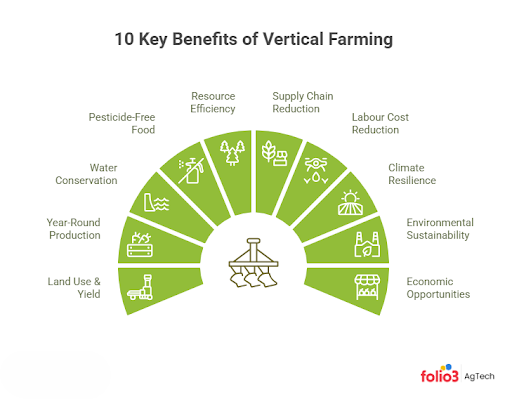
1. Maximizes Land Use & Crop Yield
Traditional agriculture requires vast horizontal land, a resource that is becoming scarcer every year as urbanization accelerates. Vertical farming flips that equation entirely by stacking growing layers, transforming a small urban footprint into a high-output production facility. According to research, vertical farms use over 90% less land while harvesting 80% more per unit of area compared to conventional farming.
To put that in perspective, a single vertical farm occupying a city warehouse can produce leafy greens equivalent to several acres of open-field farmland. For markets with expensive real estate or limited agricultural land, such as Singapore, the UAE, or dense urban centers, this advantage directly impacts project feasibility and long-term ROI. It also opens up farming opportunities in places where traditional agriculture simply is not possible.
2. Year-Round Production & Continuous Harvests
In a vertical farm, there are no seasons. Controlled environments allow crops to grow 365 days a year, enabling 12 to 16 harvest cycles annually for leafy greens compared to just 2 to 3 in open-field farming. This consistency fundamentally changes your supply chain dynamics: predictable output, stable revenue, and the ability to honor contractual commitments with retailers and foodservice operators year-round.
For regions dealing with harsh winters, monsoon disruptions, or unpredictable growing seasons, year-round production is not just a convenience. It is a food security imperative and one of the most practical advantages of vertical farming for commercial growers looking to build reliable supply partnerships.
3. Dramatically Reduces Water Use
This is one of the most significant environmental benefits of vertical farming. Closed-loop hydroponic and aeroponic systems recirculate water, using up to 95% less water than traditional field farming. Water that is not absorbed by plant roots is captured, filtered, and redelivered, virtually eliminating waste.
Consider the scale of the problem this addresses: agriculture accounts for approximately 70% of global freshwater withdrawals. In regions like the western United States, the Middle East, and parts of South Asia where water scarcity is already a critical constraint, this efficiency is transformative. For investors, water efficiency is also a key ESG metric that increasingly influences funding decisions and regulatory positioning.
4. Pesticide-Free & Safer Food
Sealed, climate-controlled environments eliminate exposure to pests, fungi, and pathogens that demand chemical intervention in field farming. Because no soil is used and air filtration prevents outside contaminants from entering, the result is produce that is pesticide-free and often qualifies for clean-label positioning. This also reduces the risk of contamination from pathogens like E. coli, which are more common in traditional outdoor growing operations.
For you as a grower or distributor, this means premium pricing potential, access to health-conscious retail channels, and reduced food safety liability. Consumer demand for pesticide-free produce continues to grow, making this one of the most market-relevant benefits of vertical farming.
5. Optimizes Energy & Resource Efficiency
Modern LED systems are tuned to specific light spectrums that match each crop’s photosynthetic needs, eliminating wasted energy from broad-spectrum lighting. Paired with AI-driven climate control, these systems optimize HVAC and nutrient delivery to reduce waste and improve margins. Unlike field farming, where fertilizer runoff pollutes waterways and over-application degrades soil over time, nutrient delivery in vertical farms is precise. Every drop and every gram of nutrient goes exactly where it is needed.
From an economic benefits of vertical farming perspective, energy efficiency directly impacts your operating margins. It is one of the key metrics investors evaluate when assessing vertical farming ventures, and one where precision agriculture technology is making rapid progress.
6. Shortens Supply Chains & Reduces Food Miles
The average food item in the US travels approximately 1,500 miles from farm to plate. That journey means spoilage, energy waste, and carbon emissions before the produce even reaches your shelf. Urban and peri-urban vertical farms drastically cut this distance by placing production within miles of consumers rather than hundreds of miles away.
The benefits are threefold: fresher produce with a notably longer shelf life, lower transportation costs that flow directly to your bottom line, and reduced carbon emissions from logistics. For your business, this also translates to a credible “locally grown” brand positioning, which resonates strongly with today’s environmentally conscious consumers.
7. Lower Labor Costs & Automation
Automated seeding, transplanting, monitoring, and harvesting reduce dependence on manual labor, which directly addresses the growing labor shortage in agriculture. Robotics and AI-driven workflows handle repetitive tasks with a precision and consistency that manual workers simply cannot match over long shifts.
From an economic benefits of vertical farming standpoint, automation enables scalable operations without proportional headcount increases. Work conditions also improve: employees operate in climate-controlled, pesticide-free environments rather than enduring extreme field conditions. This makes recruitment easier and positions agriculture as a technology career path for a new generation of workers.
8. Resilience to Weather & Climate Shocks
Fully enclosed systems are immune to droughts, floods, hurricanes, frost, and heatwaves. While traditional farms face increasing vulnerability as climate events become more frequent and severe, a vertical farm continues producing at the same pace regardless of what is happening outside its walls.
This reliability is a core advantage of vertical farming for food processors, retailers, and foodservice operators who need supply chain insurance. When a drought wipes out lettuce crops across a key growing region, your vertical farm keeps delivering. That kind of consistency has tangible value in contract negotiations and customer retention.
9. Sustainable & Environmentally Friendly Growth
Vertical farming eliminates several of the most damaging environmental impacts of conventional agriculture: no soil degradation, no deforestation to create new farmland, and no agricultural runoff polluting rivers and waterways. Because crops grow indoors, there is no need for the heavy machinery that burns fossil fuels on traditional farms.
When powered by renewable energy, vertical farms deliver a significantly reduced carbon footprint across the entire production cycle. This aligns with ESG mandates, corporate sustainability goals, and the growing consumer demand for eco-friendly food sourcing. For institutional investors and major retail partners, ESG alignment is increasingly a prerequisite rather than a differentiator.
10. Economic & Community Opportunities
Vertical farms create high-tech jobs that did not exist in traditional agriculture: data scientists, control systems engineers, automation technicians, agronomists specializing in controlled environments, and facility managers with cross-disciplinary expertise. This shifts the agricultural talent pipeline toward higher-skilled, higher-wage roles.
The market opportunity is substantial. The global vertical farming market was valued at $9.62 billion in 2025 and is projected to reach $39.20 billion by 2033, registering a CAGR of 19.3%. For communities, vertical farms transform abandoned warehouses and vacant urban buildings into productive economic assets, improving food access in underserved food deserts. Government incentives, grants, and tax credits are increasingly available for urban agriculture ventures, further improving the economic calculus.
Disadvantages of Vertical Farming
Understanding the disadvantages of vertical farming is just as important as knowing its benefits. No agricultural method is without trade-offs, and if you are evaluating vertical farming as an investment or operational strategy, these are the challenges you need to factor into your decision.
1. High Initial Capital Investment
This is the most frequently cited con of vertical farming, and for good reason. Building or retrofitting a vertical farm requires significant upfront spending across multiple categories: facility construction, LED lighting systems, HVAC infrastructure, automation equipment, growing systems, and software platforms. Startup costs can range from approximately $500K for a small container-based operation to $30M or more for a commercial-scale, building-based facility.
The lighting component alone accounts for approximately 38.5% of capital outlay in a typical setup, making it the single largest cost driver. However, costs are declining as technology matures and supply chains scale. Modular approaches, phased buildouts, and the growing availability of agricultural grants can help manage initial capital requirements and reduce entry barriers for new operators.
2. High Energy Consumption & Costs
Artificial lighting and climate control are energy-intensive. Energy can represent 25 to 40% of operating costs in a vertical farm, and dependence on grid electricity raises both cost and carbon footprint concerns if the facility is not powered by renewables.
However, next-generation LED efficiency is improving rapidly, and on-site solar or wind integration combined with AI-driven energy management is narrowing this gap. The climate-control systems segment is growing at 20.2% CAGR as operators sharpen their energy efficiency.
3. Limited Crop Variety
Vertical farming is currently most viable for leafy greens, herbs, microgreens, and strawberries. Staple crops like wheat, rice, and corn are not economically feasible in stacked indoor environments. Root vegetables and large fruiting crops also present challenges due to space and light requirements.
That said, R&D is expanding what is possible. Tomatoes, peppers, and blueberries are increasingly produced commercially in vertical farms, and the berries segment is projected to grow at a 27.3% CAGR through 2030. This limitation defines your addressable market, so understanding it is critical for planning.
4. Technical Complexity & Specialized Labor
Operating a vertical farm is not like running a traditional growing operation. It requires cross-disciplinary expertise spanning agronomy, data science, systems engineering, and facility management, a skill set combination that is rare in the labor market. Finding and retaining this specialized talent is one of the most persistent cons of vertical farming, especially outside major agtech hubs like the Netherlands, Singapore, or select US metros.
System failures in lighting, climate control, or nutrient delivery can cascade quickly. Unlike outdoor farming, where a bad week might reduce yields, a climate system failure in a sealed vertical farm can cause total crop loss within days. Built-in redundancy and real-time monitoring are not optional; they are essential.
The good news is that managed service providers, SaaS-based farm management platforms, and AI-powered agricultural solutions are steadily reducing the expertise barrier. Automation is handling more of the routine decision-making, freeing human operators to focus on strategic oversight rather than hands-on troubleshooting.
5. Scalability & Profitability Challenges
Many vertical farming startups have struggled with unit economics, and this is a disadvantage you cannot afford to ignore. High-profile closures and financial difficulties have raised legitimate questions about long-term viability at scale. The core challenge is that revenue per square foot needs to consistently exceed the high operating costs of energy, labor, and facility maintenance.
Break-even timelines can stretch to 3 to 7 years depending on facility size, crop mix, market positioning, and local energy costs. That is a long runway, and it demands patient capital and disciplined execution.
That said, the industry is maturing rapidly. The focus is shifting from “grow at all costs” to sustainable unit economics. Operators who target premium markets, such as high-end restaurants, direct-to-consumer subscription models, and pharmaceutical-grade produce, are demonstrating that profitability is achievable with the right business model and technology stack.
6. Environmental Footprint Debate
While vertical farming reduces land and water use, its energy consumption can offset environmental gains if the facility is powered by fossil fuels. Life-cycle assessments show mixed results depending on energy source, location, and crop type.
Facilities powered by renewable energy dramatically improve the environmental calculus. Carbon credit programs and ESG frameworks are increasingly incentivizing clean-energy vertical farms, making this a solvable challenge rather than a fundamental flaw.
Pros and Cons of Vertical Farming
We have covered the detailed benefits and disadvantages of vertical farming individually. Now, here is a consolidated, side-by-side comparison for decision-makers who want the bottom-line view. Whether you are a commercial grower evaluating your next facility, an investor assessing vertical farming ventures, or an agribusiness executive exploring diversification, this comparison captures the essential trade-offs.
| Factor | Pros | Cons |
| Land & Yield | Up to 10–20x yield per acre; minimal footprint | Facilities are expensive to build and retrofit |
| Water Usage | Up to 95% less water than field farming | Requires sophisticated closed-loop systems |
| Production Cycle | 365-day, year-round harvests | Currently limited to select crop types |
| Food Safety | Pesticide-free, controlled environment | System failure can cause rapid, total crop loss |
| Energy | AI-optimized LED and HVAC efficiency | High energy consumption; grid-dependent |
| Supply Chain | Hyper-local; significantly reduces food miles | Distribution infrastructure still developing |
| Labor | Automation reduces costs meaningfully | Requires specialized, hard-to-find talent |
| Climate Risk | Immune to weather and climate events | Does not address broad food system needs (staples) |
| Environment | Reduced carbon footprint, no soil degradation | Fossil-fuel-powered facilities may offset gains |
| Economics | Growing $9.6B+ market; high-tech job creation | 3–7 year break-even; profitability not guaranteed |
The takeaway? Vertical farming is not a silver bullet, but for the right crops, markets, and operators, the pros significantly outweigh the cons, especially as technology continues to reduce costs and expand capabilities. Weigh these factors against your specific business context, crop strategy, and capital position.
How AI is Shaping Vertical Farming to Enhance Efficiency and Yield
If the disadvantages above gave you pause, here is the technology bridge that is actively closing the gap. AI in agriculture is transforming vertical farming from a capital-intensive experiment into a data-driven, optimizable operation. Where first-generation vertical farms relied heavily on manual calibration and trial-and-error growing protocols, AI-enabled facilities use continuous data feedback loops to refine every variable in real time.
Here is how AI is making a measurable difference across the vertical farming stack:
- Predictive Crop Analytics: Machine learning models analyze historical growth data, environmental conditions, and nutrient levels to forecast yields and detect crop stress before visible symptoms appear. This proactive approach minimizes losses and optimizes harvest timing.
- Computer Vision for Plant Health: AI-powered cameras monitor plant color, leaf structure, and growth patterns in real time, identifying nutrient deficiencies, disease risk, or pest intrusion at the earliest stages when intervention is cheapest and most effective.
- AI-Driven Climate Control: Intelligent HVAC and lighting systems adjust temperature, humidity, CO₂, and light spectrums dynamically based on crop stage and real-time sensor data. This reduces energy consumption while optimizing growth conditions, directly addressing the energy cost disadvantage.
- Demand Forecasting: AI models predict market demand to align production schedules with actual buyer needs, reducing overproduction, waste, and the carrying costs that erode margins.
- Robotic Harvesting Optimization: AI-guided robotics determine optimal harvest timing based on visual and sensor data, then automate the picking process to reduce labor costs and improve product consistency.
AI is the differentiator between first-generation vertical farms that struggled with profitability and the current generation, achieving sustainable unit economics. If you want to understand how AI solutions are being applied across agriculture, the technology roadmap is becoming clearer every quarter.
Wrapping It Up
Vertical farming offers transformative benefits for food production, sustainability, and economic growth, but it comes with real challenges that demand careful planning, the right technology stack, and realistic financial expectations. The pros and cons of vertical farming are not abstract; they are operational realities that shape your investment returns and growth trajectory.
If you are a commercial grower, focus on crop selection and facility design that align with your target market and local demand patterns. If you are an investor, study the unit economics of operators targeting premium channels and assess their technology readiness. If you are an agribusiness executive, consider how vertical farming can strengthen your supply chain resilience, bolster your sustainability credentials, and open new product lines.
As AI, automation, and renewable energy continue to advance, the disadvantages of vertical farming are shrinking while the advantages are compounding. The question is not whether vertical farming will play a significant role in the future of food production. The question is whether you will be positioned to benefit from it. Explore how technology is transforming agriculture across every link in the value chain, and start evaluating what vertical farming means for your specific operation.
FAQs
What Are The Main Benefits Of Vertical Farming?
The top benefits include up to 95% water savings through closed-loop systems, year-round production with 12–16 annual harvest cycles for leafy greens, significantly higher yields per acre compared to traditional farming, and pesticide-free produce. These advantages make vertical farming particularly valuable in water-scarce regions, urban environments, and markets demanding clean-label food.
Is Vertical Farming Profitable?
Profitability depends on several factors: facility scale, crop mix, market positioning, and energy costs. Operators targeting premium channels like restaurants, direct-to-consumer, and pharmaceutical-grade produce are showing stronger margins. The industry is shifting from growth-at-all-costs to sustainable unit economics, with break-even timelines of 3–7 years for well-managed operations.
What Crops Can You Grow In A Vertical Farm?
Currently, leafy greens (lettuce, spinach, kale), herbs (basil, cilantro, mint), microgreens, and strawberries are the most commercially viable. Tomatoes, peppers, and blueberries are increasingly being produced at a commercial scale. Staple crops like wheat, rice, and corn remain economically unfeasible in vertical settings due to space and light requirements.
How Does Vertical Farming Help The Environment?
The environmental benefits of vertical farming include up to 95% less water use, over 90% less land required, zero pesticide runoff, and significantly reduced food miles by growing produce closer to consumers. When powered by renewable energy, vertical farms can also achieve a substantially lower carbon footprint compared to conventional field farming.
What Are The Pros And Cons Of Vertical Farming Vs. Traditional Farming?
The pros include water efficiency, year-round harvests, pesticide-free production, climate resilience, and smaller land footprints. The cons include high startup costs, energy intensity, limited crop range, technical complexity, and profitability uncertainty. For a detailed factor-by-factor comparison, refer to the pros and cons table in this guide.
How Much Does It Cost To Start A Vertical Farm?
Startup costs range widely: small container-based farms start around $500K, mid-scale operations run $2M to $10M, and commercial-scale building-based facilities can exceed $30M. Key cost drivers include lighting infrastructure, HVAC systems, automation equipment, and real estate. Modular approaches can reduce initial capital requirements.
How Is AI Used In Vertical Farming?
AI applications in vertical farming include predictive crop analytics for yield forecasting, computer vision for real-time plant health monitoring, AI-driven climate control for energy optimization, demand forecasting for production planning, and robotic harvesting automation. These technologies are helping modern vertical farms achieve better margins than first-generation facilities.