
If you manage cattle, or you’re thinking about getting into the business, you already know the beef supply chain isn’t simple. Unlike poultry or swine, where a single company often controls every step from genetics to the grocery shelf. Beef cattle move through a series of independent, specialized operations before they ever reach the consumer’s plate.
The USDA reports 86.2 million head of cattle in the U.S. as of January 2026. The sheer scale of this industry demands that every producer understands where they fit in the chain and how to run their segment profitably.
This guide breaks down the different types of cattle operations, compares production methods, highlights real-world ranch success stories, and shows you how modern AgTech is helping livestock managers make smarter, data-driven decisions at every stage.
How Modern Cattle Farming and the Beef Supply Chain Operate
One of the most important things to understand about the beef industry is that it is not vertically integrated like poultry or pork production. In those industries, a single integrator typically owns the animals, the feed, and the processing plant. Beef is different. The supply chain is segmented into distinct, independently operated phases, each with its own economics, risk profile, and management requirements. A calf born on a ranch in Montana may change hands three or four times before it reaches a packing plant in Kansas.
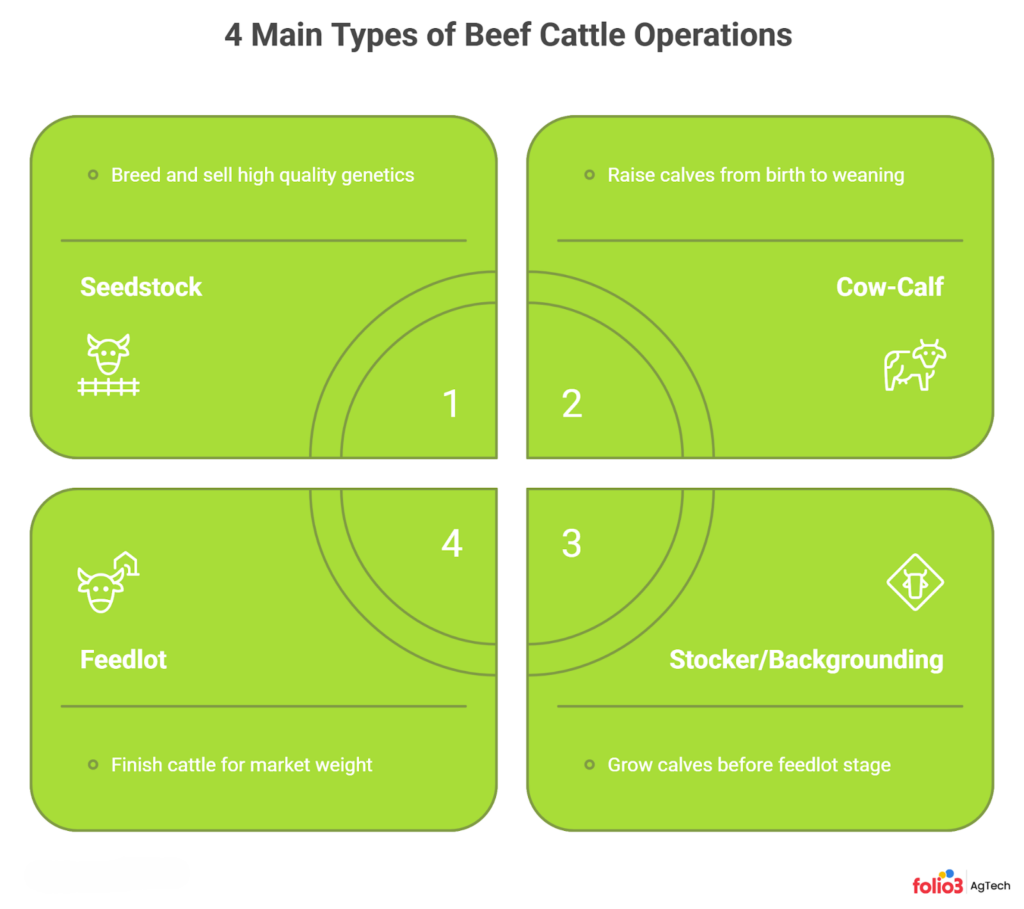
What are the different types of cattle operations? The beef supply chain is primarily broken down into four distinct segments: Seedstock, Cow-Calf, Stocker/Backgrounding, and Feedlot operations. Each segment plays a specific role in bringing beef from pasture to plate, and understanding how they connect is essential for any livestock manager looking to optimize profitability and efficiency.
This segmentation is precisely why livestock management software with data management has become so critical. When animals move between operations, the ability to transfer accurate health, weight, and genetic records digitally can mean the difference between a profitable transaction and a costly mistake.
The 4 Main Types of Beef Cattle Operations Explained
Whether you’re a first-generation rancher or a multi-generational operation evaluating where to specialize, understanding these four pillars will help you identify opportunities, manage risk, and invest in the right technology for your specific operation type.
1. Seedstock (Purebred) Operations
Seedstock operations form the genetic foundation of the entire beef industry. If you think of the supply chain as a building, seedstock producers are the architects. They design the genetics that determine how efficient, healthy, and profitable every downstream animal will be.
These operations focus on producing high-quality registered bulls and replacement heifers from purebred herds. The most common breeds optimized at this level include Angus (which dominates the U.S. market), Hereford, Charolais, and Brahman, particularly in hotter, more humid climates across the South. The goal isn’t to produce the most cattle, it’s to produce the best genetics.
Seedstock producers invest heavily in performance testing, genomic evaluations, and Expected Progeny Differences (EPDs) to quantify traits like birth weight, weaning weight, marbling, and feed efficiency. The U.S. beef herd consists of more than 80 breeds and crosses, which underscores just how critical genetic selection decisions are at this stage.
That’s where AgTech is making one of its biggest impacts. Modern livestock breeding software allows seedstock producers to centralize genomic profiles and automate mating recommendations based on trait objectives. It tracks reproductive outcomes digitally, replacing the spreadsheets and paper pedigrees that slowed genetic progress for decades.
2. Cow-Calf Operations
Cow-calf operations represent the largest and most widespread segment of beef cattle operations. Here, the production cycle begins in earnest: a permanent herd of brood cows is maintained year-round, bred annually, and their calves are raised until weaning at roughly six to eight months of age.
According to the USDA Economic Research Service, the average beef cow herd in the U.S. is about 47 head, and nearly 80% of beef cow operations have fewer than 50 animals. Yet operations with 100 or more beef cows, only about 10.5% of all operations, control over 60% of the national beef cow inventory. That statistic alone tells you how diverse this segment is, ranging from small family ranches supplementing off-farm income to large commercial herds running thousands of head across multiple states.
Managing a cow-calf operation demands strong grazing management skills. You’re working with massive land requirements, and your profitability is directly tied to forage quality, calving distribution, and your ability to wean a healthy, heavy calf at the lowest possible cost. Spring calving remains the most common strategy, but many producers have shifted to fall calving or split seasons to align with market timing and labor availability.
Digital tools for farm record keeping are transforming how cow-calf producers track breeding dates, calving ease scores, vaccination histories, and weaning weights, all from a mobile device in the pasture. When you’re managing dozens or hundreds of cows across thousands of acres, having that data at your fingertips instead of on a clipboard changes everything.
3. Stocker and Backgrounding Operations
Once calves are weaned from the cow-calf operation, they often enter the stocker or backgrounding phase, the “middleman” stage of the beef supply chain. According to peer-reviewed research, 60% or more of the U.S. calf population passes through some form of backgrounding or stocker program before entering a feedlot.
The primary goal here is straightforward: add cheap weight. Stocker operators purchase lightweight, freshly weaned calves, typically 400–600 lbs. They grow them on forage-based diets; grass pasture, wheat pasture, or harvested forages until they reach 700–900 lbs and are ready for the feedlot. Backgrounding operations do the same thing, but often in a drylot setting with more supplemental feeding.
This phase carries significant market risk. You’re buying lightweight calves at one price and selling heavier cattle months later at a price you can’t predict. You’re also dealing with the highest health risk in the supply chain. Freshly weaned calves are stressed, immunocompromised, and highly susceptible to bovine respiratory disease (BRD), the single most costly disease in the U.S. cattle industry.
That’s why biosecurity protocols, vaccination programs, and real-time health monitoring are non-negotiable in this segment. Livestock identification and traceability systems help stocker operators track individual animal health events. They flag sick animals early through behavior monitoring, and maintain the treatment records that buyers downstream increasingly demand.
4. Feedlot (Finishing) Operations
The feedlot is the final production stage before cattle reach the packing plant. Here, cattle are moved from forage-based diets to high-energy grain rations. It primarily includes corn, distillers’ grains, and protein supplements to put on the muscle and intramuscular fat (marbling) that USDA quality grades like Choice and Prime require.
Cattle typically spend 120 to 200 days in a feedlot, gaining 3 to 4 pounds per day until they reach a target slaughter weight of 1,200 to 1,400 lbs. Feedlots with a capacity of 1,000 or more head accounted for 82.7% of all cattle on feed in the United States. The concentration is even more dramatic when you look at marketed cattle: large feedlots representing roughly 7% of all feeding operations market about 88% of fed cattle.
Efficiency is everything in the feedlot. Feed conversion ratios (FCR), the pounds of feed required to produce one pound of gain, typically range from 6:1 to 8:1. Even small improvements in FCR translate to significant cost savings when you’re feeding thousands of animals daily. That’s why precision livestock farming (PLF) and feedlot management software have become essential tools for large operations. They enable real-time tracking of feed consumption, pen-level cost of gain, animal health events, and projected close-out performance.
Comparison Table: Analyzing Different Types of Farming Methods for Cattle
The table below provides a quick-reference comparison of the four primary beef cattle operations. It highlights the core differences in purpose, land needs, financial risk, and the technology tools that give modern producers a competitive edge in each segment.
| Operation Type | Primary Goal | Land Requirement | Capital/Risk Level | Tech/Software Used |
| Seedstock | Produce elite genetics (bulls & heifers) | Low–Moderate | High capital; long-term ROI | Genomic testing, breeding & EPD software |
| Cow-Calf | Raise calves for sale at weaning | High (extensive grazing) | Moderate; tied to forage & markets | Pasture management, cattle record-keeping apps |
| Stocker/ Backgrounding | Add weight via forage before the feedlot | Moderate (seasonal pasture) | High market & health risk | Health monitoring, traceability systems |
| Feedlot | Finish cattle to slaughter weight on grain | Low (confined pens) | Very high capital; feed cost exposure | Feedlot ERP, feed management, PLF software |
Traditional vs. Alternative Beef Production Methods
Beyond operation types, the method of production you choose also shapes your costs, your market, and your margins. Here’s how the main production approaches compare.
Conventional (Grain-Finished)
It is the dominant production method in the United States and the path most cattle follow through the supply chain. Calves are raised on pasture through the cow-calf and stocker phases, then moved to a feedlot where they’re finished on high-energy grain rations for 120–200 days.
The result is a well-marbled carcass that consistently grades USDA Choice or Prime. Conventional finishing accounts for the vast majority of U.S. beef production, and it’s the system most feedlot technology is designed to support.
Grass-Fed and Grass-Finished
Grass-fed beef has become one of the fastest-growing segments of the premium beef market. In this system, cattle are never transitioned to grain rations; they spend their entire life on forage. About 40% of cow-calf operations in the U.S. already use some form of rotational grazing.
For producers going fully grass-finished, rotational grazing tools and pasture management software become essential for maintaining forage quality. They are preventing overgrazing across the longer finishing timeline that grass-based systems require.
Organic Beef Production
Organic certification adds another layer of complexity. Cattle must be raised on 100% organic feed, have unrestricted outdoor access, and cannot receive antibiotics or growth hormones. The certification process through USDA’s National Organic Program is rigorous, but organic beef commands a significant price premium at retail.
For producers considering this path, digital compliance and audit management tools are particularly valuable. They help you maintain the detailed records that organic certification requires without drowning in paperwork.
Real-World Ranch Examples of Successful Cattle Operations
Theory is useful, but seeing how real operations solve real problems is where the learning deepens. These three examples show AgTech in action across the supply chain.
1. Scaling Elite Genetics: The Vytelle Advance Story
Vytelle is a global leader in precision livestock solutions, serving cattle producers in more than 20 countries. Their Vytelle Advance platform leverages in vitro fertilization (IVF) technology to help seedstock producers accelerate genetic progress, but the operational bottleneck wasn’t the science. It was the data.
Before partnering with AgTech specialists, Vytelle’s Ovum Pick-Up (OPU) process relied on manual donor forms, paper-based lab inventory tracking, and disconnected systems for managing mating decisions, semen sorting, and grading. Technicians were spending valuable time writing down information by hand and re-entering it into separate systems, creating delays and data integrity risks.
The solution was a custom web application that digitized the entire OPU workflow from donor form pre-filling and event management to real-time lab inventory updates and advanced analytics reporting. The result: faster satellite onboarding, more OPUs performed in less time, and 100% data integrity across the process. For seedstock producers relying on Vytelle’s services, this means elite genetics can be scaled faster and with greater confidence.
View the Vytelle Advance Case Study →
2. Precision Feedlot Management: Cactus Feeders
Cactus Feeders is one of the largest cattle feeding operations in the United States, producing approximately one million fed cattle annually with gross revenues exceeding $1 billion. With 800 employee-owners and multiple massive yards, efficiency at scale isn’t optional; it’s survival.
Their legacy system was built on an older technology stack that had become slow, complex, and frustrating for workers to use. Simple tasks like entering cattle movement data, managing feed delivery, or pulling health records took far longer than they should have, creating operational inefficiencies that compounded across the organization.
The upgrade delivered a streamlined, multi-device “Cattle View” solution that consolidated cattle movement, feed consumption, and health data into a single, intuitive platform accessible from handhelds in the yard to desktops in the office. The result proved that size doesn’t have to mean inefficiency; even at the scale of a million head per year, the right software turns data into daily decisions that protect margins.
View the Cactus Feeders Case Study →
3. Eliminating Paper Trails: Progressive Beef’s Compliance Victory
Progressive Beef operates across dozens of feed yards and needed a way to digitize the compliance and auditing processes that food safety and animal welfare programs demand. The challenge was deeply practical: paper-based animal records were slow to complete, hard to access during audits, and prone to the kind of errors that can cost a feedlot its program certification.
A cross-platform mobile and web solution was built to automate data entry. It enables real-time compliance tracking, supports corrective action notifications, and provides offline functionality for workers in areas without reliable connectivity. The transition from paper to digital didn’t just save time; it fundamentally changed the accuracy and accessibility of audit-ready records.
The impact was measurable: Progressive Beef expanded its network to 83 feed yards, with managers and auditors now able to track productivity and compliance in real time. In an industry where consumer trust and regulatory scrutiny are increasing, digital auditing and compliance management directly impact marketability and long-term viability of cattle operations.
View the Progressive Beef Case Study →
Optimize Your Cattle Operation for the Future!
Whether you’re a seedstock producer chasing genetic progress, a cow-calf rancher managing thousands of acres of pasture, a stocker operator navigating market volatility, or a feedlot manager optimizing feed costs across massive yards, the common thread is clear. The operations that thrive are the ones that combine sound animal husbandry with accurate data, efficient resource management, and technology that works the way you do.
The beef industry is in a period of historic tightness, continuing a multi-year contraction; every animal matters more than ever. The producers who will come out ahead are the ones investing in the tools and systems that let them make faster, better-informed decisions every day.
Ready to see what modern cattle management software can do for your specific operation? Whether you need a customized demo, a consultation on digitizing your workflows, or simply want to explore what’s possible, the right AgTech partner can help you turn raw data into real profitability.
FAQs
What Is the Most Profitable Type of Cattle Operation?
Profitability depends on your region, resources, and management skills more than the operation type itself. Feedlots typically generate the highest gross revenue, but cow-calf operations often deliver stronger returns relative to capital invested, especially when land costs are low and forage conditions are favorable.
How Many Acres Do You Need Per Cow in a Cow-Calf Operation?
Stocking rates vary widely based on climate and forage productivity. In the humid Southeast, you might run one cow per 2–3 acres. In the arid West, that number can jump to 30–50 acres or more per cow. Your local USDA Natural Resources Conservation Service office can provide region-specific guidance.
What Technology Do Small Cattle Operations Actually Need?
At a minimum, a reliable cattle management app that tracks health events, breeding records, and weights is a worthwhile starting point. Even small herds benefit from replacing paper notebooks with a centralized digital system that generates reports and sends reminders.
What Is the Difference Between Stocker and Backgrounding Operations?
Both serve the same purpose, adding weight to weaned calves before the feedlot, but the method differs. Stocker operations rely primarily on pasture grazing, while backgrounding operations typically use drylot facilities with supplemental feeding of hay, silage, or limited grain rations.
How Is the Beef Industry Adapting to Traceability Requirements?
With the USDA’s electronic identification (EID) mandate gaining momentum, producers at every level are adopting RFID ear tags and digital livestock identification and traceability systems. These tools create a verifiable chain of custody from birth to harvest, which supports disease control, food safety, and export market access.