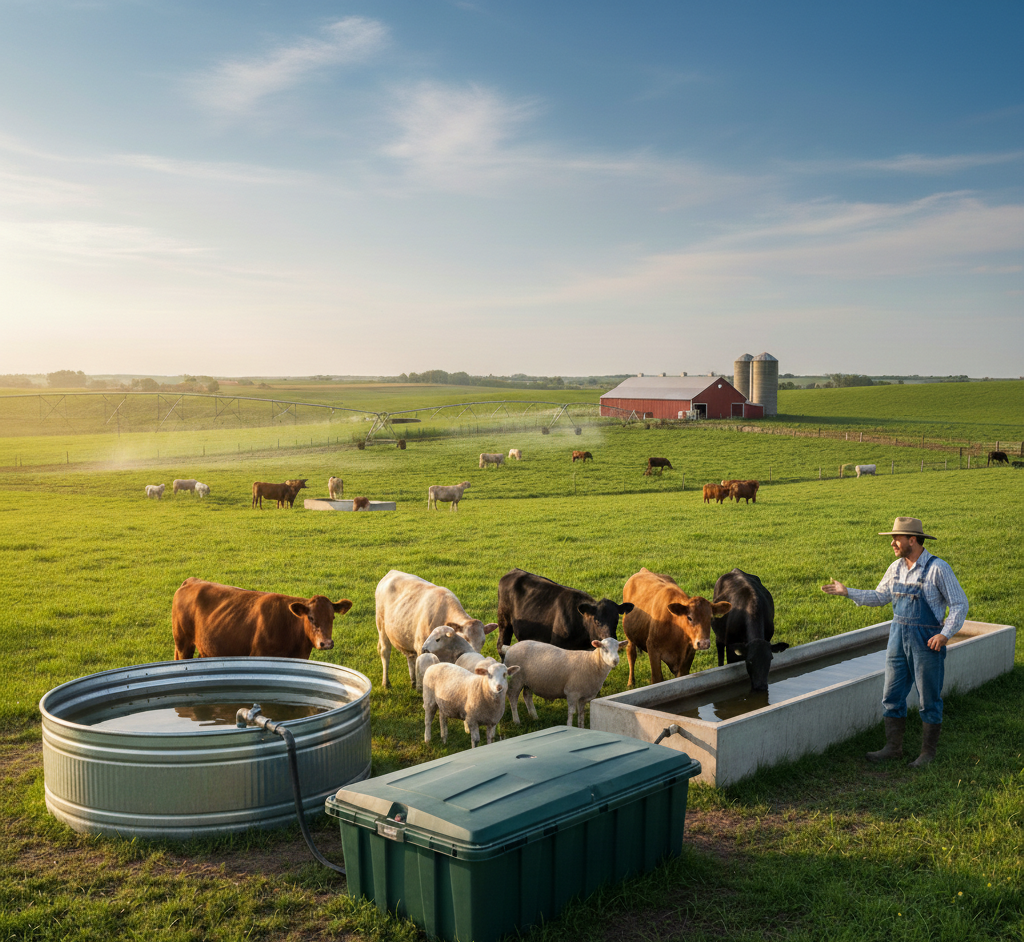

Water is not just another input on your farm; it is the single most critical nutrient your livestock consumes every day. A beef cow’s body is estimated to be 50 to 80 percent water, and milk itself is roughly 87% water. Yet despite its outsized impact on animal health, productivity, and your bottom line, the infrastructure that delivers this essential resource often gets overlooked. The livestock water tank remains one of the most under-evaluated purchases in agribusiness.
This guide is built for you: the farm manager, the procurement head, or the AgTech-forward operator who understands that choosing the right farm water tank is not a commodity purchase. It is a strategic decision that affects feed conversion, daily weight gains, milk yields, and ultimately, your operation’s return on investment.
From material comparisons and cattle water trough design to IoT-enabled smart monitoring and long-term maintenance protocols, you will find everything you need to make a confident, data-driven decision about your animal watering systems right here.
The Crucial Role of Reliable Animal Watering Systems in Farm Operations
Your livestock water system is revenue-driving infrastructure, not just hardware. Understanding the physiological demands behind cattle water consumption helps you protect both your herd and your margins.
Water as a Physiological Priority for Your Herd
Every physiological process in your herd, from digestion and nutrient absorption to thermoregulation and lactation, depends on consistent access to clean, fresh water. When you think of a water tank for animals, think beyond a simple container. It is the front line of your animal welfare strategy and, by extension, your profitability.
Daily Consumption: What the Numbers Tell You
The numbers make the case clearly. A lactating dairy cow will consume 30 to 50 gallons of water per day, and that figure can double during heat stress. On the beef side, cattle need approximately 1 gallon of water per 100 pounds of body weight under normal conditions, rising to nearly 2 gallons per 100 pounds when temperatures hit 90°F. A spring-calving cow-calf pair in peak summer heat can require 25 to 30 gallons daily.
What Poor Water Access Costs You
What happens when that supply falters? Even a brief two-hour limitation in water access can decrease milk production faster than a deficiency in any other nutrient. On beef operations, dehydration triggers a cascade of problems: reduced feed intake, impaired digestion, increased susceptibility to heat stress, and ultimately, slower weight gains for feedlot operators, which translates directly to a higher cost-per-pound of gain and eroded margins.
The connection is straightforward, as the quality and reliability of your livestock water infrastructure directly determines how much feed your animals convert into saleable product. Whether you are raising beef cattle on pasture or managing a dairy herd in confinement, inconsistent water access creates invisible losses that compound over the entire production cycle. When you position your water system as the operational priority it truly is, every downstream metric from average daily gain to milk yield per cow starts to improve.
Types of Livestock Water Tanks: Which Is Right for Your Farm?
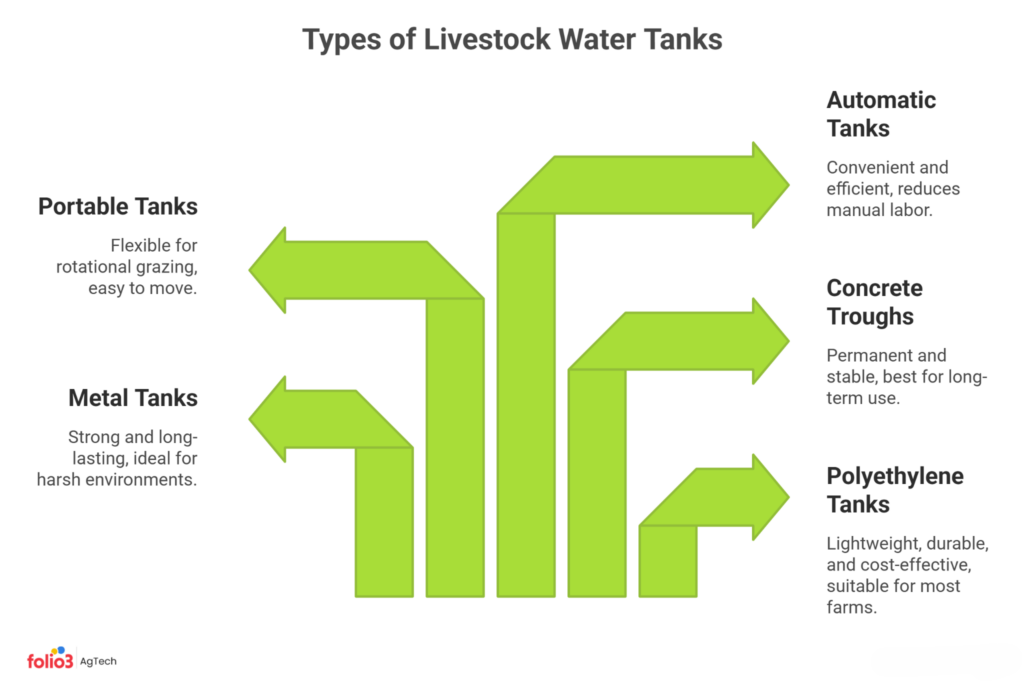
Walk through any farm supply catalog, and you will find dozens of options for water tanks for cattle. The sheer variety can be overwhelming. Below is an objective, deep-dive comparison of the most common materials and designs on the market, along with their best use-cases for commercial-scale operations.
Polyethylene and Plastic Tanks (The Modern Standard)
Polyethylene tanks have emerged as the go-to cow water container for modern operations, and for good reason. Manufactured through rotational molding, these one-piece tanks have no seams or joints that could weaken over time. The material is inherently UV-resistant, rust-proof, and chemically stable, which means it will not leach harmful substances into your water supply.
Higher-end models feature double-wall construction with foam insulation, providing meaningful temperature regulation in both summer heat and winter cold. The lightweight design simplifies installation and repositioning, making them a practical choice for operations that shift pastures seasonally. Many polyethylene tanks are FDA-approved for food-contact applications, giving you confidence in water purity.
Meanwhile, lifespan typically ranges from 10 to 20 years, depending on exposure conditions and maintenance, with some premium models exceeding that range. On the downside, extreme cold can make lower-grade plastic brittle, so if you operate in northern climates, invest in a tank specifically rated for your temperature extremes and look for models with reinforced walls.
Metal Water Tanks for Livestock (Galvanized Steel)
Galvanized steel tanks have been a staple of American ranching for over a century. Their zinc coating provides a reasonable defense against rust, and the rigid structure offers excellent impact resistance. It is a real advantage if your herd includes curious, pushy cattle. They are widely available and often cheaper at the point of purchase than their polyethylene counterparts.
However, metal water tanks for livestock carry some significant trade-offs. Steel is a strong conductor of heat, meaning water gets hotter in summer and colder in winter. Over time, the zinc coating wears away, especially at seams and bolt points, leading to corrosion that can contaminate your water supply and create sharp edges that pose an injury risk to your stock. Maintenance requirements are moderate, so expect to inspect for rust and consider recoating every few years to extend the 15- to 30-year potential lifespan.
Concrete Water Troughs (The Permanent Fixture)
If your operation is a permanent feedlot or a long-established dairy, a concrete water trough deserves consideration. These tanks are cast in place or precast and delivered, and once installed, they are not going anywhere. Their mass provides natural cooling properties, keeping water temperatures more stable than steel in warm climates. Durability is exceptional; well-built concrete troughs can serve for 20 to 50 years.
The downsides are significant for some operations. Installation requires site preparation, heavy equipment, and often professional contractors, driving up initial costs substantially compared to drop-in alternatives. Concrete is also vulnerable to freeze-thaw cracking in cold climates, and when cracks develop, repairs are neither cheap nor simple, often requiring partial demolition and re-pouring.
However, algae tends to colonize the porous surface more readily than smooth plastic, increasing your cleaning frequency. If your operation demands any degree of flexibility in tank placement or if you anticipate expanding and repositioning your infrastructure in the coming years, concrete is not your answer.
Portable Water Tank for Livestock (For Rotational Grazing)
For operations practicing rotational or adaptive grazing, a portable water tank for livestock is a game-changer. Collapsible frame tanks, trailer-mounted units, and lightweight polyethylene tubs let you move water with your herd, supporting better pasture utilization and more even manure distribution. These solutions are increasingly popular among sustainable-minded producers who understand that grazing management and water placement go hand in hand.
The trade-off is capacity and durability. Most portable solutions hold less water than their permanent counterparts, which means more frequent refilling or reliance on mobile pumping systems. They are also more exposed to UV damage and physical wear from repeated transport. For smaller herds or as a supplementary system alongside a primary livestock water tub, portable tanks excel.
Automatic and Heated Cattle Watering Tanks
Automatic waterers combine a reservoir with float valves and pressure regulators to maintain a constant water level, eliminating the daily chore of manually filling tanks. For operations in northern states, heated models integrate thermostatically controlled heating elements that prevent freezing, ensuring year-round water access without the labor of breaking ice.
These systems deliver substantial labor savings and improved water freshness, since the supply is continuously replenished rather than sitting stagnant. The upfront cost is higher, and they require electrical connections and more complex plumbing.
Plus, maintenance demands are also elevated; float valves need regular inspection, and heating elements should be tested before each winter season. However, for large-scale commercial operations, the long-term labor and health cost savings typically justify the investment. If you are exploring how livestock farming technology impacts ROI, automatic watering systems are one of the clearest examples.
Comparison Table: Livestock Water Tank Materials
| Feature | Polyethylene | Galvanized Steel | Concrete | Portable | Automatic/Heated |
| Initial Cost | $$ | $ – $$ | $$$ | $ – $$ | $$$ |
| Lifespan | 10–20 years | 15–30 years | 20–50 years | 5–10 years | 10–15+ years |
| Maintenance | Low | Moderate | Low | Low–Moderate | High |
| Portability | Moderate | Low–Moderate | None | High | None–Low |
| Ideal Climate | All climates | Moderate | Warm/Dry | All climates | Cold/Freezing |
| Best For | Most operations | Budget-conscious ranches | Permanent feedlots | Rotational grazing | Large-scale, cold climates |
Cattle Water Trough Design & Sizing: Calculating Your Herd’s Needs
Undersized tanks create herd bottlenecks and lost production. Getting your cattle water trough design right starts with understanding exactly how many gallons your operation demands.
How Many Gallons Does Your Herd Need?
Calculating the right capacity for a large livestock water tank begins with species-specific daily consumption. Here is a quick reference based on credible extension research:
- Lactating dairy cows: 30 to 50 gallons per day under normal conditions; can double during heat stress.
- Beef cattle: Approximately 1 gallon per 100 lbs of body weight for dry cows and bulls; 2 gallons per 100 lbs for lactating cows and growing stock in hot weather.
- Horses: Highly variable based on body weight, exercise, and diet, typically 5 to 15 gallons daily.
- Sheep and goats: Smaller volumes (1 to 4 gallons daily), but they require more frequent access points due to social drinking behavior.
To size your large cattle water tanks, multiply the per-head daily requirement by total headcount. Then, add a buffer of at least 15 to 20 percent for hot days, system downtime, or unexpected spikes in consumption. For example, a 100-head beef operation with 1,200-pound dry cows needs a baseline of about 1,200 gallons per day. Plus that buffer brings you to roughly 1,400 gallons of accessible reserve.
Understanding Peak Drinking Periods and Flow Rates
Cattle do not drink evenly throughout the day. Dairy cows, for instance, consume 30 to 50 percent of their total daily water intake within one hour of milking. In beef operations, peak consumption aligns with feeding times and the early-morning and late-afternoon hours.
This is where the “5% Rule” becomes essential: your watering infrastructure should accommodate at least 5 percent of your herd drinking simultaneously. If you run 200 head, that means your tanks and troughs must serve 10 animals at once without any cow waiting for access. Industry guidelines suggest providing 3.5 linear inches of accessible waterer perimeter per cow, with at least two watering locations per group.
Equally important is the flow rate feeding your tank. A minimum of 30 gallons per minute flow rate into the tank to ensure water does not become limited at peak times. For smaller waterers, a minimum of 3 to 5 gallons per minute. The key principle: your refill rate must exceed peak demand, or your static reserve capacity must be large enough to bridge the gap.
Best Practices for Placement and Installation of Farm Water Tanks
Where you place your livestock water storage tanks matters as much as which tank you buy. Strategic installation protects your pastures, your infrastructure, and your herd’s health.
Pasture Utilization and Off-Site Watering Systems
Tank placement is a grazing management tool. When a water container for animals sits in one corner of a pasture, cattle congregate there, overgrazing nearby forage, concentrating manure, and underutilizing distant areas. Strategic placement or better yet, rotating your water source alongside your herd promotes even grazing distribution and healthier pastures.
A widely referenced guideline is to keep water within 500 to 800 feet of grazing areas, and when the distance to the waterer increased beyond 900 feet, average daily gains declined measurably. If your pastures are large, consider installing satellite watering stations or using portable tanks to bring water closer to the herd rather than forcing cattle to walk excessive distances.
Off-site watering systems, which pipe water away from ponds or streams to a designated trough, also offer environmental benefits. They prevent livestock from trampling stream banks and contaminating surface water. It helps you stay ahead of environmental regulations and supports the long-term health of your land. For those starting a cattle farm business, planning water placement during the infrastructure phase saves expensive retrofitting later.
Plumbing, Foundations, and Avoiding Trampling
The area around a watering trough for livestock takes a beating. Hundreds or thousands of hooves per day will turn bare ground into a mud pit in short order, creating an unsanitary environment that breeds bacteria and can lead to hoof problems in your herd.
Best practices for installation include:
- Concrete pads or gravel aprons: Install a 10- to 15-foot pad of concrete or compacted gravel around the tank perimeter to prevent mud buildup and provide a stable footing.
- Buried supply lines: In regions with freezing temperatures, bury your water supply lines below the frost line (typically 3 to 6 feet, depending on your location) to prevent freeze damage.
- Drainage grading: Grade the area around the tank so that spilled or overflow water drains away from the tank, not toward it, to minimize standing water and mud.
- Tank elevation: Slightly elevate the tank base above the surrounding grade to prevent surface runoff from entering the tank and contaminating the water supply. A 4- to 6-inch raised concrete pad works well for most installations.
Taking the time to install your water infrastructure correctly the first time avoids costly remediation later. Operations that skip the gravel apron or proper plumbing insulation often spend more on repairs, herd health treatments, and lost production within the first two to three years than the initial installation savings were ever worth.
Advanced Considerations While Choosing a Livestock Water Tank
This is where your watering strategy goes from operational to competitive. Integrating water quality management and smart monitoring turns your animal water tanks into data-generating assets.
Why Water pH and Quality Testing Are Non-Negotiable
Your livestock water tank pool is only as good as the water inside it. The acceptable pH range for cattle drinking water is 6.0 to 8.5. Water outside that range can suppress feed intake, disrupt digestion, and in extreme cases, cause acidosis or alkalosis. Here are the key quality metrics to track:
- pH level (6.0–8.5): Test at least annually. Water that falls below 6.0 can trigger acidosis, while water above 8.5 may cause digestive upset and reduced intake.
- Total dissolved solids (TDS): TDS below 1,000 ppm is for safe consumption. Levels up to 5,000 ppm are considered satisfactory for most adult livestock classes, but anything higher warrants investigation.
- Nitrates and sulfates: Nitrate-nitrogen levels above 100 ppm pose a toxicity risk for cattle. Sulfate levels should remain below 500 ppm for calves and below 1,000 ppm for adult cattle.
- Bacterial contamination: Fecal coliform counts should be near zero. Surface water sources like ponds are especially susceptible to contamination from runoff.
Managing Algae Buildup in Livestock Water Storage Tanks
Algae growth is a persistent challenge, particularly in open-top tanks exposed to sunlight. Stagnant water, warm temperatures, and nutrient contamination from manure or runoff create ideal conditions for algae blooms, and certain blue-green algae species produce toxins that can be fatal to cattle. Your approach to algae control should include:
- Covered or insulated tanks: Significantly reduce evaporation and algae risk compared to open livestock water storage tanks by limiting sunlight penetration and temperature spikes.
- Weekly bleach treatment for open tanks: A dilute bleach solution of 2 to 3 ounces per 50 gallons of tank capacity applied weekly can suppress algae growth without harming your animals.
- Aggressive schedules for high-density operations: On feedlot operations where water contamination risk is elevated due to pen density and manure proximity, more frequent testing and covered water systems are strongly recommended.
Smart Water Systems and Remote Monitoring
This is where agribusiness meets AgTech. Modern IoT-enabled sensors can be integrated into large livestock water tanks to monitor water levels, temperature, flow rates, and even water quality parameters in real time. When a float valve fails at 2 a.m., or temperatures drop below freezing, you receive an alert on your smartphone instead of discovering a dry tank or a frozen line during morning chores. Here is what a smart watering system delivers:
- Automated alerts: Real-time notifications for low water levels, abnormal flow patterns, or freezing temperatures let you respond before a problem becomes an emergency.
- Centralized dashboards: The data feeds into broader livestock management software platforms, giving you a single view that connects water access data to herd health events, feeding patterns, and production metrics.
- Early health signals: When a pen’s water consumption drops unexpectedly, that data point can trigger a health check before clinical symptoms appear in the herd, a powerful complement to sensor-based livestock monitoring systems.
Falling Costs and Rising ROI of Water Monitoring Technology
As IoT sensor technology in agriculture continues to mature, the cost of these monitoring systems is dropping while their reliability improves. For large-scale cattle watering tanks serving hundreds or thousands of head, the payback period on a smart water monitoring system can be surprisingly short, especially when you factor in the cost of even one preventable water outage event. Operations that pair water monitoring with broader herd analytics consistently catch problems earlier and spend less on reactive interventions.
Maintenance Protocols for Long-Lasting Livestock Watering Tanks
A reliable maintenance schedule protects your capital investment. Consistent upkeep keeps your livestock watering tank performing at peak efficiency and extends its serviceable life by years.
Daily Protocols:
- Visually inspect float valves, overflow drains, and water levels.
- Observe herd access patterns; if cattle are crowding one tank and ignoring another, investigate water quality or flow issues at the avoided station.
- Check for visible debris, manure contamination, or dead wildlife in open tanks.
Weekly/Monthly Protocols:
- Scrub interior surfaces to remove algae buildup and sediment.
- Check pressure regulators and supply line connections for leaks.
- Test water quality (pH and TDS) at least monthly during summer and quarterly in cooler months.
- Inspect tank structural integrity, look for cracks in plastic or concrete, and rust spots on steel.
Seasonal Winterization:
- Inspect and test heating elements before the first freeze. Replace any element showing signs of damage or inconsistent performance.
- Verify insulation integrity on double-wall polyethylene tanks.
- Check and test GFCI (Ground Fault Circuit Interrupter) electrical connections for all heated or automatic systems.
- Confirm that supply lines are buried below the frost line or adequately heat-traced.
Tying your maintenance data into a centralized cattle health monitoring system can help you correlate water quality dips with herd health events, turning reactive troubleshooting into proactive management.
Budgeting and Procurement: Maximizing the ROI of Your Livestock Water Tank
A basic galvanized steel tank might cost less upfront, but when you factor in rust-related replacement cycles, the labor to check and maintain it, it’s more expensive. Plus, the potential veterinary costs from poor water quality, the true expense picture changes dramatically. Conversely, a premium polyethylene or automatic cattle water tank carries a higher initial price tag but delivers lower maintenance costs, longer service life, and the labor savings of automation.
When budgeting for your next livestock water tank purchase, evaluate these ROI levers:
- Warranty terms, look for 5 to 10-year coverage
- Projected labor savings from automatic or heated systems
- The veterinary cost reductions that come with consistently clean, accessible water.
Also, consider the feed efficiency angle; proper hydration directly supports optimal feed conversion ratios. It means every dollar you spend on quality water infrastructure has a multiplier effect on your feed program’s effectiveness. The operations that treat their watering infrastructure as a strategic investment rather than a grudge purchase consistently outperform those that do not.
Ready to evaluate how modern livestock management solutions can integrate with your watering infrastructure to drive better herd outcomes? Reach out to our AgTech team for a consultation tailored to your operation’s scale and goals.
FAQs
How Often Should You Replace a Livestock Water Tank?
Replacement frequency depends on the material. Polyethylene tanks typically last 10 to 20 years, galvanized steel 15 to 30 years, and concrete up to 50 years with proper maintenance. Inspect annually for cracks, corrosion, or structural weakness to determine when replacement is warranted.
What Is the Safest Way to Prevent Livestock Water From Freezing?
Thermostatically controlled, submersible heating elements designed for livestock use are the safest option. Always connect them through a GFCI-protected outlet, and inspect elements before winter. Insulated double-wall tanks also significantly slow heat loss and reduce energy costs.
Can You Use the Same Water Tank for Multiple Livestock Species?
Yes, multi-species tanks are common on diversified farms. However, trough height should accommodate your smallest species, and you may need additional access points since horses and cattle can dominate shared watering stations, limiting access for sheep or goats.
How Does Water Temperature Affect Livestock Intake?
Cattle prefer water between 50°F and 65°F. Excessively cold water in winter can suppress intake, while extremely warm water in summer reduces palatability. Insulated tanks help regulate temperature year-round, encouraging consistent consumption and supporting stable production.
Are Government Cost-Share Programs Available for Livestock Watering Infrastructure?
Yes. The USDA’s EQIP (Environmental Quality Incentives Program) frequently covers livestock water systems, including tanks, pipelines, and off-stream watering points. Contact your local NRCS office to determine eligibility and current funding cycles for your county.