
Most agricultural businesses don’t stop at the farm gate. Growers add packing, storage, processing, and distribution. Processors move backward into production or input sourcing. The logic is simple: control more of the value chain, and you reduce your dependency on outside parties.
But every stage you take on also adds assets, people, inventory, compliance obligations, financial transactions, and data. According to the USDA Economic Research Service Food Dollar Series, farms received just 11.8 cents of every dollar spent on domestically produced food in 2024. The remaining 88.2 cents went to post-farm activities like processing, packaging, transportation, and retail. That gap represents real value, but it also represents real operating costs, not simply available margin waiting to be captured.
This article breaks down how vertical integration in agriculture works, what it looks like across different sectors, its benefits and risks, and how to decide whether your business should control the next stage of the value chain.
What Is Vertical Integration in Agriculture?
Vertical integration in agriculture is when a single agribusiness controls two or more consecutive stages of the agricultural value chain, from input sourcing and production through processing, packaging, distribution, or retail. Under USDA classification, common ownership of successive stages defines vertical integration, while contractual arrangements represent a related but distinct form of vertical coordination.
The key point is ownership. If your agribusiness owns the stage and bears its financial risk, that is vertical integration.
Vertical Integration Is About Control Across the Value Chain
Think of the agricultural value chain as a series of connected steps:
Inputs → Production → Harvest → Storage → Processing → Packaging → Distribution → Customer
A vertically integrated agribusiness controls multiple consecutive stages in this chain. You don’t have to control every stage to qualify. A grower who also operates a packing house and distribution center is vertically integrated even if they don’t produce their own seed or manage retail.
Vertical Integration vs. Vertical Coordination and Contract Farming
These terms are related but not the same.
| Factor | Vertical Integration | Contract Farming | Spot Market |
| Ownership | Single entity owns multiple stages | Separate entities, contractual terms | Separate entities, no ongoing agreement |
| Capital Required | High | Moderate | Low |
| Operational Control | Full | Partial | None |
| Risk Ownership | Concentrated in one business | Shared by contract terms | Distributed |
| Flexibility | Lower | Moderate | High |
USDA’s Economic Research Service treats common ownership as vertical integration, while production or marketing contracts are another form of vertical coordination. Many agribusinesses use a combination of both.
Vertical Integration Is Not Vertical Farming or Horizontal Integration
These are three completely different concepts.
- Vertical farming refers to a production method where crops are grown in stacked layers, often indoors. You can learn more about how vertical farming works in our detailed guide.
- Horizontal integration is when a business expands at the same value chain stage, such as a grower acquiring another grower’s operation.
- Vertical integration is about control across different stages, from production to processing to distribution.
How Does Vertical Integration in Agriculture Work From Production to Distribution?
Every stage adds new operational challenges. Here is how control flows through the agriculture value chain in practice.
Input Sourcing and Farm Production
This is where the value chain begins. Inputs include seeds, breeding stock, feed, fertilizer, chemicals, and equipment. When an agribusiness moves backward to control this stage, it gains supply reliability, tighter specifications on input quality, and often better cost visibility.
For example, a livestock operation that produces its own feed reduces dependency on external suppliers and can adjust ration formulations faster based on herd needs.
Harvest, Storage, and Inventory
Once a crop is harvested or an animal reaches market weight, you face decisions about storage capacity, lot identity, grading, and perishability. Owning this stage means you control the timing. For perishable commodities, that timing directly affects quality and shelf life. Proper grain storage practices and fresh produce inventory management become essential competencies at this point.
Processing, Packaging, and Quality
This is where raw agricultural commodities become consumer-ready products. You manage production scheduling, recipes or specifications, quality standards, yields, waste, and packaging. Control here lets you enforce quality standards that match customer requirements without relying on a third party’s process. Quality control for fresh produce is a good example of why ownership of this stage can make a measurable difference.
Distribution, Sales, and Customer Delivery
The final stage involves warehouse fulfillment, transportation, customer orders, retail channels, and direct-to-consumer sales. Owning distribution lets you respond to customer orders faster and maintain lot identity all the way to the point of sale. Supply chain tracking becomes your operational backbone at this stage.
Agricultural Value Chain Control Map
| Value Chain Stage | What Is Controlled | Data That Must Follow | Main Operational Risk |
| Input Sourcing | Seed, feed, fertilizer, chemicals | Supplier, cost, specification data | Supply disruption |
| Production | Crop or livestock activity | Field, herd, input, and cost data | Yield variability |
| Harvest and Storage | Timing, grading, lot identity | Lot, grade, inventory, and storage data | Spoilage, inventory loss |
| Processing | Transformation and packaging | Lot, quality, yield, and recipe data | Capacity and quality risk |
| Distribution | Warehouse and transportation | Order, shipment, lot, and customer data | Fulfillment and delivery risk |
What Are Backward, Forward, and Balanced Vertical Integration in Agriculture?
Each direction of integration carries different risks and rewards. Here is how to tell them apart.
Backward Integration Moves Toward Inputs
Backward integration happens when a business takes control of stages closer to the beginning of the value chain. Examples include:
- A livestock business producing its own feed instead of purchasing from suppliers
- A processor acquiring farming capacity to secure raw materials
- A grower producing or controlling planting material
- A food company securing agricultural production to guarantee supply
The business reasons are straightforward: supply reliability, control over input specifications, and often better cost visibility.
Forward Integration Moves Toward the Customer
Forward integration pushes control toward the consumer. Examples include:
- A grower adding a packing house
- A farm building processing capacity
- A producer operating warehouse and distribution
- A producer launching branded direct-to-consumer sales
When you control the stages between your product and the buyer, you capture more of the margin that typically goes to intermediaries, and you build direct relationships with your customers.
Balanced Integration Expands in Both Directions
Some businesses control stages both upstream and downstream. A dairy operation that grows its own feed, manages the milking herd, processes milk into branded products, and runs its own distribution is a balanced integration model. This approach gives maximum control but also demands the broadest range of management capabilities.
Hybrid Integration Uses Ownership and Partnerships Together
Full ownership isn’t always practical or necessary. A processor might own the plant and warehouses while sourcing crops from contracted growers. Academic research recognizes these hybrid structures as a way to balance control with scalability. Agricultural cooperatives often operate in this space, pooling resources across members while maintaining shared control of processing or distribution.
Why Do Agribusinesses Use Vertical Integration?
The decision to integrate usually comes down to specific business pressures. Here are the most common reasons agribusinesses choose to own more of the value chain.
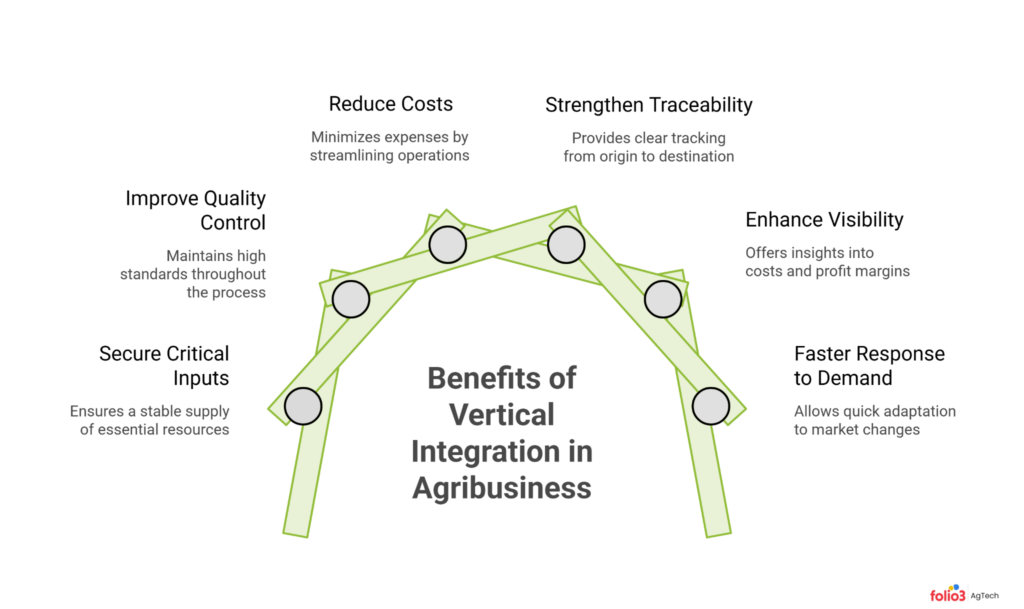
Secure Critical Inputs and Market Access
When you depend on a single supplier for a critical input or a single buyer for your output, your business is exposed. Vertical integration reduces that dependency. Owning your feed production, for instance, protects against feed price volatility and supply shortages, especially during tight markets.
Improve Quality Control Across Stages
When you control both production and processing, you can directly connect farm-level practices with product specifications. A poultry integrator that controls the breeder flock, the hatchery, the grow-out, and the processing plant can enforce biosecurity and quality standards from start to finish.
Reduce Transaction and Coordination Costs
Every handoff between independent businesses creates a transaction: contracts, negotiations, invoicing, reconciliation, and scheduling. Owning the stages eliminates many of those handoffs. The USDA Economic Research Service found that contracting and vertical integration in the broiler industry provided a means for reducing transaction costs and facilitated gains in production efficiency. However, owning a stage does not automatically lower total costs since you now bear all the costs internally.
Strengthen Traceability From Source to Shipment
Modern buyers and regulators demand traceability. The FDA Food Safety Modernization Act (FSMA) Rule 204 requires additional traceability records for certain foods across the supply chain. When you control multiple stages, you maintain lot identity, production records, input data, and shipment documentation under one operational roof, which makes compliance faster and recall readiness more practical.
Gain Better Visibility Into Costs and Margins
When you own production through distribution, you can measure profitability beyond the farm gate. You gain visibility into costs by crop or herd, processing cost, packaging cost, warehouse cost, freight cost, and margin by channel. This level of financial management visibility is nearly impossible when each stage is owned by a different entity.
Respond Faster to Demand
With integrated operations, demand signals from customers can flow back into production and procurement planning without the delays that come from coordinating across separate businesses. If a retail buyer increases an order, your processing schedule and production plan can adjust in the same system.
Business Pressure and Integration Impact
| Business Pressure | What Vertical Integration Changes | KPI to Monitor |
| Unreliable supply | Owned input production | Fill rate, supply continuity |
| Quality inconsistency | Controlled processing standards | Processing yield, defect rate |
| High coordination costs | Eliminated third-party handoffs | Order cycle time |
| Weak traceability | End-to-end lot tracking | Traceability response time |
| Poor margin visibility | Unified cost accounting | Gross margin by channel, cost per unit |
What Are Some Vertical Integration in Agriculture Examples?
Real-world examples make the concept clearer. Here is how vertical integration looks across five major agricultural sectors.
Poultry: From Feed and Hatchery to Processing
Poultry is the classic agricultural integration example. The USDA Economic Research Service documented how integration in the broiler industry helped coordinate inputs, production, processing, technology adoption, and quality control while ensuring a steady supply for processing plants. Nearly all broilers produced in the U.S. today are raised under production contracts or within vertically integrated systems, making poultry one of the most highly coordinated agricultural sectors.
Fresh Produce: From Growing to Packing and Distribution
In produce, the chain runs from grower to harvest to cooling to packing to warehouse to distribution. Perishability makes timing and inventory visibility critical. A delay of even a few hours at any stage can result in quality loss, shrinkage, and rejected loads. That is why many large produce operations integrate packing and distribution. Understanding the challenges in fresh produce supply chains helps explain why ownership of these stages is so common.
Dairy: From Feed and Milk Production to Processing
Dairy operations that control feed production, manage the milking herd, handle milk collection, and operate their own processing facility can enforce quality from pasture to packaged product. This model is common among larger dairy enterprises, particularly those producing branded consumer products.
Grain or Seed: From Production to Storage and Sales
Grain and seed operations that integrate production with cleaning, conditioning, testing, lot storage, packaging, and commercial sales control the entire post-harvest chain. Lot identity and quality documentation become critical when selling certified seed or specialty grain with premium pricing.
Wine: From Vineyard to Finished Product
The vineyard-to-bottle model is another well-known example. A winery that controls the vineyard, harvest, winemaking, bottling, and distribution manages quality at every point. Research on the Spanish wine industry published in the Journal of Wine Economics found that quality control, transaction costs, and firm size all influence integration decisions in this sector.
Vertical Integration by Sector
| Sector | Integrated Stages | Primary Reason for Control | Critical Data |
| Poultry | Feed, hatchery, grow-out, processing | Quality, supply scheduling | Flock, feed, processing yield |
| Fresh Produce | Growing, packing, distribution | Perishability, timing | Lot, grade, temperature, inventory |
| Dairy | Feed, herd, processing | Quality, brand control | Milk yield, composition, lot data |
| Grain/Seed | Production, storage, sales | Lot identity, certification | Lot, test results, inventory |
| Wine | Vineyard, winery, bottling | Quality, brand | Vineyard, batch, blend, lot |
What Are the Risks of Vertical Integration in Agriculture?
Vertical integration increases control, but it also concentrates capital, management responsibility, operational risk, and fixed costs inside one business. Before committing, understand what can go wrong.
High Capital Requirements
Processing facilities, warehouses, fleet, equipment, labor, and technology all require significant capital. Unlike contracting, where you share capital requirements with your partners, integration puts the entire investment on your balance sheet.
Greater Management Complexity
Farming, manufacturing, logistics, sales, and finance each require different expertise. Finding or developing leaders who can manage across these functions is one of the hardest parts of integration.
Fixed Capacity Can Become a Liability
If your production volumes decline due to weather, disease, or market shifts, internally owned plants, warehouses, or vehicles may sit underutilized. Those fixed costs don’t disappear with lower throughput.
Integration Can Reduce Flexibility
Owning specialized assets may make switching products, suppliers, or sales channels harder. A processing plant built for one product line may not be easily repurposed for another.
More Control Does Not Eliminate Market Risk
Integration moves risk from external counterparties onto your own balance sheet. You still face commodity price swings, weather events, regulatory changes, and demand shifts, but now you absorb all of that internally.
Disconnected Systems Can Recreate Fragmentation Internally
This is the risk most competitors miss. A company can own the farm, warehouse, processor, and distribution operation and still lack actual control if every stage runs on separate spreadsheets and disconnected software. Without a unified data layer, physical ownership does not create operational visibility or data-driven management.
Should Your Agribusiness Vertically Integrate the Next Stage?
This is not a yes-or-no question. Use a structured framework to evaluate where deeper analysis makes sense.
Evaluate the Stage Before You Own It
Before you commit capital to owning a new stage, score the candidate against these criteria:
- Supply risk – How exposed are you if your current supplier fails?
- Quality criticality – Does the stage directly affect product quality?
- Traceability importance – Does ownership improve your compliance position?
- Transaction cost – How much are you spending on contracts, negotiations, and coordination?
- Margin opportunity – How much value does the stage add?
- Capital requirement – What is the total investment to own this stage?
- Management capability – Do you have the expertise to run it?
- Capacity utilization – Can you keep the new assets running efficiently?
- Compliance exposure – Does ownership increase your regulatory burden?
- Data readiness – Can you connect the new stage’s data to your existing operations?
This is not about creating a universal score that tells you integration is good or bad. The result helps your management team identify where the case is strongest and where the risks need deeper analysis.
Ownership Is Not the Only Way to Gain Control
You have four choices when evaluating a value chain stage:
- Own the stage outright through acquisition or greenfield investment
- Contract the stage through production or marketing agreements
- Partner or cooperate by sharing ownership and risk through cooperative structures
- Connect the stage digitally while ownership remains separate, using shared systems and data
The USDA’s distinction between spot markets, contracts, and vertical integration provides a useful framework. Not every business needs to own every stage. Sometimes the right answer is better coordination, not more ownership.
How Technology Helps Agribusinesses Manage Vertical Integration at Scale
The right technology turns physical ownership into actual operational control. Here is what that looks like.
Vertical Integration Creates a Data Integration Problem
Owning multiple stages is only half the challenge. Production, inventory, quality, finance, warehouse, logistics, and sales data all need shared identifiers and workflows. Without that shared foundation, you end up with silos inside your own organization, which defeats the purpose of integrating in the first place. Digital transformation in agriculture is increasingly about connecting these data streams, not just digitizing individual tasks.
ERP Connects Operational and Financial Control
An agriculture ERP is the system that ties your integrated operations together. It handles procurement, inventory, production, warehousing, contracts, financial accounting, cost allocation, sales, and reporting in a single connected platform.
Folio3 AgTech’s Farm ERP capabilities map closely to this operating model, covering production tracking, inventory, procurement, lot and batch traceability, financial management, contract management, analytics, shipping, packaging, and transportation.
Traceability Connects Product Identity Across Stages
Lot and batch identity should follow products through receipt, production, processing, packing, storage, and dispatch. When that identity stays intact, you can trace any product back to its source and forward to its customer in minutes, not days. It is essential for food traceability and safety compliance.
Analytics and AI Turn Connected Data Into Decisions
Once your data is connected, analytics and AI can add another layer of value:
- Demand forecasting to plan production schedules
- Input demand prediction based on downstream orders
- Inventory planning to reduce waste and carrying costs
- Exception detection to flag quality issues early
- Margin analysis to identify your most and least profitable channels
AI supports better decisions, but it is a layer on top of connected data, not a substitute for it.
Integration Matters More Than Adding Another Application
The goal isn’t to put separate software at every stage. It is to connect the stages so operational events flow into inventory, financial, traceability, and management records without manual re-entry or reconciliation.
Folio3 AgTech’s implementation for Rombola Family Farms demonstrates this in practice. The project connected finance, procurement, inventory, warehousing, and supply chain data for a large fresh produce operation, giving management a single operational view across the entire business.
Building More Control Without Creating More Silos
Vertical integration in agriculture can give your business more control over supply, quality, cost, inventory, traceability, and customer delivery. But ownership alone is not the end goal. The real objective is reliable, connected control, where every stage of your value chain operates from the same data and the same operational truth.
The most common failure in vertical integration is not choosing the wrong stage to own. It is owning the right stages but running them on disconnected systems, so the data, decisions, and accountability stay siloed even though the assets are under one roof.
As your agribusiness adds production, processing, warehousing, or distribution, the technology question becomes straightforward: how do you keep every stage working from the same operational and financial information? The answer to that question determines whether integration delivers on its promise or simply creates a bigger, more complex version of the same fragmentation you were trying to solve.
FAQs
What Is the Simplest Example of Vertical Integration in Agriculture?
A grower who builds a packing house to grade, pack, and ship their own produce is forward-integrating. They control both production and the first post-harvest stage. This is one of the most common and lowest-risk forms of vertical integration in agriculture.
How Is Vertical Integration Different From Contract Farming?
In vertical integration, one entity owns and operates multiple stages. In contract farming, separate businesses use agreements to coordinate production. The key difference is ownership and financial risk. Contracts share risk; integration concentrates it within one business.
Can Small Farms Benefit From Vertical Integration?
Yes. Small farms often integrate forward by adding direct-to-consumer sales, on-farm processing, or packing operations. The scale is smaller, but the principle is the same: capture more value by controlling the next stage of the chain.
What Role Does Traceability Play in Vertically Integrated Operations?
Traceability connects product identity across all stages you control, from inputs and production through processing and distribution. It is critical for food safety compliance, recall readiness, and meeting buyer requirements, especially under regulations like FSMA 204.
Why Do Vertically Integrated Agribusinesses Still Struggle With Data Silos?
Owning multiple stages does not automatically connect them. If each stage runs on a different system, spreadsheet, or software tool, data stays fragmented. An agriculture ERP solves this by providing a shared platform that connects procurement, production, inventory, quality, finance, and logistics in one system.
Which Agricultural Sectors Are Most Vertically Integrated?
The U.S. broiler poultry industry is the most highly integrated sector, with nearly all production occurring under integration or production contracts. Dairy, fresh produce, and wine are other sectors where integration is common, typically driven by quality control, perishability, or brand requirements.