
If you run an agribusiness, you already know the challenge: data is everywhere. It lives in your accounting software, your inventory spreadsheets, your IoT soil sensors, and the supply chain platforms tracking shipments from field to buyer. The problem is rarely a lack of data; it’s the lack of a unified system that ties it all together.
That’s where ERP data management comes in. An agricultural ERP system acts as the backbone of your operation, pulling data from finance, operations, supply chain, and field-level sensors into one centralized platform. When managed well, it gives investors, owners, CTOs, and CFOs a single, reliable view of the business that enables faster decisions, tighter compliance, and measurable growth.
This guide walks you through everything you need to know about the data management of ERP in agribusiness. Whether you’re evaluating your first ERP or optimizing an existing system, you’ll find actionable strategies rooted in real-world agricultural operations.
What is ERP Data Management?
At its core, an ERP system is a centralized, integrated platform that collects and stores data across every department in your organization: finance, inventory, supply chain, HR, and sales. Think of it as your operation’s central nervous system, where every transaction, every record, every report flows through it. In many modern organizations, ERP systems are further strengthened by integrating asset management software to improve visibility and control over physical and digital assets across departments. Modern platforms enhanced with AI Mode further improve automation and intelligence within these systems.
ERP data management refers to the processes, policies, and tools you use to ensure that the data flowing through this system is accurate, consistent, secure, and accessible. It covers everything from how data is entered and validated to how it’s stored, integrated, and eventually used for reporting and decision-making.
For agribusinesses managing complex, multi-site operations, a well-implemented ERP for agriculture consolidates information that would otherwise sit in disconnected systems. It gives you one reliable source for every operational and financial insight.
Types of ERP Data
Not all ERP data is the same. Understanding the different categories helps you manage each type appropriately. ERP systems typically handle four main types of data:
| ERP Data Type | Description | Characteristics | Agribusiness Example |
| Configuration Data | System setup, including user roles, currencies, and company settings | Set during implementation; rarely changed | User permissions for agronomists, currency conversion for grain exports |
| Master Data | Core entities such as customers, suppliers, and products | Relatively static; referenced across departments | Seed varieties, soil types, livestock breeds, fertilizer vendors |
| Transactional Data | Time-stamped records of business events | High volume; generated daily through operations | Crop yields per harvest, feed deliveries, pesticide application logs |
| Analytical Data | Aggregated or summarized data used for reporting | Derived from transactional data; supports strategic planning | Yield trends by region, cost per hectare, seasonal profitability reports |
Configuration data forms the foundation, master data provides the reference points, transactional data captures day-to-day activity, and analytical data in agriculture transforms it all into actionable insight. Each type requires its own governance approach, which we’ll cover in detail later.
Why Data Management Matters
Here’s a number that should get your attention:
- According to Gartner research, poor data quality costs the average organization approximately $12.9 million per year.
- The McKinsey Global Institute further estimates that bad data can lead to a 20% decrease in productivity and a 30% increase in costs.
For agribusinesses operating on thin margins with seasonal cash flows, those numbers can be the difference between a profitable year and a devastating one.
Clean data enables faster decisions and eliminates the second-guessing that comes from unreliable numbers. Poor integration, on the other hand, creates hidden costs and erodes the trust your leadership team places in reports.
ERP Data Management in Agribusiness
Agriculture generates some of the most diverse and complex data of any industry. You’re pulling information from farm machinery, IoT sensors, satellite imagery, weather services, financial systems, and multi-tier supply chains, all of which need to talk to each other through your ERP.
What makes agribusiness data uniquely challenging includes:
- Seasonal variability: Crop cycles, weather patterns, and market pricing shift constantly, meaning data structures must adapt to time-sensitive conditions.
- Perishability constraints: Products like fresh produce or livestock feed have limited shelf lives, requiring real-time inventory tracking and demand forecasting.
- Compliance and traceability: Food safety regulations (USDA, FSMA, and organic certification) demand granular lot-level traceability from seed to shelf.
- Multiple system integration: CRM, supply chain platforms, IoT devices, and field management tools must all integrate with your ERP for a unified view.
Poor data quality in these areas doesn’t just cause reporting headaches; it can lead to compliance gaps, product recall failures, and a loss of trust among buyers and regulators.
Benefits for Agribusiness Investors, Owners, CTOs & CFOs
The global farm ERP market reflects this demand. The farm ERP market is projected to grow from $1.17 billion in 2024 to $3.95 billion by 2035, at a CAGR of 11.95%, reflecting how agribusinesses worldwide are investing in integrated data solutions.
When ERP data management is done right, it creates measurable value across every level of leadership:
- For investors and owners: Clean, well-governed data enhances confidence in financial reporting. You can accurately forecast yield, demand, and market exposure, giving stakeholders the transparency they need.
- For CFOs: Integrated data means faster financial close cycles, accurate cost-of-production calculations, and reliable compliance reporting. Your farm accounting software should feed directly into your ERP for seamless financial visibility.
- For CTOs: Proper data management reduces manual data entry, eliminates integration bottlenecks, and frees your technical team to focus on innovation, such as precision agriculture, predictive analytics, or automated workflows.
Master Data Management (MDM) in ERP
Master data is the stable, core business information referenced by every process in your ERP; procurement, production, sales, and finance all depend on it. Unlike transactional data, which changes with every order or payment, master data represents the foundational entities: your customers, vendors, products, and employees.
Getting master data right isn’t optional. If your seed supplier’s details are inconsistent across purchasing and finance, you’ll end up with duplicate payments, mismatched invoices, and compliance headaches. Maintaining accurate master data management in ERP ensures consistent, reliable operations across your entire organization.
Master Data Domains
In any agribusiness ERP, you’ll manage several critical master data domains. Here’s how each one applies to agriculture:
Material Master Data
It tracks everything about your physical inputs and outputs: item descriptions, specifications, procurement details, storage requirements, and regulatory information. For farms, this includes seed varieties, fertilizer formulations, veterinary supplies, and harvested commodities. The biggest challenges here are duplication, inconsistent naming, and outdated records, all of which can cascade into procurement delays and production bottlenecks.
Customer Master Data
Your customer records include IDs, contact details, payment terms, credit limits, and sales history. High-quality customer data enhances CRM accuracy, streamlines invoicing, and ensures regulatory compliance. For agribusinesses selling to processors, distributors, and direct-to-consumer channels, clean customer data enables better demand forecasting and relationship management.
Supplier/Vendor Master Data
Centralizing your supplier information, like contracts, performance metrics, certifications, and payment terms, directly impacts procurement efficiency. In agriculture, it is especially critical when managing relationships with seed suppliers, fertilizer vendors, equipment dealers, and contract growers. Poor vendor data quality leads to missed contract terms, redundant purchases, and weakened negotiation positions.
Employee Master Data
It includes personal details, employment records, certifications, and payroll information. For agricultural operations with seasonal labor, accurate employee data is essential for scheduling, compliance with labor regulations, and operational planning.
Challenges & Solutions for MDM
The most common MDM challenges in agribusiness include data inconsistencies across departments, duplicate records, non-standardized naming conventions, and the operational inefficiencies that result from all of these. When your field team calls a product by one name, and your purchasing department uses another, errors multiply.
Best practices for tackling these challenges include:
- Establishing clear governance policies with defined data ownership for each domain
- Implementing validation rules and standardized naming conventions at the point of data entry
- Leveraging AI-driven tools for automated data cleansing and deduplication
- Scheduling regular audits and quality checks to catch drift before it causes problems
- Planning data migration carefully during ERP implementations, avoiding unnecessary legacy data that introduces errors
If you’re currently evaluating or implementing an ERP, our guide on ERP implementation in agriculture covers the practical steps to get data migration right the first time.
4. Product Data Management (PDM) in ERP
Product data management in ERP refers to maintaining accurate, consistent product information. It includes specifications, bills of materials, pricing, and regulatory details across your entire system. For agribusinesses, products span a wide range: seeds, fertilizers, crop protection chemicals, farm machinery parts, and packaged goods.
Accurate product data ensures that every department, procurement, production, sales, and compliance works from the same information. When your farm inventory management system and your ERP share consistent product records, you avoid stockouts, duplicate orders, and mismatched shipments.
PDM Processes
Key PDM processes include creating and updating product records, managing bills of materials (BOMs), tracking revisions, controlling access permissions, and integrating with product lifecycle management (PLM) systems. Standardized naming conventions and automated validation rules are essential to prevent duplication and maintain consistency.
For agricultural operations, it means ensuring that when a new seed variety is added or a fertilizer formulation changes. So, every system referencing that product reflects the update automatically, from purchasing to supply chain management.
Ag-Specific Product Data Considerations
Agricultural products come with unique data management challenges:
- Variable attributes: Seed traits, soil amendments, and livestock genetics all carry complex, multi-dimensional attributes that standard product records may not capture.
- Seasonal availability: Product availability changes with growing seasons, requiring dynamic inventory adjustments and planning.
- Regulatory compliance: Organic certification, pesticide residue limits, GMO labeling, and food safety traceability all require precise, auditable product records.
- Recall readiness: A unified ERP supports rapid product recall processes by tracing every lot from origin to customer, ensuring data integrity across the entire supply chain.
These factors make product data management in ERP an essential discipline for any agribusiness that needs to maintain buyer trust, regulatory compliance, and operational efficiency.
Data Security Management in ERP Platforms
Your ERP houses some of the most sensitive information in your organization: financial records, customer data, proprietary yield data, and supply contracts. In some cases, it also includes genetic information for seed or livestock breeding programs. A breach doesn’t just expose data; it can destroy trust with buyers, investors, and regulators.
Data security management in ERP platforms is foundational. As agribusinesses increasingly integrate IoT devices and cloud-based tools, the attack surface grows, making proactive security essential.
Security Threats and Risks
The interconnected nature of modern ERP systems means that a vulnerability in one integration point can compromise your entire data ecosystem. Common threats to ERP data in agribusiness include:
- Unauthorized access from former employees, contractors, or compromised credentials
- Ransomware attacks targeting operational data to force payment
- Insider misuse, whether intentional or through negligence
- IoT vulnerabilities from sensors, drones, or field devices with weak security protocols
- Outdated legacy systems that lack modern encryption or patch management
Best Practices for Securing ERP Data
Protecting your ERP data requires a layered approach:
- Role-based access controls (RBAC): Ensure users only access data relevant to their function. Implement segregation of duties to prevent fraud.
- Encryption and multi-factor authentication are essential for securing ERP systems: encrypt data at rest and in transit, and require MFA for all access, especially remote logins. For additional protection when working remotely, consider using a VPN, and for Apple users, tools like VPN for Mac can be a practical option.
- Regular security audits and penetration testing: Schedule quarterly assessments to identify vulnerabilities before they’re exploited.
- Activity monitoring and audit logs: Track user actions within the ERP to detect anomalies and maintain accountability.
- Compliance with data privacy regulations: Ensure your ERP setup meets GDPR, local food safety regulations, and any industry-specific data handling requirements.
- Backups and disaster recovery: Maintain up-to-date backups with tested recovery procedures. Don’t wait for a crisis to learn your backup process is broken.
- Vendor security assessments: When integrating third-party systems, evaluate their security posture as thoroughly as your own.
ERP Data Management Best Practices
Strong ERP data management starts with clear ownership, consistent standards, and the right automation. These best practices help you build a data foundation your entire team can trust.
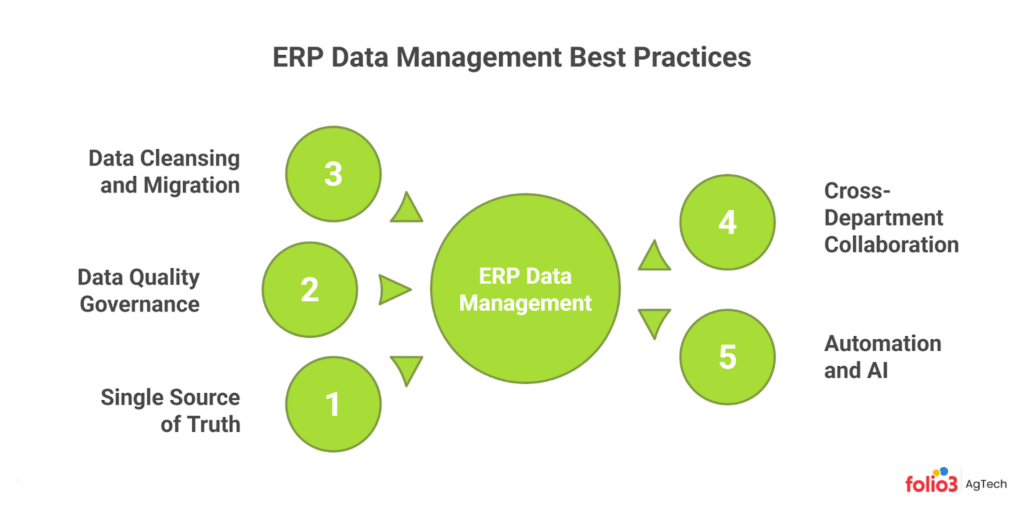
Establish a Single Source of Truth & Integrate Systems
A modern ERP should function as the single source of truth for all your master records. That means your CRM, supply chain platform, IoT systems, and financial tools should all feed into and draw from one unified database. Duplicating data across systems creates discrepancies that compound over time.
Use APIs or middleware to create seamless integrations. Your ERP should enforce data rules and maintain referential integrity. So, when a customer record updates in one system, it reflects everywhere. If you’re running an agriculture ERP on NetSuite or Dynamics 365, integration capabilities should be a key selection criterion.
Govern Data Quality & Ownership
Every dataset in your ERP needs an owner; someone accountable for its accuracy, completeness, and timeliness. Assign data stewards for each domain (customer, product, supplier, financial) and establish cross-departmental governance committees.
Implement automated validation rules, mandatory fields, and standardized input formats to prevent incomplete or inconsistent records at the point of entry. Document naming conventions, coding structures, and versioning practices. When your field team, procurement team, and finance team all follow the same data standards, you eliminate the friction that costs time and money.
Cleanse, Audit & Migrate Data
Data decay is real. Records go stale, duplicates accumulate, and orphaned entries clutter your system. Schedule regular data audits, quarterly at a minimum, to identify and resolve issues before they cascade.
AI-driven cleansing tools can automate much of this work, correcting errors, merging duplicates, and flagging anomalies. During ERP migrations, be deliberate about what data you bring over. Not every legacy record deserves a spot in your new system. Cleaning data before migration is always cheaper than fixing it after. For deeper guidance, see our blog on the importance of farm inventory management, which covers how data hygiene directly impacts operational efficiency.
Facilitate Cross-Department Collaboration
Data quality isn’t just IT’s responsibility; marketing, finance, operations, and HR all create and consume ERP data. Encourage regular cross-departmental meetings to align data definitions, review audit findings, and resolve discrepancies.
When departments work in silos, they develop their own naming conventions, shortcuts, and workarounds, all of which degrade system-wide data quality. A collaborative culture around data stewardship prevents these problems before they start.
Leverage Automation & AI
Manual data management doesn’t scale. As your agribusiness grows, automation becomes essential for maintaining data quality. making IT automation a critical component for it. AI solutions for agriculture can detect anomalies in real time, predict data entry errors, and automate cleansing processes.
Implement automation for ETL (Extract, Transform, Load) workflows, data validation, and alerting when data quality thresholds are breached. The global precision farming market is expected to reach $48.36 billion by 2035 (CAGR of 13.05%), and much of that growth depends on quality data flowing through automated, AI-enhanced systems. Embracing smart farming technology starts with the data infrastructure to support it.
ERP Data Analytics and Decision-Making
Data is only valuable when it informs decisions. ERP data analytics extracts insights from the vast datasets your system collects, transforming raw numbers into strategic advantages, often enhanced through approaches like conjoint analysis for better decision-making. For agribusinesses, it means anticipating demand fluctuations, optimizing resource allocation, and spotting trends before your competitors do.
The best ERP analytics go beyond backward-looking reports. They provide real-time dashboards, predictive forecasts, and automated alerts that help you act on information rather than simply storing it.
Tools and Technologies
A robust analytics stack for agribusiness ERP typically includes:
- ETL processes: Extract, transform, and load data from multiple sources (field sensors, financial systems, third-party feeds) into a centralized data warehouse.
- Data warehouses and data marts: Purpose-built repositories optimized for fast querying and analysis, organized by business domain.
- BI tools: Dashboards and reporting platforms like Power BI or Tableau that visualize trends, KPIs, and performance metrics.
- Advanced analytics and ML: Machine learning models that forecast crop yields, detect supply chain anomalies, and optimize pricing strategies.
Many ERP vendors now offer integrated analytics modules or provide connectors to platforms like Power BI, making it easier to build reporting capabilities directly into your operational workflows.
Use Cases for Agribusiness
Here’s how agribusinesses are putting ERP analytics to work:
- Financial analysis: Real-time cost-per-hectare calculations, margin analysis by crop or livestock enterprise, and cash flow forecasting.
- Supply chain visibility: Tracking inputs from the supplier to the field, identifying bottlenecks, and optimizing procurement timing.
- Inventory optimization: Balancing stock levels to prevent waste while avoiding stockouts during critical planting or feeding windows.
- Yield forecasting: Using historical data, weather feeds, and soil analytics to predict harvest outcomes and inform sales commitments.
For a deeper look at how technology supports these decisions, explore how livestock farming technology is transforming ROI for producers.
Choosing and Implementing the Right ERP
Selecting the right ERP is only half the challenge; getting it implemented without derailing your operations is the other. Here’s how to approach both with confidence.
Selection Criteria
Not every ERP fits every operation. When evaluating systems, prioritize:
- Industry specificity: Does the ERP understand agriculture? Generic manufacturing ERPs often miss critical features like lot traceability, seasonal planning, and compliance tracking.
- Scalability: Can the system grow with your operation, from a single site to multi-location, multi-enterprise?
- Integration capabilities: Does it connect cleanly with your existing tools, IoT devices, CRM, financial platforms, and e-commerce channels?
- Analytics features: Are reporting and BI tools built in, or will you need expensive add-ons?
- Vendor support: Does the provider have real agricultural expertise, not just a generic consulting team?
Our comparison of the best ERP software for agriculture can help you evaluate your options against these criteria.
Implementation & Data Migration
Implementation is where many ERP projects succeed or fail. Follow a structured approach:
- Define clear requirements and success metrics before selecting a vendor
- Cleanse and map your data thoroughly before migration; this is not a step to rush
- Configure modules to match your actual workflows, not the other way around
- Test rigorously, including edge cases specific to your operation (harvest surges, seasonal labor changes)
- Plan phased rollouts to minimize disruption; don’t go live across all departments simultaneously
Involve key stakeholders from every department early in the process. The people who use the system daily will catch requirements that leadership may overlook.
User Adoption & Training
The best ERP in the world fails without user adoption. Train your team thoroughly, not just on clicking buttons, but on data entry standards, analytics tools, and security protocols. Appoint department champions who can support their peers and escalate issues. Ongoing training and refresher sessions ensure your team keeps pace as the system evolves.
Future Trends and Innovations
AI, IoT, and machine learning are reshaping how agribusinesses collect, manage, and act on ERP data, driving a modern service innovation process. Staying ahead means preparing your data infrastructure now.
AI and Machine Learning
AI in agriculture is rapidly moving from pilot projects to production-grade capabilities in ERP systems. AI-driven data cleansing and enrichment tools can maintain master data quality at scale. Meanwhile, predictive analytics models help forecast market prices, optimize irrigation schedules, and anticipate equipment failures.
Agtech companies are already using machine learning in agriculture to analyze weather data, satellite imagery, and soil sensor readings. It turns raw inputs into yield forecasts and resource optimization recommendations. As these tools become more accessible, they’ll be standard features in competitive ERP platforms, not premium add-ons.
IoT and Smart Agriculture
IoT devices like sensors, drones, and connected equipment generate a continuous stream of real-time data on soil moisture, crop health, livestock conditions, and environmental factors. Integrating this data into your ERP provides a comprehensive operational view that was impossible a decade ago.
The key considerations for IoT-ERP integration are data volume management, connectivity planning for remote rural locations, and security hardening for every connected device. Businesses can also use hubspot erp integration to connect ERP data with CRM workflows.
Conclusion
ERP data management isn’t a one-time project; it’s an ongoing discipline that determines how effectively your agribusiness operates, complies, and grows. Clean, secure, and well-governed data underpins every meaningful decision you make, from daily operations to long-term investment strategy.
The agribusinesses that treat data as a strategic asset will be the ones that adapt fastest, comply most easily, and grow most sustainably. Start with the fundamentals, invest in the right tools, and build a culture where every team member understands that data quality is everyone’s responsibility.
Ready to transform your agricultural data management? Connect with our Agtech experts to explore how Folio3 AgTech’s ERP solutions for agriculture can give you the unified, data-driven foundation your operation needs.
FAQs
What Is the Difference Between ERP and a Farm Management System?
A farm management system typically handles field-level tasks like crop planning or herd tracking. An ERP integrates those functions with finance, HR, procurement, and supply chain into one unified platform, giving you full operational and financial visibility.
How Long Does It Take To See ROI From an Agriculture ERP?
Most agribusinesses start seeing measurable returns within 6 to 12 months of go-live. Early gains typically come from reduced data entry errors, faster reporting cycles, and improved inventory accuracy across locations.
Can Small and Mid-Sized Farms Benefit From ERP Data Management?
Absolutely. Cloud-based ERP solutions now offer modular pricing that scales with your operation. Even a 200-acre farm can benefit from centralized inventory tracking, automated compliance records, and integrated financial reporting.
How Does ERP Data Management Support Food Safety Compliance?
ERP systems maintain lot-level traceability from input to finished product, automate documentation for audits, and flag compliance gaps in real time. It makes meeting USDA, FSMA, and organic certification requirements significantly faster and more reliable.
What Should I Prioritize When Migrating Data to a New Agriculture ERP?
Start by cleansing your existing data: remove duplicates, update stale records, and standardize naming conventions before migration. Prioritize master data (customers, vendors, products) first, then migrate transactional history selectively based on reporting needs.
FAQs
What is ERP Data Management?
ERP data management is the process of collecting, organizing, and analyzing data from various business functions using ERP software. It helps businesses manage their operations effectively and make informed decisions based on data insights.
What are the Three Types of ERP Data?
The three types of ERP data are:
- Transactional Data: This refers to day-to-day business activities and processes,
- Master Data: This contains important information about products, customers, and suppliers,
- Reference Data: This includes codes and identifiers used for identification and classification purposes.
What Does ERP Stand for in Agriculture?
In agriculture, ERP stands for Enterprise Resource Planning. The software system helps businesses manage and integrate their core operations, such as production, inventory, sales, and financials.