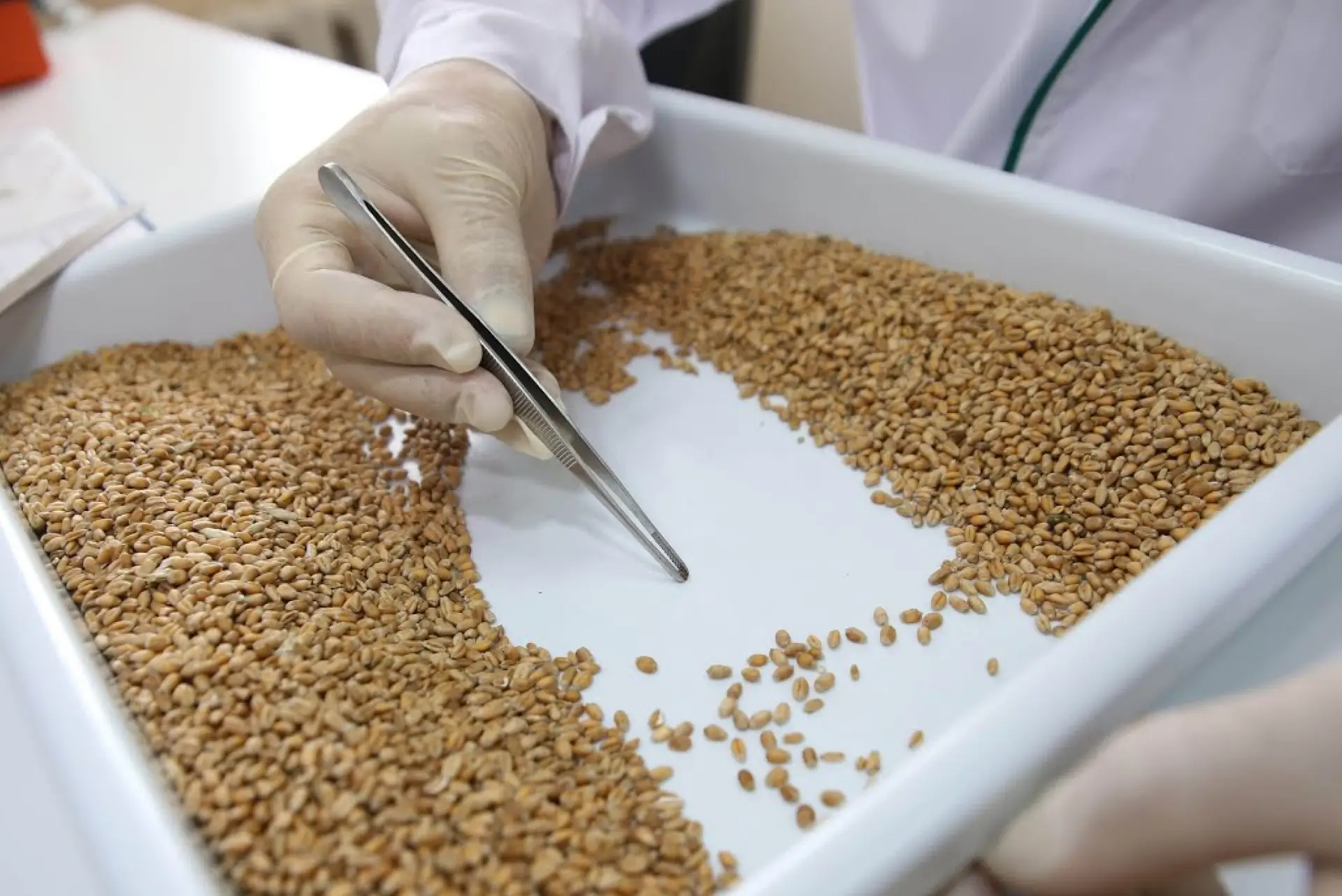

High crop yields don’t start at planting; they start with the seed itself. The genetics locked inside every kernel, grain, or pellet determine a crop’s ceiling for yield, disease resistance, and market value long before a planter hits the field.
The global commercial seed market was valued at roughly USD 93.51 billion in 2025, and it’s projected to surpass USD 200 billion by 2035. That kind of growth signals one thing: the demand for quality-assured, genetically pure seed has never been higher.
Yet producing high-quality seed is nothing like harvesting commodity grain. It demands meticulous field management, rigorous laboratory testing, and strict certification protocols. Plus, it requires technology-enabled traceability from the breeding nursery to the final bag.
From traditional field practices to the innovations reshaping modern seed farming, this guide walks you through every stage of that journey. We’ll share the best practices, processes, and tech integrations you need to build a world-class seed quality assurance program.
What is Seed Production and Why Does It Matter?
Seed production is the systematic process of multiplying genetically superior planting material under controlled conditions. So, farmers receive seed that is true-to-type, free from contamination, and capable of delivering predictable performance in the field.
Unlike commercial grain farming, where the harvest goes straight to market as food, feed, or fuel, seed farming exists to preserve and propagate specific genetic traits across successive generations.
Every bag of certified seed traces back through a carefully managed chain of custody. It starts from a plant breeder’s original seed selection and ends with a product that meets strict purity and germination standards.
The Economic and Agricultural Impact
The difference between grain production and seed production has massive economic implications. According to the International Seed Federation, professionally bred, quality-assured seeds contribute to a 20–30% increase in crop productivity compared to traditional farm-saved seed. For an agribusiness, investing in certified seed is not merely a cost; it is the single highest-leverage input for yield improvement.
When you scale that advantage across thousands of hectares, the revenue impact is substantial. That’s why commercial seed companies, cooperatives, and contract growers invest heavily in the production of seed that meets stringent certification benchmarks.
Classes of Certified Seed
Certification systems worldwide follow a generational framework to maintain genetic purity. Based on NDSU seed certification guidelines, here are the four recognized classes:
| Seed Class | Function | Control / Ownership |
| Breeder | The original seed stock directly controlled by the plant breeder or sponsoring institution. No formal certification standards apply at this stage. | Originating breeder or institution |
| Foundation | Produced from breeder seed under strict oversight to maintain genetic identity and purity. This is the first officially certified generation. | Originator, licensee, or authorized agency |
| Registered | Grown from foundation seed (or approved stocks) and must meet quality standards suitable for producing certified seed. Usually, one generation from foundation. | Approved seed growers |
| Certified | Produced from foundation, registered, or other approved stocks. This is the class that reaches commercial farmers. It cannot be used to produce certified seed again without special agency approval. | Commercial growers under certification agency oversight |
Each generation exists to ensure that the genetics a breeder developed in a controlled environment reach the farmer’s field with minimal drift. However, understanding the importance of seed certification at every step is what separates high-quality seed production from commodity farming. As a result, it makes planning and compliance essential at every step of high-quality seed production.
General Principles of Seed Production
Whether you’re producing hybrid corn, certified wheat, or foundation soybean seed, several universal principles underpin every successful seed production program. Master these, and you’ll build a quality assurance framework that holds up under any crop or certification scheme.
Genetic Purity
Genetic purity is the non-negotiable backbone of every seed program. It means every plant that grows from your lot expresses exactly the traits the breeder intended. Producers guard against genetic drift by maintaining strict parent-line records.
Moreover, they control pollination sources and keep each seed class clearly separated through the entire production chain. Contamination can sneak in through biological routes, mechanical routes, or simple human error. Preventing all three demands disciplined protocols at every stage.
Pollination and Seed Maturation
Timing pollination correctly is what turns a healthy crop into viable seed. For cross-pollinated species like corn, synchronizing silk emergence with pollen shed is critical; even a few days’ mismatch can slash seed set.
For self-pollinated crops like wheat or soybeans, the focus shifts to protecting the plant’s own pollination window from environmental stress. Equally important is harvest timing: picking too early produces immature, low-vigor seed, while waiting too long invites weather damage and shattering. So, monitoring moisture content and physiological maturity indicators helps you hit the sweet spot.
Adequate Isolation
Isolation distances are your first physical line of defense against unwanted cross-pollination and mechanical mixtures. Federal standards under 7 CFR § 201.76 specify minimum distances that vary by crop, seed class, and field size.
For hybrid corn, that baseline is 660 feet from any contaminating source, reducible with additional pollen-parent border rows. Selecting your seed field the preceding season gives you time to plan rotations and establish buffers.
Roguing
Roguing is the hands-on practice of walking every row to identify and physically remove off-type plants, volunteer crops, and problem weeds before they set seed. So, pulled plants must leave the field entirely, not simply be tossed between rows where they can still shed pollen or drop seed. Timing is everything: rogue before flowering, when off-types are most visible, and before they can contaminate the lot.
Field Inspections
Certified inspectors visit seed fields at critical growth stages. Typically, it happens during pre-bloom and again before harvest to verify genetic purity, assess weed density, and check for diseases.
These inspections are not optional; passing them is a prerequisite for certification. Walking the field alongside the inspector is a smart practice, as they can flag issues like hard-to-identify weeds or early disease symptoms you might otherwise miss.
Grow-Out Tests and Certification
After harvest, a representative sample of the seed lot is planted in a controlled grow-out plot. If the resulting plants match the expected variety profile in height, maturity, head type, and grain characteristics, the lot’s genetic identity is confirmed.
This final verification is combined with lab results for germination, purity, and moisture. It is what earns the certification tag that tells commercial farmers your seed is exactly what it claims to be.
The Step-by-Step Seed Production Process
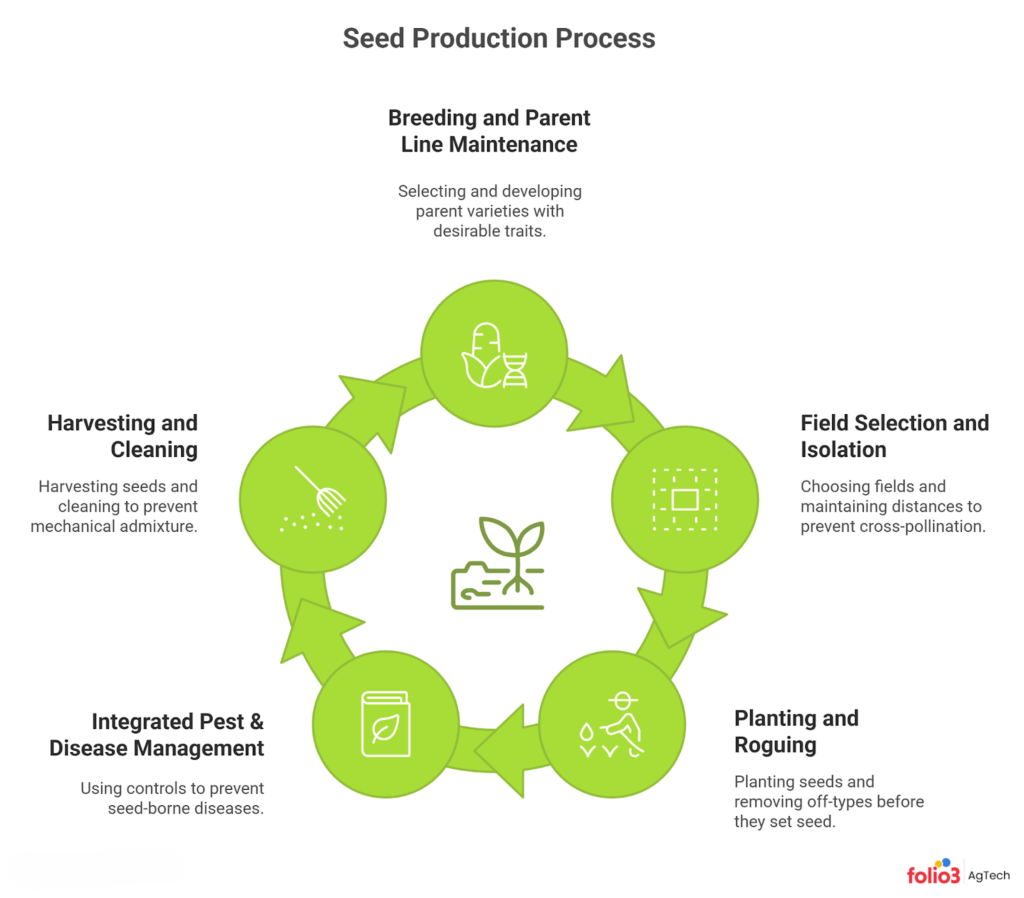
Understanding the seed production process from start to finish helps you identify where quality can be gained or lost. Here is the workflow that commercial seed operations follow.
Breeding and Parent Line Maintenance
Everything starts with the breeder selecting or developing parent varieties with desirable traits: yield potential, disease resistance, standability, maturity group, or grain quality. These elite lines are then increased through breeder and foundation seed stages under the strictest possible controls. Parent line maintenance also means periodically purifying inbred lines to prevent genetic drift over repeated multiplication cycles.
Field Selection and Isolation Distances
Choosing the right field is just as important as choosing the right genetics. A good seed production field should have no history of the same crop from the previous season, unless it was the same certified variety. It should also have minimal weed pressure and adequate isolation from other crops of the same species.
For corn, federal standards require a minimum isolation of 660 feet from contaminating sources. The distance is modifiable by planting additional border rows of the pollen parent. For wheat and soybeans, both self-pollinating crops, the distances are shorter, but the preceding-crop requirement remains critical. Selecting your field the season before gives you time to manage weed seed banks with fall-applied herbicides and plan rotations accordingly.
Planting and Roguing
Once the field is prepared, planting follows recommended seeding rates and row spacing for the specific crop class. Then comes one of the most labor-intensive but most critical quality steps: roguing.
Roguing means physically walking every row to identify and remove off-type plants, volunteer crops from a previous season, and weeds that could produce seed before harvest. Timing matters: rogue before flowering when off-types are most visible and before they shed pollen.
Integrated Pest and Disease Management
Seed-borne diseases can devastate an entire lot’s certification status. That’s why an integrated approach combining cultural, biological, and chemical controls is standard practice.
Crop rotation breaks disease cycles; resistant varieties reduce the need for fungicides; and timely scouting catches infections before they spread. Any pest management program in seed production must also consider residue implications. Certain chemical treatments applied close to harvest can affect germination or violate seed treatment tolerances.
Harvesting Techniques and Rigid Equipment Cleaning
Harvest is where mechanical contamination becomes the greatest risk. A combine that processed a different variety in the last field can carry enough residual seed to fail a purity test. Best practice calls for a thorough cleaning protocol:
- Shut the combine down for three to four hours (or more) and open every access panel.
- Use a high-pressure air hose and industrial vacuum to remove trapped grain from the clean-grain elevator, unloading auger, sieves, and tailings system.
- Run a “flush load”, harvest the first round from the certified field, and divert it to the commodity bin, not the seed bin.
- Apply the same rigor to grain carts, augers, and storage bins.
Many experienced seed growers install trap doors at strategic points in the combine to speed future cleanouts. The rule of thumb: if you can identify what was harvested previously, you haven’t cleaned well enough.
Inside the Seed Production Plant: Conditioning and Enhancement
Once raw seed arrives at the conditioning facility, the goal shifts from field-level purity to physical quality and commercial readiness. This is where the seed production plant turns a bulk harvest into a precision product.
Seed Conditioning, Cleaning, and Grading
Conditioning is the multi-step process of removing everything that is not pure, viable seed. Air-screen cleaners separate seed by size and weight, removing chaff, stems, weed seeds, and broken kernels. Gravity tables further sort by density as lighter, immature seeds float to the top while heavy, plump seeds settle.
Meanwhile, indent cylinders or disc separators handle length-based separations. The result is a seed lot with high physical purity that meets certification standards for inert matter and other-crop contamination.
Seed Treatment and Enhancement
After cleaning, many seed lots receive treatments, whether chemical or biological, to boost field performance. Fungicide seed treatments protect against soil-borne pathogens during the vulnerable germination period. Insecticide coatings guard against early-season pests like wireworms or seed corn maggots.
Particularly for legumes, inoculants introduce beneficial rhizobium bacteria that enhance nitrogen fixation. These treatments are applied with precision coating equipment to ensure uniform coverage without damaging the seed coat.
Post-Harvest Drying and Optimal Storage
Seed moisture content at harvest is often too high for safe storage. Forced-air dryers bring moisture down to the crop-specific target, typically 12–13% for corn, 12% for soybeans, and 12–13% for wheat.
The FAO recommends storing seed in cool, dry conditions, preferably in airtight containers, because high temperatures and elevated humidity accelerate viability loss. Commercial facilities use climate-controlled warehouses with continuous temperature and humidity monitoring to preserve germination rates through to the planting season.
Crop-Specific Deep Dive: Corn Seed Production
Corn seed production is arguably the most technically demanding and quality-sensitive segment of the seed industry. It offers a real-world example that brings all the general principles together.
Isolation and Planting Patterns
Hybrid corn seed production involves planting designated male (pollen-parent) and female (seed-parent) rows in carefully calculated ratios, typically 4:1 or 6:2 (female-to-male). The male rows supply the pollen; the female rows produce the harvested seed.
Isolation from other corn fields must meet federal minimums, generally 660 feet. This distance can be reduced by adding pollen parent border rows to prevent foreign pollen contamination.
Detasseling and Pollination Control
Detasseling is the signature QA step in corn seed production. It involves removing the tassel from every female plant before it sheds pollen to ensure that female ears are pollinated exclusively by the designated male rows.
The process typically combines a mechanical cutter pass with follow-up hand crews who remove any tassels the machine missed. Meanwhile, mechanical detasseling can reduce seed yield by up to 40% compared to hand-only methods if too many leaves are stripped alongside the tassel, so precision matters. Certification standards require that no more than 1% of female plants shed pollen at any single inspection.
Harvesting on the Ear and Husking
Unlike commodity corn that is shelled in the field, seed corn is typically harvested on the ear. Ear-harvesting preserves kernel integrity by avoiding the aggressive threshing forces of a conventional combine.
After harvest, ears are transported to the drying facility and dried to the target moisture. Only then, the shells are shelled using gentler equipment designed to minimize cracking and chipping. This extra step adds cost but protects germination rates; a cracked seed coat is an open door for pathogens.
Leveraging Seed Production Technology for QA and Compliance
Modern seed production technology is transforming quality assurance from a paper-heavy, inspection-driven process into a digitized, data-rich system. Here’s how agribusinesses are using technology to raise the bar.
Modern AgTech ERPs and Audit Software
Purpose-built agriculture ERP platforms and dedicated tools like Folio3’s seed management software digitize field inspection reports, roguing logs, conditioning records, and compliance audits, all in one centralized system. Instead of chasing paper forms across multiple locations, QA managers access real-time dashboards that flag overdue inspections, expired test results, or lots that haven’t cleared lab analysis.
For seed businesses managing multiple varieties and grower contracts simultaneously, a crop management platform connects planting schedules, scouting observations, and harvest records directly to seed production data. As a result, it ensures traceability begins at the field level.
Automated Traceability and Regulatory Compliance
The Plant Variety Protection (PVP) Act and state seed certification laws require full traceability for certified seed. Each bag must be linked to its exact field plot, parent lot, conditioning plant, and test results.
Manual tracking across paper trails and spreadsheets is error-prone and audit-risky. Digital traceability systems assign unique lot identifiers at harvest and carry them through every processing step. So, they are automatically generating the compliance documentation auditors need.
This is exactly the kind of end-to-end traceability that Folio3’s native seed producer ERP case study demonstrates. It is based on lot-level intelligence, automated pricing logic, and vendor management consolidated into a single platform.
IoT Sensors for Precision Monitoring
Connected IoT sensors play a dual role in seed production QA. In the field, soil moisture probes and microclimate stations track the environmental conditions that influence pollination timing, disease pressure, and seed maturation. In storage, temperature and humidity sensors provide continuous monitoring of warehouse conditions, triggering alerts if conditions deviate from safe ranges.
When paired with drone-based crop monitoring for aerial field inspections, these tools create a comprehensive digital twin of your seed production operation that is visible from anywhere and auditable at any time.
Quality Control and Laboratory Testing
No seed lot ships without passing laboratory analysis. According to seed quality guidelines, there are the foundational parameters of seed quality, and here’s what each test evaluates:
- Physical purity analysis: Determines the percentage of pure seed versus inert matter, weed seeds, and other crop seeds in a sample. High physical purity means the conditioning process did its job.
- Germination testing: Measures the percentage of seeds that produce normal seedlings under controlled laboratory conditions. Most certification standards require a minimum germination rate before a lot can be sold.
- Vigor testing: Evaluates seedling strength under stress conditions, such as cold temperatures, aged seed, or accelerated aging. So, it predicts how the seed will actually perform in the field, not just in a warm lab.
- Moisture determination: Confirms that the seed has been dried to the safe storage threshold. Seed stored above its target moisture degrades faster and is more susceptible to fungal growth.
- Seed health testing: Detects the presence of seed-borne pathogens (fungi, bacteria, viruses) and pests. Infected lots may require treatment or, in severe cases, rejection.
- Genetic purity assays: Grow-out tests or molecular marker analysis (such as SSR or SNP genotyping) confirm that the seed is true-to-type. It is the ultimate verification of the entire production chain’s integrity.
Together, these tests form the final checkpoint before seed enters the supply chain. Skipping or shortcutting any one of them puts an entire season’s production at risk.
Conclusion
High-quality seed production sits at the intersection of agronomy, strict certification protocols, and modern technology. From maintaining genetic purity through isolation and roguing, to conditioning and laboratory testing, every step exists to ensure that the seed reaching your planter delivers on its genetic promise.
As the global seed market continues to grow, agribusinesses that digitize their QA workflows will gain a clear advantage. By replacing paper trails with real-time traceability, IoT monitoring, and ERP-driven compliance, they can scale efficiently, pass audits with confidence, and build stronger buyer trust.If you’re ready to take that step, connect with our Agtech experts to see how leading seed businesses are making it happen.
FAQs
What Is the Difference Between Seed Production and Grain Production?
Grain production focuses on maximizing yield for food, feed, or fuel markets. Seed production prioritizes genetic purity, certification compliance, and germination quality over raw volume. It requires additional steps like isolation, roguing, field inspections, and laboratory testing that grain farming does not.
How Long Does Certified Seed Remain Viable in Storage?
Viability depends on the crop, storage temperature, and humidity. Under proper conditions, cool, dry, and airtight, most certified seed maintains acceptable germination for one to three years. However, annual retesting is recommended before each planting season to verify that germination rates still meet certification minimums.
Can a Farmer Save and Replant Certified Seed?
Under the Plant Variety Protection Act, farmers may save seed from a protected variety for their own replanting use. However, saved seed cannot be sold or marketed as certified seed, and some newer varieties carry additional licensing restrictions. Always check the specific variety’s terms before saving.
What Role Does Molecular Testing Play in Seed QA?
Molecular marker analysis, such as SNP or SSR genotyping, provides rapid, lab-based confirmation that a seed lot matches its expected genetic profile. It complements traditional grow-out tests, which can take an entire growing season, by delivering results in days rather than months.
How Can Small-Scale Seed Producers Afford Digital QA Tools?
Cloud-based platforms and modular farm record-keeping software allow smaller operations to start with core modules like lot tracking and compliance documentation and scale up as their business grows. The cost of a missed audit or rejected lot almost always exceeds the investment in basic digital infrastructure.