
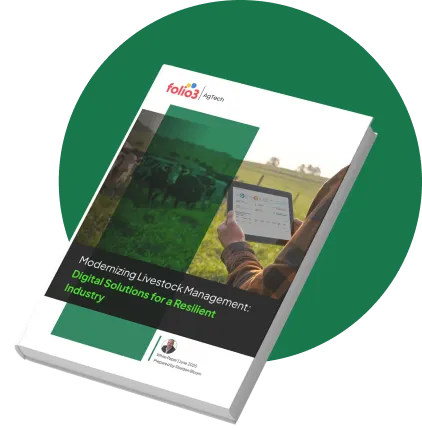
The livestock industry is navigating a period of significant change.
Rising input costs, labor shortages, increasing compliance requirements, market volatility, and growing consumer expectations are placing pressure on every part of the value chain. At the same time, disconnected systems and manual processes make it difficult to gain timely visibility into operations, costs, and performance.
This white paper examines where digital technologies deliver the greatest impact and how organizations can prioritize modernization initiatives that generate measurable business value.
A stage-by-stage look at where digital tools are delivering measurable impact across the full livestock production lifecycle, from ranch inputs through to sales and financial reporting.
Ranch Inputs: Inefficient land use, feed waste, reactive equipment maintenance, and labor scheduling gaps are driving up input costs quietly and consistently. This section covers how precision agriculture tools, automated feed management, and predictive maintenance systems address each of these at the source.
Primary Production: Delayed disease detection and inefficient breeding decisions directly increase mortality rates and treatment costs. Learn how real-time health monitoring, AI-assisted diagnostics, and automated alerts are changing the economics of herd management.
Feed Management: Poor feed quality, inaccurate moisture levels, and inconsistent energy values reduce feed efficiency and inflate costs without obvious warning signs. This section covers how real-time nutrient analysis, automated ration adjustments, and integrated inventory alerts close that gap.
Lot Ownership and Financial Reporting: Multi-owner lot structures create cost tracking and revenue allocation problems that manual systems handle poorly. See how centralized financial platforms automate ownership splits, interest calculations, and settlement reporting, and what that means for stakeholder transparency.
Livestock Processing: Manual tracking through the harvest-to-fabrication workflow creates traceability gaps, inconsistent yield management, and compliance exposure. This section covers how real-time lot-level data and automated carcass tagging improve accuracy from slaughter through packaging.
The whitepaper addresses some of the most common operational challenges faced by livestock businesses today, including:
Each challenge is paired with practical digital solutions and examples of how technology can improve efficiency, transparency, and decision-making.
The numbers from operations that have made the shift are consistent. Digital livestock platforms for ranch input management typically deliver a 2.5x to 4x return on investment within 18 to 24 months, with annual savings of $75–150 per head depending on herd size and operational complexity.
Across the value chain, operations typically see:
These aren't projections; they're outcomes from operations that replaced disconnected legacy workflows with integrated digital systems built around how livestock businesses actually operate.
This guide is written for leaders across the livestock value chain who are responsible for operational performance, financial outcomes, or technology decisions.
Get the full stage-by-stage analysis of digital solutions across the livestock value chain, with real-world problem descriptions, technology recommendations, and outcome data at each phase of production.
Get a Free Consultation Within 24 Hours, with a No-Obligation Ballpark Estimate
[contact-form-7 id="5196998" title="Intent Popup Form"]