

Folio3 AgTech designed a clickable mobile prototype that validated the digital path forward for a Gates Foundation-funded animal health initiative serving smallholder farmers across nine countries.
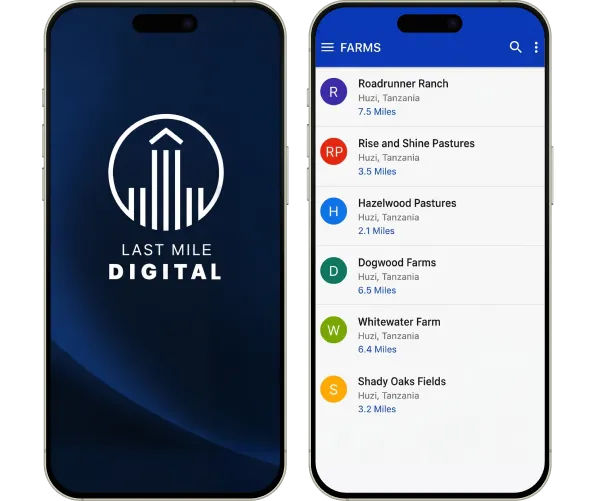
Boehringer Ingelheim's LastMile initiative relied on field agents managing farm visits, surveys, and animal health training entirely on paper. Folio3 AgTech designed a clickable mobile prototype called the Last Mile App, covering both field agent and administrator workflows, giving the program a validated digital foundation before any production development began.
Boehringer Ingelheim is one of the largest privately owned pharmaceutical companies in the world. Founded in 1885, the company operates across 76 countries with more than 54,000 employees. Its Animal Health division serves over 150 markets globally, producing vaccines, parasiticides, and therapeutics for livestock, poultry, and companion animals. The LastMile initiative, launched in 2018, is a partnership with GALVmed funded by the Bill & Melinda Gates Foundation, focused on expanding animal healthcare access for smallholder farming communities across Sub-Saharan Africa.
Industry
Animal Health · Pharmaceutical
Geography Served
Ingelheim, Germany
Technology
Mobile Application Prototype
Smallholder farmers reached by the LastMile initiative the app was designed to support
Countries Across Sub-Saharan Africa in the initiative's operational footprint
Farm visits conducted by field agents annually, the core workflow the prototype was built to digitize
Increase in veterinary medicine availability across target markets after the program scaled
Boehringer Ingelheim's LastMile program deployed Livestock Service Providers (LLSPs) across remote farming communities in Sub-Saharan Africa. Their job was to visit farms, conduct surveys, advise farmers on animal health, and distribute training on disease prevention and veterinary products. All of it ran on paper.
For a program operating across nine countries, serving farmers in areas with poor connectivity and no fixed addresses, paper-based operations created problems that got worse as the initiative scaled. Administrators had no way to consolidate or analyze field data. Field agents had no reliable access to training materials or pricing. And the initiative had no digital infrastructure to measure its own reach or impact.

Farm visit data and survey results were handwritten. Records were slow to compile and impossible to centralize across regions.

Staff rotation caused repeated knowledge loss. Without GPS coordinates, relocating off-grid farms in remote areas was unreliable for new agents.

LLSPs carried printed materials into the field. Current manuals, videos, and pricing were not reliably accessible during farmer consultations.

Field data arrived late or not at all. LLSP activity and program performance could not be tracked across countries reliably.
Before any development began, Boehringer Ingelheim needed to know the system would work for the people using it. Field agents operating in remote areas and administrators managing program data across borders had different needs and different workflows. Folio3 AgTech started with discovery and built up from there.
Mapped the needs of both user types: LLSPs and program administrators. Defined functional requirements across farm visit management, data capture, training delivery, and reporting.
Built storyboards for each role. Documented LLSP visit sequences and the data flows administrators need to track field performance across regions and countries.
Translated workflow maps into low-fidelity and high-fidelity screens. Designed for low-connectivity environments and users with varying levels of digital experience.
Assembled a fully interactive Last Mile App prototype covering all primary workflows for both user roles, ready for stakeholder review and usability validation.
The Last Mile App prototype demonstrated a complete field service management system for Boehringer Ingelheim's LLSP network. Every feature was designed around the realities of operating in areas with limited connectivity, no fixed farm addresses, and two distinct user types with different needs.
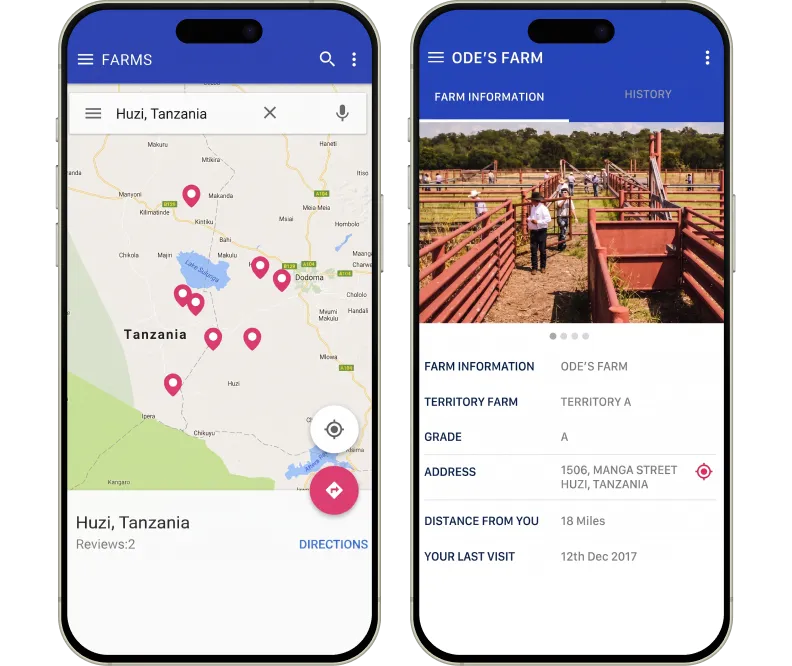

Field agents scheduled farm visits in advance, making visit cycles systematic and ensuring better preparation before reaching each farm.

The app allowed agents to view existing farm profiles and add new entries with accurate geolocation coordinates for future navigation.

Saved GPS coordinates let agents relocate remote farms without an active internet connection, removing guesswork from navigation in off-grid areas.

Agents recorded product sales directly in the app during visits, replacing paper order forms and handwritten logs.

Personnel could photograph animals, record observations, and attach notes to individual farm records during visits and consultations.

Pre-configured fields for cattle, dairy cows, calves, and poultry gave agents a consistent format for recording animal health data.

Agents completed standardized surveys in the app during visits, replacing paper forms and manual data entry after leaving the field.

Product manuals, videos, and disease prevention materials were accessible from the device so agents could share content directly with farmers.
The Last Mile App prototype gave Boehringer Ingelheim a clear, interactive view of what a digital field operations system would look like before production development began. Stakeholders could walk through every workflow and confirm the design matched how the program actually operated. That validation reduced development risk and aligned teams across a multi-country, multi-partner rollout.
All farm data, notes, sales records, and survey responses captured digitally during the visit, not reconstructed from memory afterward.
Remote farms locatable using saved coordinates without an active internet connection, removing navigation guesswork in off-grid areas.
Product manuals, videos, and disease prevention materials accessible directly from the device during farmer consultations.
Visit and survey data organized for consolidation, analysis, and reporting across countries and field teams.
LLSP check-in and check-out records gave administrators a view into visit frequency, coverage, and field team performance.
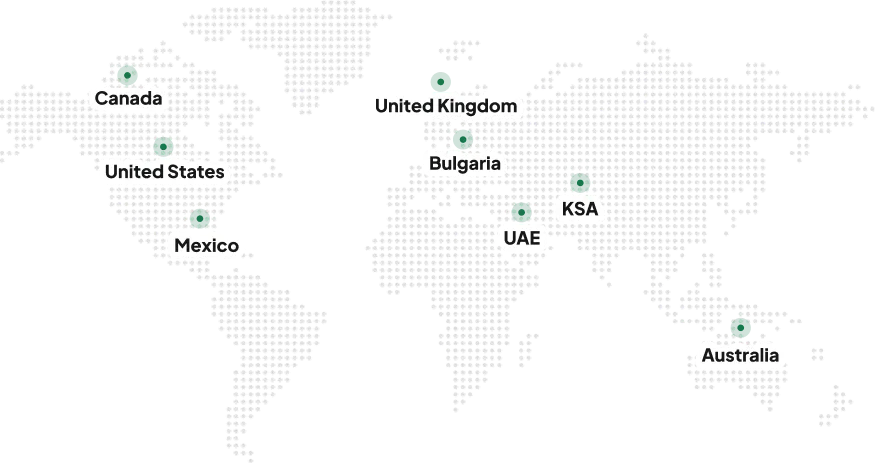
The prototype was built around a closed, role-based access model suited to secure APK distribution across a nine-country field network.
Boehringer Ingelheim used a validated prototype to map out a field service system before a single line of production code was written. If your field program still runs on paper, that is where we start.
Start Your Success Journey With Folio3 Today!
Get a Free Consultation Within 24 Hours, with a No-Obligation Ballpark Estimate
[contact-form-7 id="5196998" title="Intent Popup Form"]