
For centuries, the most resilient farms have shared one trait: they never relied on a single source of income. Mixed crop and livestock farming brings that age-old wisdom into the modern era, combining crop cultivation with animal husbandry in a way that strengthens both. Whether you grow maize alongside cattle or rotate legumes with sheep grazing, this approach helps you diversify risk, restore soil health, and build a more stable operation.
According to the Food and Agriculture Organization (FAO), mixed farming systems occupy roughly 2.5 billion hectares worldwide and produce over 50% of the world’s meat and 90% of its milk. With climate pressures mounting and input costs rising, these systems are more relevant than ever. However, they also demand careful management, the right crop–animal pairings, and increasingly, smart technology to keep everything running smoothly.
In this guide, you’ll explore what mixed crop and livestock farming actually involves, where it thrives globally, the different system types, real-world case studies, best practices, and how modern tools can help you manage it all. Let’s dig in.
What Is Mixed Crop and Livestock Farming?
At its core, mixed crop and livestock farming is the practice of combining crop production with animal raising on the same farm or within connected operations. Think of it as growing grains like maize, millet, or rice alongside livestock such as cattle, sheep, goats, or poultry, where both enterprises feed into and support each other.
These systems can serve both subsistence and commercial goals. In both cases, the mixed crop and livestock farming definition centers on intentional interaction between crops and animals.
An important distinction to understand is between diversified and integrated systems. In diversified systems, crops and livestock coexist on the same farm but operate mostly independently. The primary goal is to spread risk across multiple income streams. In integrated systems, resources are deliberately recycled: manure fertilizes fields, crop residues feed animals, and the whole operation functions as a closed loop that reduces external inputs.
Mixed farming can also happen on-farm (resource recycling within a single operation) or between farms (neighboring farms exchanging manure, crop residues, or grazing access). Understanding where your operation falls on this spectrum is the first step toward optimizing it.
Where Is Mixed Crop and Livestock Farming Practiced? (Global Distribution and Climate)
Mixed crop and livestock farming is not confined to a single continent or climate zone; it’s practiced on every inhabited continent. From the humid tropics of Southeast Asia to the semi-arid savannas of West Africa, from the temperate plains of Europe to the rangelands of South America, these systems adapt to local conditions with remarkable flexibility.
The research reports that two-thirds of the global population live in or near mixed farming systems. These systems produce 41% of the world’s maize, 86% of rice, 66% of sorghum, and 74% of millet, along with 75% of dairy and 60% of meat in developing countries.
What determines the specific crop–animal combination is climate, soil type, and local market demand. Humid tropical regions typically pair rice or maize with pigs, poultry, or fish. Arid and semi-arid areas lean toward sorghum, millet, and hardy livestock like goats and camels. Temperate zones often combine cereal grains with cattle or sheep.
Here’s a snapshot of how mixed crop and livestock farming locations vary by region:
| Region | Common Crops | Typical Livestock | Climate |
| Sub-Saharan Africa | Maize, sorghum, millet, cowpea | Cattle, goats, poultry | Semi-arid to humid tropical |
| South & Southeast Asia | Rice, maize, vegetables | Cattle, buffalo, pigs, fish | Humid tropical to subtropical |
| Europe | Wheat, barley, potatoes, clover | Dairy cattle, sheep, pigs | Temperate |
| North America | Corn, soybeans, alfalfa, wheat | Beef cattle, sheep, poultry | Temperate to semi-arid |
| South America | Soybeans, sugar cane, maize | Beef cattle, sheep, poultry | Tropical to subtropical |
| Australia | Wheat, barley, canola | Sheep, beef cattle | Semi-arid to temperate |
Types of Mixed Crop and Livestock Systems
Mixed crop and livestock systems range from on-farm recycling to between-farm exchanges. Learn how each type works and which fits your operation best.
On-Farm vs. Between-Farm Mixing
On-farm mixing is exactly what it sounds like: crops and livestock share the same property, and resources like manure and crop residues cycle between them. It is common in low-external-input systems where farmers rely on what the land produces.
Between-farm mixing involves neighboring farms exchanging resources. A crop farmer might receive manure from a nearby livestock operation, while the livestock farmer gets straw or grain in return. This approach is particularly common where manure or feed is scarce, and it requires good coordination and social trust between participants.
Mixing Within Crops or Animals
Farmers can also diversify within the crop or animal component itself. Multiple cropping, such as intercropping millet with cowpea, makes better use of light, moisture, and soil nutrients while controlling pest pressure.
On the animal side, mixed grazing (running cattle and sheep on the same pasture) allows different species to use different plant resources. Cattle prefer grasses while sheep consume shorter herbs, and camels and goats browse shrubs, so combining them can maximize biomass utilization.
Diversified vs. Integrated Systems
In diversified systems, crops and livestock are kept relatively independent. The farmer benefits from multiple revenue streams but doesn’t necessarily recycle resources between enterprises. High-external-input agriculture (HEIA) often operates this way.
Integrated crop systems deliberately link livestock production through nutrient recycling, shared labor, and complementary timing. These systems are hallmarks of low-external-input agriculture (LEIA) and conservation farming. Integration can deliver striking results: fish–livestock pond systems that combine ducks, geese, or pigs with aquaculture have been documented to increase fish yields by two- to four-fold.
Modes: Expansion, LEIA, HEIA, and NCA
The FAO identifies four modes of mixed farming based on resource availability. Expansion agriculture operates where land is abundant, and systems are largely traditional. LEIA (low-external-input agriculture) relies on labor, skill, and on-farm resources. HEIA (high-external-input agriculture) uses capital-intensive methods with purchased inputs. New Conservation Agriculture (NCA) combines integrated practices with modern management, aiming for both sustainability and productivity.
Intensity: Intensive or Extensive?
A frequently asked question is whether mixed crop–livestock farming is intensive or extensive. The answer: it can be either. A feedlot operation integrated with grain production is clearly intensive, relying on high external inputs to maximize output per unit of land. A smallholder system in rural Africa where cattle graze communal pasture,s and crops are grown with minimal fertilizer is extensive. What matters most in mixed systems is the degree of resource integration, not the scale of inputs.
Real-World Examples and Case Studies of Mixed Crop and Livestock Farming
See how farmers across the U.S., France, Sweden, Asia, and Colombia are making mixed farming work. These case studies show measurable results you can learn from.
Palouse Organic Mixed System (USA)
In Washington State’s Palouse region, the Zakarison family integrates wheat, peas, alfalfa, and sheep across 100 acres. Their organic approach allows sheep to graze on pasture growth after harvest, supplying nitrogen through manure and steadily improving soil organic matter. Over a three-year monitoring period, the USDA documented that this mixed system proved more profitable and increased soil carbon compared with conventional crop-only rotations in the same region.
Coteaux de Gascogne (France)
A comparative study of farms in southwestern France found that mixed crop–livestock operations achieved similar gross margins to specialized farms but with notably lower production costs and less vulnerability to commodity price swings. These farms also demonstrated lower potential nitrogen pollution, showing that integrating crops and livestock makes financial sense, and it benefits the environment, too.
Swedish Pig Rotations
Swedish researchers developed a model that incorporated pigs into clover and grassland rotations. The results were compelling: environmental loading dropped by 64%, and purchased feed inputs fell by 48% compared to conventional pig production. Pigs’ natural rooting behavior also improved soil structure, and wheat yields in the following year increased when soil moisture conditions were favorable.
Fish–Livestock Integration (Asia)
Across South and Southeast Asia, integrated fishpond systems combine ducks, geese, or pigs with aquaculture. Livestock manure feeds plankton, which in turn nourishes fish, while pond sediment fertilizes surrounding vegetable crops. This circular approach can increase fish production two- to four-fold. Additionally, grazing livestock under oil palm and rubber plantations in Malaysia and Indonesia has been shown to reduce weed management costs by up to 40%.
Mixed Grazing in Sugar Cane Fields (Colombia)
In Colombia, sheep grazing beneath sugar cane canopies suppresses weed growth, cuts herbicide costs in half, and provides an additional meat income stream. It’s a straightforward example of how a simple crop–livestock pairing can solve multiple problems at once.
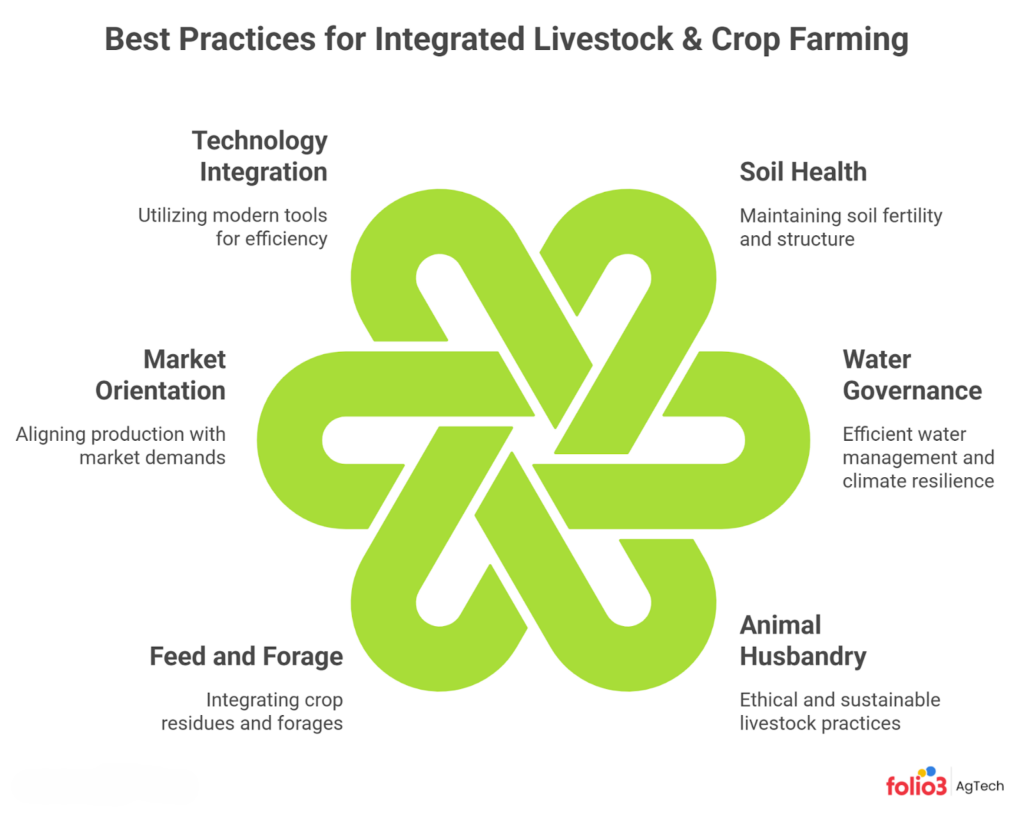
Key Components and Best Practices to Ensure Integrated Livestock and Crop Farming
From soil health and water management to tech integration, these best practices help you build a mixed system that runs efficiently and stays profitable long-term.
Soil Health and Nutrient Cycling
Healthy soil is the foundation of any successful mixed farming system. Practicing crop rotations with cereals, legumes, and tubers breaks pest and disease cycles while improving soil structure over time. Incorporating legumes like beans, peas, clover, or alfalfa fixes atmospheric nitrogen, showing legume rotations can add up to 70 kg of nitrogen per hectare to the soil, substantially reducing your reliance on synthetic fertilizer.
Composting and applying manure efficiently closes the nutrient loop between your livestock and crops. Use cover crops to suppress weeds and prevent erosion during fallow periods, and reduce tillage wherever possible to protect soil microbial communities and boost carbon sequestration. These practices to increase crop yields work best when applied as a system rather than in isolation.
Water Governance and Climate Adaptation
Efficient water use is non-negotiable in mixed systems. Employ drip or sprinkler irrigation to align water delivery with crop and pasture needs. Harvesting rainwater and monitoring soil moisture helps you time grazing rotations and planting windows more precisely.
Match your crop and animal selections to local conditions. Drought-tolerant crops like sorghum, millet, and cowpea, paired with heat-resistant livestock breeds, perform far better in arid zones than trying to force temperate varieties into harsh climates.
Animal Husbandry
Choose locally adapted breeds to build resilience into your herd. Adjust stocking rates carefully to prevent overgrazing and pasture degradation, as it is one of the most common pitfalls in mixed systems. Implement integrated pest and disease control through vaccination schedules, biosecurity protocols, and rotational grazing. Healthy animals produce better outputs, and modern livestock management software makes it easier to track health events, treatments, and breeding records across your entire operation.
Feed and Forage Integration
Crop residues are a built-in feed resource. Maize stover, sorghum straw, and bean haulms can all serve as dry-season feed for ruminants, reducing your dependence on purchased inputs. Complement residues with dedicated forage crops like alfalfa and clover to maintain year-round green matter availability. Diversifying feed sources helps you manage feed rations for cattle precisely, matching nutrition to each animal group’s needs without overspending.
Market Orientation and Diversification
Select crops and livestock that have accessible, reliable markets in your area. Integrating value-added products like dairy, processed meat, and preserved foods can significantly increase your per-unit revenue. Participating in cooperatives helps smaller operations scale their market power and reduce barriers to entry.
Technology Integration
Crop and livestock management software platforms, including specialized feedlot management software, can consolidate your rotation schedules, grazing plans, inventory data, and health records in one place. Instead of juggling spreadsheets and paper notebooks, you can plan and monitor every component of your operation digitally.
Precision agriculture tools, such as GPS guidance, soil sensors, and drones in farming, gather real-time data on soil conditions, crop health, and pasture biomass. Remote sensing and satellite-based platforms help you optimize resource allocation and catch problems early. For livestock-specific tasks like herd tracking and health monitoring, AI solutions for agriculture are becoming increasingly practical and affordable.
Implementation Tips
- Start with a farm audit: map your existing crops, livestock, inputs, outputs, and seasonal patterns before making changes.
- Pair compatible crop–animal combinations and synchronize planting and grazing cycles so they complement rather than compete with each other.
- Build market connections early, know where you’ll sell before you produce.
- Record everything. Detailed activity logs help you identify bottlenecks, track improvements, and justify investments. A solid farm record-keeping system simplifies this process enormously.
Pros, Cons, and Challenges of Mixed Crop and Livestock Farming
Mixed farming diversifies income and improves soil, but it also demands more planning and labor. Weigh the key benefits against the real challenges before you commit.
Pros (Benefits)
- Risk diversification: Mixed systems reduce your vulnerability to crop failure or commodity price crashes because income comes from both crops and livestock simultaneously.
- Soil fertility and nutrient cycling: Manure and crop residues recycle nutrients back into the soil, improving structure and organic matter without heavy reliance on synthetic inputs.
- Resource optimization: Efficient use of water, land, and labor increases overall farm productivity per unit of input.
- Ecosystem services: Integrated systems can boost biodiversity, provide pollinator habitat, and sequester carbon in soils and perennial vegetation.
- Cost savings: Studies have shown that mixed farms often have lower production costs and are less sensitive to input price fluctuations than specialized operations.
Cons (Challenges)
- Complex management: You’re running multiple enterprises simultaneously, which demands more knowledge, coordination, and record-keeping than a single-commodity operation.
- Reduced economies of scale: Dividing resources among several activities can limit the efficiencies that come with full specialization.
- Potential resource conflicts: Grazing animals may compete with crops for space and timing. Poor coordination between planting and grazing schedules can lead to crop damage or overgrazing.
- Labor demands: Integrated systems, particularly in low-input contexts, can be labor-intensive. In some regions, mixed farming represents a necessity driven by limited resources rather than a deliberate strategic choice.
Environmental and Economic Impacts of Mixed Crop and Livestock Farming
Integrated systems can cut emissions and lower costs, but poor management risks soil damage and pollution. Understand the trade-offs to make informed decisions.
Environmental Benefits
Mixed systems reduce the need for chemical inputs and external fertilizer by recycling manure and residues on-farm. Integrating livestock into cropping systems can cut greenhouse gas emissions by roughly 15% compared with monoculture. Integrated pond systems with fish and livestock increase biodiversity and total biomass output.
Environmental Risks
Without proper management, mixed systems can cause problems. Overgrazing compacts soil, degrades pastures, and pollutes water through nutrient runoff. Diversified systems that don’t truly integrate their components may not recycle resources efficiently, negating many of the environmental advantages.
Economic Impacts
Comparative studies consistently show that mixed crop–livestock farms achieve margins similar to specialized operations but with lower production costs and greater resilience to price volatility.
Trade-offs
Pursuing aggressive environmental goals comes with financial costs. Environment-oriented optimization can reduce profitability by about 8% over a decade. This trade-off underscores why farmers and policymakers must evaluate local conditions, market access, and cost structures when deciding how far to push integration.
Intensity Considerations
Mixed crop–livestock systems span the full intensity spectrum. High-input feedlot–grain operations are clearly intensive; smallholder LEIA systems are extensive. The question “why is mixed crop and livestock farming intensive?” has a nuanced answer: intensiveness arises when high external inputs (purchased feed, synthetic fertilizer) are used to maximize output per unit area. Extensive systems instead rely on natural pasture, labor, and on-farm nutrient cycling.
Future Trends and Policy Perspectives
Climate-smart practices, digital tools, and supportive policies are shaping the future of mixed farming. Stay ahead by understanding where the industry is heading.
Climate-Smart Agriculture
Mixed crop–livestock systems are central to the climate-smart agriculture movement. They mitigate drought and flood risks through diverse soil cover and revenue streams, sequester carbon in pasture and perennial root systems, and give farmers multiple fallback options during erratic seasons. As extreme weather events become more frequent, the resilience built into integrated systems becomes increasingly valuable.
Sustainable Intensification
Incremental productivity gains are possible through integrated nutrient management (combining organic and synthetic inputs at optimal ratios), precision feed strategies, improved seed varieties, and remote sensing to fine-tune resource allocation. The goal isn’t to eliminate inputs entirely but to use them with surgical precision.
Digital Technologies
Precision agriculture tools, remote sensing, and farm ERP software are becoming more accessible. Satellite-based platforms enable real-time monitoring of soil health, land use, and vegetation cover. As IoT in agriculture matures, connected sensors will feed continuous data into decision-support dashboards, making it easier for farmers to manage complex mixed systems with confidence.
Policy Frameworks
Effective policy support for mixed farming requires secure land tenure (so farmers invest in long-term integration), extension and training services for crop–animal planning, access to credit for purchasing improved breeds, seeds, and irrigation equipment, and strong value chains that connect diversified farm outputs to viable markets.
Research and Modeling
Agent-based models and life cycle assessments are giving policymakers and farmers better tools to evaluate both the environmental and economic outcomes of mixed systems. As these modeling tools become more accessible and user-friendly, individual farmers will be able to simulate different scenarios and plan for both profitability and sustainability before committing resources.
Fun Facts and Interesting Insights
Discover surprising facts that show just how impactful these systems really are.
- Productivity Boost: Integrating crops and livestock can raise overall farm productivity by up to 30% compared with monoculture practices.
- Global Importance: More than 2.5 billion people worldwide depend on mixed crop–livestock systems for food and income, making them the backbone of global food security.
- Nitrogen Fixation Power: Combining legumes in crop rotations can add up to 70 kg of nitrogen per hectare to the soil, essentially free fertilizer from nature.
- Pigs as Ploughs: Integrating pigs into Swedish cropping systems reduced environmental loading by 64% and cut purchased feed inputs by 48%, while wheat yields improved where soil moisture was adequate.
- Fish Pond Gains: Combining fishponds with ducks, pigs, or geese can increase fish production by 2–4 times and supply manure for surrounding crop and garden areas.
Conclusion
Mixed crop and livestock farming is not a relic of the past; it’s a forward-looking strategy that addresses many of the challenges modern agriculture faces, from soil degradation and climate volatility to market uncertainty. By combining crops and animals into a cohesive system, you build natural nutrient cycles, diversify income streams, and create an operation that is genuinely more resilient than any single-commodity farm.
The key is intentional planning: choosing the right crop–animal pairings for your climate, integrating resources rather than just co-locating enterprises. Whether you’re a smallholder exploring integration for the first time or a commercial operator looking to reduce input costs, the principles in this guide can set you on the right path. For further information on how to manage both integrated systems effortlessly with a digital solution, book a free consultation with our Agtech experts.
Frequently Asked Questions
What Is the Main Advantage of Mixed Crop and Livestock Farming Over Monoculture?
The biggest advantage is risk diversification. When crops and livestock are integrated, a poor harvest doesn’t wipe out your entire income because animal products continue generating revenue. Additionally, nutrient recycling between crops and livestock lowers input costs over time.
How Do You Choose the Right Crop–Livestock Combination for Your Farm?
Start by assessing your local climate, soil type, water availability, and market demand. Match drought-tolerant crops with heat-resistant livestock in arid regions, or pair legume-cereal rotations with ruminants in temperate zones. A farm audit and consultation with local extension services are the best first steps.
Is Mixed Crop and Livestock Farming Suitable for Small-Scale Operations?
Absolutely. In fact, smallholder farms in developing regions are among the most common practitioners of mixed farming. The approach scales well because even a modest integration of livestock manure into crop fields or crop residues into animal feed can deliver measurable benefits.
What Role Does Technology Play in Managing Mixed Farming Systems?
Technology helps manage the complexity that comes with running multiple enterprises. Livestock and crop management software can track rotations, animal health, feed inventories, and financial performance in one platform. Meanwhile, drones and sensors provide real-time field and pasture data.
Can Mixed Farming Help Reduce Greenhouse Gas Emissions?
Yes. Integrated mixed systems have been shown to reduce greenhouse gas emissions by roughly 15% compared to monoculture operations. The nutrient recycling, reduced synthetic fertilizer use, and carbon sequestration through diverse vegetation cover all contribute to a lower environmental footprint.