
In 2026, you’re farming in one of the tightest environments this industry has seen in decades. Between volatile weather patterns, razor-thin margins, and the constant pressure to feed a global population projected to reach nearly 10 billion by 2050, simply buying the latest gadget won’t cut it anymore.
The conversation has shifted. It’s no longer about whether you should adopt technology, it’s about demanding that every dollar of tech investment delivers measurable ROI. This year, the impact of technology in agriculture is more tangible than ever.
In this guide, we break down the top ten trends in agriculture reshaping the industry right now, from AI-driven precision farming to carbon credit monetization, and show you exactly how each one ties back to your bottom line.
The Shifting Landscape of the Agriculture Industry in 2026
Macro forces are fundamentally reshaping how farms operate. Understanding these trends in the agriculture industry is the first step toward making smart investment decisions.
If you’re running an operation today, you already feel the squeeze. Labor costs are at record levels, with the U.S. agriculture sector forecasting over $53 billion in labor expenses in 2025, and those numbers keep climbing. An estimated 2.4 million agricultural jobs remained open in 2024, with 56% of farmers reporting persistent shortages. Meanwhile, input prices as fertilizer, seed, fuel have not returned to pre-inflation norms.
At the same time, climate volatility is no longer a future threat; it’s your daily reality. Droughts, floods, and unpredictable frost windows are forcing growers to rethink everything from planting schedules to crop selection. The result? A massive push toward technologies that reduce uncertainty and protect yield.
The workforce challenge is equally pressing. By 2026, nearly a quarter of the U.S. workforce is projected to be over the age of 55, and the agricultural sector is aging even faster. Younger generations are gravitating toward urban careers in technology and business, leaving fewer candidates for traditional farm roles. Immigration policy uncertainty compounds the issue further, as roughly 40–45% of the U.S. crop workforce consists of undocumented workers. It is a pipeline that recent enforcement actions have disrupted significantly.
Across the broader landscape, the latest market trends in agriculture point to two converging realities: the macro trends driving systemic change and the micro-level innovations you can deploy right now. Here’s how they stack up:
| Macro Trends | Micro Trends |
| Climate resilience and regenerative land management | Drone-based precision spraying and laser weeding |
| Supply chain transparency and traceability mandates | IoT sensor networks for real-time field monitoring |
| Farm labor shortages and rising wage pressures | Autonomous tractors and robotic harvesters |
| AI-driven decision support for yield optimization | Seed gene-editing and biological crop inputs |
| Dual-use land strategies (energy + food production) | Agrivoltaic panel installations over crop fields |
These macro trends in agriculture create the demand. The micro trends deliver the solutions. Let’s dig into each one.
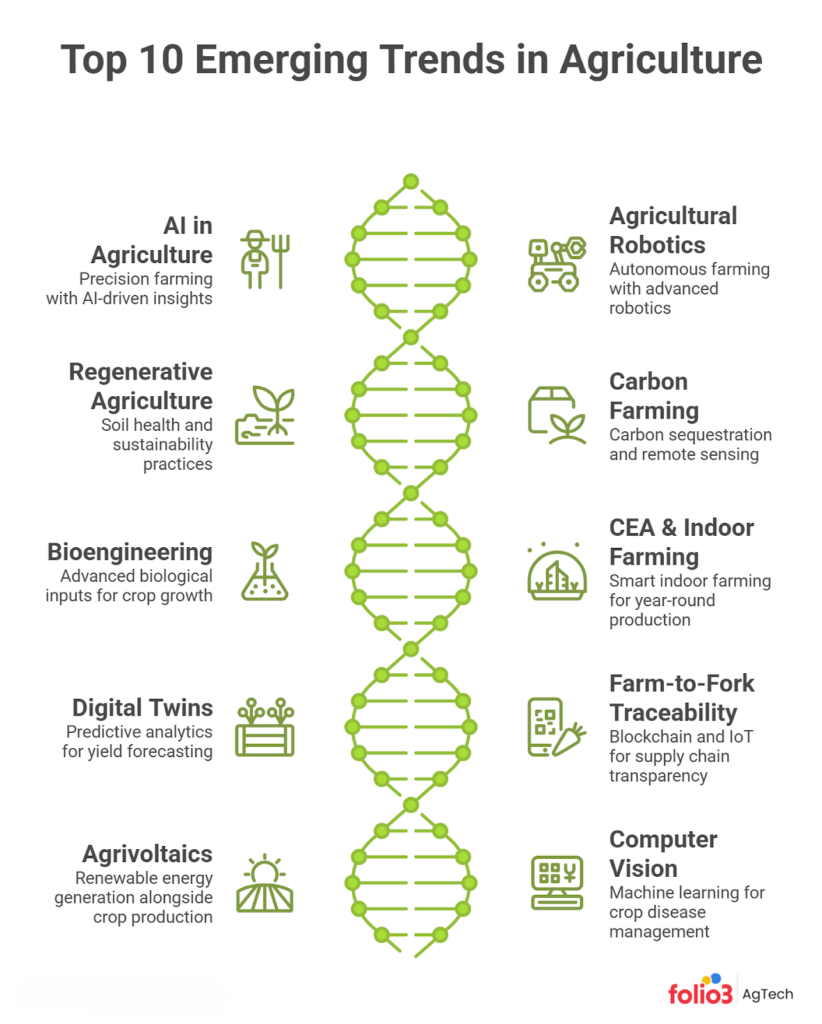
Top 10 Emerging Trends in Agriculture You Can’t Ignore
Whether you manage 500 acres or 50,000, these emerging trends in agriculture are the ones shaping budgets, boardroom conversations, and field-level decisions in 2026. Here are the new trends in agriculture that deserve your attention.
1. AI in Agriculture: Moving from Hype to High-ROI Precision
The global AI in agriculture market was valued at approximately $2.96 billion in 2025 and is projected to reach $11.59 billion by 2032, growing at a 21.5% CAGR. But adoption isn’t uniform. According to industry analysis, 81% of large farms over 5,000 acres are willing to adopt AI solutions, while only 36% of smaller operations have similar plans.
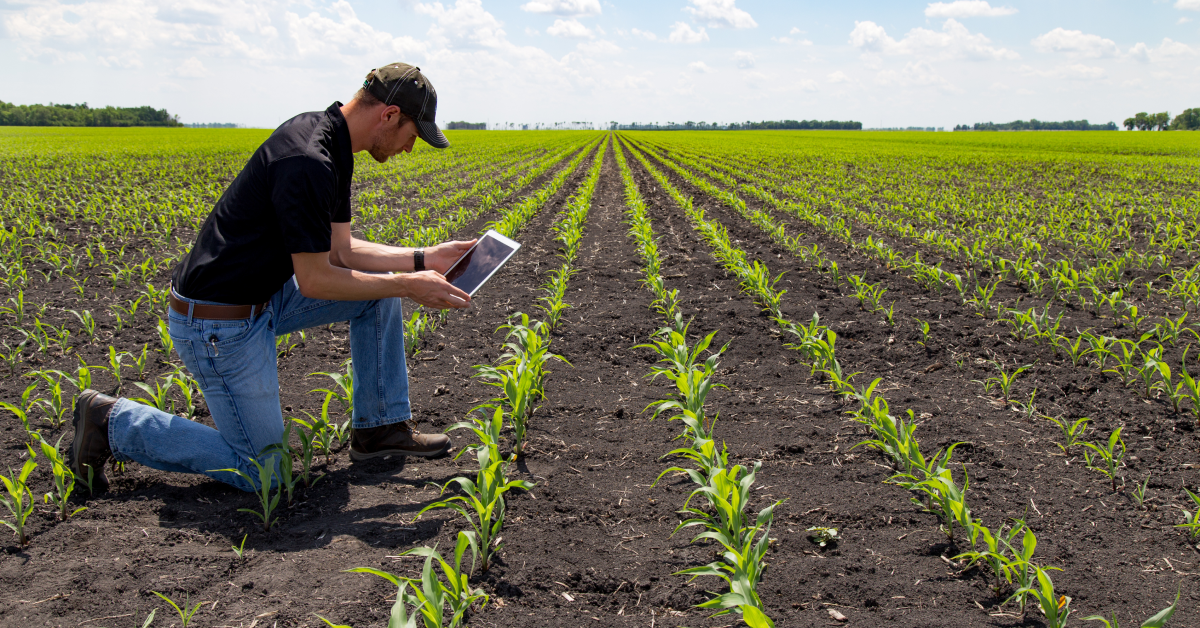
What does this look like in practice? Predictive analytics platforms are now processing satellite imagery, soil sensor data, and weather models to forecast yields weeks before harvest. Instead of blanket-applying fertilizer, AI-driven precision techniques are enabling variable-rate applications that can reduce input costs significantly while maintaining or improving output.
Farmer skepticism remains the primary barrier, particularly around data ownership and the learning curve. But the ROI numbers are hard to argue with: validated data indicates AI-enabled precision irrigation can boost yield accuracy by 15% and reduce water consumption by 20–30%. For growers operating on tight margins, those percentages translate directly into profitability.
One of the most practical developments is the rise of generative AI advisors. These are conversational tools that let you ask plain-language questions about crop planning, pest identification, or nutrient schedules and receive data-backed recommendations instantly. Platforms like these are democratizing access to agronomic expertise, especially for mid-sized operations that can’t afford a full-time agronomist on staff.
The key takeaway? The AI in agriculture trends 2026 aren’t about futuristic robotics, they’re about practical, measurable improvements you can implement this season using platforms already on the market.
2. Next-Gen Agricultural Robotics and Autonomous Farming
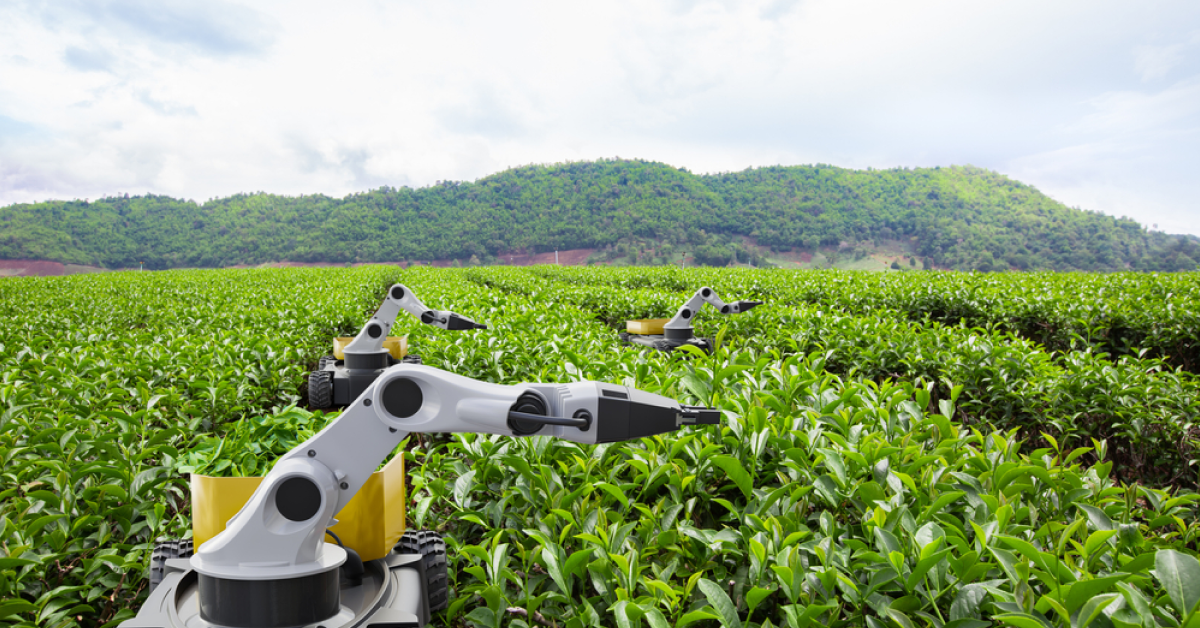
When half of surveyed U.S. farmers report they can’t hire all the workers they need, and those who do are running roughly 20% short on labor, the business case for robotics writes itself. Autonomous tractors equipped with GPS and AI-driven navigation now handle plowing, seeding, and fertilizing without a human in the cab.
But the real innovation is in specialty applications. Robotic weeders using laser technology, sometimes called “zap” systems, identify and destroy weeds at the root level without disturbing soil health or requiring herbicides. Delicate fruit-picking robots, once dismissed as too clumsy for ripe produce. Now, they use computer vision and soft-touch grippers to harvest strawberries, apples, and tomatoes with minimal bruising.
The role of robotics in agriculture goes beyond replacing manual labor. These machines generate continuous data streams like plant counts, weed density maps, and yield estimates that feed back into your decision-support systems. In that sense, every robotic pass across your field is also a scouting mission.
For operations facing chronic labor shortages, modern trends in agriculture point clearly toward a hybrid workforce where humans handle strategy and supervision. Meanwhile, machines handle the repetitive, physically demanding fieldwork.
The economics are becoming compelling. As precision agriculture technology matures, the cost of autonomous systems continues to fall while their capabilities expand. Industry projections indicate autonomous equipment trials have surged by 57% in recent years, with AI-based crop analytics growing 61% as a complementary trend. The farms investing in this infrastructure today are building the operational advantage that will define competitiveness for the next decade.
3. Regenerative Agriculture and Soil Health Prioritization
Regenerative agriculture isn’t just a sustainability talking point. It’s a holistic land management approach built on practices like no-till farming, diverse cover cropping, adaptive multi-paddock grazing, and reduced synthetic inputs. The goal is to rebuild soil organic matter, restore microbial diversity, and strengthen the biological engine that drives nutrient cycling.
Why does this matter for your bottom line? Healthy soil holds more water, meaning lower irrigation costs and better drought resilience. It also cycles nutrients more efficiently, reducing your dependency on expensive synthetic fertilizers. Long-term studies consistently show that farms transitioning to regenerative practices see reduced input costs over time, even as yields stabilize or improve.
The financial case is getting even stronger as carbon credit programs mature. Farms with verified improvements in soil organic carbon can now monetize those gains through voluntary carbon markets. It creates a secondary revenue stream directly tied to soil health, something conventional farming simply cannot offer.
If you’re exploring how precision fertilization integrates with regenerative goals, the answer is data. Agriculture sensors such as soil sensors, remote sensing, and AI analytics help you apply exactly what’s needed, where it’s needed, minimizing waste while supporting biological recovery.
4. Carbon Farming and Remote Sensing (MRV Technologies)
Carbon farming turns your soil management practices into verifiable, tradable carbon credits. The concept is straightforward: adopt practices that sequester more carbon in your soil (cover crops, reduced tillage, agroforestry). Then, use technology to measure, report, and verify (MRV) how much carbon you’ve actually stored.
The challenge has always been measurement. How do you prove your soil captured X tons of CO₂? That’s where AI-driven MRV platforms come in. These systems combine satellite imagery, drone-based remote sensing, soil sampling data, and machine learning models to quantify soil carbon sequestration with increasing accuracy. It isn’t guesswork anymore; it’s auditable data.
As highlighted in industry research, carbon farming with AI-driven MRV platforms is emerging as the backbone for credible carbon credit systems. For you, that means a potential secondary revenue stream of anywhere from $15 to $50+ per ton of verified carbon, depending on the market and verification rigor.
This trend sits at the intersection of the latest trends in sustainable agriculture and hard economics. As voluntary and compliance carbon markets continue to mature, the farms with verified, data-backed sequestration will be the ones commanding premium credits.
5. Advanced Bioengineering and Biological Crop Inputs
If you’ve noticed more conversations about biofertilizers, microbial biostimulants, and biopesticides at your local dealer or ag conference, there’s a reason. The biological crop inputs market is experiencing rapid growth as growers seek alternatives to synthetic chemicals that are both cost-effective and environmentally sustainable.
Here’s the appeal: biological inputs that are derived from naturally occurring microorganisms, plant extracts, and beneficial fungi work with your soil’s existing biology rather than against it. Biofertilizers improve nutrient uptake, and microbial biostimulants enhance root development and stress tolerance. Biopesticides target specific pests without decimating beneficial insect populations.
Nano-biofertilizers represent the cutting edge, using nanotechnology to deliver nutrients at the cellular level for maximum absorption efficiency. Early adopters are reporting comparable yields with significantly reduced chemical input costs, a micro trend in agriculture with macro financial implications.
For operations focused on AI in agriculture crop care trends, the integration of biological inputs with AI-driven crop management software creates a powerful combination. Sensor data tells you exactly where biological treatments will have the most impact, ensuring you’re not over-applying and that every dollar of product spend counts.
The transition doesn’t have to be all-or-nothing. Many growers are adopting a hybrid approach by using biological inputs alongside reduced rates of conventional chemicals during the transition period. This strategy manages risk while allowing you to observe how your soils and crops respond. Over time, as soil biology strengthens, you can continue shifting the ratio toward biologicals, lowering your dependency on synthetics and the cost volatility that comes with them.
6. Controlled Environment Agriculture (CEA) and Smart Indoor Farming
The global controlled environment agriculture market was valued at approximately $96.1 billion in 2024 and is projected to reach $507.3 billion by 2034, expanding at an 18.1% CAGR. That’s not incremental growth, it’s a fundamental shift in how and where food gets produced.
Modern CEA goes far beyond basic greenhouses. Aeroponic systems grow crops in air with nutrient mist, using up to 95% less water than field farming. Hydroponic operations stack growing trays vertically, maximizing output per square foot. Meanwhile, AI-automated climate controls adjust temperature, humidity, CO₂ levels, and lighting in real time, eliminating the weather variable entirely.
For your operation, the appeal is consistency, as controlled environment agriculture delivers year-round harvests independent of frost, drought, or excessive rain. For high-value crops like leafy greens, herbs, strawberries, tomatoes that consistency translates into premium pricing and reliable supply contracts.
The challenge remains energy costs, particularly for fully enclosed vertical farms. However, LED lighting efficiency has improved dramatically, and facilities pairing with renewable energy sources are closing the profitability gap. Multi-level vertical farms are projected to expand at the highest growth rates during 2026–2033, driven by urban land constraints and automation-driven cost optimization. If you’re evaluating modern trends in agriculture for future investment, CEA is one to watch closely.
For growers exploring how smart farming technology integrates with indoor operations, the answer lies in connected systems. Sensors, AI-driven climate controls, and centralized dashboards bring together every data point. They include temperature, humidity, nutrient levels, and light intensity into a single operational view that enables real-time adjustments and long-term planning.
7. Digital Twins and Predictive Analytics for Yield Forecasting
A digital twin is a virtual replica of your physical farm; your fields, equipment, soil profiles, and irrigation systems built from real-time sensor data and historical records. Think of it as a simulation sandbox. You can run “what-if” scenarios on crop rotations, test how a weather event would impact yield, or model the ROI of a new irrigation upgrade, all without risking a single acre.
Paired with AI-powered yield prediction, digital twins are becoming serious decision-support tools. They integrate weather forecasts, satellite imagery, soil moisture readings, and market pricing to give you a dynamic, continually updated picture of your operation’s performance trajectory.
For CTOs and farm managers evaluating AI in agriculture trends 2026, digital twins represent the next frontier in data-driven farming. They move you from reactive management to truly predictive, proactive decision-making.
The practical applications are expanding rapidly. Enterprise-level operations are using digital twins to simulate the financial impact of switching crop varieties, assess infrastructure investments before breaking ground, and optimize logistics across multi-site portfolios. As future trends in agriculture continue to evolve, the farms with the most accurate digital replicas of their operations will make the fastest, most confident decisions.
8. Farm-to-Fork Traceability Powered by Blockchain and IoT
Food safety recalls, contamination scares, and growing consumer demand for transparency are pushing traceability from “nice-to-have” to “non-negotiable.” The latest market trends in agriculture reflect this: IoT sensors now track environmental conditions from planting through harvest. At the same time, blockchain ledgers create immutable, auditable records of every touchpoint in the supply chain.
Here’s how it works in practice. IoT devices embedded in your fields monitor soil conditions, water quality, and chemical applications in real time. That data feeds into a blockchain-based traceability platform where each data point is timestamped and tamper-proof. When a retailer or consumer scans a QR code on a package, they can trace that product back to the exact field, row, and date it was harvested.
For growers, this transparency builds brand equity and opens doors to premium markets. Retailers increasingly require traceability documentation before placing orders, and operations that can’t provide it will find themselves locked out of the most profitable channels.
When combined with IoT-enabled farm monitoring, traceability doesn’t just serve compliance, it generates operational insights that help you optimize processes across the board.
The investment in traceability infrastructure also positions your operation for emerging regulatory requirements. As food safety mandates tighten across the U.S. and EU, having a verifiable chain of custody from field to fork is becoming a prerequisite for market access. The new trends in agriculture around transparency are here to stay, and the cost of retrofitting later will be far higher than building the system now.
9. Agrivoltaics: Harvesting Renewable Energy Alongside Crops
Agrivoltaics is the practice of co-locating solar panels with active crop production, and it’s moving rapidly from pilot projects to commercial scale. The global agrivoltaics market is projected to grow from roughly $5.26 billion in 2025 to $18.4 billion by 2035, growing at a 12% CAGR.
The concept is simple but powerful: elevated or semi-transparent solar panels are installed above crops, creating a partial shade canopy. In hot and arid regions, this microclimate reduces heat stress for both plants and livestock. Research shows certain crops like lettuce, spinach, peppers, and tomatoes can achieve 12–18% higher yields under agrivoltaic systems due to temperature regulation and reduced water evaporation.
On the revenue side, you’re generating clean energy that can power your operation, sell back to the grid, or provide income through power purchase agreements. In the U.S., federal incentives and state-level programs are further sweetening the deal for early adopters.
The latest trends in sustainable agriculture increasingly point toward dual-use strategies like agrivoltaics. If you have the land and the sunlight, this micro trend in sustainable agriculture could add a meaningful revenue stream while improving growing conditions for specific crops.
Livestock operations are seeing benefits, too. Grazing animals under agrivoltaic arrays gain shade that reduces heat-related stress among livestock on agrivoltaic sites. For the solar developer, grazing animals provide natural vegetation management beneath the panels, reducing maintenance costs. It’s a win-win scenario that illustrates how creative land management can unlock value from every acre.
10. Computer Vision and Machine Learning for Crop Disease Management
Crop diseases cost billions annually, and the window between early detection and devastating spread can be days. That’s where computer vision and machine learning are making the biggest impact at the field level.
Drones equipped with multispectral and hyperspectral cameras fly over your fields, capturing imagery that AI models analyze for the earliest signs of disease, nutrient deficiency, and pest pressure. These systems can identify issues like Red Crown Rot in soybeans, Septoria leaf blotch in wheat, or early blight in potatoes, often before symptoms are visible to the naked eye.
The result is pinpoint intervention. Instead of blanket-spraying an entire field, you treat only the affected zones. This targeted approach slashes chemical costs, reduces environmental runoff, and protects beneficial organisms in your soil. It’s the kind of precision that turns AI-driven crop monitoring from a tech demo into a profit center.
For operations managing thousands of acres, this AI in agriculture crop care trend is quickly becoming essential. The cost of a missed detection, an unchecked pathogen spreading across multiple fields, far outweighs the investment in aerial scouting and machine learning analytics.
The technology is also evolving toward accessibility. Smartphone-based disease identification apps powered by the same computer vision models now give smaller operations access to diagnostic tools that once required expensive drone fleets. Whether you’re deploying multirotor drones in farming or scanning leaves with your phone, the underlying principle is the same: early detection powered by machine learning saves you money, protects your yield, and reduces your chemical footprint.
How to Overcome Adoption Barriers? ROI and Tight Margins in AgTech
Let’s be real: reading about these current trends in agriculture is one thing. Committing capital to them when margins are slim is another. The good news is you don’t have to go all-in on day one.
Start with technologies that offer immediate payback. Precision upgrade kits, such as GPS guidance, variable-rate controllers, and soil sensor arrays, often layer onto existing equipment without requiring a full fleet replacement. Many agricultural ERP platforms now offer subscription-based pricing, eliminating the massive upfront software investment that scared away smaller operations.
Focus on the trends in the agriculture industry that directly address your biggest cost drivers. If labor is your pain point, invest in autonomous equipment first. If input costs are eating your margins, start with precision application tools. The farms that succeed in 2026 won’t be the ones that adopted every trend; they’ll be the ones that matched the right technology to their specific operational challenges.
Another practical approach is to pilot new tools on a single field or section before committing to a farm-wide rollout. Run a side-by-side comparison for one growing season, measure the actual input savings and yield differences, and let the data make the case for expansion. This incremental strategy reduces risk and builds internal confidence among your team, both critical when you’re navigating current trends in agriculture on a real-world budget.
Embrace the Future of Farming!
From AI and robotics to regenerative soil strategies and blockchain traceability, what are the trends in agriculture really telling us? The future belongs to data-driven operations that can measure impact, optimize resources, and adapt faster than the weather can change.
You don’t need to implement all ten trends simultaneously. Start with the one or two that align with your biggest operational challenges, measure the results, and scale from there. The compounding effect of incremental technology adoption is powerful, and it’s how the most successful operations are building resilience right now.
Whether it’s AI-powered yield forecasting, autonomous field equipment, or a blockchain traceability system, the common denominator is data. The farms that digitize their operations first will have the foundation to layer on any of these innovations as they mature. Those that wait risk falling behind competitors who’ve already built the digital infrastructure that makes precision, efficiency, and adaptability possible.
Ready to take the next step? Connect with Folio3 AgTech’s team to explore how ERP integrated with precision agriculture software can help you digitize operations, cut costs, and drive measurable ROI this season.
FAQs
What Is the Biggest Technology Trend in Agriculture for 2026?
AI-driven precision farming is the dominant trend, with predictive analytics, automated input adjustments, and computer vision transforming field-level decisions. It delivers the highest measurable ROI across operations of all sizes.
How Can Small Farms Afford New Agricultural Technology?
operations can start with subscription-based software platforms, precision retrofit kits for existing equipment, and government incentive programs. These entry points reduce upfront costs while delivering immediate operational improvements.
Are Carbon Credits a Viable Revenue Stream for Farmers?
Yes, but verification is critical. Farms using AI-driven MRV platforms to measure soil carbon sequestration are earning $15–$50+ per ton of verified carbon. The voluntary carbon market is expanding rapidly, and early movers are positioning themselves for premium pricing.
What Role Does Blockchain Play in Modern Agriculture?
Blockchain creates tamper-proof, auditable records of every step in the food supply chain. Combined with IoT sensors, it provides the farm-to-fork traceability that retailers and consumers increasingly demand before purchasing.
How Does Controlled Environment Agriculture Compare to Traditional Farming?
CEA uses 90–95% less water than conventional methods and delivers year-round harvests independent of weather. While energy costs remain higher, rapidly improving LED technology and renewable energy integration are closing the profitability gap, especially for high-value crops.
FAQs
How Can Small-Scale Farmers Benefit From These Trends in Agriculture?
While some of these trends in agriculture may seem geared toward large-scale operations, many of them offer benefits to small-scale farmers as well. For example, digital agriculture tools can help smallholders optimize resource use and increase yields.
What is the Role of Government in Promoting These Trends in Agriculture?
Governments play a crucial role in fostering innovation and adoption of these trends in agriculture. This includes providing financial incentives, supporting research and development, and creating favorable regulatory environments. Additionally, policies that promote sustainable agriculture and food security are essential.
How Can Consumers Contribute to the Adoption of These Trends in Agriculture?
Consumers have a powerful role to play by supporting sustainable and ethically produced food. Choosing to buy local, organic, or sustainably sourced products can incentivize farmers to adopt these practices.
What are the Potential Challenges in Implementing These Trends in Agriculture?
The adoption of new technologies, practices, and agricultural trends can be challenging for farmers due to factors such as cost, access to technology, and education. Additionally, there may be uncertainties about the long-term impacts of some technologies, such as genetic engineering.
How Can We Ensure that the Benefits of These Trends in Agriculture are Distributed Equitably?
It is essential to address the potential disparities that may arise from the adoption of these trends in agriculture. Access to technology, education, and financial resources should be equitable to ensure that all farmers can benefit.
What is the Future Outlook for Agriculture?
The future of agriculture is bright, but it will require continued innovation and adaptation. By embracing the current trends in agriculture outlined in this blog, the agriculture industry can build a more sustainable, resilient, and productive food system that meets the needs of a growing population while protecting our planet.