
One calf per year. For most cow-calf operators, that’s the rule of nature and also one of the biggest bottlenecks standing between you and faster genetic progress. If your best cow produces one calf annually, it would take decades to meaningfully move the needle on your entire herd’s genetics.
That’s exactly the problem embryo transfer in cattle was built to solve.
This guide breaks down everything you need to understand about the ET process, the science behind it, the step-by-step protocol, what the success rate data actually says, and much more to come.
What is Embryo Transfer in Cattle?
Embryo transfer in cattle is an advanced reproductive technology that allows a single genetically superior cow, called the donor, to produce far more offspring than she ever could on her own. Rather than carrying each pregnancy herself, her embryos are transferred into other cows, called recipients or surrogates, who carry the calves to term.
The concept flips the traditional model on its head: instead of one elite cow producing one calf per year, she can produce dozens of calves in her lifetime while continuing to breed.
According to Mississippi State University Extension, ET allows producers to multiply the genetics of top females rapidly, particularly within the seedstock segment of the beef industry, where genetic improvement drives premium pricing and market competitiveness.
The Science Made Simple
A cow’s reproductive biology normally limits her to a single ovulation and pregnancy per cycle. Embryo transfer bypasses this “one calf per year” ceiling by using hormones to trigger the donor cow to superovulate releasing multiple eggs in one cycle instead of just one. When those eggs are fertilized via artificial insemination and collected seven days later, each viable embryo can be transferred into a different recipient cow.
The result? A single elite cow can produce 10, 20, or even 30+ calves in a single year, dramatically compressing the timeline for herd genetic improvement.
In Vivo vs. In Vitro Fertilization (IVF)
There are two primary routes for producing embryos:
In Vivo ET (MOET – Multiple Ovulation and Embryo Transfer): The donor cow is superovulated with hormones, bred via AI, and the resulting embryos are flushed directly from her uterus. Everything happens inside the cow. It is a traditional ET approach and is the focus of this guide.
In Vitro Fertilization (IVF): Eggs are harvested directly from the donor cow’s follicles using a procedure called OPU (ovum pick-up), then fertilized in a laboratory setting before being cultured into embryos and transferred. IVF allows donors to be used more frequently and doesn’t require superovulation. To understand how IVF compares, see our detailed breakdown of cattle IVF vs. artificial insemination.
Why Consider Embryo Transfer for Your Herd? (Pros and Cons)
Before you invest in an ET program, you owe it to yourself to look at both sides of the equation. Embryo transfer in beef cattle carries real advantages, but it also demands real resources.
The Strategic Advantages (Pros)
- Rapid genetic improvement: ET lets you multiply the offspring of your highest-performing cows exponentially faster than natural breeding. A cow with elite EPDs, superior frame score, or proven show results can produce an entire herd of superior replacements within a few years.
- Global export of genetics: Frozen embryos can be shipped internationally at a fraction of the cost of transporting live cattle, making it possible to sell or access top-tier genetics worldwide without moving animals across borders.
- Disease control: Properly processed embryos have a low disease transmission risk compared to live animal imports. It makes ET a biosecurity-friendly method for introducing new genetics into a closed herd.
- Preserving value from injured or aging cows: A cow that sustains an injury, develops structural issues, or is simply getting older can still produce offspring for years through ET, protecting the value of your genetic investment even when she can no longer carry a pregnancy herself. It has particular importance if you’re working with breeding management strategies centered on preserving elite lines.
The Challenges to Keep in Mind (Cons)
- High upfront costs: Between hormone protocols, technician fees, semen costs, and recipient management, an ET program is a significant financial commitment.
- Labor-intensive scheduling: Synchronizing multiple animals, tracking injection days, and coordinating flushing and transfer requires tight, documented management.
- Need for highly trained technicians: Embryo flushing and transfer require specialized skills. Poor technique is one of the most common reasons ET programs underperform.
- Variable success rates: Not every flush yields the expected number of embryos, and not every transfer results in a live calf. Success rates vary based on cow, technician, season, and management.
AI vs. Embryo Transfer in Beef Cattle: A Comparison
| Feature | Artificial Insemination (AI) | Embryo Transfer (ET) |
| Average Cost per Pregnancy | $25–$50 per straw + synchronization | $300–$600+ per embryo transferred |
| Labor Intensity | Moderate (synchronization + insemination) | High (hormone protocols, flushing, grading, transfer) |
| Speed of Genetic Progress | Moderate (improves sire genetics quickly) | Very fast (multiplies elite cow and bull genetics simultaneously) |
| Calves Per Donor Per Year | 1 (donor is the recipient) | 10–30+ (donor’s embryos spread across recipients) |
| Best Fit | Commercial and seedstock herds | Seedstock producers, elite genetic multiplication |
The Step-by-Step Embryo Transfer Process in Cattle
Understanding the steps of embryo transfer in cattle gives you a clearer picture of what you’re coordinating and where the opportunities for success or failure actually lie.
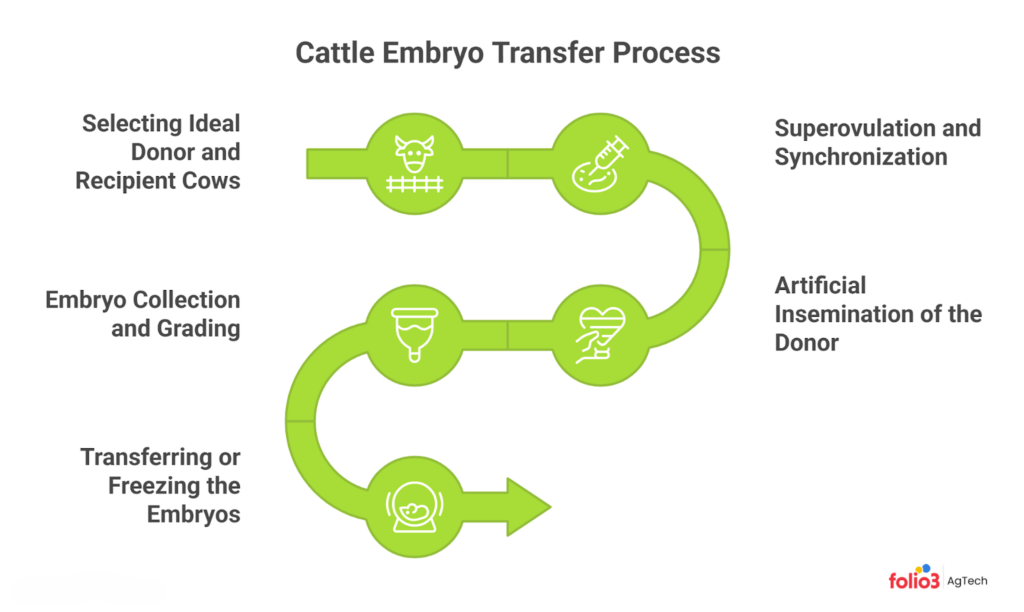
Step 1: Selecting the Ideal Donor and Recipient Cows
Everything starts with selection. Your donor cow must justify the cost of the program through her genetic value. The ideal donor has a strong EPD profile or performance record, a proven history of cycling regularly, conceives without repeated attempts, calves without difficulty, and is free of reproductive abnormalities or heritable defects.
Understanding how EPDs factor into your selection decisions is covered in our guide on EPD in animal science, a must-read before finalizing your donor lineup.
Recipient cows are equally important. They don’t need to be genetically elite. Still, they must be healthy, in good body condition, of appropriate size to carry a calf from a potentially larger donor, and have a well-functioning reproductive tract. A competent corpus luteum (CL) on the ovary at the time of transfer is non-negotiable.
You should always prepare more recipient females than the number of expected embryos to ensure adequate candidates on flushing day, since not all will have a usable CL.
Step 2: Superovulation and Synchronization
This is the hormonal engine of the ET process. The goal is to synchronize the estrous cycles of the donor and all recipient cows so that the recipients’ uteruses are at exactly the right developmental stage when the embryos are transferred seven days later.
A common protocol, such as the Select Sync + CIDR approach, involves:
- GnRH injection to synchronize the next follicular wave
- CIDR insertion (Controlled Internal Drug Release device), releasing progesterone to prevent premature ovulation
- CIDR removal + prostaglandin F2α (PGF2α) injection seven days later to allow the marker heat
The donor’s superovulation is triggered with a declining series of FSH (follicle-stimulating hormone) injections over four to five days after a synchronization prep period. It encourages multiple follicles to grow simultaneously. Two PGF2α injections are then given 12 hours apart to induce estrus, and the donor is artificially inseminated.
Step 3: Artificial Insemination of the Donor
Once the donor displays standing heat, AI begins. Most protocols call for inseminating with one straw at the start of estrus, a second straw 12 hours later, and often a third straw 24 hours in. This staggered approach ensures an adequate concentration of live sperm throughout the window when multiple ovulations are occurring.
High-quality semen from a proven bull is critical here, since poor semen quality directly reduces the number of viable embryos recovered during flushing.
Step 4: Embryo Collection (Flushing) and Grading
Seven days after the AI, a trained technician performs a non-surgical uterine flush to collect the embryos. Here’s how it works:
- A local anesthetic (usually Lidocaine) is injected near the tailhead to reduce muscular contractions in the rectum, making it easier to manipulate the uterus.
- A catheter with an inflatable cuff is passed through the cervix into the uterine body. The cuff is inflated to prevent flush media from leaking out.
- Flushing media flows in, the technician massages the uterine horns to dislodge embryos, and the fluid flows out through a fine filter that traps them.
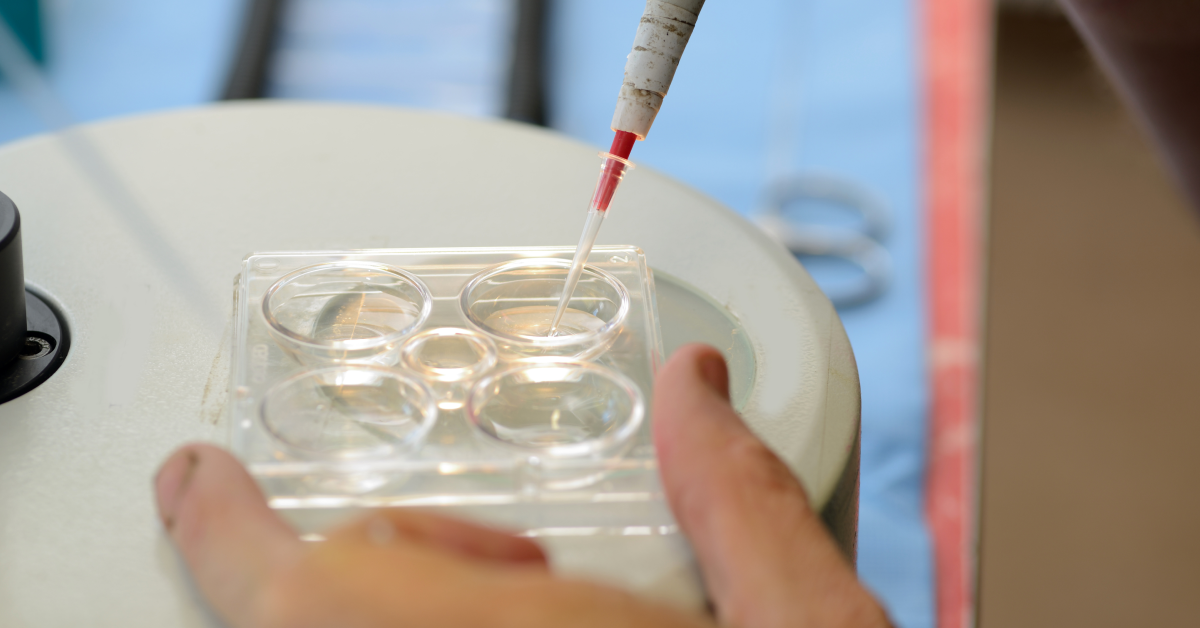
- The process is repeated several times per horn, and the filter is then rinsed into a petri dish and examined under a microscope.
Each recovered embryo receives a two-number classification per the IETS (International Embryo Transfer Society) grading system:
- First number: Developmental Stage (1 = unfertilized oocyte through 9 = expanding hatched blastocyst). Stages 5–8 are most commonly transferred.
- Second number: Quality Grade (1 = Excellent/Good, 2 = Fair, 3 = Poor, 4 = Dead/Degenerating)
Grade 1 and Grade 2 embryos are suitable for both fresh transfer and freezing. Grade 3 embryos have significantly reduced viability after freezing and should only be transferred fresh. Grade 4 embryos are generally discarded.
Step 5: Transferring or Freezing the Embryos
Fresh transfer is performed immediately on the same day as flushing. Each embryo is loaded into a 0.25cc straw and deposited into the uterine horn of a synchronized recipient using a transfer rod similar in technique to the AI process. The embryo must be placed in the horn corresponding to the side where the CL is present on the ovary.
Frozen embryos are first washed and suspended in a cryoprotectant solution, and then loaded into labeled straws. Then place into a controlled-rate embryo freezer that gradually reduces temperature before final storage in liquid nitrogen. Properly labeled and stored embryos can remain viable indefinitely in liquid nitrogen.
Frozen embryos give you flexibility; you can transfer them when recipient availability is optimal, ship them to other locations, or sell them to other producers. For operations integrating cattle IVF management alongside conventional ET, frozen inventory management becomes especially important to track.
Analyzing the Embryo Transfer in Cattle Success Rate
Success rates are the most important number in any ET program because they determine whether you’ll hit your ROI targets.
Fresh vs. Frozen Embryos: What the Data Says
Rates using fresh Grade 1 embryos transferred into properly synchronized recipients average approximately 65%. When using frozen-thawed embryos, that figure drops to approximately 55%, as the freezing process introduces some reduction in embryo viability.
These benchmarks represent well-managed programs with experienced technicians and synchronized recipients. Real-world averages in less controlled conditions will often be lower.
Key Factors That Make or Break Your Success
Several variables exert a significant influence on your final pregnancy rate:
- Technician proficiency: ET is a skill-dependent procedure. An experienced, IETS-certified technician will consistently outperform a less practiced one—not just in embryo recovery numbers but in transfer technique and recipient evaluation accuracy.
- Precise synchronization timing: The recipient’s uterus must be at exactly Day 7 of the estrous cycle to match the embryo’s developmental age. Any drift in synchronization degrades the uterine environment and reduces implantation success.
- Embryo handling: Embryos are sensitive to light exposure, temperature fluctuations, and media contamination. Poor lab hygiene or a break in the cold chain during transport can quietly devastate your pregnancy rates.
- Recipient cow stress post-transfer: Early embryonic death is a real risk in the first 14 days post-transfer. Rough handling, overcrowding, sudden diet changes, or heat stress during this window can cause recipient cows to lose pregnancies that would otherwise have continued.
The ability to track these outcomes per technician, per flush, and per recipient cohort is what separates operations that improve over time from those that repeat the same expensive mistakes. This is where livestock breeding software becomes essential.
Preparing Your Cows: The Role of Nutrition & Health
You can have the best technician in the country and embryos from your most elite cow—and still fail if your donors and recipients are nutritionally compromised. Nutrition is the foundation that everything else is built on in embryo transfer in beef cattle.
Body Condition Scoring (BCS) Guidelines
Body Condition Score is your most practical, on-farm indicator of reproductive readiness. For embryo transfer programs, both donors and recipients should ideally be at a BCS of 5.5 to 6.5 on the standard 1-to-9 beef cattle scale at the time of program entry.
Cows that are too thin (BCS below 5) often produce fewer, lower-quality embryos and have reduced uterine competency as recipients. Conversely, overly fat cows (BCS above 7) can experience hormonal disruptions that reduce superovulation response.
Monitoring and documenting BCS across your entire recipient pool before the program is a non-negotiable step. Tools that digitize cattle body condition scoring can make this process far more consistent across large herds.
Trace Minerals and Vitamin Requirements
For donors on a superovulation protocol, targeted nutritional support can make a measurable difference in embryo yield and quality. Key micronutrients for reproductive performance include:
- Zinc: Supports cellular replication and DNA integrity in developing embryos.
- Manganese: Plays a critical role in ovarian function and early embryo development.
- Copper: Deficiency is associated with irregular cycling and early embryonic loss.
- Vitamin E: Acts as an antioxidant that protects developing eggs and embryos from oxidative stress, particularly important in the weeks leading up to flushing.
Beginning a focused “flushing diet” 60 to 90 days before your program begins, rather than last-minute corrections. It gives these nutrients time to be absorbed and metabolized at the cellular level, where they matter.
Managing Environmental Stressors
Heat stress is a particularly damaging force during the ET window. High ambient temperatures raise core body temperature in cattle, which directly impairs oocyte quality in donors and reduces embryo survival rates in recipients. Providing shade, fans, water misters, and scheduling procedures during the cooler parts of the day is not optional in warm-climate operations.
Beyond heat, avoid making abrupt diet changes during the synchronization and transfer period. Sudden shifts in forage or grain can disrupt rumen function and indirectly alter hormone metabolism. Low-stress handling throughout the process is equally critical, since cortisol released during stressful handling events has a measurable negative effect on reproductive hormones. If you’re tracking animal health monitoring data already, this is the right time to flag any animals with elevated health events or recent illness.
The Economics: Is ET Right for Your Cattle Operation?
Embryo transfer in beef cattle is not a cheap tool, but it doesn’t need to be cheap to be profitable. The question is whether the math works for your specific operation.
Calculating Your Break-Even Point
The costs you’ll accumulate in a typical ET program include:
- Hormone kits for superovulation and synchronization (donor + recipient pool)
- Technician fees for flushing and transfer
- High-index semen straws from proven bulls
- Recipient cow feed, vaccination, and management costs throughout gestation
- Freezing and storage fees if embryos are banked
Against those costs, you should weigh the premium market value of each calf born. A weaned calf from a documented ET program using elite parents can command meaningfully higher prices at seedstock sales, show cattle markets, or as replacement heifers to other producers. The genetics story backed by a clear pedigree and performance record is what creates that premium.
Who Should Invest in ET?
Seedstock producers: Selling registered bulls and replacement heifers will almost always see a strong ROI from a well-managed ET program. The genetic value of the calves produced justifies the cost multiple times over when marketed correctly.
Show cattle operations: Targeting high-value sales also benefits significantly. a single ET calf from an elite donor, sold at a premier show cattle auction, can cover the cost of an entire flush program.
Commercial cow-calf operators: For most commercial operations, AI remains the more cost-effective path to genetic improvement unless the goal is to produce elite herd bulls from superior commercial cows or to build a replacement heifer line with specific trait targets.
Understanding the science of cattle breeding management is essential before committing to which reproductive technology makes the most financial sense for your herd goals.
How Modern Technology & Software Elevate ET Success
Here’s a reality that most ranchers running ET programs eventually face: the data volume is overwhelming. You’re tracking hormone injection schedules for dozens of recipients, recording embryo grades from multiple flushes, logging which recipients are confirmed pregnant, and trying to figure out which donors produce the best embryos and which recipients hold pregnancies best. On paper or a basic spreadsheet, this is a recipe for missed injections, misidentified animals, and lost insight.
Modern livestock management software changes that equation entirely.
Eliminating Human Error in Synchronization
The synchronization protocol is a timed sequence; miss an injection window by even a few hours, and the whole cohort can fall out of sync, wasting hormone costs and a flush cycle. Software built for breeding management sends automated alerts to your phone or tablet when it’s time for each hormone administration. Every injection can be logged immediately with timestamp, dosage, and animal ID, giving you a complete, auditable record of every protocol event.
When your recipients are perfectly synchronized to Day 7 post-estrus at the time of transfer, and you have documentation proving it. As a result, your veterinarian and technician can make better decisions on transfer day about which animals to use and which to skip.
Data-Driven Culling and Selection
Over multiple flush cycles, the data tells a story that’s impossible to see from memory alone. Which donor consistently produces Grade 1 blastocysts? Which recipients have a 70% pregnancy hold rate versus a 40% rate? Which technician’s transfers lead to the highest pregnancy outcomes?
Digital record-keeping within a livestock breeding software platform tracks all of this automatically, allowing you to make objective culling decisions. It removes poor-performing recipients from the program, retaining the high-holders, and focusing your best embryos on the recipients most likely to carry them to term.
Ready to stop relying on pen-and-paper for your high-stakes ET program? Discover how Folio3 AgTech’s Livestock Management Software streamlines your breeding data from synchronization through pregnancy confirmation, so every flush cycle teaches you something that makes the next one better. Book a Demo or Learn More.
FAQs
How Much Does Embryo Transfer in Cattle Cost?
Total program costs typically range from $1,500 to $3,500+ per flush, covering hormones, technician fees, semen, and recipient management. Individual embryo transfer fees usually run $150–$300 per recipient, not including the cost of raising her through gestation and calving.
How Many Embryos Do You Get from One Flush?
On average, a flush yields around 8 transferable or 6 freezable embryos per session. However, results vary widely as some cows consistently produce 20+ quality embryos while others produce only 2 or 3. Donor response is influenced by genetics, nutrition, age, and the specific hormone protocol used.
Can Any Cow Be a Recipient?
Not all cows qualify as suitable recipients. She must be healthy, in good body condition, free of reproductive abnormalities, and ideally of sufficient size to carry a calf from a potentially larger-framed donor. Most importantly, she must have a well-developed corpus luteum present on the correct ovary at the time of transfer.
What is the Embryo Transfer in Cattle Success Rate for Frozen Embryos?
Frozen-thawed embryos transferred into properly synchronized recipients yield approximately 55% pregnancy rates under good management conditions, compared to roughly 65% for fresh embryos. The quality grade of the embryo before freezing is the single biggest predictor of post-thaw viability—only Grade 1 and Grade 2 embryos are routinely frozen.
Is There an Age Limit for Donor or Recipient Cows?
There’s no strict age cutoff, but older donors may show reduced superovulation response, and heifers used as first-time donors often produce fewer transferable embryos than proven cows. For recipients, heifers and young cows with solid maternal histories and consistent cycling tend to hold pregnancies most reliably, though experienced recipient cows in good condition perform excellently too.