
Commercial breeding programs don’t fail from lack of effort, they falter when critical IVF data lives in disconnected spreadsheets. The best cattle IVF software for commercial breeding programs is an integrated platform that centralizes animal, lab, inventory, finance, and field operations; automates protocols and alerts; provides end-to-end traceability; and exposes open APIs for seamless integrations. That’s how teams move from reactive firefighting to predictable, audit-ready performance. In this guide, we break down the risks of spreadsheet dependence, the measurable gains of centralized data cattle IVF software, and a step-by-step path to deploying a modern, AI-driven cattle embryo tracking system that fits real-world ranch and lab conditions.
Understanding Spreadsheet Challenges in Cattle IVF Workflows
Spreadsheet-driven IVF tracking commonly creates duplicate entries, version confusion, missed synchronization events, and slow audits. As one software engineering summary notes, spreadsheets make it easy to lose or overwrite data and create multiple conflicting copies (spreadsheets vs. custom systems). That’s spreadsheet chaos: frequent data loss, version mismatches, and manual error propagation inside workflows where timing and traceability matter.
IVF steps most prone to spreadsheet failure include:
| IVF step | What goes wrong in spreadsheets |
| Donor/recipient log | Duplicates and mismatched IDs; no lifetime linkage |
| OPU scheduling | Missed windows from manual calendars and late updates |
| Embryo inventory | Inconsistent counts across tanks; unclear chain of custody |
| Synchronization protocols | Missed injections or checks; no automated reminders |
| Reporting/audits | Manual merges; slow responses and incomplete history |
When dozens of small manual steps stack up, every batch becomes a risk event.
Benefits of Integrated Cattle IVF Software
Centralized Data and Single Source of Truth
Integrated cattle IVF software unifies breeding, health, and lab data to create a single source of truth: one authoritative database where all operational data is entered and maintained, minimizing discrepancies and audit risk. In practice, centralized data eliminates redundant record-keeping, prevents accidental edits, and simplifies reporting integrated systems reduce manual data entry and prevent information silos on the farm.
Enhanced Traceability and Audit Readiness
Digital embryo IDs, cryo tank telemetry, and transfer documentation make every embryo traceable across the chain of custody. As summarized, embryos are tracked from collection through freezing, storage, and transfer for traceability (IVF cattle software). Farms using digital records report up to 30% faster audit preparation, driven by complete, searchable histories and standard reports (real-world uses of cattle software).
Protocol Compliance and Timing Automation
Protocol compliance is adherence to the required schedule of hormone treatments, donor/recipient selection, and transfer timing. Even missing 5% of injections in a 3-dose protocol can reduce overall compliance to roughly 86%, small lapses compound quickly (synchronization compliance in beef herds). Software enforces schedules, sends automatic reminders, and enables mobile field capture to lower missed events and minimize compliance drift.
Operational Efficiency and Cost Control
Automation cuts manual workload across lab, ranch, and office while surfacing real-time costs. Integration with accounting systems provides live IVF expense and revenue tracking, and operations using cattle management software have reported up to 20% feed cost savings through better planning and visibility (real-world uses of cattle software). The spreadsheet tax is the hidden cost of redundant manual work and error correction inherent to spreadsheet-based operations.
Operational touchpoints improved by automation:
| Area | Manual pain | Automated improvement |
| Inventory (media, semen, embryos) | Hand counts; delayed updates | Real-time counts, lot tracking, expiries |
| Accounting/billing | Manual invoices; late cost capture | Synced transactions and cost centers |
| Donor/recipient logs | Version drift; mismatched IDs | Unified profiles and lifetime history |
| Lab notes | Unstructured comments | Standardized forms and searchable records |
| Scheduling | Static calendars | Rule-based OPU/transfer schedules and alerts |
AI-Driven Planning and Forecasting
AI-driven cattle breeding software can forecast donor productivity to plan oocyte collections and semen allocation, improving timing and reducing waste. Predictive IVF analytics use real-time and historical data to suggest the best breeding, collection, and transfer strategies, supporting higher yield per cycle and better resource allocation.
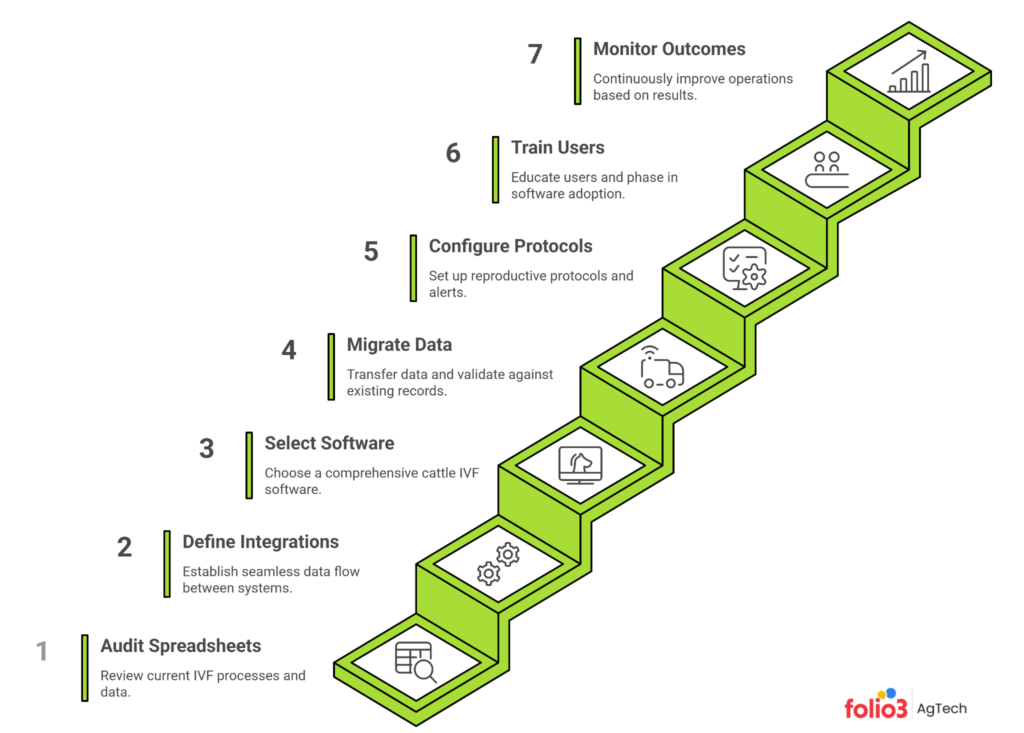
Step 1: Audit Your Current IVF Spreadsheets and Processes
Start by mapping the spreadsheet sprawl. Catalog every IVF-related file, its owner, update cadence, and known problems (duplicates, late updates, complex merges). Quick checklist:
- Who owns each spreadsheet? Who can edit?
- How are updates made and communicated?
- Where have errors occurred that impacted outcomes?
- Which reports require data merges or manual reformatting?
Capture findings in a simple table (sheet name, owner, purpose, pain points, downstream consumers) to visualize risk hot spots.
Step 2: Define System Integrations for Seamless Data Flow
List hardware and software that must connect: RFID/tag readers, scales, cryo tank telemetry, lab devices, herd management, genetics databases, and accounting/ERP. IVF software should read RFID data and auto-link to animal profiles, while integration APIs connect ERP, accounting, cryo telemetry, genetic databases, and lab instruments (IVF cattle software). System integration is the connection of specialized hardware and business applications into a unified platform to reduce duplicate data entry and errors.
Step 3: Select a Comprehensive Cattle IVF Software Platform
Prioritize platforms that cover donor/recipient management, OPU and transfer workflow automation, embryo inventory with chain-of-custody, full audit trails, and documented APIs. Best-in-class solutions support digital OPU logs, technician notes, and embryo tracking from collection to transfer.
Must-have features vs. what they fix:
| Feature | Why it matters | Spreadsheet failure mitigated |
| Unified donor/recipient profiles | Lifetime linkage and health context | Duplicates, ID mismatches |
| OPU/transfer workflow automation | Standardized steps and timestamps | Missed tasks, inconsistent notes |
| Embryo inventory with tank mapping | Real-time counts and location | Lost units, double allocation |
| Full audit trail and reports | Traceable edits and approvals | Version drift, slow audits |
| Open APIs and device integrations | No double entry; live data | Silos, rekeying errors |
| Mobile field apps (offline) | Capture at source, even offline | Late/forgotten entries |
Step 4: Migrate Data and Validate Against Existing Records
Use a phased approach: import herd lists and IDs first, then IVF event data and inventories. Run parallel outputs from both systems on a subset of animals to reconcile counts, dates, and outcomes before go-live. Data validation is the systematic check that migrated records are complete, accurate, and consistent. Many vendors provide hands-on support, Folio3 AgTech offers migration support to move herd data from spreadsheets into the app.
Step 5: Configure Reproductive Protocols and Alerts
Embed your facility protocols—dose schedules, treatment recording, and optimal OPU timing—directly into the system. Best-in-class IVF software schedules and tracks estrous synchronization protocols, while technicians update recipient readiness from the field via mobile apps. Configure alerts for upcoming injections, pregnancy checks, tank inventory thresholds, and overdue lab steps.
Step 6: Train Users and Phase in Software Adoption
Assign clear roles (data owner, technician, lab manager) and start with supervised, real-world events. Short, targeted training sessions build confidence and reduce disruption. Expect some cultural resistance from teams used to spreadsheets; mitigate with quick wins (time saved on protocols), job-relevant training, and responsive vendor support during the first cycles.
Step 7: Monitor Outcomes and Continuously Improve Operations
Use dashboards to track OPU efficiency, embryo yield per donor, timing accuracy, protocol compliance, and audit turnaround time. Modern software provides predictive metrics to refine donor selection, reduce wasted collections, and prove ROI in time saved and improved compliance (IVF cattle software). Review KPIs monthly, run exception reports, and iterate on protocols and training based on findings.
Implementation Considerations and Risk Mitigation
- Connectivity variability: Offline access and hardware integrations matter on farms with limited internet; prefer software with local capture and background sync.
- Data loss risk: Back up spreadsheets, use vendor import tools, and validate on a pilot cohort before cutover.
- Integration gaps: Confirm device and ERP/API compatibility in writing; test with sample data and acceptance criteria.
- User pushback: Involve power users early, set role-based goals, and celebrate measurable wins in audit speed and compliance.
FAQs
How Does Integrated IVF Software Improve Data Accuracy Over Spreadsheets?
Integrated IVF software eliminates version confusion and manual entry errors by centralizing all breeding records in a single database, making data more accurate and audit-ready.
What Types of Hardware Can Be Integrated With Cattle IVF Software?
Modern IVF software platforms can integrate RFID tag readers, weighing devices, cryo tank telemetry, and laboratory equipment to automatically capture and sync relevant data.
How Can Farms With Limited Connectivity Effectively Use Integrated Software?
Leading IVF software solutions offer offline data entry capabilities, allowing farms to collect and store information locally until internet access is available for synchronization.
What Training Approaches Help Staff Transition From Spreadsheets to Digital Systems?
Short, hands-on sessions, clear role assignments, and responsive vendor support make the transition smooth and build staff confidence.
How Does Software Support Compliance With Reproductive Protocols?
The software automates protocol schedules, sends reminders, and captures all treatment events, helping ensure critical steps are followed and compliance rates remain high.