
Computer Vision for Livestock sounds high-tech, but the pain it solves is very practical: you can’t be everywhere at once. Labor is tight, cattle don’t show problems loudly at first, and every missed early signal can turn into higher treatment costs, lost weight gain, or welfare issues you only notice after performance drops. Computer vision turns everyday video into measurable signals, so you can intervene earlier and more consistently.
In this playbook, you’ll learn what computer vision can realistically detect on cattle operations, what to do with those alerts, and how to measure ROI using farm KPIs you already track.
What is Computer Vision for Livestock?
Computer vision is software that learns to “read” images and video the way you and your team do, only it does it continuously and consistently. In practice, computer vision for livestock converts a camera feed into signals you can trend: movement (mobility), posture, bunk visits, time at the feeder, lying time, and body-shape changes tied to condition and growth. It can also support decisions by helping estimate intake, body weight, and gain, body condition score (BCS), health status, and reproductive performance of cattle.
Most systems combine cameras + context. Cameras and sensors can detect and interpret behaviors like walking patterns, social interaction, or an animal spending too long at the feeder or lying down. That always-on visibility can highlight early signals between manual checks as needed.
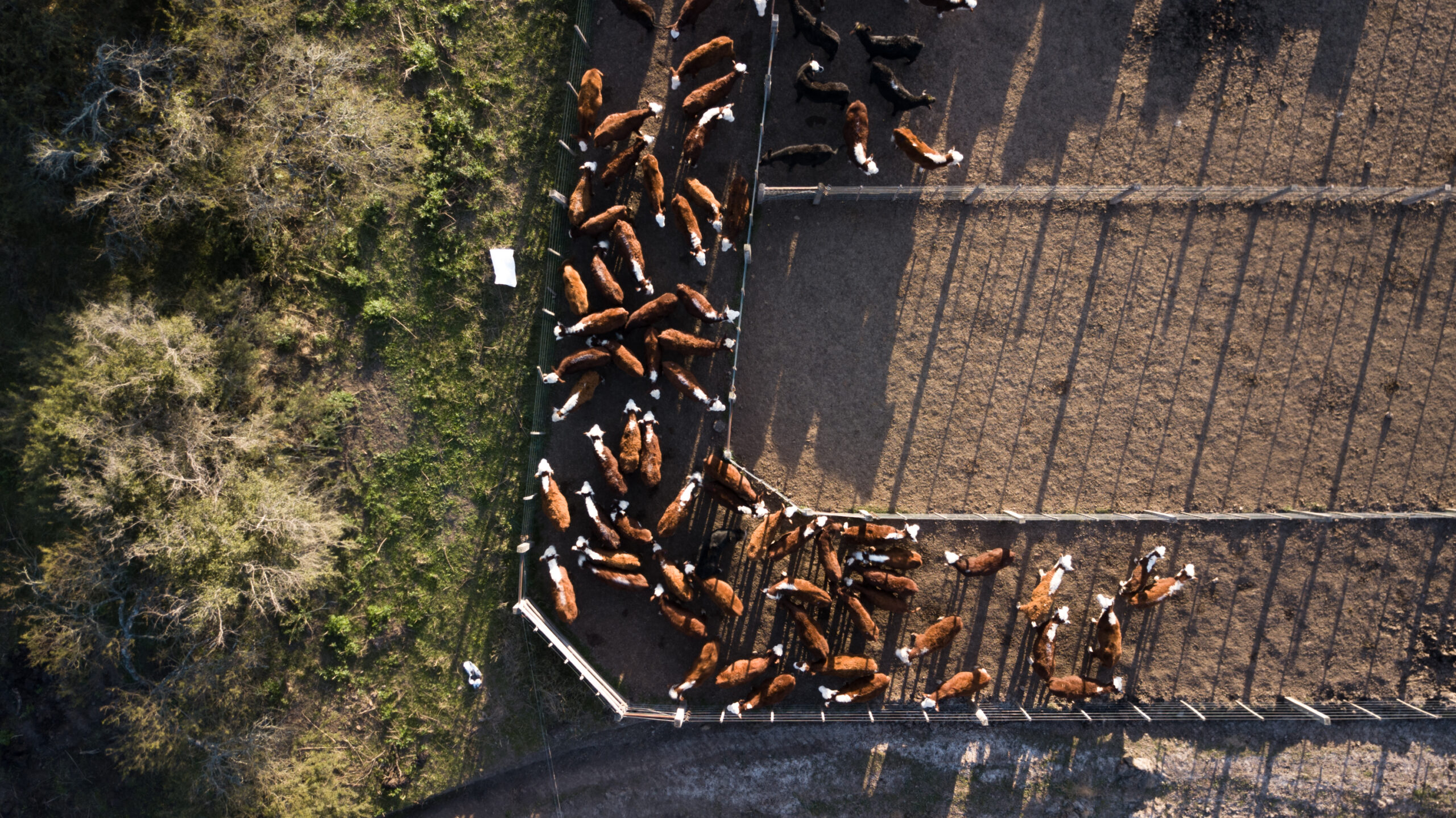
On cattle operations, computer vision for cattle fits best where animals naturally pass or pause. Different operation types for cattle present unique monitoring challenges and opportunities that influence where cameras deliver the most value.
- Pens and barns (group behavior and resting patterns)
- Alleys and chute exits (repeatable mobility and posture views)
- Waterers and bunks (attendance patterns and time-on-feed signals)
- Gates, sorting lanes, and parlors (consistent angles for repeat checks)
The “Inputs → Signals → Decisions” Model
Think of your system as a simple pipeline:
- Inputs: RGB/IR/thermal/depth video, timestamps, and pen context where the camera is, which group it’s watching.
- Signals: Measurable changes like altered gait, reduced bunk time, long lying time, animals isolating from the group, or a gradual BCS shift.
- Decisions: Practical actions such as a daily pull-and-check list, ration adjustments, a pen move to reduce competition, or a cooling intervention during heat stress.
Finally, log actions and outcomes to validate ROI over time. This keeps the tech tied to decisions.
Why Cameras Beat Occasional Human Observation for Early Signals
Even the best stockman is working with “snapshots”: a pen walk, a check at feeding, a look during processing. Cameras don’t replace that judgment; they fill the gaps between those moments. With always-on monitoring, computer vision can flag shifts you may miss in one pass, like a cow spending too long at the feeder, lying too long, or drifting away from the group. It’s non-invasive and doesn’t depend on batteries.
The 3 Outcomes Framework You Gain by Integrating Computer Vision
To make Computer Vision for Livestock pay off, treat it like an operator dashboard, not a science project. Link every alert to one of three outcomes you already manage daily: health, weight gain, and welfare. If done right, it gives you a consistent way to respond.
That’s the point of precision livestock farming computer vision: continuous observation that leads to consistent decisions. Understanding how emerging technologies integrate with traditional animal health protocols and production management practices helps you build systems where computer vision complements the stockmanship.
Use the table below to define what the system should detect, what you will do next, and which KPI proves it’s working.
| Outcome | CV Signal to Watch | Action You Take | KPI to Track |
| Health | Mobility/posture change; isolation; reduced feed/water attendance | Add to pull-and-check list; confirm and treat early | Morbidity rate, pulls per week, treatment cost/head |
| Weight Gain | Reduced bunk time; uneven feeder access; slower body shape | Adjust ration timing; regroup to reduce competition | ADG; feed conversion; days on feed |
| Welfare | Prolonged lying; social stress patterns; heat-stress behavior cues | Improve comfort/cooling; adjust stocking or space | Heat-event counts; injuries; downer/fall incidents |
How Computer Vision is Helping to Improve Animal Health
When you use smart cattle health monitoring with cameras the right way, you are not trying to “diagnose off video.” You are turning daily movement and behavior into early flags so that you can check the right animals sooner, with less guesswork. In cattle systems, computer vision has been documented as supporting estimation and monitoring tied to health status.
Lameness & Mobility
For cattle lameness detection computer vision, the most useful value is visual, not mysterious: the system can flag mobility patterns that look “off” compared to the cow’s normal. One validation across three commercial dairy farms reported over 80% agreement between a top-down vision lameness system and human locomotion scoring.
A practical workflow looks like this:
- Flag: System highlights a mobility change (asymmetry, shorter stride, altered posture).
- Confirm: You or your pen rider validates in-person (and checks footing, claws, swelling).
- Trim/Treat: Corrective action based on your protocol.
- Monitor resolution: The same camera view helps verify whether the gait trend improves.
By understanding the full progression of lameness in cattle, you ensure what to look for during confirmation checks and can make informed trim/treat decisions based on your established protocols.
Respiratory/General Sickness Flags in Feedlot and Barn Conditions
Most “sickness” detection starts with what you already watch, just more consistently. Animals that look dull, separate from the group, spend less time at the bunk, or hold an abnormal posture. Vision systems are also being applied to quantify physiological proxies. One area is respiration rate, which is normally counted visually by watching flank movements.
Research has used computer vision to measure respiration rates in dairy settings, including a noncontact pipeline in a free-stall barn, and it frames respiration as relevant because increased respiration is associated with heat stress and is discussed alongside bovine respiratory disease in calves.
To reduce missed pulls, integrate this into your pull-pen routine:
- Feed your daily pull list with “high-confidence” flags.
- Require a quick confirmation before treatment decisions.
- Track outcomes so you can tune thresholds and keep the system credible with your crew.
Udder/Body Condition Visual Markers
Udder and body-condition signals are where computer vision can be helpful, but you still need clear rules for when video is enough and when you go hands-on. In practice, vision can support conformation-style assessment, and conformation is widely framed as relevant to production performance, health status, and breeding value.
For udder health, computer vision approaches use infrared thermography to detect temperature changes around the udder and eye region for subclinical mastitis screening. However,maintaining optimal udder health requires understanding the full spectrum of factors from milking hygiene to genetic predisposition. So, it means vision-based temperature screening works best as one input alongside conventional mastitis monitoring protocols.
A sensible boundary:
- Trust vision for trends like recurring udder-area changes, consistent BCS drift.
- Go hands-on for confirmation of palpation, quarter checks, strip cup/CMT, and your standard mastitis workflow.
Reproduction & Calving-Adjacent Monitoring
Computer vision has been positioned as supporting reproductive performance monitoring in cattle. However, results depend heavily on your facility layout and how you operationalize alerts.
For example, the value isn’t just “more activity data,” it is capturing what you can actually see. You can see which cow is mounting/jumping and which stands, so heat-related decisions are grounded in observable behavior.
How Computer Vision Improves Weight Gain for Your Cattle
If you prioritize weight gain monitoring cattle, you already know the biggest leak isn’t “lack of data”, it’s lack of consistent, decision-grade signals. Computer vision is a practical tool that can help estimate intake, body weight, and gain, and body condition score (BCS).
Weight Estimation Without Scales
Cattle weight estimation using computer vision works best when you give the system repeatable views. Think of the same “moment” over and over: a gate pass, a walkway, a chute exit, or a consistent pen corner. That repeatability matters because most approaches rely on extracting body measurements (biometrics) and then predicting weight from those measurements.
At a high level, you’ll see two common approaches:
- 2D camera methods: use a side/top view to measure body outlines and area-related features.
- 3D / depth methods: capture depth and volume-related features to improve shape measurements.
Intake Proxies
You don’t need to “measure every bite” to make better decisions for livestock feeding. Computer vision can quantify feeding behavior like visits, visit duration, and time at the bunk, and those patterns can be used to estimate intake. For example, estimating DMI based on predicted feeding time from RGB-D cameras.
What you can operationalize immediately:
- Who shows up consistently vs. who starts missing meals
- Time-on-feed trends like shorter visits, fewer visits, or reduced total feeding time
- Bunk-side crowding patterns you can review in clips when performance drops
BCS as a “Nutrition Reality Check”
Body condition score computer vision is your early warning system for “invisible drift” when cows look fine day-to-day but are slowly losing or gaining condition. Reviews describe automated BCS measurement as a practical direction because BCS trends can be tied to performance and health risk, especially around demanding physiological windows.
Use it as a reality check: if BCS is trending off-target, you adjust nutrition before reproductive efficiency or resilience takes the hit.
How Computer Vision Transforms Livestock Welfare
The strongest case for animal welfare monitoring AI is not “more technology.” It’s continuous, non-invasive monitoring, especially for behaviors that you cannot watch all day. At the same time, credible voices are blunt: reliability still needs proof in real-world conditions, and the economic value must be clear.
Heat Stress & Comfort Signals
Heat stress isn’t just a weather index problem; it’s an animal-response problem. Visual responses like increased respiration rate or panting are observable, but continuous visual monitoring is labor-intensive and subjective, which is why automation is being explored.
Computer vision adds value when it captures what you can see:
- Panting/respiration-related cues when the view supports it
- Clustering, avoidance of certain zones, and stretched-out lying postures as comfort signals
Practical actions: tighten fan/mister timing to the hours cattle actually show stress, improve shade access, and adjust stocking density in the highest-heat pens so cattle can rest and cool effectively.
Lying Time, Rest Patterns, and Crowding Effects
Rest is not “soft.” It impacts performance and resilience, and it’s one of the easiest welfare dimensions to track with video. Video-based analysis is explicitly described as enabling non-invasive, automated quantification of behavior with few sensors. It has been used to detect lying-down and standing-up events from video.
What you do with that: identify pens where cattle rest less, then fix the bottleneck; stall/space layout, footing, or hotspots that keep animals on edge.
Aggression, Mounting, and Social Stress
This is where cattle behavior monitoring AI becomes a management tool. Video can help you validate what’s happening in your highest-pressure areas, like feed bunks, waterers, and narrow lanes where negative interactions often concentrate.
Two evidence-backed applications to lean on:
- Social interactions at the feeding area have been analyzed with computer vision, including the detection of affiliative and agonistic interactions in research settings.
- For reproduction-adjacent behavior, vision’s added value is seeing mounting activity directly, rather than relying only on indirect activity metrics.
What a Farm-Ready CV System Actually Looks Like
Discover what practical hardware, data flow, and alerts look like on a real cattle operation. It helps you separate workable setups from overcomplicated, lab-style solutions.
Cameras
Most AI livestock monitoring setups start with the simplest camera that answers your question.
- RGB is typically used for behavior and movement signals like walking patterns, time at the feeder, and lying/standing events.
- Depth is a better fit when you want body-shape measurements for weight estimation. Weight prediction using both 2D and 3D vision systems relies on depth maps and point clouds, and it strongly depends on consistent camera location and viewing angles.
- Thermal can help when your goal is temperature-related screening, but it adds cost and setup complexity and still needs a transparent workflow to confirm what the camera suggests.
Edge vs Cloud
If you need alerts that drive same-day action, you want analysis close to the barn. Research explicitly points to the future goal of running computer vision on-farm for real-time algorithms, which aligns with an edge approach.
Edge computing is widely described as enabling low-latency response by creating a real-time decision unit near the data source, avoiding delays from sending everything to a remote cloud first.
Use the cloud when you’re doing heavier analytics and when your connectivity is reliable enough to move large video files. In practice, many farms land on a hybrid: edge for real-time flags, cloud for dashboards, and deeper analysis. Purpose-built computer vision systems designed specifically for agricultural environments address these deployment realities by offering configurable processing architecture and integration with existing farm management platforms.
Alerts That Don’t Get Ignored
Alerts fail when they create noise. A farm-ready system uses:
- Thresholds (what counts as “abnormal,” and for how long)
- Confirm steps (who checks, how fast, and what they look for)
- Ownership (one role accountable for closing the loop)
Computer Vision Rollout Plan for Cattle Operations
A step-by-step plan shows how you can pilot, validate, and scale computer vision without disrupting daily routines. It focuses on quick wins, staff adoption, and measurable performance improvements.
Days 0–30: Pick 1 High-Value Use Case + Define “Done.”
Start with one use case that directly reduces labor waste or missed early signals. Common options are mobility flags, bunk-attendance anomalies, or heat-stress behavior cues. Computer vision is often positioned as reducing reliance on manual, subjective monitoring, so keep your scope tight and measurable.
Define “done” in farm terms:
- What the system must detect
- What action follows
- What KPI proves value
Also, lock camera locations that give repeatable views of the gate, alley, and bunk line, and set a simple maintenance routine.
Days 31–60: Pilot, Validate, and Tune
Run the pilot on a limited number of pens and treat it like a controlled test:
- Compare alerts to treatment logs, pull-pen outcomes, and crew observations
- Review false positives and identify why they happened
- Adjust thresholds so alerts represent sustained changes, not one-off moments
Your goal is credibility: an alert should help the crew find the right animal faster, not add a new chore. This is also where you confirm whether you need more edge processing for timelier alerts.
Days 61–90: Scale to More Pens + Lock SOPs
Once you trust the signal, scale in a controlled way:
- Expand to additional pens with the same layout pattern
- Train staff on “alert → confirm → action → log outcome”
- Standardize camera upkeep and weekly performance checks
Note: Document interventions, so you can show operational impact over time, and keep refining the system so it stays useful as conditions change.
Questions to Ask Before You Invest in Computer Vision for Livestock
In livestock operations, computer vision only pays when it changes decisions fast enough to protect performance. A recurring critique in real-world adoption is that the “economic aspect” is often ignored as expensive systems get built, but farms are left asking what they actually deliver.
Before you buy any AI livestock monitoring solution, ask for farm-proof commitments:
- What outcomes do you guarantee in 90 days, and what baseline will you use?
- How do you handle occlusion, lighting, mud/dust, and seasonal shifts that change how cattle look and move?
- Where does inference run, and what still works if connectivity drops?
- What proof do you provide: before/after metrics, validation method, and false-positive rate in conditions like yours?
- Who owns the data, how long is it retained, and how is access controlled, especially when health and production data are involved?
Finally, insist on a written pilot plan: who responds to alerts, how outcomes are logged, and when you’ll review results together.
Limits, Myths, and Failure Modes to Implement Computer Vision
Computer vision for livestock can be powerful, but it also comes with predictable limits. The biggest myth is that cameras solve individual tracking automatically. In practice, reliable identification is still a hard problem at scale. It is described as the “holy grail” for vision systems because farms are messy, animals block each other, and views change constantly.
A second myth is that models trained somewhere else will just work in your facility. Research reviews point to recurring deployment challenges: data quality issues, limited generalization, real-time performance constraints, and the cost and complexity of device deployment. Practitioners also caution that image processing must prove itself under challenging practical conditions, and the economic value cannot be assumed. Emerging sensor technologies and integration approaches are rapidly evolving to address these deployment challenges.
Watch for these common failure modes in cattle health monitoring with cameras:
- Occlusion: feeders, rails, or cattle movement blocking the view can reduce detection accuracy, especially in larger herds and obstructive layouts.
- Lighting and shadows: low-resolution or poor lighting conditions can compromise detection reliability.
- Camera angle drift: bumped mounts or pen redesigns quietly alter the “baseline” view.
- Dirty lenses and dust/mud: small clarity losses can create missed events.
- False-positive fatigue: if alerts are frequently wrong, crews stop trusting the system.
Conclusion
Computer vision for livestock is most valuable when it turns “things you can’t watch all day” into clear, repeatable actions. It includes catching health issues earlier, preventing weight gain, and improving welfare through consistent monitoring.
If you keep the scope tight, demand ROI proof, and build a simple alert→confirm→act workflow, you’ll avoid the trap of paying for dashboards instead of outcomes.
Ready to take action? Let’s connect with our computer vision experts at Agtech to discover a smooth implementation program.
FAQs
Can Computer Vision For Livestock Integrate With Existing Herd Management Or Feedlot Software?
Most modern systems offer APIs or built-in connectors to sync alerts, weights, and health flags with your herd or feedlot software, so camera insights appear directly in the same dashboards you already use.
What Level Of Technical Support And Maintenance Do These Systems Require After Installation?
You’ll need routine camera cleaning, angle checks, and occasional software updates. Good vendors also provide remote monitoring, model tuning, and support to adjust thresholds as seasons, pens, and cattle behavior change.
What Data Privacy And Ownership Concerns Should Livestock Producers Be Aware Of With AI Camera Systems?
You should confirm that you retain ownership of all video and animal data, how long it’s stored, who can access it, and whether it’s used to train external models or shared with third parties.
What Kind Of Internet Connectivity Is Required For Computer Vision Systems On Remote Or Rural Farms?
Many systems can run core detection on-farm using edge devices, sending only summaries to the cloud. Stable but modest bandwidth is usually sufficient, with offline buffering during connectivity gaps.