

A premier, multi-generational purebred cattle breeding and genetics operation headquartered in Montana was running out of room to grow its data the way it had always grown its herd, by instinct and habit. As their registered stock grew to thousands of animals, critical information, including breeding lineage, pasture movements, veterinary treatments, and supply usage, became scattered across pocket notebooks, a legacy genetics program, a whiteboard medicine shed log, and disconnected accounting spreadsheets.
This fragmented architecture created dangerous gaps in traceability, non-compliance risk around mandatory medicine withdrawal periods, and a complete inability to calculate a true, burdened cost per head. The executive team was effectively setting sale prices on premium genetics while flying blind financially.
By implementing Folio3’s ERP for Agriculture, the ranch consolidated its entire livestock lifecycle into a single Record-to-Report ecosystem. The transformation digitized field-level RFID tag scanning, synchronized medical inventory with individual animal records, and accrued lifetime costs directly to the General Ledger, tracking every animal from the moment a calf hit the ground to the day it sold in the ring.
Spring calving season in Montana is a high-stakes operational sprint. At this ranch, hands were working around the clock to assist with births and tag calves, but the data collection process was dangerously fragile. Herderdsman would write the calf’s tag number, birth weight, and the dam’s ID in a pocket notebook. Hours, sometimes days, later, an office manager would manually type those notes into a standalone genetics database. Smudged ink or a transposed number frequently produced lineage mismatches that were nearly impossible to unwind after the fact.
For a business built on registered purebreds, lineage integrity is not a back-office concern; it is the product. Expected Progeny Differences (EPDs) are the primary valuation metric buyers use when purchasing breeding stock. If a calf’s sire is recorded incorrectly, every EPD figure associated with that animal becomes unreliable, and the premium pricing it should command evaporates.
To eliminate manual transcription errors and protect lineage integrity, an Agriculture ERP establishes a Master Animal Database. Field workers utilize ruggedized, offline-capable mobile applications integrated with the ERP. When a calf is born, the herdsman scans the mother’s Electronic Identification (EID) tag and enters the new calf’s data (birth weight, sex, vigor score) directly into the app. The ERP uses Parent-Child Hierarchy Logic to instantly link the calf to its sire and dam, creating an unbroken digital lineage tree. Because the system is centralized, the moment the herdsman syncs his device, the office team sees the new record in the master database, complete with all genetic markers and breeding history, eliminating dual data entry and the lineage errors that came with it. This is the foundation of breeding optimization at scale, where every EPD calculation depends on the integrity of the underlying record.
For operations exploring how advanced reproductive technologies integrate with digital records, our guide on how IVF in cattle breeding works covers the data trail these programs leave. It explains why a centralized ERP is the only system capable of managing it reliably.
As calves grew, they were routinely moved between pastures for rotational grazing, weaning, and eventual sale. Movement tracking, however, lived on a dry-erase board in the main office. If a ranch hand moved a group of fifty heifers to the North Pasture but forgot to update the board, the management team temporarily lost those animals in the inventory, a problem that became acutely visible when prospective buyers visited the ranch expecting to inspect specific animals.
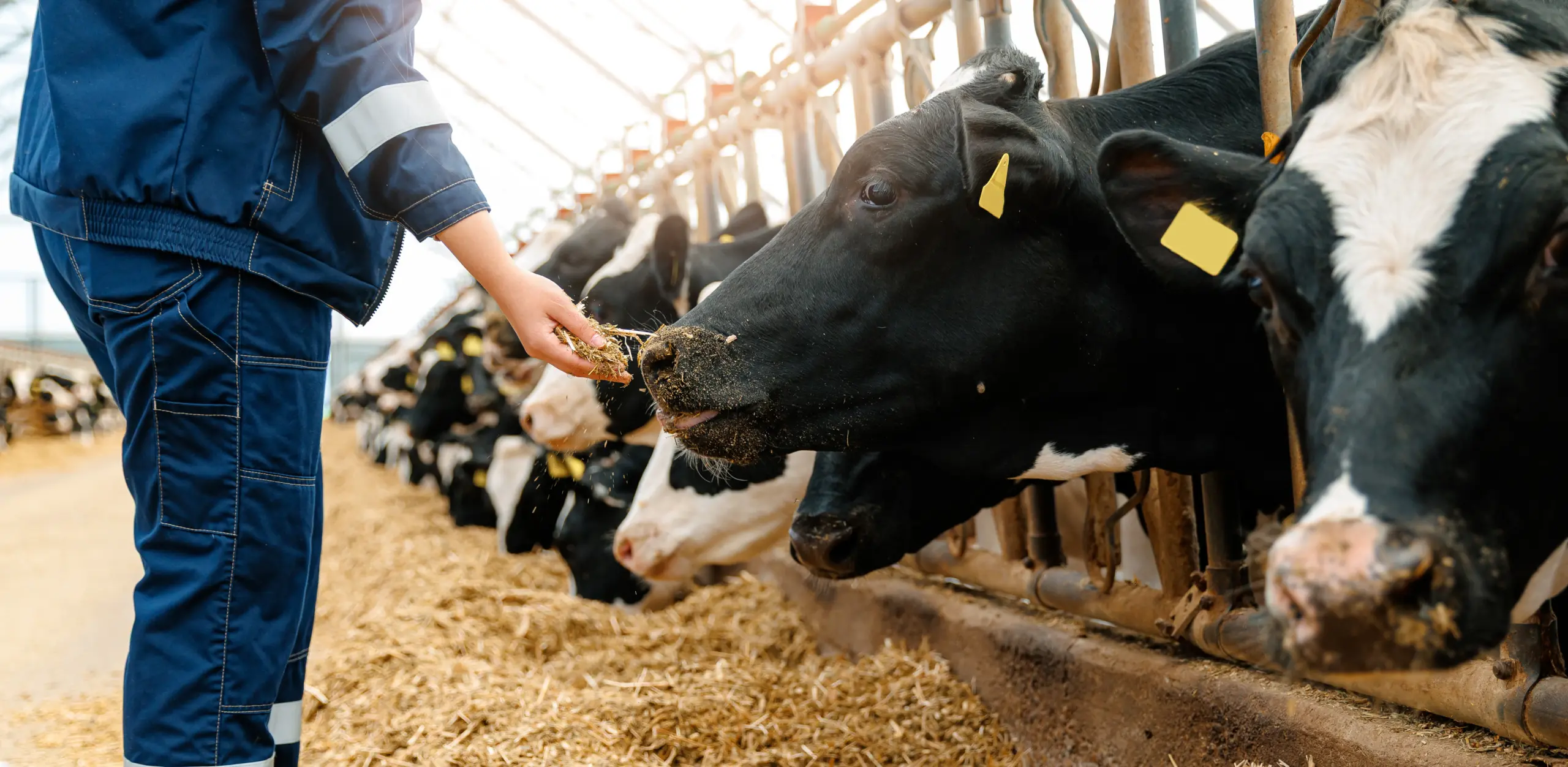
Achieving absolute herd visibility requires RFID/EID Integration and Location Management within the ERP. Every pasture, pen, and holding area is configured in the system as a distinct Warehouse or Bin Location. When animals are moved, they pass through an alleyway equipped with an RFID panel reader. The reader captures the unique EID tag of every passing animal and automatically pushes a Transfer Order to the ERP, moving those specific animal IDs from the South Pasture ledger to the North Pasture ledger. This automation provides a live, 100% accurate pasture map on the manager’s dashboard, detailing exactly how many head, and which specific animals, are currently in any given location.
The most consequential point of failure occurred at the vet chute. When animals received vaccinations, dewormers, or antibiotic treatments, the veterinary crew recorded dosages in a localized spreadsheet. Critically, this spreadsheet was not connected to the main animal database, the medicine inventory, or the financial ledger. Three separate systems held three separate realities, and none of them talked to each other.
The most serious exposure involved FDA Withdrawal Periods, which are the mandatory intervals an animal must remain off-market after receiving certain medications before it can enter the human food supply. In a manual system, this compliance window is tracked by whoever last updated the spreadsheet. When that spreadsheet is siloed from the sales workflow, the gap between a treatment record and a sales invoice becomes a regulatory liability.
The financial exposure compounded the compliance risk. Medicine is one of the most significant variable costs in a breeding operation. Without lot-level inventory tracking tied to individual animal records, the medicine shed count never matched the accounting ledger, a phenomenon sometimes called ghost stock, where the books show inventory that the physical shed no longer contains. For a deeper look at how these gaps accumulate, our overview of 10 essential tips for farm record keeping outlines why disconnected logs are the root cause of both compliance failures and inventory write-offs.
Mitigating compliance risk requires linking Lot-Level Inventory Traceability directly to the Animal Medical Record. Within the unified ERP, the medicine shed is treated as a highly controlled inventory location. When an animal is treated at the chute, its EID tag is scanned alongside the barcode on the medication bottle. The ERP instantly executes three actions:
If the sales team attempts to invoice or transfer that animal before the withdrawal date has passed, the system actively prevents the transaction. This integration is a core component of a properly architected agricultural supply chain management system, where the medication lot number, animal record, and financial deducare tionupdatedpdate in a single transaction.
For operations managing animal health data across multiple locations, our overview of animal health monitoring explains how real-time health records connect to treatment protocols, inventory management, and regulatory compliance within a unified system.
At the end of each fiscal year, the ranch’s CFO faced the same agonizing exercise. To determine profitability on the premier bull crop, he had to pull feed costs from supplier invoices, pasture lease costs from the General Ledger, and veterinary costs from the vet spreadsheet, then attempt to divide those figures by herd count. The result was an average, not an accurate reflection of what any specific animal costs to raise.
In a commodity cattle operation, averages may be acceptable. In a premium genetics business, they are dangerous. The true value of a breeding program lies in identifying which genetic lines are profitable to raise, not just expensive to sell. An average cost obscures that signal entirely. This challenge is well-documented in cattle ranching profitability guides: without individual animal cost accrual, pricing decisions become guesswork dressed up as strategy.
This is also where weak farm bookkeeping and accounting practices carry the heaviest operational cost. Manual reconciliation across disconnected systems not only delays financial visibility (in the ranch’s case, the books closed 3 weeks late every quarter) but it systematically prevents the kind of per-animal cost analysis that separates good ranching decisions from great ones.
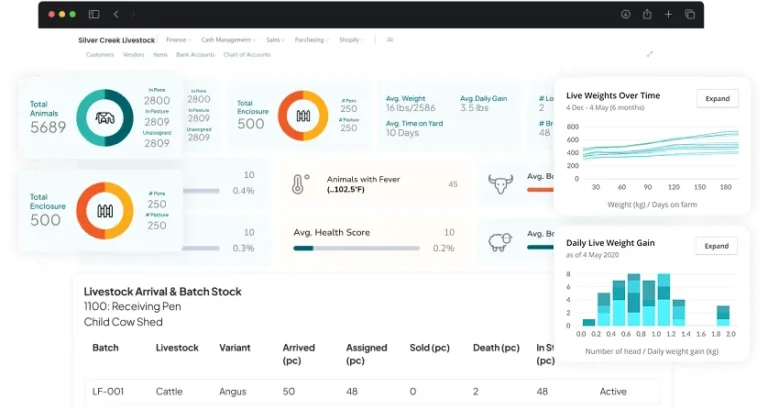
Achieving precise financial visibility requires an ERP architecture that treats every individual animal, or designated lot, as a Cost Center tied directly to a unified General Ledger. Because the ERP integrates all operational data, financial accrual happens automatically: – When an animal receives a vaccination, the exact cost of that dose is added to that animal’s Capitalized Cost. – When supplemental feed is distributed to the North Pasture, the ERP automatically divides the feed cost among the specific EID tags currently grazing there. By the time an animal reaches the sale ring, the CFO has a real-time, fully landed Cost per Head dashboard. This transforms financial strategy, as ownership can now identify which genetic lines are the most profitable to raise, not just the most expensive to sell.
By replacing their fragmented tools with a unified ERP for Livestock, the livestock enterprise achieved unprecedented control over their genetics, operations, and margins:
Area | Outcome |
Traceability & Compliance | 100% individual animal traceability; zero compliance violations or accidental sales during medical withdrawal periods. |
Operational Efficiency | Eliminated 20+ hours per week of manual data transcription between the pasture, vet shed, and main office. |
Inventory Control | Improved veterinary and supply inventory accuracy by 35%, eliminating ghost stock and emergency over-purchasing. |
Financial Precision | Real-time, fully burdened Cost per Head dashboard; books close in 3 days rather than 3 weeks. |
Data Integrity | 100% elimination of breeding lineage reentry errors, protecting EPD accuracy and premium bull pricing. |
See how Folio3’s Agriculture ERP connects breeding records, pasture movements, and financials into a single source of truth, tracking every animal from the calving pen to the sale ring. Explore the platform to understand what a fully integrated livestock operation looks like in practice.
If your operation is still reconciling pocket notebooks with accounting spreadsheets, it’s time to map out a better system. Talk to a Folio3 AgTech Solutions Architect today to build your livestock operations blueprint.
Get a Free Consultation Within 24 Hours, with a No-Obligation Ballpark Estimate
[contact-form-7 id="5196998" title="Intent Popup Form"]