
Every day a cow doesn’t calve when expected is a day of added labor, wasted resources, and unnecessary stress on both you and your herd. If you’ve ever relied on a static gestation chart pinned to the barn wall, you know the problem: those charts assume every cow carries for exactly 283 days. Reality tells a different story.
Gestation length in cattle ranges from 279 to 287 days for most breeds, and Bos indicus breeds like Brahman can carry up to 292 days. That’s a potential 13-day swing that a one-size-fits-all chart simply can’t account for. Our interactive cow gestation calculator eliminates the guesswork, giving both beef and dairy operations a reliable, breed-adjusted due date you can actually plan around. Whether you run a 50-head cow-calf outfit or a 500-head dairy, accurate calving predictions start here.
How to Use the Gestation Period of a Cow Calculator
Using this gestation period of a cow calculator is as straightforward as it gets. You need two pieces of information: the date of service (the day your cow was bred or artificially inseminated) and the average gestation length for your breed.
Here’s how it works:
1. Enter the Date of Service: Input the exact date your cow was exposed to the bull or received AI. If she was pasture-bred and you only have a range, use the first day of bull exposure as your starting point.
2. Select or Adjust Gestation Length: The calculator defaults to the industry-standard 283 days, which works for most Bos taurus breeds. However, you can manually adjust this number based on breed-specific averages. Running Jerseys? Dial it down to 278 days. Got Brahmans? Bump it up to 291.
3. Get Your Estimated Due Date: The cow gestation period calculator instantly returns a projected calving date, along with a recommended “watch window” starting 5–7 days before the due date.
Note: If you know the sex of the calf from an ultrasound, add 1–2 days for bull calves. If you’re working with first-calf heifers, remember their gestation can run slightly shorter than that of mature cows in the same herd.
How Long is a Cow Actually Pregnant?
The short answer is roughly 283 days. But if you’re relying on that single number without understanding the biological range behind it, you’re setting yourself up for surprises during calving season.
Meanwhile, gestation length in cattle varies by breed and sex of the calf, typically falling between 279 and 287 days. For Bos indicus cattle, published data recorded a mean gestation of 292.8 days in Brahman cattle. That’s nearly 10 days longer than a Holstein, a gap that can wreck your calving schedule if you’re not accounting for it in your cow gestation calculator.
Factors That Influence Gestation Length
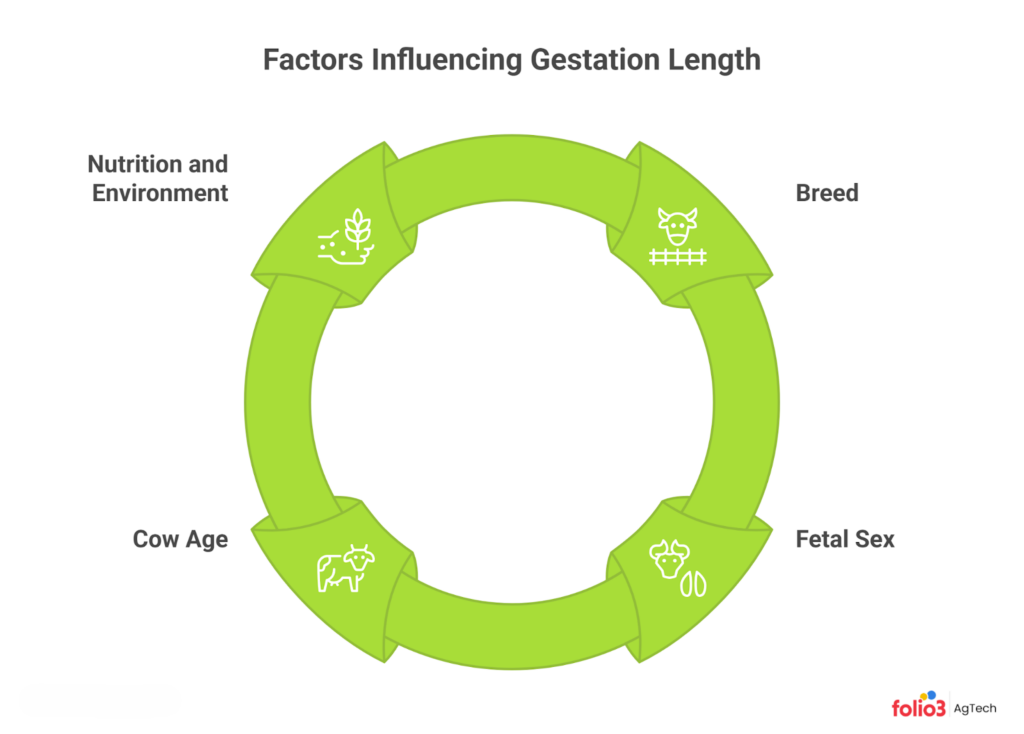
Understanding these variables transforms a basic cow gestation calculator from a nice-to-have into a must-have planning tool.
- Breed is the single biggest variable. Holstein-Friesians average 279 days, while Aberdeen Angus average 283 days, and Blonde d’Aquitaine can stretch to 294 days. If you’re crossbreeding, your cow’s due date lands somewhere between the two parent breed averages, making a gestation calculator for cows with adjustable settings essential.
- Fetal Sex also plays a measurable role. Bull calves tend to be carried longer than heifer calves, with the difference typically being 1–2 days. Research using Irish dairy herd data confirmed that gestation length was 1.27 days longer for bull calves compared to heifer calves.
- Cow Age matters more than most producers realize. First-calf heifers often have slightly shorter gestations compared to mature cows in the same herd. Conversely, older and larger cows tend to calve a few days later. That’s why experienced ranchers adjust their watch schedules based on the age and parity of each female.
- Nutrition and Environment round out the picture. Cows in poor body condition or under heat stress can experience altered gestation timing. Maintaining a body condition score of at least 5 (on a 1–9 scale) heading into the third trimester helps keep things on track.
Choosing the Right Gestation Settings for Beef vs. Dairy Cattle
The way you use a gestation calculator depends heavily on whether you’re running a beef or dairy operation. The end goals are fundamentally different, and your calculator settings should reflect that.
Beef Sector: Tight Calving Windows
For cow-calf producers, calving season uniformity is everything. Research highlights that ideally, 60% of a herd should calve within the first 21-day period to maximize calf crop uniformity and weaning weights. A beef cow gestation calculator helps you map backward from your target calving start date to determine exactly when bulls should go in and when they should come out.
Tight calving windows give you uniform calf crops for batch marketing, concentrated labor needs (no checking heifers in July and October), and better nutritional management since all cows are at similar stages of production.
Dairy Sector: Dry-Off Dates and Transition Nutrition
Dairy producers have a different priority. Your dairy cow gestation calculator isn’t just about predicting when the calf arrives, it’s about back-calculating the dry-off date and planning transition cow nutrition. Most dairy cows need a 60-day dry period before calving. If you don’t nail the due date, you risk either drying off too early (lost milk revenue) or too late (insufficient mammary recovery).
Average Gestation Length by Breed:
| Breed | Average Gestation | Primary Sector |
| Holstein | 279 Days | Dairy |
| Jersey | 278 Days | Dairy |
| Angus | 281 Days | Beef |
| Hereford | 285 Days | Beef |
| Simmental | 285 Days | Beef |
| Brahman | 291 Days | Beef |
Notice the 13-day gap between Jersey and Brahman. If your operation runs multiple breeds like Angus cows bred to Simmental bulls, a one-number calculator simply won’t cut it. You need a tool that lets you adjust for these differences, and ideally,livestock breeding software that stores breed-specific defaults alongside each cow’s record.
Why You Need a Gestation Cow Calculator for Modern Herd Management
A gestation cow calculator isn’t just a calving date predictor. When used correctly, it becomes the backbone of your entire late-pregnancy management system. Here’s how it connects to the three pillars of pre-calving preparedness.
Nutrition Planning
The third trimester is when roughly 75% of fetal growth occurs, meaning your cow’s energy and protein demands spike dramatically in the final 60–90 days. Without an accurate due date, you’re either overfeeding cows that aren’t close yet or underfeeding cows that are about to calve.
A reliable calving date lets you sort cows into the right feeding group at the right time and adjust rations precisely for each production stage. For beef cows, it means increasing protein in the last 45 days. For dairy cows, it means managing the critical transition diet to prevent metabolic disorders like ketosis and milk fever.
Labor Allocation
Calving season is all hands on deck, but you can’t run a 24/7 heifer watch for three straight months. Knowing when each cow is due lets you schedule your crew efficiently. You focus your night checks on animals within 7 days of their projected date, saving labor hours on cows that aren’t due for another three weeks.
It is especially critical for first-calf heifers, where stage 2 labor lasts roughly 60 minutes compared to 30 minutes for mature cows. As a result, timely intervention can mean the difference between a live calf and a loss.
Vaccination Windows
Pre-calving vaccines, particularly scour shots, need to be administered at a precise window, usually 3–6 weeks before calving to ensure adequate antibody levels in colostrum. If your due date is off by even a week, you risk vaccinating too early or too late.
The same applies to pre-calving mineral and vitamin programs. Accurate gestation tracking through livestock farm management tools ensures every cow gets the right shot at the right time.
From Manual Calculations to Automated Tracking: The Folio3 Advantage
Let’s be honest, most ranchers start with a pocket calendar and a pencil. You jot down the breeding date, count forward 283 days, and circle the due date. It works fine when you’re tracking 10 cows. But when you scale to 50, 200, or 500 head, that back-of-the-napkin math becomes a liability.
Paper records get lost. Dates get transposed. The notebook that had your AI dates in it? It went through the wash last Tuesday. And when calving season hits, you’re left scrambling to figure out which cows are due this week versus next month.
That’s where Folio3 AgTech’s livestock management software changes the game. When you enter an AI date or record a bull-in date through the app, the system automatically calculates the estimated due date for every cow in your herd, adjusted for breed-specific gestation averages. No manual math. No lost notebooks.
The platform also integrates with your existing workflow. Whether you’re recording data chute-side on a mobile device or syncing RFID tags during processing, the system captures everything in real time, no double entry, no transcription errors.
Future-Proof Your Calving Season
The days of guessing when cows will calve are behind us. A reliable cow gestation calculator gives you the foundation, but truly data-driven ranching demands more; automated alerts, breed-adjusted defaults, and herd-wide tracking that scales with your operation. Every calving season teaches you something new about your herd, but only if you’re capturing and using that data.
Don’t just calculate, manage. Consult with our Agtech experts today to discover how Folio3 AgTech turns raw breeding dates into a fully optimized calving season.
FAQs
What Is The Shortest A Cow Can Carry A Calf And It Survives?
Calves born before approximately 260 days of gestation rarely survive without intensive neonatal care. Viability generally improves significantly after 270 days, though premature calves may still be weak and require colostrum supplementation and extra monitoring. If a cow shows signs of premature labor, contact your veterinarian immediately and prepare a warm, dry environment for the calf.
How Do I Calculate The Dry-Off Date For A Dairy Cow?
Take the projected calving date from your cow gestation calculator and subtract 60 days. That gives you the target dry-off date. For example, if a Holstein is due on March 15, her dry-off date would be around January 14. Some operations use a 45-day dry period for high-producing cows, but 60 days remains the standard recommendation for optimal mammary tissue regeneration.
Can I Use The Same Calculator For Twins?
You can, but build in a buffer. Twin pregnancies in cattle typically result in calving 4–5 days earlier than single births, with some arriving up to 8–10 days early. If ultrasound confirms twins, subtract 5–7 days from the standard calculated due date and start your watch window earlier.