
If you’ve been counting calendar days to predict when your corn will tassel or reach maturity, you’re relying on a system that makes weather unreliable every season. Two fields planted on the same date can develop at wildly different rates depending on temperatures. The real driver of corn development isn’t the calendar; it’s accumulated heat.
Growing degree units (GDUs), also called growing degree days (GDDs) or heat units, measure the daily accumulation of warmth that corn needs to advance through each growth stage. Imagine tracking your field’s accumulated GDUs and predicting tasseling within a few days, not weeks, of accuracy. That’s the advantage heat-unit tracking gives you.
Throughout this guide, you’ll learn how to calculate corn growing degree days, map each growth stage to GDU milestones, and apply this data to planting, irrigation, nutrient management, and harvest planning.
Whether you’re a first-generation grower or a seasoned producer, mastering GDUs will sharpen every decision you make across the season.
Understanding GDUs and GDDs
Growing degree days are a measurement of heat accumulation used to predict plant development. Every crop has a base temperature below which meaningful growth stops. For corn, that base is 50 °F (10 °C). Growth also slows above 86 °F (30 °C), so temperatures beyond that threshold provide no additional developmental benefit.
You’ll often hear “Growing Degree Units” and “Growing Degree Days” used interchangeably for corn. Some seed companies and agronomists prefer one term over the other, but the underlying concept is the same: both quantify the thermal energy a crop accumulates each day.
Seed companies began rating hybrid maturity by GDD rather than calendar days because a corn hybrid requires a specific number of GDD to reach maturity. It’s a number that is independent of the total number of growing days, and it makes the GDD method more reliable across variable climates and planting dates.
The 86/50 Corn System and Temperature Thresholds
The corn GDD calculation most commonly used in the United States is the 86/50 cutoff method. Here’s how it works:
- Upper cap: If the daily high exceeds 86 °F, you replace it with 86 °F in the formula.
- Lower cap: If the daily low drops below 50 °F, you replace it with 50 °F.
These caps exist because corn growth is effectively zero below 50 °F and does not increase above 86 °F. You may also encounter the terms “crop heat units” or simply “heat units,” which refer to the same concept.
Why Use Heat Units Instead of Calendar Days?
Because the weather varies from year to year, simply counting calendar days from planting is unreliable. Two hybrids marketed as “95-day” and “100-day” maturities can both require roughly 2,400 GDUs to reach black layer. That means a warm spring can compress development, and a cool summer can stretch it, but the total GDU requirement stays constant.
Consider a practical example. A central Iowa field planted May 1 in a warm year may accumulate 2,400 GDUs by mid-September, pushing that hybrid to maturity. The same hybrid planted on the same date during a cool year might not hit 2,400 GDUs until early October, delaying harvest by two to three weeks. Calendar days said both crops were at “100 days” in mid-August, but only GDUs told the real story.
How to Calculate GDUs for Corn?
Calculating growing degree days for corn is straightforward once you know the formula. You need only two daily weather readings: the maximum temperature and the minimum temperature.
Get your local temperature data from on-farm weather stations, regional networks, or a reliable weather service. If you use precision agriculture technology with integrated sensors, daily high and low readings may already be logged for you.
The Calculation Formula
GDU = [(Tmax + Tmin) / 2] – 50
Before plugging numbers into the formula, apply the temperature caps. Replace any maximum above 86 °F with 86, and any minimum below 50 °F with 50.
Working example: Daily high = 80 °F, daily low = 56 °F. Average = (80 + 56) / 2 = 68 °F. GDU = 68 – 50 = 18 GDUs for that day.
Capped example: Daily high = 94 °F (cap to 86), daily low = 48 °F (cap to 50). Average = (86 + 50) / 2 = 68 °F. GDU = 68 – 50 = 18 GDUs.
Accumulating GDUs and Interpreting the Numbers
Daily GDUs are summed starting from the day after planting. This cumulative total tells you how quickly your crop is progressing and which growth stage it has likely reached.
Some seed companies rate maturity from emergence rather than planting. Emergence typically requires 100–150 GDDs, so when comparing hybrid ratings, always check whether the number is calculated from planting or emergence and adjust accordingly.
The table below shows how different temperature scenarios translate to daily GDU values.
| Scenario | High (°F) | Low (°F) | Daily GDU |
| Cold day | 51 | 29 → 50* | 0.5 |
| Moderate day | 76 | 40 → 50* | 13 |
| Hot day | 94 → 86* | 67 | 26.5 |
*Temperature capped per the 86/50 method.
3. Corn Growth Stages and GDU Requirements
Knowing the GDU milestone for each growth stage lets you anticipate what your crop needs next. This section maps vegetative and reproductive stages to approximate GDU accumulations with management insights at each phase.
1. Emergence and Early Vegetative Stages (VE to V4)
Seed germination begins when soil temperatures rise above 50 °F. Radicle growth initiates first, and germination generally requires 65–80 GDUs. However, soil conditions such as residue cover, moisture levels, and planting depth can extend this period.
VE — Emergence: The coleoptile pushes above the soil surface once roughly 100–120 GDUs have accumulated after planting. Cool or crusted soils can delay emergence and cause variable plant sizes, reducing stand uniformity. If you’re managing fields with heavy residue, consider monitoring soil temperature alongside air temperature to get a more accurate picture.
V1 (first leaf collar): Occurs about 3–4 days after emergence, around 200 GDUs. The first leaf has a distinctive, rounded tip. Seminal roots still feed the plant, and weed control is critical at this stage.
V2 to V4: Additional leaves appear every few days. V2 arrives around 200 GDUs; V3 around 350 GDUs; V4 roughly 360 GDUs. The nodal root system begins developing, and stress from cold, herbicide injury, or soil crusting can damage the coleoptile and reduce your stand.
Management tip: Maintain seed-zone moisture, minimize surface residue interference, and monitor soil temperature closely to ensure uniform emergence.
2. Mid-Vegetative Stages (V5 to V10)
V5–V6: By V5, the plant stands about 8–12 inches tall, and the growing point moves above the soil surface. Around 475 GDUs are needed to reach V6. Tassel initiation and ear-shoot initiation occur during this window, and plants become susceptible to hail and frost once the growing point is exposed.
V7–V9: Rapid stem elongation occurs, and brace roots start forming at the nodes. Eight fully expanded leaves are typically visible around 610 GDUs. The number of kernel rows on the ear is determined around V7—stress at this stage can permanently reduce row count.
V10: Approximately 740 GDUs. The stalk elongates rapidly, and tassel growth begins. New leaves emerge every 2–3 days, and nutrient demand ramps up.
Management tip: Complete weed control before V5–V6. Ensure adequate nitrogen and phosphorus to support rapid vegetative growth, and avoid mechanical or chemical injury when the growing point is above ground. Tools like integrated pest management software can help you time herbicide applications precisely.
3. Late Vegetative Stages (V11 to VT)
V11–V15: Leaves continue appearing every 2–3 days. By V12, the corn plant has accumulated close to 10% of its total dry matter. Kernel rows per ear and kernels per row are largely determined between V12 and V16. Drought or nutrient stress during this period can permanently reduce your yield potential.
V17+: At roughly 1,300 GDUs, the plant nears tasseling and becomes highly sensitive to hail or moisture stress. If you have access to crop irrigation systems, now is the time to confirm your water supply is reliable through tasseling.
VT — Tasseling: Tassels emerge 2–3 days before silks. Pollen shed lasts roughly 4–6 days for an individual tassel, and by this stage, the plant has taken up about 65% of its nitrogen, 50% of its phosphorus, and 85% of its potassium. Greensnap and lodging risk increase during this rapid-growth phase.
Reproductive Stages (R1 to R6)
R1 — Silking (~1,500 GDUs): Silks emerge, and each one must receive pollen to develop a kernel. Moisture stress during silking can dramatically reduce kernel set and yield. Extreme dry heat reduces U.S. corn yields primarily through moisture stress rather than direct thermal damage. Ensuring adequate water supply at R1 is one of the highest-return investments you can make.
R2 — Blister (~1,700 GDUs): 10–14 days after silking. Kernels appear white and blister-like, filled with clear fluid. Starch begins accumulating.
R3 — Milk (~1,875 GDUs): About 20 days after silking. Kernels turn yellow and contain a milky white fluid. Rapid dry-matter accumulation begins.
R4 — Dough (~1,950 GDUs): 26–30 days after silking. Kernels have a doughy consistency with roughly 70% moisture. Approximately half of the kernel’s final dry weight has accumulated.
R5 — Dent (~2,300 GDUs): 38–42 days after silking. Kernels dent at the crown, moisture drops to 55–60%, and the “milk line” becomes visible on the kernel.
R6 — Black Layer / Physiological Maturity (~2,700 GDUs): 55–65 days after silking. A black layer forms at the kernel base, signaling that dry-matter accumulation has ceased. Kernel moisture is around 30–35%. Yield is now determined; field drying or mechanical drying is all that remains.
Management tip: During reproductive stages, maintain water and nutrient supply to maximize grain fill. Be cautious with late-season nitrogen because uptake is nearly complete by tasseling. Monitor for ear-feeding insects and diseases such as gray leaf spot.
3.5 Corn Growth Stages and Approximate GDUs: Quick-Reference Table
| Growth Stage | Approx. GDU Range | Key Developmental Events |
| Germination | 65–80 | Radicle emerges; seed absorbs moisture and swells |
| VE (Emergence) | 100–120 | Coleoptile breaks soil surface; photosynthesis begins |
| V1 | ~200 | First leaf collar visible (rounded tip); seminal roots active |
| V3 | ~350 | Three leaf collars; nodal root system developing |
| V6 | ~475 | Growing point above soil; tassel and ear shoots initiated |
| V9 | ~610 | Eight expanded leaves; brace roots forming; rapid growth |
| V10 | ~740 | Stalk elongation accelerates; tassel growth starts |
| VT (Tassel) | ~1,350 | Tassels fully emerged; pollen shed begins; 65% N uptake |
| R1 (Silk) | ~1,500 | Silks visible; pollination; critical water-demand period |
| R2 (Blister) | ~1,700 | White, blister-like kernels; starch accumulation starts |
| R3 (Milk) | ~1,875 | Yellow kernels; milky fluid; rapid dry-matter gain |
| R4 (Dough) | ~1,950 | Doughy kernels; ~50% dry weight accumulated |
| R5 (Dent) | ~2,300 | Kernel denting; milk line visible; 55–60% moisture |
| R6 (Black Layer) | ~2,700 | Physiological maturity; black layer forms; yield set |
Note: GDU values are approximate and vary by hybrid, region, and environmental conditions.
Factors That Modify GDU Requirements
GDU benchmarks are useful guides, but real-world conditions can shift requirements up or down. Understanding these factors helps you interpret GDU data with field-level accuracy.
Management and Environmental Adjustments
Residue, soil texture, planting date, and tillage practices can all alter how many GDUs your corn needs to emerge. Research from the University of Nebraska–Lincoln highlights the following adjustments:
- Heavy residue: May add 5–50 GDUs to emergence by insulating the soil and keeping it cooler.
- Fine-textured soils: Add 30–60 GDUs because they warm more slowly.
- Coarse soils: Subtract 30–60 GDUs because they warm faster.
- Late planting (after May 15): Can subtract 50–70 GDUs from the emergence requirement due to warmer soils.
- Deeper planting: Each additional inch below 2 inches may add ~15 GDUs.
If your hybrid’s maturity rating is measured from emergence to black layer, remember to add 100–150 GDDs when calculating from planting.
Soil Temperature and Moisture
Soil temperature lags behind air temperature, especially early in the season. Cool soils can delay emergence even when air-based GDUs appear adequate. That’s why checking soil temperature at seeding depth, ideally 2 inches, gives you a more reliable planting signal.
Waterlogged or extremely dry soils also delay emergence and stunt early root growth. Maintaining proper seed-zone moisture through good drainage and timely irrigation management is critical during the first 120 GDUs after planting.
Hybrid Genetics and Regional Differences
Hybrids vary widely in total GDU requirement. Seed-company product guides include GDU ratings for each hybrid, and a general rule of thumb is that each one-day increase in relative maturity adds approximately 22 GDDs to the requirement.
Region matters too. Pennsylvania hybrids typically mature with roughly 200 fewer GDUs than comparable Midwestern hybrids, reflecting shorter growing seasons and cooler average temperatures. Long-season hybrids accumulate more GDDs and therefore need a longer frost-free window.
Impact of Stress and Climate Variability
Prolonged temperatures below 50 °F halt GDU accumulation entirely, delaying vegetative development and extending the time your crop occupies the field. On the other hand, sustained temperatures above 95 °F reduce photosynthesis, accelerate development, and shorten the grain-fill period, potentially lowering yield.
Corn yields show a consistent negative response to the accumulation of temperatures above 86 °F (30 °C). Integrating GDU data with real-time weather forecasts helps you prepare for frost risk in spring and heat-stress windows in summer.
How to Apply GDUs in Crop Management
GDU data becomes truly valuable when you use it to drive decisions across the growing season. Here’s how to apply heat-unit tracking to six core management areas:
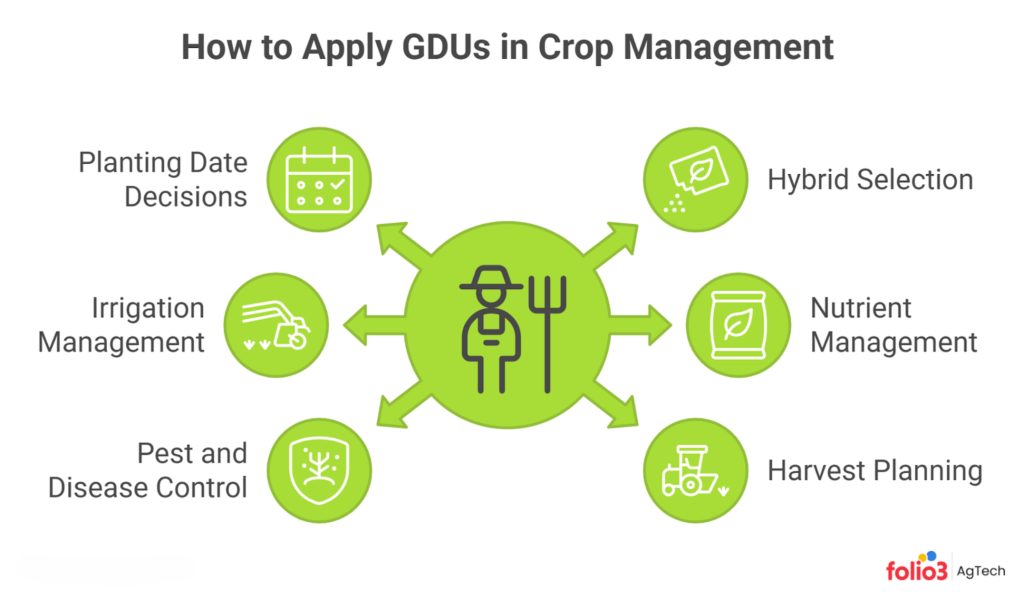
1. Planting Date Decisions
Historical GDU accumulation data, often available as 30-year normals from climate centers, helps you choose the optimal planting window for your region. By matching your hybrid’s GDU requirement against the typical accumulation from your target planting date to the first fall frost, you can assess whether a hybrid will reach maturity safely.
Early planting often leads to higher yields because the crop captures more total GDUs. However, it requires careful monitoring of soil temperatures to avoid cold-soil emergence delays. Late planting reduces total GDU accumulation and can shorten grain fill, though research suggests a degree of “growing degree compression” can partially offset delayed starts.
2. Hybrid Selection and Maturity Rating
Select hybrids whose GDU requirement matches your local growing-season length. A 95-day hybrid generally needs 2,350–2,400 GDDs from planting to maturity. Always verify whether the seed company rates maturity from emergence or planting; the difference can be 100–150 GDDs.
Diversifying maturities by planting both mid-season and full-season hybrids spreads risk across pollination windows and harvest dates. This strategy protects you if a heat wave or drought strikes during a narrow window.
3. Irrigation and Water Management
GDU milestones tell you exactly when your corn’s water demand spikes. Ensure moisture availability during VE–V6 for stand establishment, and again during silking and grain fill when water stress causes the steepest yield losses.
High temperatures increase evapotranspiration and water demand. So, pairing GDU tracking with smart irrigation scheduling based on soil-moisture sensors and weather data lets you apply water precisely when and where it’s needed.
4. Nutrient Management
Corn’s nutrient uptake follows a predictable curve tied to GDU milestones. By tasseling (VT), the plant has absorbed roughly 65% of its total nitrogen, 50% of its phosphorus, and 85% of its potassium. It means the bulk of your nitrogen must be available before V10.
Consider side-dressing nitrogen before V6 and top-dressing additional nitrogen (if needed) before V10 to supply remaining needs. Late-season nitrogen applications after R1 provide minimal yield benefit and are generally not cost-effective. For more on precision nutrient strategies, explore how precision fertilization for crop growth can optimize your input costs.
5. Pest, Disease, and Weed Management
Many pests and diseases are temperature-dependent, making GDU data a powerful scouting aid. For example, black cutworm moth flights and subsequent larval feeding often align with early GDU accumulations, helping you time scouting and treatment.
Early-season weeds should be controlled before V5 to avoid yield-robbing competition. Fungicide applications are most effective when timed around tasseling, especially if disease pressure from gray leaf spot or northern corn leaf blight is high. An integrated pest management approach that aligns interventions with GDU milestones is far more efficient than calendar-based spraying. You can learn more about common crop diseases and how to prevent them to pair your GDU tracking with effective disease management.
6. Harvest Planning and Yield Forecasting
Monitoring accumulated GDUs from planting to R6 lets you estimate harvest dates well in advance. If your hybrid needs 2,700 GDUs to reach black layer and you’ve accumulated 2,200 by late August, you can project the remaining days by dividing the deficit by the average daily GDU for your location.
Comparing your current season’s GDU accumulation against 30-year normals reveals whether the crop is ahead or behind schedule, enabling you to coordinate labor, equipment, grain drying, and even market timing. Using a harvest management platform that integrates GDU tracking with yield forecasting and logistics planning automates much of this analysis for you.
Tools and Technologies for Tracking GDUs
You can track GDUs with a notebook and thermometer, or with sophisticated digital platforms. Here’s a rundown of options from low-tech to fully integrated solutions.
Low-Tech Calculation
The simplest method is recording daily high and low temperatures and computing GDU by hand. It’s free, requires no technology, and works perfectly for small operations. Keep a running total from planting day onward, and reference the growth-stage table above to estimate where your crop stands.
Online Calculators and Mobile Apps
Several free tools automate GDU tracking and let you enter a planting date and location, then project accumulated and expected GDUs based on 30-year climate normals. These calculators are excellent starting points. Many allow you to input multiple planting dates, hybrid GDU requirements, and even predict maturity windows.
Integrated AgTech Solutions
For operations that want GDU tracking embedded within a complete farm-management workflow, platforms like Folio3’s crop management software integrate heat-unit calculations with field-level data from soil-moisture sensors, satellite imagery, and weather feeds. These systems can trigger automated alerts when your crop approaches critical growth stages, deliver nutrient recommendations timed to GDU milestones, and connect GDU data to harvest logistics.
Digital tools reduce manual workload, improve accuracy, and integrate with agronomy management software that ties scouting, inputs, and performance tracking into a single platform. The payoff is less guesswork and a faster response to changing field conditions.
Conclusion and Next Steps
Tracking growing degree units transforms corn management from guesswork into data-driven precision. Here’s a recap and your action plan going forward.
Growing degree units and growing degree days give you a reliable, weather-adjusted framework for predicting corn growth stages, planning management actions, and maximizing yield. From choosing the right hybrid and planting date to timing irrigation, fertilization, pest control, and harvest, GDU data sharpens every decision across the season.
Integrating heat-unit tracking with modern AgTech solutions takes this a step further by automating calculations, connecting GDU milestones with field-level data, and delivering actionable alerts directly to your phone or dashboard.
Your next steps: Start tracking GDUs this season using the formula and table above. If you’re ready to integrate GDU tracking into a complete digital crop-management workflow, reach out to Folio3 AgTech to see how our platform can work for your operation.
FAQs
How Many GDUs Does Corn Need To Emerge?
Most hybrids require 90–125 GDUs from planting to emergence, though conditions like heavy residue, shallow moisture, or deep planting can push that higher. Expect around 100–120 GDUs under normal conditions.
How Many Growing Degree Days Does Corn Need To Mature?
A typical hybrid needs approximately 2,400–2,700 GDUs from planting to physiological maturity (R6 / black layer), depending on its relative maturity rating and whether the rating is from planting or emergence.
What Happens If Temperatures Drop Below 50 ° F?
GDUs stop accumulating. The corn plant essentially pauses its development. Prolonged cold delays germination and root growth, and extended periods near or below freezing can cause tissue damage.
Can GDUs Predict Exact Harvest Dates?
GDUs provide a strong estimate, but they aren’t a crystal ball. Field scouting, kernel milk-line progression, and local weather conditions should always confirm maturity before you schedule harvest.
How Do I Choose A Hybrid Based On GDUs?
Match the hybrid’s GDU requirement to your local growing-season length. Check historical GDU accumulation for your area, subtract a 10-day buffer before the average first fall frost for grain dry-down, and select hybrids that fit within that window. Always confirm whether the seed company rating is from planting or emergence.