

If you’re searching for key considerations for adopting AI in agriculture, you’re already past the hype, and that’s where smart decisions happen. While understanding AI capabilities and use cases in agriculture provides essential context, this guide focuses on the operational readiness and governance decisions that determine whether those capabilities deliver value on your farm.
It’s a decision-grade readiness framework you can use before you commit a budget, share operational data, and ask teams to change field and office workflows.
In practice, AI adoption in agriculture often rises or falls on data governance, interoperability, and clear accountability, not just algorithms.
This framework is written for:
- Farm owners/CEOs who approve investment
- Farm managers/ops leads who protect uptime
- Ag-investors and Agtech founders who need scalable, defensible adoption plans
You’ll leave with the questions to ask, the evidence to request, and the red flags to watch first.
Adoption vs. Implementation: What “Adopting AI” Actually Means on a Farm
On a farm, adopting AI in farming is not the same as “installing an AI tool.” Implementation is the project work (setup, integration, training). Adoption is the business decision to run AI as part of operations under clear rules for data, people, and accountability. This is where you protect uptime, reduce rework, and avoid vendor lock-in when the season gets busy again. Clear data governance and interoperability are widely recognized friction points in digital agriculture.
In practical terms, AI readiness in agriculture shows up in three outcomes:
- Pilot: One workflow, baseline metrics, trusted ground truth, and clear stop rules. Your goal is evidence, not perfection.
- Scale: Repeatable performance across fields and teams, integrated into daily planning and equipment data flows; machinery standards like ISO 11783 (ISOBUS) help normalize data exchange.
- Institutionalize: A durable operating capability as named owners for monitoring and updates, documented decision rights, and explicit data-rights terms. It usually happens when you digitize traceability records, such as permanent animal identification methods.
If you can’t name the owner and the evidence for each outcome, you’re not adopting yet, you’re experimenting.
The 8 Considerations That Decide Whether AI Will Succeed or Stall
These considerations help you assess whether your farm is genuinely ready for AI or headed toward stalled adoption. Use them as a practical filter before committing data, budget, and operational change.
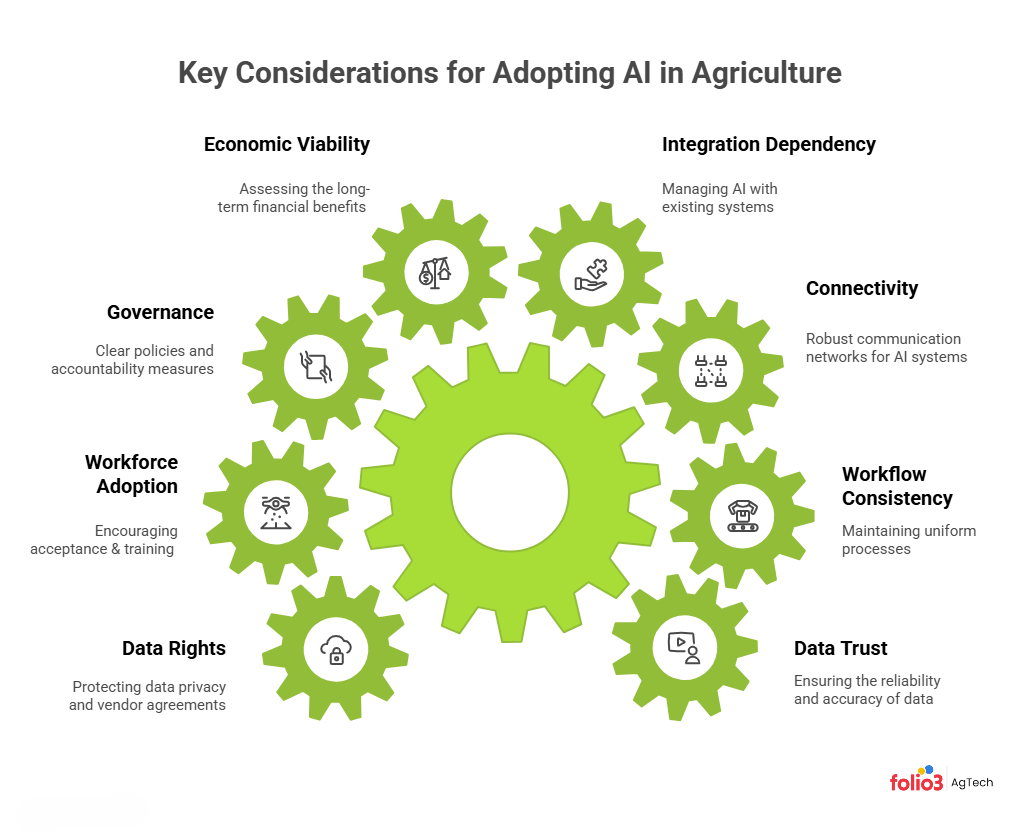
1) Data You Can Trust
- Key question: Do you have agricultural data quality that’s decision-ready, or just data that’s “available”?
- What “ready” looks like: Consistent sampling, clear definitions, and a repeatable ground-truth approach so your AI outputs can be verified in the field. It is foundational to AI readiness in agriculture.
- Proof to gather: Sampling frequency by data type, missingness/completeness reports, documented ground-truth method, and calibration routines/logs for sensors and scales.
- Red flags: “Best-guess” manual entries, inconsistent units, long gaps in records, or sensors that are never calibrated but used as if they’re precise.
2) Workflow Consistency Across Fields, Crews, and Seasons
- Key question: Are your workflows stable enough that AI can support them, or do they change by person, field, or week?
- What “ready” looks like: Basic farm operations standardization as SOPs exist, exceptions are defined, and your team follows the same steps even under pressure. That’s what makes adopting AI in farming scalable instead of fragile.
- Proof to gather: SOP library, variance sources (where/why deviations happen), and “exceptions handling” rules (who decides, how it’s documented).
- Red flags: “Tribal knowledge” only, ad-hoc workarounds, different record-keeping by crew, or seasonal resets where nothing stays consistent year to year.
3) Connectivity + Edge Reality
- Key question: Where will decisions be made, like field-side or office-side, and what happens when connectivity drops?
- What “ready” looks like: A clear plan for edge AI agriculture vs cloud processing, with offline tolerance matched to your reality. Rural internet access remains a practical constraint for digital tools, so your adoption plan must assume interruptions, not perfection.
- Proof to gather: Connectivity map by location, offline operating procedure, edge vs cloud split, and latency requirements by decision type (minutes vs hours).
- Red flags: Tools that fail silently offline, “always-connected” assumptions, or no fallback workflow when the network is unavailable.
4) Integration Dependency
- Key question: Will AI connect cleanly to your farm stack, or become another silo your team ignores?
- What “ready” looks like: A single source of truth for core records, plus interoperability planning across equipment and systems. Data incompatibility and limited interoperability are well-recognized barriers in agriculture, which is why standards and integration architecture matter early.
- Proof to gather: APIs, data standards used, equipment compatibility, and a “system-of-record” plan. For machinery, standards like ISO 11783 (ISOBUS) are designed to standardize data exchange between tractors and implements.
- Red flags: No API access, proprietary formats, duplicate master data, or vendor “connectors” that only export PDFs/CSVs.
5) Economics Beyond ROI Slides
- Key question: Do your economics reflect farm reality as seasonality, labor constraints, and ongoing operating costs, not just a spreadsheet ROI?
- What “ready” looks like: A defensible model of AI ROI in agriculture tied to baseline metrics and season-cycle payback expectations, plus a full view of AI cost in agriculture.
- Proof to gather: Baseline KPIs, season-based payback assumptions, and a total cost of ownership view, including software, connectivity, integration, data labeling/cleaning, maintenance, and monitoring.
- Red flags: ROI based on “best season,” ignoring labor/time costs, no budget for maintenance, or assuming the model stays accurate without updates.
6) Governance and Accountability
- Key question: When AI recommends something, and it doesn’t work, who is accountable, and what’s the escalation path?
- What “ready” looks like: Clear AI governance in agriculture with decision rights, override rules, and an audit trail. This is the backbone of responsible AI in agriculture as AI supports decisions, but your org owns outcomes. Governance frameworks are commonly highlighted as necessary to protect rights and ensure responsible data use.
- Proof to gather: Decision matrix (who decides what), override/approval rules, audit logs, and a named model monitoring owner with review cadence.
- Red flags: “No one owns it,” black-box decisions with no traceability, or no process to handle model drift across seasons.
7) Workforce Adoption and Trust Thresholds
- Key question: Will your team actually use AI outputs when the day gets busy—or quietly revert to old habits?
- What “ready” looks like: Practical change planning: training built into work schedules, incentives aligned to usage, and a clear “human-in-the-loop” procedure. Trust and attitude are repeatedly cited as adoption drivers/barriers in digital agriculture.
- Proof to gather: Training plan by role, field-friendly playbooks, adoption metrics (usage, overrides, time-to-action), and escalation support.
- Red flags: Training treated as a one-time event, no time allotted for adoption, “AI-only” decisions in high-risk workflows, or supervisors who don’t model usage.
8) Data Rights, Privacy, and Vendor Contract Reality
- Key question: Who owns your data, who can reuse it, and what happens if you switch vendors?
- What “ready” looks like: Explicit terms on farm data ownership and agricultural data privacy, especially when your datasets include traceability records such as permanent animal identification methods. Data ownership and privacy concerns are widely reported obstacles in digital agriculture adoption, so contracts must match your risk posture.
- Proof to gather: Ownership clauses, portability and export formats, retention/deletion terms, model training consent, breach notification, and subcontractor access rules.
- Red flags: Vendor claims broad reuse rights, no clear export path, indefinite retention, unclear subcontractors, or contract language that treats your operational data as the vendor’s asset.
AI Adoption Readiness Scorecard (Use This Before You Approve Budget)
Before you fund AI, use this AI readiness assessment agriculture scorecard. It forces evidence on interoperability, connectivity, governance, and farm-data rights, known adoption barriers. Use it to align Ops, IT, Finance, and Legal in one short review.
| Dimension | Questions to answer | Evidence to verify | Owner | Go/No-Go red flags |
| Data reliability | Complete/consistent? | Missingness, units | Ops/Agronomy | “Best-guess” data |
| Ground-truth process | How validate? | Method, calibration | Agronomy/Ops | No validation |
| Workflow standardization | SOPs repeatable? | SOPs, exceptions | Ops | Crew variance |
| Connectivity/edge readiness | Offline plan? | Coverage, offline SOP | IT/Ops | Always-on required |
| Integration readiness | Can it connect? | APIs, standards | IT | CSV/PDF only |
| Security & access control | Who sees what? | RBAC, MFA | IT/Sec | Shared accounts |
| Governance & accountability | Who owns decisions? | Rights, audit trail | Exec/Ops | “No owner” |
| Economics | Full cost/timing? | TCO, payback | Finance | Upkeep ignored |
| Workforce readiness | Will it be used? | Training, usage KPIs | Ops/HR | No adoption plan |
| Data rights & portability | Who owns/exports? | Clauses, export test | Legal/Exec | Vendor reuse rights |
Build vs. Buy vs. Partner: A Due Diligence Checklist for Farms, Investors, and Founders
The right AI adoption strategy for agriculture depends on what you can support long-term, not what looks impressive in a demo. Use this Agtech vendor evaluation checklist to verify integration, support, and most importantly, data rights in writing.
When “Buy” Works Best and What to Confirm
Buy when the workflow is stable, and you want faster time-to-value from proven AI systems designed specifically for agricultural operations. Confirm:
- Integration: APIs, supported standards, and connector costs
- Support: Hours, escalation path, on-farm vs IT coverage
- SLAs: Uptime and response times
- Roadmap: Release cadence, end-of-life policy
- Portability: Export formats and data retrieval steps
When “Build” Makes Sense and What it Really Costs
Build when you have unique processes or defensible IP, and you can own the lifecycle. Confirm:
- Data pipeline ownership (ingest → storage → access)
- MLOps capability (monitoring, retraining, version control)
- Ground-truth/labeling budget and staffing
- Ongoing maintenance across seasons
When “Partner” is the Lowest-Risk Path and How to Avoid Lock-in
Partner when you need speed plus guardrails. Confirm:
- Phased scope with go/no-go gates
- Exit plan (data export + handover)
- IP/data terms, including model-training consent
- Success metrics tied to operations
Defining Success Before the First Pilot
Before you run anything in the field, write a one-page charter you can share with Ops, IT, Finance, and Legal. It forces governance and measurement up front:
- Baseline metric + target delta: Pick one KPI you already track and define the improvement you need to prove.
- Decision frequency + action owner: How often outputs arrive, and who must act on them (and what “no action” means).
- Data responsibilities: Who captures, validates, and signs off on data (including traceability records such as permanent animal identification methods).
- Stop rules: When to pause/kill so the pilot stays reversible (no ground truth, poor uptime, persistent data gaps, or zero adoption).
The 5 Metrics That Prevent “Cool Demo, No Impact”
For AI pilot success metrics in agriculture, track five numbers that keep decisions honest:
- Adoption: real in-field usage (not logins).
- Accuracy: validated against your ground truth.
- Time-to-decision: signal-to-action cycle time.
- Cost-to-operate: ongoing seasonal cost (data, support, monitoring).
- Outcome: the operational/financial KPI tied to the charter.
Conclusion: The Adoption Decision You Can Defend in the Boardroom
If you want a fast way to de-risk AI, stop chasing “the best model” and start proving operational readiness. The key considerations for adopting AI in agriculture are not glamorous, but they are controllable: trusted data, repeatable workflows, connectivity reality, integration fit, governance, economics, and clear data rights. Interoperability gaps and farmer concerns about who controls and shares farm data are widely documented barriers, so treating them as “later” issues is how adoption stalls under real operational pressure. Run the scorecard with your leadership team before you approve the budget. If you’re ready to move forward, explore how structured AI implementation can support your operational goals while respecting the governance, data rights, and integration requirements outlined above.
If you want to validate your AI readiness with experienced practitioners, connect with our AgTech experts who specialize in AI in farming. We’ll help you assess gaps, reduce adoption risk, and define a path that works in real farm conditions, not just on slides.
FAQs
How Do I Know If My Farm Is Ready for AI Without Running a Pilot?
Your farm is ready if you can clearly answer who owns the data, how decisions are made today, and where AI outputs would actually be used. If those answers are unclear, a pilot will expose gaps, but it won’t fix them.
What Is a Reasonable Timeline to See Results From AI Adoption in Agriculture?
Expect early signals within one season, not instant ROI. Meaningful results usually appear after at least one full operational cycle, once data quality, workflows, and team adoption stabilize.
How Do I Choose Between Edge AI and Cloud AI for Farm Operations?
Choose edge AI when decisions must happen in the field with unreliable connectivity. Cloud AI works better for planning, forecasting, and analysis where latency is less critical and connectivity is stable.
Can AI Adoption Work If My Farm Uses Multiple Equipment Brands and Systems?
Yes, but only if interoperability is planned upfront. AI adoption works when data from different machines and systems can be normalized into a single, trusted source rather than managed in silos.
What Should an AI Contract Include to Protect Farm Data Ownership and Portability?
Your contract should clearly state that you own your data, control how it’s reused, and can export it in usable formats. It should also define retention, deletion, and whether your data can be used for model training.