
Cattle operations are the businesses and management systems that move an animal from genetics to beef. Your operation type matters because it drives your most considerable costs, your day-to-day workload, and how you sell for premiums or steady cash flow.
Many beef cattle operations are specialized: one ranch breeds and weans calves, another grows them as stockers/backgrounders, and a cattle feeding operation finishes them for harvest. This guide maps the lifecycle from calf to beef, with clear definitions and ranch-style examples. You’ll see where each stage hands off.
For those just getting started, our guide on how to start a cattle farm business covers the foundational decisions before choosing your operation type.
Cattle Operations 101: The Beef Production Chain in One Picture
Most cattle operations fit into a “beef production chain,” and many beef cattle operations make money by doing one stage well. Thinking in stages helps you compare types of cattle operations, spot where margins come from, and decide whether to hold cattle longer or sell earlier.
Mini flow:
Seedstock → Cow-calf → Stocker/Backgrounding → Finishing (feedlot or grass) → Processing/market
| Stage type | Typical age/weight range | Primary goal | Typical diet | Typical seller → buyer handoff |
| Seedstock | Mature breeding animals | Improve genetics; sell bulls/heifers | Forage + supplements as needed | Seedstock breeder → cow-calf producer |
| Cow-calf | Birth → weaning (~6–9 mo; ~350–600 lb) | Produce a healthy, weaned calf | Milk + pasture/forage | Cow-calf producer → stocker/backgrounder or feeder |
| Stocker/Backgrounding | Weaned calf → yearling (~12–20 mo; ~700–900 lb) | Add frame and lean gain; manage health | Mostly forage; may use stored forages/mixed rations | Stocker/backgrounder → feedyard/finisher |
| Finishing | ~700–850 lb on feed → ~1,250–1,400 lb | Add “finish” for harvest | High-energy ration + limited roughage | Feedyard → processor/packer |
| Processing/market | Harvest animal | Convert carcass to saleable beef | N/A | Packer → wholesalers/retail/foodservice |
If you retain ownership across stages, you stack risk and reward; align land, feed access, and financing with that choice.
Stocker vs Backgrounding vs Cattle Feeding Operations
People use these terms differently, so focus on what the cattle are eating and what the operator is trying to “add” before the next sale. In northern-tier states, snow cover can replace “stocker grazing” with a forage-based ration, yet still the operational goal is the same: grow, don’t fatten.
- Stocker cattle operations: You buy or retain weaned calves and grow them primarily on pasture/forage to add economical pounds and frame before they’re “ready for feed.”
- Cattle backgrounding operations: Often used interchangeably with “stocker,” but in many regions it implies a more controlled, post-weaning growing phase, commonly taking calves from ~450–600 lb to ~700–850 lb before the feedyard.
- Cattle feeding operations: This is the finishing step, cattle are fed in confinement for slaughter on a high-energy diet (grain/concentrates with limited roughage) until they reach harvest condition. Feedlots can be small under 100 head or enormous, depending on the business model.
Different Types of Cattle Operations
A clear breakdown of major cattle operations, explaining their roles, income drivers, and how real ranches run each system profitably.
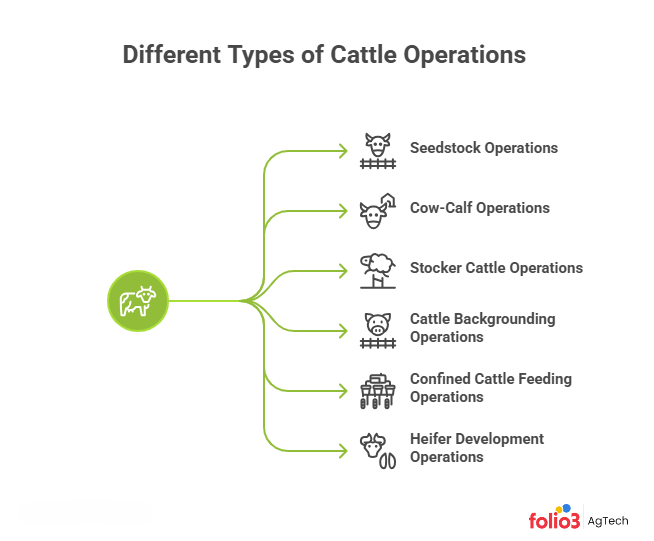
Seedstock Operations
Seedstock ranches sit at the front of the beef supply chain. Their job is to produce genetics, so other beef cattle operations can buy bulls, replacement females, or semen backed by performance records. In practical terms, you’re running a registered herd, recording traits, and selling breeding animals based on documented value. Modern breeding management system helps seedstock operators track performance records and pedigrees efficiently.
How seedstock operators typically make money:
- Selling registered bulls through private treaty or a scheduled bull sale calendar.
- Selling registered females (open or bred) as replacements.
- Marketing the program itself: consistent records, herd health, and repeat buyers.
Real-world example: A registered Angus operation that performance-tests bulls, publishes a sale catalog, and sells bulls each spring to commercial cow-calf producers preparing for breeding season.
Cow-Calf Operations
A commercial cow-calf ranch is one of the most common types of cattle operations and it’s where the “calf crop” starts. Your core goal is straightforward: breed cows, deliver live calves, and wean a healthy calf from each breeding female each year.
Where do you make money in cow-calf:
- Selling weaned calves often by weight, uniformity, and health program.
- Selling preconditioned calves when your market rewards documented health and reduced stress.
- Retained ownership by keeping calves longer into stocker/backgrounding or finishing when you have the forage/feed and risk tolerance to do it.
Ranch example archetype: A pasture-based, spring-calving herd that breeds on a defined season, weans calves, then chooses between selling at weaning, or running a simple preconditioning pathway so calves are bunk-broke, vaccinated, and more “buyer-ready.”
Stocker Cattle Operations
Stocker cattle operations exist because many calves aren’t the “right kind” of animal for immediate finishing. Stocker programs buy or retain weaned calves and grow them primarily on forage, so they add frame and lean weight efficiently before moving into finishing.
What you typically buy and sell:
- Buy: Weaned calves or lightweight feeders.
- Sell: Heavier, healthier “feeder-ready” cattle that fit feedyard specs more consistently.
Why location matters (real geography archetypes):
- Winter wheat pasture stockers: Calves graze wheat to gain economically during a specific seasonal window.
- Flint Hills grass stockers: Cattle are placed on tallgrass prairie for a defined grazing season, then marketed as feeders.
Success in stocker operations depends heavily on effective cattle marketing strategies and timing your sales to market conditions. In practice, stocker operators make money (or lose it) on forage cost, health management, and marketing timing because your “product” is weight gain plus improved fit for the next buyer.
Cattle Backgrounding Operations
Cattle backgrounding operations are the bridge for calves that need time and management before they belong in a finishing program. In many regions, “backgrounding” is used interchangeably with stocker, but the operational pattern is often more controlled. It commonly uses a drylot or a structured forage + roughage ration, especially when pasture is limited, or weather reduces grazing options.
Two common backgrounding styles:
- Drylot/high-roughage programs: Calves are fed a growing ration designed to add weight without pushing heavy fat deposition. Meanwhile, learning how to balance cattle feed rations is critical for backgrounding programs that use mixed rations.
- Grazing-emphasis programs: Calves grow on forage but under a tighter plan for weight targets and sale timing.
Feeder-ready cattle are typically heavier, acclimated to feed/bunks, and positioned for a smoother transition into finishing. Typical time window is often described as a post-weaning growing period before finishing. It is long enough to build size and stability, but not intended to “finish” the animal.
Confined Cattle Feeding Operations
Confined cattle feeding operations often called feedlots finish cattle using high-energy diets so they reach harvest endpoints. A standard description you’ll see in production literature is cattle “fed in confinement for slaughter,” which is the simplest way to separate finishing from forage-based growing.
What feedlots do:
- Place feeder cattle on a managed feeding program.
- Manage the finishing period until cattle reach harvest condition and weight targets.
- Operate at many scales from small “farmer-feeder” yards to large commercial feedyards.
- Implement systems to optimize feedlot operations and improve feedlot efficiency through data-driven decisions.
However, you can leverage modern feedlot management software and cattle feeding systems streamline pen assignments, ration delivery, and performance tracking.
How money works in cattle feeding operations:
- Owner-retained cattle: You own the cattle and capture the value change through finishing
- Custom feedlot model: The yard provides feeding/management as a service, while the cattle may be owned by someone else.
Ranch example archetypes:
- A cow-calf ranch retains ownership and places calves into a commercial yard on a custom-feeding arrangement.
- A smaller farmer-feeder operation finishes a limited group annually using locally sourced feeds, marketing finished cattle into conventional channels.
Heifer Development Operations
Heifer development is a distinct lane within types of cattle operations because replacement females have a different objective than feeder cattle: you’re building a future breeding cow. Some businesses specialize in developing heifers for sale, while others do it in-house to upgrade their own herd and stabilize long-term production.
What you’re doing operationally:
- Selecting heifers with the proper structure and reproductive potential.
- Managing growth and breeding so heifers reach appropriate maturity and can enter the herd as productive females.
How heifer development operations make money:
- Selling bred heifers as ready-to-work replacements for commercial cow-calf ranches
- Capturing herd value internally by reducing replacement risk and improving consistency across calf crops
Integrated example: A cow-calf ranch keeps top heifer calves, develops them through breeding, and either sells a portion as bred heifers, or keeps them as replacements to expand or refresh the herd.
Beef Production Methods That Cut Across Operation Types
Beef production methods don’t replace your cattle operations, they describe how cattle are finished for the beef market. The two most common approaches are grain-finished and grass-finished, and the choice changes your timeline, your cost drivers, and what you can honestly market.
Grain-finished (feedlot-style finishing): Cattle are finished on a high-energy ration in a confined cattle feeding operation (feedyard). This system is built around purchased or grown feeds, ration management, and close monitoring to reach harvest endpoints efficiently. As environmental concerns grow, understanding cattle farming and climate change impacts helps producers make informed decisions about their finishing methods.
Grass-finished (forage-based finishing): Cattle are finished primarily on pasture (or a forage-heavy drylot program) and typically take longer to reach a finished endpoint than grain finishing. That longer timeline often shifts more of your “cost” into land/forage management and seasonality rather than grain and yard costs.
Where each method happens, most often:
- Grain-finished: commercial yards/feedlots (but some small operators finish cattle in smaller confinement setups).
- Grass-finished: managed grazing systems and forage-based programs.
Marketing angle: “grass-finished” and “grain-finished” are production claims, so your records should match how you sell the beef.
Practical note: Your operation type can stay the same while your production method changes. A finisher might run cattle through a feedyard model one year and shift to grass-finishing the next. What changes is the finishing system, timeline, and marketing claim, not the fact that you’re still finishing cattle.
How to Choose the Right Cattle Operation Type
Choosing among types of cattle operations is less about what sounds “best” and more about what fits your resources and your risk tolerance. A simple scoring checklist keeps you honest before you buy cows or build facilities.
Score yourself (low/medium / high):
- Land and dependable forage base (owned, leased, or crop residues)
- Facilities (working pens, water, fencing, feed storage, handling system)
- Labor and observation time (calving checks, health pulls, feeding rhythm)
- Capital/credit (operating cash for feed, cattle purchases, and setbacks)
- Risk tolerance (price swings, weather, health events)
- Market access (barns, order buyers, retained-ownership options, local beef demand)
If you have X, consider Y:
- High forage and limited capital → stocker cattle operations (you “sell gain” using grass).
- Strong calving management plus pasture → cow-calf (you build a consistent calf crop).
- Limited pasture seasons but access to hay, silage, and a drylot → cattle backgrounding operations (a controlled post-weaning growing phase).
- Infrastructure, feed sourcing, and a manure plan → confined feeding/finishing (you manage cattle fed in confinement for slaughter).
Final step: Pick the one stage you can execute repeatably through good years and bad. Many profitable cattle operations start narrow, then add the next stage only after their records and cash flow prove it.
What Buyers Expect When Cattle Move Between Operations
Every handoff in the beef chain is a “fit check”: does your group match what the next operator gets paid to do? Whether you’re selling into stocker cattle operations, cattle backgrounding operations, or straight to cattle feeding operations, buyers usually pay more for cattle that are low-risk and easy to start.
What “ready to sell” looks like (by handoff):
- Cow-calf → stocker/backgrounder: Calves are weaned, healthy, castrated/dehorned as needed, and backed by a clear vaccination plan. Many preconditioning programs also expect calves to be bunk- and water-trough trained and held after weaning before sale.
- Stocker/backgrounder → finisher: Cattle are in uniform lots, current weights and dates are available, and animals are already adapted to a consistent forage or growing ration, so the next step is smoother.
- Finisher → processor/market: Lot history is clear, and cattle meet buyer specs (weight/finish) for marketing.
Why Preconditioning Matters:
Preconditioning separates major stress events and is commonly described as weaning ahead of sale, vaccinating appropriately, and training calves to eat and drink from bunks/troughs. Some markets require documentation such as product/vet invoices, weaning records, or certification forms. Meanwhile, preconditioned calves can require fewer treatments after arrival at the feedlot which is precisely what downstream buyers want.
Key KPIs by Operation Type in Cattle Farming
If you don’t measure, you end up “managing by gut feel.” Strong beef cattle operations track a few KPIs consistently then compare turns (groups) over time.
Cow-calf (reproduction + weaning):
- Monthly/seasonal: Pregnancy rate (scanning), calving distribution, calving interval, and weaning rate.
- Per turn (calf crop): Average weaning weight and pounds weaned per cow.
Stocker/backgrounding (gain efficiency):
- Weekly: Pulls/health events, headcount, water/feed access issues.
- Per turn: Average daily gain (ADG) and cost of gain (total costs ÷ pounds added). KPI frameworks commonly use daily liveweight gain to evaluate calf growth and cost-effective performance.
Finishing (feedlot performance):
- Weekly: morbidity (sick pulls/hospitalizations) and mortality, plus pen-level intakes.
- Per turn: feed efficiency (feed-to-gain), days on feed, average daily gain, and closeout cost per head.
Minimum viable record system: Start with a cow list (ID, breeding/calving/weaning dates), and a lot sheet for each group sold/bought (arrival/ship dates, starting/ending weights, treatments with product/lot numbers, and withdrawal dates).
Even a basic spreadsheet works if it captures treatment dates, product names, and lot/serial numbers, dosages, route, and the earliest date withdrawal time is met for compliance. However, dedicated livestock management software automates record-keeping and generates compliance reports with less manual effort.
Compliance, Welfare, and Environmental Reality of Cattle Operations
Confinement isn’t just “more feed.” In the literature, a feedlot/concentrated facility is a distinct management system where cattle are held in an enclosed area. After that, the feed is brought to them, and manure accumulates on a limited footprint, so your environmental obligations tighten.
Key high-level realities to plan for:
- Manure + runoff control: Keep clean water off lots, collect runoff, and apply manure under a nutrient plan to protect water quality.
- Water supply + drainage: Reliable volume, trough capacity, and pen drainage to avoid mud and heat stress.
- Air/dust/odor: Dry surfaces, scraping, and runoff control reduce particulates and odor impacts on neighbors.
- Stocking density + pen condition: Overcrowding and persistent mud elevate health risk and performance loss.
Manure from beef cattle can be a source of water and air pollution if it’s not managed deliberately so that confinement can increase your risk exposure. Because rules vary by size and discharge risk, confirm state and federal requirements early, often under CAFO/AFO frameworks. Implementing cattle traceability for supplier compliance also helps meet regulatory documentation requirements and buyer expectations.
3 Ranch Examples: Realistic Pathways Producers Use
Three practical ranch pathways showing how producers match forage, facilities, and markets to build workable cattle operations in real-world conditions.
- Cow-calf only (sell at weaning): You run a defined calving season, wean calves, and sell them as uniform lots through an auction, video sale, or order buyer. It keeps facilities simple and turns cash faster. If buyers pay for “low-risk,” add preconditioning after weaning.
- Cow-calf → stocker/backgrounding: When you have cheap forage, you retain ownership and add economical pounds as stockers or through a backgrounding phase, then sell feeder-ready cattle into finishing. This pathway often matches seasonal grazing regions like wheat pasture programs.
- Cow-calf → finishing → direct-to-consumer: You keep cattle through finishing, then sell beef locally as halves/quarters or packaged cuts built around processing access, storage, and delivery. The upside is margin capture; the tradeoff is marketing time, tighter scheduling, and clear pricing. Plus, the deposits are made to protect cash flow and consistent customer communication so freezer inventory and pickup dates never surprise you later.
Conclusion
Your operation type is more than a label, it’s a business model plus a management system. Each phase in cattle operations rewards different strengths: forage, facilities, labor, capital, and risk tolerance. Your goal is to match what you have with the phase you can run consistently, then expand only when your numbers prove it. If you want a recommended operation pathway, share your forage base, handling facilities, feed access, and how you plan to sell. Our AgTech experts will map the best-fit phases and the next steps.
FAQs
Can A Cow-Calf Ranch Also Finish Cattle?
Yes, a cow-calf ranch absolutely can finish its own cattle, which is often called retaining ownership to add value. Still, it requires extra resources like feed, different management, and potentially new infrastructure.
When Do Calves Typically Leave The Cow-Calf Operation?
Calves typically leave the cow-calf operation by being weaned at 6 to 8 months of age, usually in the fall for spring-calving herds, allowing them to transition to solid feed.
Are Cow-Calf Operations Still Profitable For Small Or Mid-Sized Ranches?
Cow-calf operations can be profitable when forage costs are controlled, reproduction is managed tightly, and calves are marketed at the right time or preconditioned for premiums.
Can One Ranch Operate More Than One Type Of Cattle Operation?
Yes. Many cattle operations are integrated, like cow-calf producers may retain ownership of stocker, backgrounding, or finishing when forage, facilities, and capital allow.