

You can’t manage what you can’t measure, and nowhere is that truer than on the ranch. Every year, producers lose thousands of dollars in poor conception rates, difficult calvings, and wasted feed, often tracing back to one overlooked metric: body condition.
Eyeballing a cow and guessing her nutritional status is a risky game, and it costs real money. Body condition scoring in cattle (BCS) is your single most powerful and completely free diagnostic tool. It cuts through the guesswork to give you a clear, standardized picture of your herd’s energy reserves, reproductive readiness, and overall health.
Whether you run a cow-calf beef operation or a high-production dairy, this guide gives you everything you need to score smarter and manage better.
What is Body Condition Scoring (BCS) in Cattle?
Cattle body condition scoring is a standardized, hands-on method for estimating the amount of fat reserves and, therefore, stored energy that a cow is carrying on her body. Think of it as a nutritional status report you can generate with your eyes and hands, right at the chute, at no cost.
Here’s the key distinction that trips up many producers: live weight is misleading. A big-framed, tall cow can weigh the same as a shorter cow with a completely different nutritional status. Body weight reflects skeletal size, gut fill, and pregnancy status as much as it reflects fat cover. BCS strips all of that noise away and focuses exclusively on one thing, how much fat energy the animal has in reserve.
BCS is assessed by evaluating specific anatomical landmarks like the spine, ribs, hooks, pins, tailhead, and brisket to assign a numerical score. Research has confirmed that BCS accounts for 85% to 91% of the variation in stored body energy in beef cows, making it a far more precise nutritional predictor than scale weight alone.
The beauty of BCS is its universal applicability. It can be used across breeds, frame sizes, and ages without adjustment, because it focuses on relative fatness rather than absolute size. A BCS 5 on a Hereford means the same thing as a BCS 5 on a Brahman, in moderate condition with adequate energy reserves for the demands ahead.
Why Cattle Body Condition Scoring Matters
Let’s talk about return on investment. Adjusting a cow’s BCS pre-calving is far cheaper than trying to fix her reproductive performance after a poor calving season. Here is what body condition scoring cattle tells you that no other metric can:
Reproductive Efficiency
Thin cows have dramatically longer postpartum anestrous intervals, meaning they take longer to cycle back into heat after calving. If a cow needs to conceive within 80–85 days post-calving to hold a 12-month calving interval, every extra week she sits in anestrus is a lost calf and lost revenue.
Calf Health & Vigor
A dam’s body condition at calving directly impacts the quality and quantity of colostrum she produces. Thin cows yield lower immunoglobulin concentrations in colostrum, leaving newborn calves with weaker passive immunity, higher scours rates, and reduced weaning weights. A calf born to a BCS 4 cow is already starting life at a disadvantage.
Feed Cost Optimization
Both ends of the BCS spectrum cost you money. Under-conditioned cows require expensive supplemental feeding post-calving, feed that often fails to recover reproductive performance in time. But over-conditioned cows (BCS 8–9) create a different problem: fat deposits accumulate in the pelvic canal, significantly increasing the risk of dystocia (calving difficulty). Fat cows also tend to have lower dry matter intake around calving, which prolongs negative energy balance in early lactation.
Whether you run a beef cow-calf operation or manage a high-producing dairy herd, digitizing your BCS records integrates seamlessly with reproductive and breeding management workflows, giving you a complete picture of each animal’s performance across her lifetime. Stop losing data and start building a herd intelligence database.
Beef vs. Dairy Cattle Body Condition Scoring: The Key Differences
One of the most common points of confusion in the industry is the difference between beef cattle body condition scoring and dairy cattle body condition scoring. They are not interchangeable systems.
While both evaluate fat reserves, they use different scales, target different ideal scores, and focus on different anatomical regions. It is a reflection of the fundamentally different physiological demands on beef and dairy cows.
- The beef BCS system uses a 1–9 scale, with a wider range to accommodate the greater variability in body fat across diverse beef breeds and management systems.
- The dairy BCS system compresses that into a 1–5 scale, reflecting the need for greater precision in managing the tighter energy balance demands of high-yielding dairy cows.
Understanding which system to apply and why is fundamental to making BCS data actionable on your farm. Here is how the two systems compare side by side:
| Industry | Scale Range | Ideal Calving Score | Anatomical Focus Areas | Primary Energy Drain |
| Beef Cattle | 1 (Emaciated) to 9 (Obese) | 5 to 6 | Brisket, ribs, spine, and tailhead fat cover. | Calf rearing & weaning weight. |
| Dairy Cattle | 1 (Severe Thin) to 5 (Fat) | 3.0 to 3.25 | “V” vs “U” angle of the thurl, hooks, and pins. | Peak milk yield & lactation. |
The single biggest management implication of this difference is the calving target score. On a beef operation, you are managing to maintain BCS through gestation so she calves in condition.
On a dairy, you are managing a predictable cycle of condition loss in early lactation and condition regain in late lactation. The goal is to keep that swing within healthy bounds to protect both production and health.
How to Do Body Condition Scoring in Beef Cattle
Body condition scoring beef cattle is a skill that improves with practice, but even a beginner can develop reliable scores in a short time by focusing on the right landmarks and following a structured process.
Visual Appraisal vs. Palpation
Many producers score cattle by eye alone and in summer or short-hair conditions, which works reasonably well. But winter throws a curveball. A thick, woolly winter coat can add the visual appearance of a full BCS point or more, masking a thin cow that is actually losing condition fast under all that hair.
That is why palpation, physically feeling the key anatomical areas is non-negotiable for accurate scoring, especially in cold-weather months. The areas you need to physically assess include:
- The ribs: Can you feel them with firm pressure, light pressure, or not at all?
- The spinous processes (backbone): Are they sharp and prominent, or smooth and rounded?
- The hooks and pins (hip bones): How prominent are they? Is there a depression or pocket around them?
- The tailhead: Is there a deep cavity, a slight depression, or a rounded, padded feel?
- The brisket: Is there visible fat deposition here?
Always score cattle before feeding for the most accurate assessment, and work in consistent lighting. Having the same person score the herd at each assessment period reduces subjectivity and improves trend tracking.
Breakdown of the 1–9 Beef BCS Scale
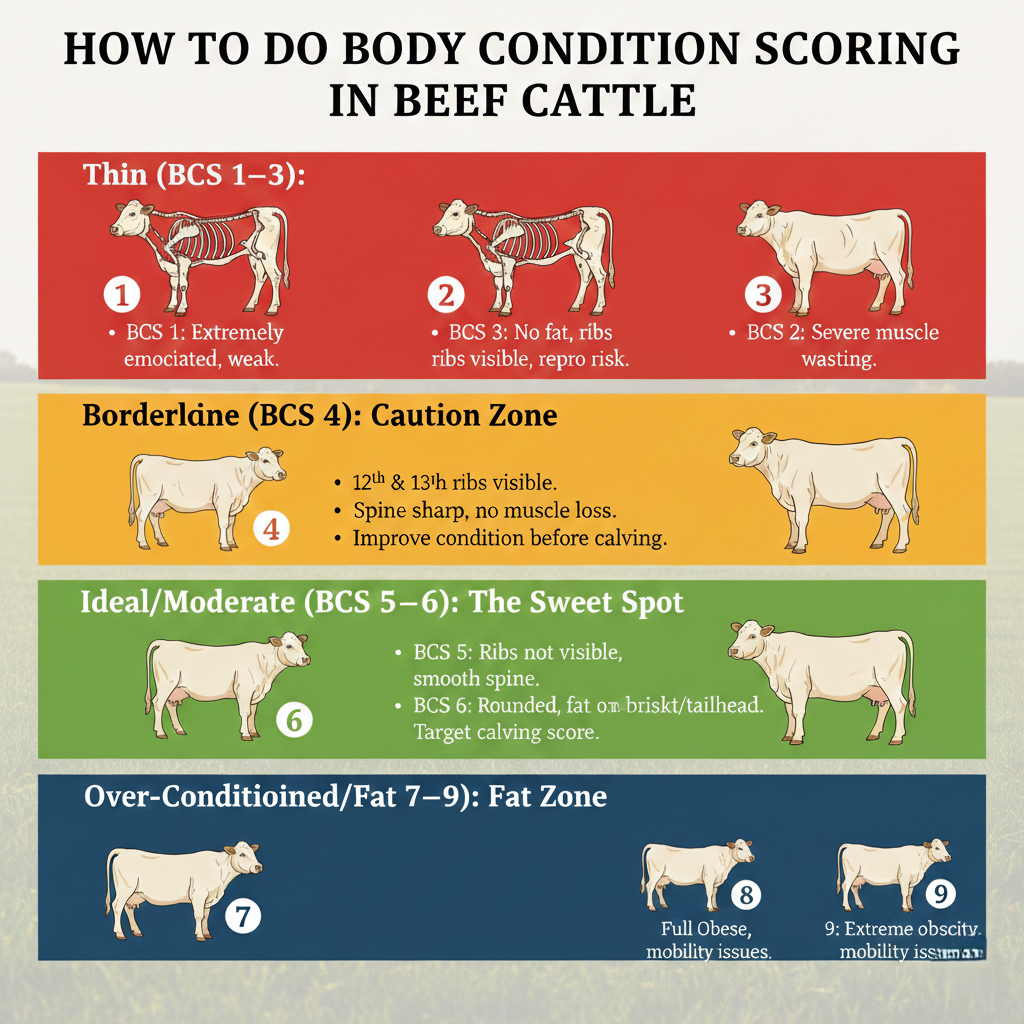
The beef BCS scale runs from 1 (emaciated) to 9 (obese). For practical herd management, grouping the scores into logical ranges makes decision-making faster and more intuitive:
Thin (BCS 1–3): Red Zone
- BCS 1: Extremely emaciated, physically weak. Bone structure is fully visible. Extremely rare outside severe disease or neglect.
- BCS 2: Similar to BCS 1, but the animal is not yet physically weakened. Severe muscle wasting through hindquarters and the shoulder.
- BCS 3: Very thin. No fat on ribs or brisket, backbone easily visible. Some muscle loss through the hindquarters. Cows at this score face a serious reproductive risk.
Borderline (BCS 4): Caution Zone
- The 12th and 13th ribs are visible and easily felt. The spinous processes are still visible and sharp. Muscle depletion is not yet evident through the shoulders and hindquarters. This is a cow you need to be moving up in condition before calving.
Ideal/Moderate (BCS 5–6): The Sweet Spot
- BCS 5: The last two ribs may be visible with no fat over the ribs or tailhead. The spinous processes are smooth and harder to identify. This is the minimum acceptable calving score for mature cows.
- BCS 6: Smooth, rounded appearance. Some fat in the brisket and over the tailhead. Fat palpable over ribs and pin bones. This is the target calving score for most cow-calf operations and the recommended score for first-calf heifers.
Over-Conditioned/Fat (BCS 7–9): Fat Zone
- BCS 7: Very good flesh. Brisket is full, tailhead shows fat pockets, back appears square. Ribs not visible due to fat cover.
- BCS 8: Obese. Neck thick, back flat or square due to excessive fat. Brisket is distended with large fat pockets around the tailhead.
- BCS 9: Extremely obese with mobility issues possible. Tailhead buried in fat, underline bulging. The risks here include severe dystocia and metabolic disorders.
How to Do Body Condition Scoring in Dairy Cattle
Dairy cattle body condition scoring demands a higher level of precision than beef scoring. High-producing dairy cows operate under intense metabolic pressure. A half-point shift in BCS at the wrong time of lactation can significantly affect dairy milk production, reproductive performance, and health outcomes. The 1–5 scale used in dairy gives you the granularity to catch small changes before they become costly problems.
Landmarks for Dairy BCS Evaluation
Dairy BCS focuses primarily on the pelvic region, where fat deposition and loss are most visible and reliable. The key landmarks to evaluate are:
- Hooks (tuber coxae) and pins (tuber ischii): How prominent are they? Are they sharp or padded with fat?
- Thurl: The area between the hook and pin. Is there a depression or flat/rounded fill?
- Short ribs (transverse processes of the lumbar vertebrae): Can they be felt easily, with moderate pressure, or not at all?
- Sacral ligament: The ligament running from the sacrum to the tailhead. Is it sunken, visible, or buried in fat?
- Tailhead ligament: Is there a cavity around the tailhead, or is it filled and rounded?
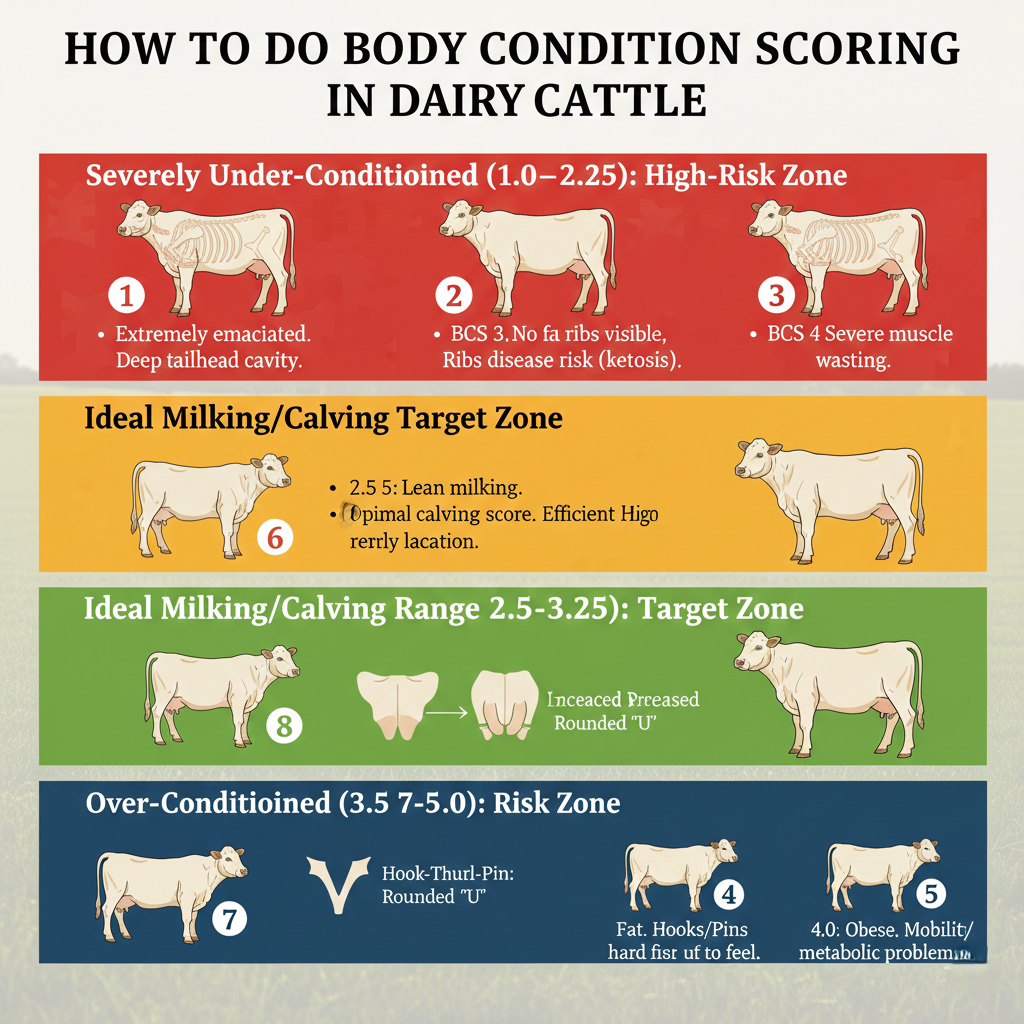
The classic guide for dairy scoring is whether the hook-thurl-pin triangle forms a sharp “V” (thin, under-conditioned) or a rounded, filled “U” (heavier condition). This visual cue alone is a quick field indicator before you even lay a hand on the animal.
Breakdown of the 1–5 Dairy BCS Scale
Dairy BCS is evaluated in 0.25-point increments for greater precision. Here are the key ranges and their management implications:
Severely Under-Conditioned (1.0–2.25): High-Risk Zone
- BCS 1.0: Severely emaciated. Deep cavity at tailhead, short ribs sharp and easily palpated, no fat tissue in the loin area.
- BCS 1.5–2.0: Poor condition. Tailhead cavities are still evident but less severe. Short ribs can be felt with minimal pressure.
- BCS 2.25: Still lean. Cows in this range are at significantly elevated risk of metabolic disease, including fatty liver syndrome, displaced abomasum, and ketosis, particularly around transition.
Ideal Milking/Calving Range (2.5–3.25): Target Zone
- BCS 3.0 at calving is considered optimal. These cows efficiently mobilize stored fat for energy without the negative consequences associated with over-conditioning.
- BCS 2.5–3.0 is the target range during lactation. The general benchmark is to have greater than 85% of your herd within this range at any given time.
- Losing 0.5–1.0 BCS units in the first 60 days of lactation is considered normal and manageable. Losses exceeding 1.0 units significantly delay return to estrus and reduce conception rates.
Over-Conditioned (3.5–5.0): Risk Zone
- Scores above 3.5 at calving are not recommended. Over-conditioned cows have a higher risk of calving difficulty, lower dry matter intake at transition, and prolonged negative energy balance. It creates a cascade of metabolic and reproductive problems that can persist throughout lactation.
- BCS 4.0–5.0: Fat to obese. Hooks and pins become difficult to palpate. Short ribs buried under fat. Udder and naval may bulge with fat deposits.
The Best Times to Score Your Herd for Maximum Impact
Cattle body condition scoring is only valuable if done at the right times. A single annual score tells you almost nothing actionable. What you need is a calendar of strategic scoring points that give you enough lead time to make nutritional adjustments before key physiological events.
Critical BCS Milestones for Beef Cattle
On a cow-calf operation, there are four moments when a BCS check is non-negotiable:
- 90 Days Pre-Calving: This is your most important scoring window. It gives you a full 90 days to move a thin cow from a BCS 4 to a 5, a realistic target with appropriate supplementation. After calving, that window closes.
- At Calving: Confirms whether pre-calving targets were met and flags which cows need close reproductive monitoring. Mature cows should be at BCS 5, first-calf heifers at BCS 6.
- At Breeding: Score the herd at the start of the breeding season to identify cows that have lost excessive condition post-calving. Cows below BCS 4 at breeding are unlikely to cycle reliably.
- At Weaning: The start of your recovery window. Weaning removes the lactation energy drain, giving you four to five months to put condition back on thin cows before the next calving cycle.
Critical BCS Milestones for Dairy Cattle
Dairy BCS management requires monitoring at closely spaced intervals due to the rapid metabolic changes of the lactation cycle. The recommended scoring points are:
- Dry Off: Score at the start of the dry period, approximately 60 days pre-calving. Target BCS 3.0–3.25. Cows that are too thin need to gain; cows that are too fat need a carefully managed dry period diet to avoid over-conditioning.
- At Calving: The critical baseline. Target BCS 3.0. Scores above 3.5 elevate the risk of ketosis and calving problems.
- Peak Lactation (60 Days Post-Calving): The lowest BCS point in the cycle. The goal is that the total BCS loss from calving to this point does not exceed 1.0 unit. Score here to assess whether the transition was well-managed and to make feeding adjustments going into mid-lactation.
How to Improve Your Herd’s Body Condition Score
Body condition scoring in cattle only pays dividends when you act on what you find. Identifying a thin cow is the first step, knowing how to efficiently move her condition up (or down) before a critical event is where the nutritional strategy comes in.
Safely Moving a Cow from BCS 4 to BCS 5
For a 1,200-pound cow, moving one BCS unit requires approximately 84 lbs of body weight gain. At a reasonable gain rate of 1.5–2 lbs/day on improved nutrition, this takes 6–8 weeks. That is why the 90-day pre-calving window is so important, it gives you enough time to do it without crash-feeding.
The strategy is to increase the energy density of the diet, not simply dump more hay in front of her. Key nutritional levers include:
- Supplement with energy-dense feeds such as corn, distillers’ grains, or cottonseed to boost total digestible nutrients (TDN) above maintenance requirements.
- Ensure protein adequacy, energy supplementation without sufficient protein is inefficient at putting on condition.
- Address body condition loss at its root cause: pasture overgrazing, forage quality issues, or parasite burden.
Sort Cows Into Nutritional Groups
This is one of the highest-ROI management practices you can implement. A herd is rarely uniform in BCS, and feeding everyone the same diet means your thin cows never get enough and your fat cows get too much. After scoring, separate cows into at least two groups:
- Thin group (BCS 3–4): Receive a higher-energy supplemental program targeting 1.5–2 lbs/day gain.
- Adequate/fat group (BCS 5–7+): Maintain on forage base without energy supplementation to avoid over-conditioning.
For operations tracking both cattle health and nutritional management, digital tools like Folio3 AgTech’s livestock management software make it straightforward to tag cows by nutritional group, track body weight changes, and generate feed cost reports by group, eliminating the guesswork from supplementation decisions.
Tracking Body Condition Scoring with AgTech Folio3
Recording body condition scoring cattle data on a notepad or a spreadsheet you can’t find six weeks later is not a strategy, it is a gap in your management system. Historical BCS trends are where the real power lies: knowing that a particular cow drops below BCS 4 every year post-calving tells you something actionable about her genetic potential relative to your forage system.
Folio3 AgTech’s livestock management solutions allow you to capture BCS data directly from the chute on your mobile device, link scores to individual animal records, and track condition trends across lactations and production cycles. The system supports predictive feed modeling, group management, and reporting that helps you make data-driven nutritional decisions — not reactive ones. Ready to take your herd management to the next level? Talk to the Folio3 AgTech team about digitizing your BCS records and integrating condition scoring into a complete livestock management system built for the modern ranch.
FAQs
What Is a Good Body Condition Score for a Beef Cow Before Calving?
Mature beef cows should ideally calve at a BCS of 5, while first-calf heifers should target a BCS of 6 to account for their continued growth demands. Cows calving above BCS 6 showed a 90% rebreeding rate in subsequent breeding seasons, compared to 60% for cows calving below BCS 4.
Can You Body Condition Score a Cow While She Is Pregnant?
Yes, and you should. BCS assessment is not affected by pregnancy status since the scoring system evaluates subcutaneous fat cover, not gut fill or fetal mass. The critical pre-calving scoring window is 60–90 days before expected calving, giving you time to adjust nutrition meaningfully before parturition.
How Often Should Dairy Cows Be Body Condition Scored?
Dairy cows should be scored at a minimum of three key times: at dry off, at calving, and at peak lactation (approximately 60 days post-calving). Research recommends scoring every 3–4 weeks during transition for high-risk cows, as condition changes in this period directly predict metabolic disease risk.
What Is the Difference Between a BCS 5 in Beef and a BCS 5 in Dairy?
These are completely different scales and should never be compared directly. A beef BCS 5 (on the 1–9 scale) is the moderate, ideal calving condition. A dairy BCS 5 (on the 1–5 scale) means the cow is obese, with the tailhead buried in fat and hooks and pins nearly impossible to palpate, a condition associated with serious metabolic disease risk.
How Does a Low BCS at Calving Affect Calf Weaning Weights?
A dam’s BCS at calving directly influences colostrum quality and milk production through early lactation, both of which drive calf growth in the crucial first weeks of life. Thin cows produce lower-quality colostrum and less milk overall, resulting in calves with weaker immunity and lower weaning weights.