

Modern agriculture is no longer just about tilling soil and hoping for rain. Today’s agribusiness owners juggle supply chain disruptions, volatile weather patterns, fluctuating commodity prices, and chronic labor shortages, all while trying to feed a global population projected to reach 9.6 billion by 2050.
If you’re managing an agribusiness, you already know that spreadsheets, standalone apps, and disconnected software tools can’t keep pace with this complexity. That’s where an agricultural ERP steps in as the single most powerful technology investment for building a profitable, scalable, and future-proof farming operation.
In this blog, we’ll uncover the impactful benefits of ERP for the agriculture industry that are proven at different levels from the business and operational perspectives.
The Dawn of Data-Driven Farming: Why Agribusinesses Need ERP
Farms have evolved into data-intensive operations where every acre, animal, and input generates information that can either drive growth or get lost in siloed systems. According to the FAO, over 13% of food produced globally is lost in the supply chain between harvest and retail, much of it due to preventable inefficiencies that integrated systems could address.
Here’s where most agribusinesses hit a wall. Your accounting runs on one platform, inventory tracking lives in another spreadsheet, crop planning sits in a third tool, and labor management might still be paper-based. The result?
- Delayed Financial Reporting: Month-end reconciliations take days because data must be manually pulled from multiple disconnected sources and cross-checked for accuracy.
- Missed Procurement Windows: Without real-time inventory visibility, you’re ordering inputs too early (tying up cash) or too late (creating downtime during critical planting or harvest periods).
- Compliance Gaps: Fragmented recordkeeping makes audit preparation stressful and time-consuming, increasing the risk of regulatory penalties from the FDA, USDA, or FSMA.
- Wasted Resources: When your soil data, weather forecasts, and input application records don’t feed into a unified system, over-application and under-utilization become the costly norm.
An agricultural ERP system solves this by creating a single source of truth; one unified platform that connects your financials, supply chain, inventory, workforce, equipment, and crop or livestock data from seed to sale.
Instead of toggling between five different dashboards and reconciling conflicting reports at month-end, you get one platform where your numbers match in real time. For CTOs tired of duct-taping disconnected tools, and for farm owners who want visibility without the chaos, an ERP becomes the operational backbone that makes data-driven farming a practical reality rather than a buzzword.
8 Transformative Benefits of an ERP System in Agriculture
The benefits of an ERP system go far beyond basic digitization. When implemented correctly, an agricultural ERP reshapes how your entire operation functions from the field to the front office. Here are the eight most impactful advantages.
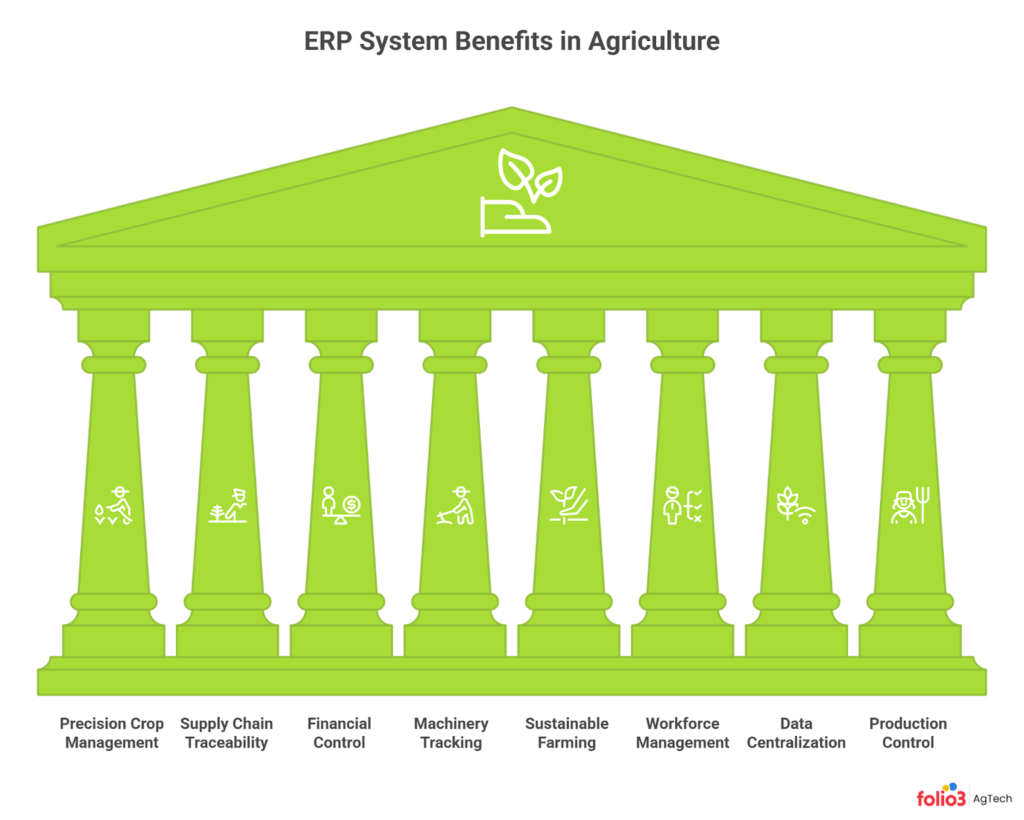
1. Precision Crop & Land Management
Your land is your most valuable asset, and an ERP helps you treat it that way. With integrated crop management modules, you can track soil health metrics, plan planting schedules based on historical yield data, and monitor crop performance across every field and zone.
Rather than applying inputs uniformly, the system enables variable-rate recommendations, putting the right fertilizer in the right place at the right time. Yield prediction models built on your own farm’s historical data help you forecast harvests more accurately.
So, it gives you a serious edge in forward contracting and commodity marketing. When your agronomist recommendations, soil test results, and planting records all live in the same system, you eliminate the costly miscommunications that lead to over-application or missed planting windows.
2. Complete Supply Chain Traceability
Regulatory pressure from the FDA, USDA, and FSMA isn’t slowing down. An ERP with built-in supply chain tracking capabilities provides seed-to-store traceability, recording every input, process, and movement in a tamper-evident digital ledger.
If a food safety event occurs, you can pinpoint the affected lot within minutes instead of days. This kind of rapid recall capability doesn’t just protect consumers, it protects your brand, your buyer relationships, and your bottom line.
For agribusinesses exporting internationally, traceability also streamlines compliance with varying global food safety standards. Major retailers and foodservice buyers are increasingly requiring their suppliers to demonstrate digital traceability as a condition of doing business. So, this capability becomes a competitive necessity rather than a nice-to-have.
3. Optimized Financial Control & Cost Savings
Farming is a business with notoriously thin margins, which makes financial visibility non-negotiable. A modern ERP centralizes your accounting and financial management; budgeting, subsidy tracking, accounts payable and receivable, and real-time profitability analysis—all in one platform.
You can see cost-per-acre, cost-per-head, or cost-per-unit in real time, rather than discovering overruns at the end of the quarter. Research consistently demonstrates the financial impact of ERP adoption; ERP systems deliver an average return of $7.23 for every dollar invested.
4. Advanced Machinery & Equipment Tracking
A combine breaking down during harvest isn’t just inconvenient; it’s expensive. Every hour of unplanned downtime during peak season can mean thousands of dollars in lost productivity.
ERP systems with equipment management modules let you schedule preventive maintenance based on actual usage hours. They also track fuel consumption across your fleet and monitor utilization rates so you can make informed decisions about purchasing versus leasing.
When your machinery data feeds into the same system as your crop planning, you can coordinate planting and harvest schedules. As a result, you optimize equipment deployment across multiple fields or sites, reducing idle time and maximizing your capital investment.
5. Sustainable Farming & Resource Efficiency
Sustainability isn’t just a moral imperative; it’s becoming a financial one. Investors and retail buyers increasingly evaluate agribusinesses on ESG (Environmental, Social, and Governance) criteria.
An ERP tracks your water usage, fertilizer applications, energy consumption, and carbon footprint at a granular level. It gives you verifiable data to support sustainability claims. Whether you’re pursuing organic certification or participating in carbon credit programs, smart farming technology embedded within your ERP provides the measurement framework that turns sustainability goals into documented outcomes.
For operations looking to attract ESG-focused investment capital, this data-backed sustainability reporting can directly influence funding decisions and partnership opportunities.
6. Streamlined Workforce & Seasonal Labor Management
Labor is one of agriculture’s biggest challenges and highest costs. With farm labor expenses rising and skilled workers increasingly difficult to find, efficient workforce management directly impacts profitability.
An ERP with workforce management capabilities handles payroll calculations and tracks hours across multiple locations. It also manages H-2A visa worker compliance documentation and measures labor productivity by task and by crew. During peak seasons when you’re scaling from 20 to 200 workers, the system automates onboarding paperwork, tax withholdings, and scheduling.
You can also analyze labor cost per acre or per unit of production, identifying which crews and processes deliver the best return. It means your farm managers spend less time on administrative tasks and more time in the field, where they’re needed most.
7. Real-Time Data Centralization & Reporting
You can’t manage what you can’t measure, and you can’t measure effectively when your data is scattered across disconnected tools. An ERP consolidates information from every department into customizable dashboards that update in real time.
Farm owners can monitor key performance indicators at a glance; CTOs can drill into system-level metrics; and field managers can access mobile-friendly reports from a tractor cab. With the global agriculture analytics market projected to reach $14.22 billion by 2030 at a CAGR of 14.4%, the shift toward data analytics in agriculture is accelerating, and ERP is the platform that makes it actionable.
Rather than exporting CSVs and building manual reports, your team can generate variance analysis and seasonal trend comparisons. Plus, you can integrate predictive models directly within the system, turning raw data into strategic decisions in minutes rather than days.
8. Enhanced Production & Inventory Control
When you’re dealing with perishable goods, whether it’s fresh produce, dairy products, or harvested grain, inventory management isn’t optional; it’s survival. An ERP enables lot tracking and FIFO (first-in, first-out) inventory rotation, monitors shelf-life expiration dates in real time, and triggers alerts before spoilage occurs.
Integrated production planning lets you align harvest schedules with buyer orders and warehouse capacity. It minimizes the gap between what you produce and what you sell.
For operations managing multiple product lines, this level of control directly translates to reduced waste and higher margins. When you consider that global food loss and waste generate an estimated 8–10% of global greenhouse gas emissions, effective inventory control becomes a responsible stewardship.
Benefits of ERP for Large-Scale Farm Operations That Aim to Scale Up
Running a single 500-acre operation is complex enough. Now multiply that across multiple farms, multiple states, or even multiple countries, each with different regulatory environments, currencies, tax structures, and growing conditions. That’s where the benefits of ERP for large-scale farm operations become truly transformative.
Modern agricultural ERP systems are purpose-built for multi-site, multi-entity complexity, allowing enterprise agribusinesses to operate at scale without losing visibility or control.
Multi-Farm Financial Consolidation
Manage each farm as a separate profit center while automatically rolling up financials into a consolidated enterprise view. Multi-currency support handles cross-border input sourcing and international sales, with exchange rate conversions and tax calculations applied automatically.
Operational Standardization Across Sites
An ERP ensures that every location follows the same planting protocols, quality benchmarks, and safety procedures. For agribusinesses operating across thousands of acres, this standardization delivers consistent yield quality regardless of which farm produced it, a critical factor for maintaining buyer contracts.
Centralized Supply Chain & Vendor Management
An ERP with robust supply chain management modules centralizes vendor relationships, automates purchase order workflows, and provides real-time visibility into procurement pipelines. You can see exactly what’s been ordered, what’s in transit, and what’s arrived across every site. It eliminates the guesswork that leads to overstocking, stockouts, and missed delivery windows.
Acquisition & Expansion Readiness
For agribusiness investors, a well-implemented ERP signals operational maturity. It means the business can scale without proportionally increasing headcount, that financial reporting is audit-ready, and that the digital infrastructure can absorb new acquisitions or greenfield expansions without operational disruption.
Enterprise-Grade Reporting & Benchmarking
Compare performance across farms, regions, and crop types using standardized KPIs. Identify your highest-performing sites, isolate underperformers, and replicate best practices across the organization, all from a single reporting dashboard.
The global farm management software market, valued at $3.20 billion in 2025 and projected to reach $13.48 billion by 2034, reflects this growing enterprise-level demand for integrated systems that can manage complexity at scale.
The Benefits of ERP Integration by Synergizing Your Tech Stack
A common misconception is that adopting an ERP means abandoning your existing Agtech tools. In reality, the greatest power of a modern ERP lies in its ability to orchestrate your entire tech stack. It acts as the central nervous system that connects sensors, drones, analytics platforms, and more into a cohesive workflow.
Connecting IoT Sensors and Drones
When IoT sensors in your fields capture soil moisture levels, nutrient readings, and microclimate data, that information is only as useful as the system processing it.
Through ERP system integration, telemetry from soil probes and weather stations feeds directly into your planning modules, automatically adjusting irrigation schedules or flagging fields that need attention.
Similarly, agricultural drones capturing aerial imagery of crop health can push their findings directly into the ERP. Here, anomalies are correlated with input application records and historical yield data to generate actionable recommendations, all without manual data entry.
AI-Driven Predictive Analytics
Integrating AI solutions for agriculture into your ERP takes your operation from reactive to proactive. AI-driven models analyze historical pest outbreak patterns alongside current weather data and field conditions to predict infestations before they happen.
It gives you time to intervene with targeted treatments instead of broad-spectrum applications. Demand forecasting algorithms process market trends, buyer order histories, and production data to help you plan planting volumes that align with actual market demand.
The result is fewer surprises, less waste, and better margins. With the U.S. precision farming market projected to reach $4.87 billion by 2030 at a CAGR of 9.7%, this integration isn’t future-state; it’s happening now.
Blockchain for Unshakable Trust
For agribusinesses selling into premium markets where provenance matters, organic, non-GMO, grass-fed, fair trade, blockchain integration adds an immutable layer of verification to your supply chain data. When your ERP records every transaction on a blockchain, buyers, auditors, and consumers can independently verify that your products are exactly what you claim them to be.
This kind of radical transparency builds trust with retail partners and commands premium pricing. It provides a competitive moat that’s difficult for less-transparent competitors to replicate.
When combined with your ERP’s existing supply chain tracking capabilities, blockchain turns traceability from a compliance checkbox into a genuine market differentiator. As consumer demand for transparent sourcing continues to grow, this integrated approach positions your agribusiness to capture premium value across increasingly discerning supply chains.
The Benefits of ERP Implementation From Strategy to ROI
Let’s be honest: the idea of an ERP implementation can feel overwhelming, especially if your operation has relied on legacy tools for years. But the data on ERP returns is compelling. Research found that organizations deploying modern ERP solutions recovered their investment within an average of 16 months and achieved over 200% ROI. The key is approaching adoption as a phased, strategic initiative rather than a single big-bang event.
Overcoming the Fear of Change
The biggest barrier to ERP adoption isn’t technology; it’s change management. Your field crews, warehouse staff, and office teams have established workflows they know and trust, and asking them to switch can create significant resistance.
Successful implementations start with stakeholder buy-in: involve your key managers early, demonstrate how the system reduces their daily frustrations, and invest in hands-on training that’s relevant to each role. When people see the ERP as a tool that makes their job easier rather than harder, adoption accelerates naturally.
Phased Value Creation
Rather than deploying every module simultaneously, start with the areas that deliver the fastest wins. For most agribusinesses, that’s financial management and inventory control.
These are the two functions where manual processes create the most friction and where automation delivers immediate, measurable savings. Once your team is comfortable and the data is flowing, layer in crop or livestock management, workforce tracking, and advanced analytics.
This phased approach reduces risk, builds internal confidence, and creates measurable value at each stage. It also gives your IT team time to resolve integration challenges incrementally rather than facing them all at once.
Timeline to ROI
While every operation is different, agribusinesses that follow a structured implementation methodology typically see reduced overhead within the first two quarters as duplicate systems are eliminated and manual reconciliation drops.
By the end of the first year, improved procurement decisions, reduced spoilage, and better labor utilization start contributing to measurably higher margins. By year two, the ERP is no longer a “new system”; it’s simply how your business operates.
Benefits of Modern Agriculture ERP Over Legacy Farm Management
If you’re still relying on spreadsheets, standalone accounting software, or basic farm apps, you’re likely experiencing the limitations of legacy tools daily. The table below highlights the practical differences between traditional approaches and what a modern agriculture ERP delivers.
| Capability | Legacy Systems | Modern Agriculture ERP |
| Data Access | Desktop-bound; delayed updates; manual consolidation required | Cloud-based; real-time access from any device; single source of truth |
| Traceability | Fragmented paper trails; slow recall response; audit risks | End-to-end digital traceability; rapid lot-level recall; audit-ready reporting |
| Scalability | Breaks down with multi-site operations; manual workarounds at scale | Multi-farm, multi-entity, multi-currency support built in; scales with growth |
| Tech Integrations (IoT/AI) | No native integration; data silos between tools | Native APIs for IoT sensors, drones, AI analytics, and blockchain |
| Financial Forecasting | Retrospective reports; manual formula-driven projections | Real-time dashboards; predictive analytics; scenario modeling |
The gap between legacy tools and a modern ERP isn’t just a technology upgrade; it’s the difference between managing reactively and leading proactively. If your current system can’t scale with you, it’s not supporting you; it’s holding you back.
Explore the best ERP software options for the agriculture industry to see what modern platforms look like in practice.
The CTO & Investor Perspective for Future-Proofing Your Agribusiness
The convergence of AI-powered agriculture, precision farming technologies, and cloud infrastructure is creating a new class of digitally mature agribusinesses. For both CTOs and investors, the question isn’t whether your operation needs an ERP; it’s how quickly you can implement one before your competitors do.
For Investors
When evaluating agribusiness investments, savvy investors look beyond acreage and yield numbers. They want to see clean data, standardized operations, and predictable scaling potential, all hallmarks of a well-implemented ERP.
An agribusiness running on an ERP demonstrates operational maturity: financial reporting is audit-ready, supply chain risks are documented and managed, and growth doesn’t require proportional increases in overhead.
This operational transparency directly impacts valuation multiples, making ERP-enabled agribusinesses more attractive acquisition targets and more likely to secure favorable financing terms.
For CTOs
Your primary concerns are system architecture, data security, integration capabilities, and long-term maintainability. A cloud-based agriculture ERP addresses each of these. Modern platforms offer SOC 2 compliance, role-based access controls, and encrypted data transmission. It is critical for operations handling sensitive financial and compliance data.
API-first architectures mean you can connect the ERP to your existing IoT infrastructure, third-party analytics tools, and legacy systems without building fragile point-to-point integrations. Most importantly, a well-chosen ERP reduces technical debt: instead of maintaining a patchwork of disconnected tools, each requiring separate updates, security patches, and vendor relationships.
So, you invest in a single, extensible platform that your team can build on for years. This consolidation simplifies your technology roadmap and frees up engineering resources for innovation rather than maintenance.
Plant the Seeds for Future Growth
The benefits of ERP for the agriculture industry extend across every dimension of your operation, from precision crop management and supply chain traceability to financial control, workforce efficiency, and AI-driven decision-making. Whether you’re managing a single farm or an enterprise spanning multiple regions, ERP provides the unified digital foundation that turns complexity into a competitive advantage.
The farms that will thrive in the next decade aren’t just the ones with the best soil or the most acres. They’re the ones with the best data, the tightest operations, and the technology infrastructure to adapt to whatever comes next. An ERP gives you the agility to respond and the intelligence to anticipate.
Ready to scale your farm’s tech infrastructure? Contact our Agtech consultants for a custom ERP readiness assessment and discover how the right system can transform your agribusiness from the ground up.
FAQs
How Does an Agriculture ERP Differ From Generic ERP Software?
An agriculture ERP includes industry-specific modules for crop planning, harvest management, lot traceability, and seasonal labor tracking that generic ERP platforms lack. It’s designed around farming workflows, compliance requirements like FSMA, and the unique seasonality of agricultural operations.
Is ERP Suitable for Small and Mid-Sized Farms, or Only Large Enterprises?
Cloud-based agriculture ERPs now offer modular pricing, making them accessible to small and mid-sized farms. You can start with core modules like financials and inventory, then add features as your operation grows. So, you’re paying only for what you use without heavy upfront infrastructure costs.
What Is the Typical Cost Range for Implementing an Agriculture ERP?
Implementation costs vary based on operation size, module selection, and customization needs. For mid-sized agribusinesses, total costs typically range from $25,000 to $150,000, including licensing, configuration, data migration, and training. Cloud-based models reduce upfront capital expenditure significantly.
Can an Agriculture ERP Work Offline in Remote Farm Locations?
Yes, many modern agriculture ERPs offer offline-capable mobile apps that sync data automatically once connectivity is restored. It is essential for field teams working in rural areas with limited or intermittent internet access to ensure uninterrupted data capture during critical operations.
How Long Does It Take To Fully Deploy an Agriculture ERP System?
A typical phased deployment takes 3 to 9 months, depending on operational complexity and the number of modules. Starting with core financial and inventory modules can deliver a functional system within 8–12 weeks, with additional modules layered in over subsequent quarters.
FAQs
What Makes ERP Unique Over Other Systems?
The core function of ERP, its ability to integrate all the different departments and functions of a business, makes it unique among other software systems.
This feature allows access to real-time information and improves collaboration within departments.
What are the Three Advantages of Using Enterprise Software in an Organization?
The three advantages of using ERP in an organization are:
- Improved Efficiency
- Better Collaboration
- Access to real-time data
What is ERP in Simple Words?
In simple words, ERP is enterprise resource planning software that integrates different business functions into a single unified system. The software helps automate processes, improve workflows, and reduce reliance on manual processes.