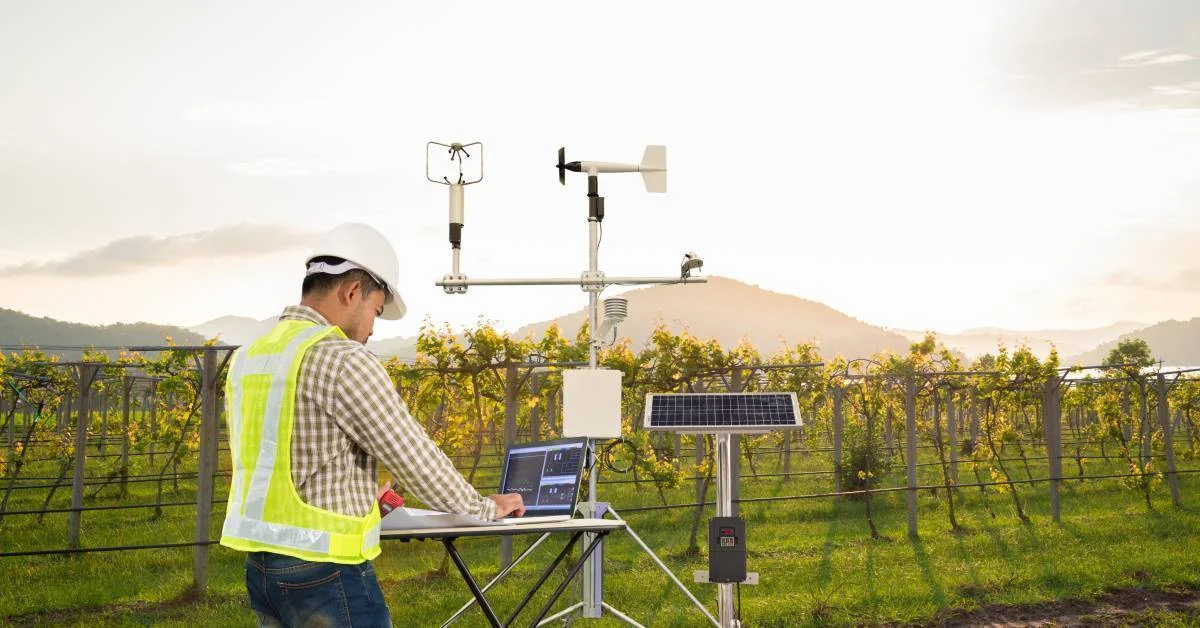

Agriculture sensors are the “eyes” that help you run a better operation when water is limited, labor is stretched, and decisions can’t wait for the next field walk. These agricultural sensors, often called agri sensors or agro sensors
They measure what’s happening in your soil, canopy, irrigation system, or microclimate, then turn readings into data you can use. That means fewer guesswork irrigations, earlier stress detection, and documentation you can share with your agronomist or crew.
In this guide, you’ll learn what sensors in agriculture do, how smart and precision agriculture sensors connect to decisions, and how IoT agriculture sensors add connectivity and alerts. You’ll also understand ROI drivers so you can choose the right sensors for agriculture without buying gadgets you won’t use.
What are Agriculture Sensors and How They Work
Agricultural sensors are devices that detect a field condition like moisture, temperature, pressure, light, or nutrient/chemical levels and convert that change into a signal your system can record and interpret.
In simple terms: they measure → convert → transmit, so you can “see” the farm without being everywhere at once. A typical agriculture sensor setup includes:
- A probe or sensing element in the field
- A data logger that timestamps readings
- A communications module
- A power source (battery or solar),
- A dashboard/app to view trends and set alerts.
Smart vs Precision Agriculture Sensors
Precision agriculture sensors help you apply the right input, at the right rate, in the right place, because conditions vary within the same field. Meanwhile, smart agriculture sensors go further by closing the loop as they sense a condition, support a decision, and can trigger an action automatically.
For example, a moisture sensor can prompt irrigation, an EC sensor can guide fertigation, weather sensors can time sprays, and greenhouse sensors can control ventilation or heating before stress builds.
What Makes IoT Agriculture Sensors Different
IoT agriculture sensors don’t just take measurements, they connect them to your phone or farm system in real time. When paired with advanced analytics that learn from your farm’s unique patterns, these connected sensors move beyond simple threshold alerts to predictive insights that help you act before problems become visible in the field.
Moreover, IoT sensors in agriculture send data through a network to a platform that stores history, spots thresholds, and pushes alerts. This agricultural sensor pilot approach can enable automation, like turning pumps on/off when problems are detected, without site visits.
Agriculture Sensors Benefits and ROI Drivers
Understand how agriculture sensors reduce waste, protect yields, save labor, and deliver measurable ROI through smarter, data-driven farm decisions.
Input Savings (Water, Fertilizer, Chemicals)
The payback from the use of sensors in agriculture is input control. Soil moisture and water sensors for agriculture help you avoid overwatering, catch leaks, and irrigate based on root-zone needs. That “apply what’s needed, where it’s needed” idea extends to fertilizer and chemicals when sensor data supports variable-rate or timed applications. Less waste reduces costs and lowers the risk of nutrient loss or runoff across the season.
Yield + Quality + Predictability
Sensors in agriculture improve yield and quality mainly by helping you act earlier and more consistently. When temperature, humidity, or canopy signals shift, you can prioritize scouting and respond before stress becomes yield loss.
Meanwhile, moisture-based scheduling also supports more uniform crop development by reducing swings between too wet and too dry. Over time, farming sensors create season-over-season records that make timing decisions. They include irrigation sets, fertigation, harvest windows as more predictable for you yearly.
Labor Efficiency + Auditability
Farm sensors reduce the “truck-and-check” routine. Instead of driving out to confirm a pump, tank level, or field condition, you can review trends and alerts from one dashboard. That saves time and improves auditability: sensor logs provide proof of what happened and when. For advisors, sensor application in agriculture means notes for recommendations and easier reporting to owners or programs.
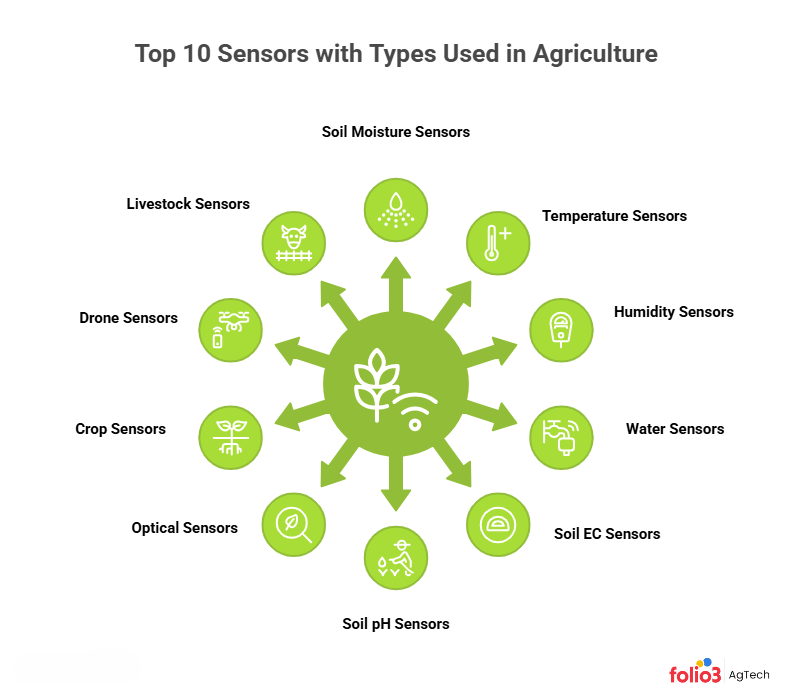
Top 10 Sensors with Types Used in Agriculture
Below is a practical list of sensors used in agriculture that farmers actually deploy, not just lab instruments. Think of it as the types of sensors used in agriculture mapped to the decision you’ll change for water, disease, fertility, vigor, and uptime. You’ll see crop and livestock farming sensors, plus a snapshot table to compare placement, pitfalls, and cost tiers.
How to Choose Your First 3 Sensors
Your first sensor used in agriculture should remove one recurring guess from your week. Pick sensors for agriculture based on what costs you most today:
- Irrigation guesswork: soil moisture sensors for agriculture.
- Disease risk + spray timing: humidity/dew point + leaf wetness.
- Uneven vigor: optical sensors in agriculture or drone sensors to target scouting and variable-rate work.
1. Soil Moisture Sensors for Agriculture (Top Sensor)
Learn why soil moisture sensors are the most impactful farm sensors, directly improving irrigation timing, water productivity, and crop consistency.
Types + Placement + Calibration Basics
Soil moisture sensors for agriculture are the “hero” sensor and agriculture sensors benefit show up turning irrigation from schedule into a root-zone decision. This sensor’s application in agriculture powers precision agriculture sensors.
Meanwhile, most either estimate volumetric water content (VWC) or measure soil water tension, two ways to track plant-available water. VWC options include capacitance/FDR and TDR/TDT sensors, which infer moisture from dielectric properties.
Place sensors by management zone and at root-active depths: a shallow depth to catch dry-down, and a deeper depth to confirm refill and avoid deep percolation. Factory calibration is a start; soil-specific calibration improves accuracy. Install with tight soil contact and protect cables. Check the response after installation.
Turning Readings Into Irrigation Decisions
Your goal isn’t “perfect moisture”, it’s staying in an effective range. After a soak and drain, treat that VWC level as your field capacity benchmark, then watch the root zone draw down. Set a refill point (management allowable deficit) where stress starts, and irrigate before you cross it. This use of sensors in agriculture is where smart agriculture sensors pay off:
- Check trends
- Confirm the shallow depth is drying
- Irrigate at your threshold
- Use the deeper sensor to confirm refill reached your target depth.
- Log events so you can adjust the runtime for soil and emitter rate.
2. Temperature Sensor Used in Agriculture
A temperature sensor used in agriculture does more than log weather; this sensor in agriculture drives timing. Air temperature alerts help you respond to frost and heat; soil temperature helps you time planting and germination; canopy temperature trends can flag water stress. In greenhouses, temperature sensors feed controllers for heating, ventilation, and shading. They support degree-day tracking for crop timing.
3. Humidity + Dew Point + Leaf Wetness Sensors
Outbreaks follow a pattern: a susceptible crop plus a long wet period. Leaf wetness sensors as crop sensors in agriculture estimate how long foliage stays wet, while humidity and dew point help you anticipate condensation. Use these sensors in agriculture with disease thresholds to time scouting and sprays around risk windows, not the calendar. In greenhouses, they help drive ventilation and dehumidification setpoints.
4. Water Sensors Agriculture
Water sensors agriculture teams rely on are about detection and distribution: flow meters confirm delivery and can reveal leaks or breaks when readings shift. Pressure sensors/gauges at key points help identify clogging, filtration issues, or uneven application across zones. Ultrasonic sensors for agriculture are widely used for non-contact level measurement in tanks and ponds, so you can trigger refills or alarms before pumps run dry and prevent surprise downtime. Used together, they help you prove uniformity and troubleshoot irrigation faster.
5. Soil EC / Salinity Sensors
Among agro sensors, soil electrical conductivity (EC/ECa) sensing helps you see variability you can’t spot from the cab. It sense salinity risk, texture shifts, and wetness patterns that change yield response. These agriculture sensors are used to create management zones and focus soil sampling, drainage, tillage, and irrigation. High EC can indicate salinity problems that restrict crop growth, so it’s a practical “where to investigate first” layer, especially where salts or texture vary.
6. Soil pH Sensors
Soil pH has consequences: it controls nutrient availability and the activity that recycles nutrients. These agricultural sensors see if pH is drifting outside the crop’s comfort range, where fertilizer efficiency drops and lime decisions become urgent. Portable probes speed checks, but lab tests still matter for recommendations across seasons and blocks.
7. Optical Sensors in Agriculture
Optical sensors in agriculture read how plants reflect light to estimate biomass, greenness, or chlorophyll. These precision agriculture sensors help you locate underperforming zones, validate whether a block is responding to nutrition, and support variable-rate decisions. Many active optical systems are used for in-season nitrogen management by comparing readings from a well-fertilized reference strip to the rest of the field. Treat optics as a “where to scout” accelerator, not a replacement for agronomy.
8. Crop Sensors in Agriculture
Crop sensors in agriculture go beyond “green or not.” Canopy sensors track closure and microclimate; LAI (leaf area index) summarizes canopy density; and growth-stage tracking helps you compare blocks. This sensor application in agriculture feeds yield-estimation models, flags development, and helps you prioritize scouting where the crop is lagging or racing ahead at the right time. They’re in orchards for canopy management and pruning decisions.
9. Drone Sensors for Agriculture
Drone sensors for agriculture are smart agriculture sensors for fast coverage when satellite revisit, or cloud cover, isn’t cooperating. RGB maps lodging and storm damage; multispectral supports vigor indices for variable-rate and scouting; thermal highlights water stress because canopy temperature can rise when transpiration drops; and LiDAR adds canopy structure and elevation for drainage/irrigation planning. The win is speed: you fly, generate a map, and send your team where it matters. Pair flights with ground truth so maps become actionable.
10. Farm Sensors for Livestock + Equipment
Farm sensors aren’t only for crops. In livestock sensors monitoring, wearables and RFID are farming sensors that identify animals and track behavior or health indicators, helping you spot problems earlier and document treatments. On equipment, vibration, and telematics sensors support maintenance planning, reduce downtime, and verify how machines are actually used. These are sensors used in agriculture to protect uptime and animal welfare. Start with a the use case and integrate later. They create an audit trail for treatments and maintenance.
Top 10 Sensors Snapshot
Use this snapshot as your “shopping filter” before you compare brands. Focus on three things first: placement, what decision you’ll change, and how you’ll keep the data usable. Cost tiers are intentionally relative, your total cost depends as much on network coverage, installation, and maintenance as on the probe itself.
If you’re starting small, pick one block, install carefully, validate the trend with field checks, then scale to more sites. Most failures come from poor siting and thresholds that no one reviews. Aim for fewer surprises, not dashboards. Keep notes on weather, irrigation, and observations.
| Sensor type | Measures | Best use case | Typical placement | Decision enabled | Common pitfalls | Cost tier (L/M/H) |
| Soil moisture (FDR, TDR, tension) | VWC or soil water tension | Irrigation scheduling | Root zone by management zone (shallow + deep) | When/how long to irrigate | Wrong depth, poor soil contact | M–H |
| Temperature (air/soil/canopy) | °C/°F | Frost, planting windows, and heat stress | Shielded air sensor; soil probe; canopy IR | Planting timing, frost/heat response | Sun exposure, poor siting | L–M |
| Humidity + dew point + leaf wetness | RH%, dew point, wetness duration | Disease risk windows | In/near canopy, representative block | Scout/spray timing | Misplacement, no model/threshold use | L–M |
| Water (flow + pressure + ultrasonic level) | Flow rate, pressure, tank/pond level | Leaks, clogging, uneven application | Mainline/manifold; above tank | Troubleshoot + verify irrigation | No baseline, poor installation | M |
| Soil EC / salinity | Apparent EC (ECa) | Zone mapping + salinity detection | Towed sensor or probe surveys | Management zones, sampling plan | No ground-truthing, moisture confounds | M–H |
| Soil pH | pH | Lime + nutrient availability | Field spot checks + sampling points | Lime decisions, nutrient guardrails | Skipping lab confirmation | L–M |
| Optical (NDVI/chlorophyll/reflectance) | Reflectance indices | Vigor/N status, variable rate | Above canopy/boom/handheld | Variable-rate N, targeted scouting | Saturation, inconsistent reference | M–H |
| Crop canopy/LAI/growth stage | LAI, canopy traits | Growth tracking | In-field canopy sensors, repeated points | Yield inputs, scouting priority | Inconsistent timing, algorithm mismatch | M–H |
| Drone (RGB/multispectral/thermal/) | Imagery, indices, canopy temp, elevation | Rapid field coverage | UAV flights | Map-based scouting + variable rate maps | No ground truth, inconsistent flights | M–H |
| Livestock + equipment | Activity/temp/rumination; vibration/telematics | Health + uptime | Wearables/RFID; machinery sensors | Early alerts, maintenance planning | Data overload, connectivity gaps | M–H |
Sensors Application in Agriculture: Turning Data Into Daily Actions
See how sensor data translates into real actions—irrigation, spraying, climate control, and storage decisions you make every day.
Irrigation + Fertigation Automation
This sensor’s application in agriculture gets reliable when you pair sensors. Start with soil moisture sensors for agriculture in the root zone so you irrigate on crop demand, not calendar. Add flow and pressure sensors to confirm delivery and flag leaks, clogged filters, or blocked zones. Use EC (electrical conductivity) in soil or fertigation water as a proxy for dissolved salts. With IoT sensors in agriculture, trigger irrigation at a threshold and get alerts when delivery or EC drifts quickly.
Pest/Disease Forecasting + Spray Timing
Most disease models care about moisture on the leaf and the air around it. Leaf wetness sensors estimate how long foliage stays wet, while humidity and temperature show when condensation and risk are likely. The use of sensors in agriculture helps you define “risk windows” for your crop, then time scouting and sprays around those windows instead of fixed intervals. When combined with predictive models that analyze historical patterns and current conditions, these risk assessments become more accurate and actionable across multiple crops and seasons.
Microclimate, Frost/Heat Protection, Greenhouse Control
A temperature sensor used in agriculture helps you act early, before damage shows up with alert crews for frost nights, verify soil temperature for planting/germination, and track heat stress risk. In protected cropping, smart agriculture sensors feed climate controllers; fans, vents, heaters, and shade to hold temperature and humidity within tight set ranges.
Post-Harvest: Storage, Cold Chain, Grain Bins
Post-harvest, sensors used in agriculture shift to protection: probes and farm sensors track grain temperature and moisture, helping you spot hotspots and spoilage early, then manage aeration and storage conditions.
Agriculture Sensors IoT Stack
Break down the IoT stack behind agriculture sensors, from field connectivity and power choices to alerts that drive timely action.
Connectivity Options
Your agriculture sensors IoT plan starts with connectivity for IoT sensors in agriculture. LoRaWAN is a long-range option that can run as a private network using gateways. It is useful when fields are spread out,, or you want to control coverage.
Meanwhile, Cellular LPWAN (LTE-M or NB-IoT) uses carrier networks; it’s convenient where you have signal and can offer coverage and penetration, but it depends on operator availability. Wi-Fi is best near buildings (shops, pump houses) because the range is short and the power draw is higher. In rural areas, coverage maps and on-farm tests decide.
Power + Durability in the Field
Most smart agriculture sensors and farm sensors run on batteries, so sleep cycles and frequency matter as much as accuracy. For remote sites, solar assist can extend year-round uptime. Choose enclosures rated for dust and water ingress, and plan for UV, fertilizer splash, rodents chewing cables, and flood-prone mounting spots.
Data Pipeline
Pipeline: sensor → gateway → cloud. The gateway forwards readings (LoRaWAN, Wi-Fi, or cellular). The cloud stores history and triggers alerts. Rules engine turns thresholds into alerts and tasks. So, keep it actionable: “Zone 7 is dry” or “Pressure dropped,” not more dashboards. With integrations to controllers and farm software, sensors in agriculture become precision agriculture sensors you use every day.
How to Choose Sensors for Agriculture (Buying + Deployment Guide)
A practical guide to selecting, placing, and integrating agricultural sensors without overspending or creating unnecessary operational complexity.
Accuracy, Calibration Burden, and Environmental Fit
When you compare agricultural sensors, aim for “accurate enough to change a decision.” Lab-grade accuracy can be wasted if the sensor used in agriculture is hard to install or needs frequent recalibration. Check what it’s validated for, how often it needs calibration checks, and whether it’s built for dust, washdown, and field abuse (IP rating). Confirm operating temperature, cabling, and local service support.
Placement Strategy: Zones, Depths, and Sensor Density
For soil moisture sensors for agriculture, placement matters more than brand. Start with management zones: different soil types or irrigation blocks deserve their own sensors. Put farm sensors where conditions are representative, not in wheel tracks, low spots, or corners. Depth should match the active root zone; extensions commonly suggest sensors at one-third and two-thirds of root depth to track dry-down and refill. Add sensor density only after you trust readings.
Integration + Data Ownership
Before you buy, confirm how the agriculture sensors’ IoT data leaves the platform. Look for exports (CSV/API), access controls, and retention terms. If you use IoT sensors across vendors, insist on an integration path to farm software, and written clarity on access, use rights, retention, and portability.
Total Cost of Ownership Checklist
Budget beyond hardware by considering the following factors:
- Installation and mounts
- Connectivity/data plans
- Calibration checks
- Batteries/solar
- Software subscriptions
- Maintenance and replacements
- Support/warranty
- Security updates
- Field repairs
- Staff training
- Time to review alerts and act
What Are the Limitations of Agriculture Sensors
Explore the real-world limitations of agriculture sensors and proven ways to reduce risk, data overload, and adoption friction.
Cost + Maintenance + Drift
The most significant limitation is ongoing care. Agricultural sensors live in mud, heat, chemicals, and irrigation water. So, you should expect maintenance; cleaning, battery swaps, cable checks and occasional replacement. Over time, readings can drift from the original calibration, especially in harsh conditions. Reduce risk by choosing smart agriculture sensors with field-proven durability, setting a calibration-check routine, and keeping a simple “known-good” reference.
Connectivity Gaps + Data Loss
IoT agriculture sensors can fail you when coverage is weak. If a gateway or cellular signal drops, you may miss alerts or lose data. Mitigate this by testing the signal on-site, using networks suited to long range (LoRaWAN) or cellular (NB-IoT/LTE-M), and selecting devices that buffer readings until a connection returns.
Data Overload and False Confidence
Another limitation is dashboard fatigue. You can collect thousands of points and still not improve outcomes if no one acts. Keep the sensors application in agriculture simple: tie each sensor to one decision, set thresholds and alerts, assign an owner, and do a weekly field check to validate what the data says.
Vendor Lock-In / Interoperability
Vendor lock-in happens when agricultural sensors’ IoT data can’t be exported or integrated. Prefer APIs, standard formats, and exit terms.
Agriculture Sensors Market: What’s Driving Adoption
Here are the key trends accelerating the agriculture sensors market, including cost savings, precision farming uptake, and demand for data-driven crop decisions.
Market Growth Snapshot
The agriculture sensors market is growing as farms push for tighter control over water, inputs, and labor. Insights estimates the global market at USD 4.43 billion in 2024, projected to reach USD 9.32 billion by 2032 (9.9% CAGR), reflecting mainstream adoption of sensor-based monitoring and automation, especially in irrigation, climate, and equipment monitoring.
Where Adoption Is Accelerating
Adoption is accelerating where decisions are time-sensitive, and variability is high: irrigation-managed specialty crops, greenhouse and protected cropping, and large row-crop operations using precision agriculture sensors for variable-rate work. Smart agriculture sensors are also expanding to pumps and fertigation lines to prevent costly, unexpected failures.
What Investors Watch in Agri Sensors
Investors look for agri sensors businesses with recurring revenue (data, analytics, service). Plus, interoperability across brands, and measurable outcomes prove that IoT sensors in agriculture reduce cost, risk, or variability at scale.
Conclusion
Treat agriculture sensors as a decision system, not hardware. Start with one outcome like better irrigation, fewer failures, or earlier stress detection then pick the sensor, placement, and alert that changes that decision. Build a simple review rhythm, validate with field checks, and scale sensors in agriculture block by block as confidence grows.
FAQs
Are Soil Moisture Sensors for Agriculture Worth It on Small Farms?
Are Soil Moisture Sensors for Agriculture Worth It on Small Farms?
Yes. For small farms, soil moisture sensors can deliver strong returns by helping you irrigate and fertilize only when needed. It reduces waste, protects yields, and lowers operating costs without adding daily complexity.
What’s the Best Temperature Sensor Used in Agriculture for Frost Risk?
For frost protection, growers rely on radiation frost sensors that approximate leaf temperature. Plus, air temperature and humidity sensors that help calculate wet-bulb conditions and predict freeze risk more accurately.
How Do IoT Sensors in Agriculture Work When Connectivity Is Weak?
When signals are limited, IoT sensors in agriculture use low-power networks like LoRaWAN, store data locally until a connection is available, or transmit small packets via satellite. So monitoring and alerts continue even in remote fields.
What Are Three Examples of Automated Systems Used in Agriculture?
Common examples include autonomous tractors for field operations, robotic systems for harvesting and sorting, and automated irrigation systems that adjust water delivery based on sensor data.