


A multi-site commercial feed manufacturing enterprise with mills in Ohio, Indiana, and Michigan was growing and breaking. Outdated formulas were hitting the mixer. Silos were blind. Micro-ingredient additions were tracked by clipboard, and the CFO’s best financial picture was 18 days old and aggregated to the point of uselessness.
By deploying Folio3’s unified feed mill ERP, the enterprise established a single Record-to-Report ecosystem. Formula governance became enforced rather than emailed. Weighbridge intake became automated rather than guessed. Micro-ingredient additions became system-directed rather than clipboard-dependent. And the CFO gained mill-wise margin visibility for the first time.
The operational friction at this enterprise almost always started at the nutrition desk in Columbus. The lead nutritionist had just optimized a high-protein dairy ration, substituting a lower-cost soy hull inventory to protect the target margin. The updated formula was finalized, exported, and emailed to the Indiana and Michigan mill managers.
What happened next was preventable and expensive: the Indiana floor supervisor initiated a 20-ton run using a printed spreadsheet from three days prior. The entire batch was produced to the wrong specification. By the time the error was caught during QA review, the cost of rework, ingredients, machine time, and operator labor exceeded $4,000 on a single run. In peak production weeks, this class of error was occurring more than once.
“Our nutritionists build a perfect, cost-optimized ration, but the mill floor is mixing based on outdated paper files,” the Quality Assurance Director stated during an emergency review. “If a formulation changes to account for ingredient costs or moisture variance, the system has to lock the old version instantly. We cannot rely on email to govern our most critical intellectual property.”
The fix wasn’t a better email protocol; it was removing email from the governance chain entirely. As the broader landscape of feed mill automation makes clear, version control failures are the most common and costly consequence of running multi-site production without a shared system of record.
The ERP acts as the Master Data Management (MDM) hub for all formulation data. Via bi-directional API integration with ration formulation software (such as Bestmix or Format), the moment the nutritionist approves a new recipe, it is pushed directly into the ERP’s Manufacturing Execution Module.
Version Control Logic governs what the floor can access. The instant Version 2.0 is approved, Version 1.0 is flagged as Obsolete. If a mill operator attempts to pull a Work Order using the obsolete BOM, the system enforces a Hard Block, preventing the batch from being sent to the PLC of the mixer. Every mill, regardless of location, is mathematically forced to use the exact, current recipe approved by corporate. There is no email chain that can override it.
With formulation governance under control, a secondary crisis demanded attention at the intake scales. At the Michigan mill, a semi-truck carrying 1,000 bushels of corn arrived at the weighbridge.
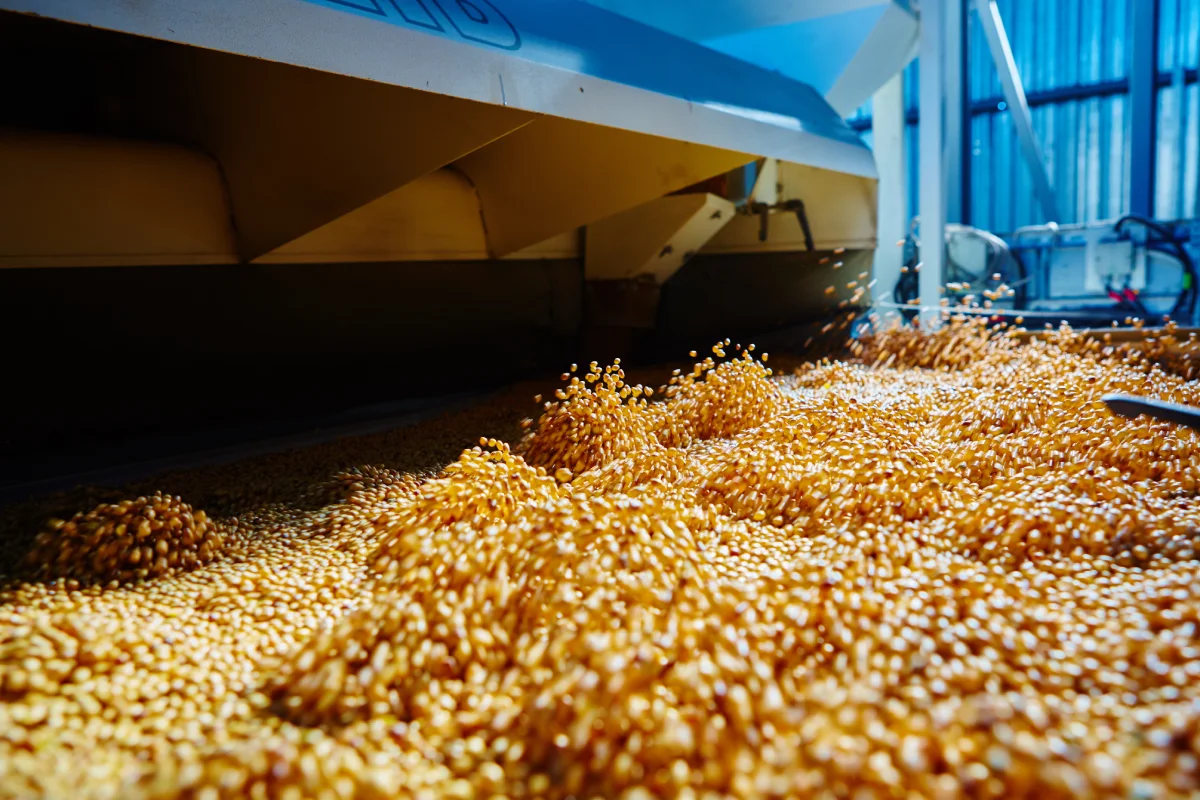
The scale recorded the weight, but the operator had no live view of which silos had capacity, no cross-reference for the grain’s moisture content against the purchasing contract. In fact, there was no system preventing him from routing a conventional corn load into a silo already assigned to an organic lot.
“A truck hits the scale and my operator is practically guessing which silo has room, risking cross-contamination with organic lots,” the Michigan Mill Manager explained. “Our scale software doesn’t talk to our inventory ledger, so silo levels are completely blind until someone physically checks them. We are risking inventory ruin because we can’t see inside our own bins.”
The gap between the scale and the ledger isn’t unusual; it’s a structural weakness in animal feed processing operations that rely on standalone scale software disconnected from inventory systems.
As the truck rolls onto the scale, the ERP captures gross, tare, and net weights directly from the scale indicator, instantly generating a digital Inbound Ticket, no manual entry, no clipboard.
Simultaneously, the ERP’s agriculture inventory management module runs Bin Allocation Logic, assessing real-time silo capacities and active commodity assignments. If Silo 4 contains conventional corn and Silo 5 contains organic corn, the ERP directs the conventional load to Silo 4. An attempt to route the intake into an incompatible bin triggers a contamination alert and halts the receiving process before a single bushel moves.
Quality metrics, such as moisture content and mycotoxin levels recorded at the scale, are tied to that specific intake lot, automatically calculating shrink and adjusting the true landed valuation of silo inventory in real time. This level of real-time bin-level control is what the agriculture inventory management module delivers across all three mills. It replaces physical checks and phone calls with live visibility at the intake dock.
On the production floor, bulk ingredients were mixing correctly, but the most regulated step in the entire process remained manual. When medicated micro-ingredients subject to the FDA’s Veterinary Feed Directive were added to a batch, the operator scooped the powder, weighed it on a floor scale, and checked off a paper clipboard. A slight over-pour or a transposed lot number could trigger an FDA regulatory action, a full batch recall, or worse.
For feed operations producing medicated rations, VFD compliance isn’t a documentation preference; it’s a federal requirement. The paper clipboard was not a compliant audit trail.
“When we add medicated micro-ingredients, a scoop error can ruin a 10-ton batch,” the Compliance Officer warned. “We cannot rely on clipboard audit trails for VFD compliance. We need a system that forces the operator to prove they are using the exact right lot and weight before the mixer even turns on.”
System-Directed Batching replaces the clipboard entirely. When the Work Order reaches the micro-ingredient phase, the system pauses and prompts the operator to scan the barcode of the specific medication bin using a ruggedized scanner integrated with the ERP.
If the scanned lot is expired, recalled, or incorrect for that specific recipe, the ERP sounds an alarm and prevents the batch from proceeding. Once the correct lot is validated, the ERP integrates with the micro-scale to record the exact weight added, down to the gram.
It creates an immutable digital audit trail covering every micro-ingredient addition: which lot was used, who weighed it, what weight was recorded, and when it entered the mixer. In an FDA audit, the enterprise can trace any bag of finished medicated feed back to its source lot in seconds.
This same end-to-end traceability architecture from inbound grain lot to finished product loadout is what separates a compliance-ready mill from one relying on clipboards. It requires an agricultural supply chain management purpose-built for formula-based manufacturing.
At month-end, all the operational data generated by the three mills was supposed to translate into financial insight at Columbus headquarters. Instead, the CFO stared at generalized, location-aggregated spreadsheets assembled through 18 days of manual reconciliation.
“I can tell you exactly how many tons we sold company-wide, but I cannot tell you if the Ohio mill is more profitable per ton than the Indiana mill,” the CFO said. “We don’t have the true landed cost of our ingredients, factoring in freight, shrink, and utility usage. We are reporting revenue, but we are completely blind to our operational margins.”
This is the financial blind spot that sits at the center of most multi-site ag manufacturing operations and it’s examined in depth in the guide to farm financial management for agribusinesses. When every mill runs its own siloed numbers, the corporate view is always a lagging approximation, never a decision-ready dashboard.
A unified General Ledger means every operational action generates an automated financial journal entry in real time. The ERP calculates an accurate COGS by capturing the base commodity price, adding the freight cost recorded at the weighbridge, and factoring in moisture shrink, establishing a true Landed Cost before production begins.
During production, the system allocates direct labor and overhead (utilities, machine depreciation) to the Work Order. When finished feed is routed to inventory, it carries this fully-loaded, multi-layered valuation.
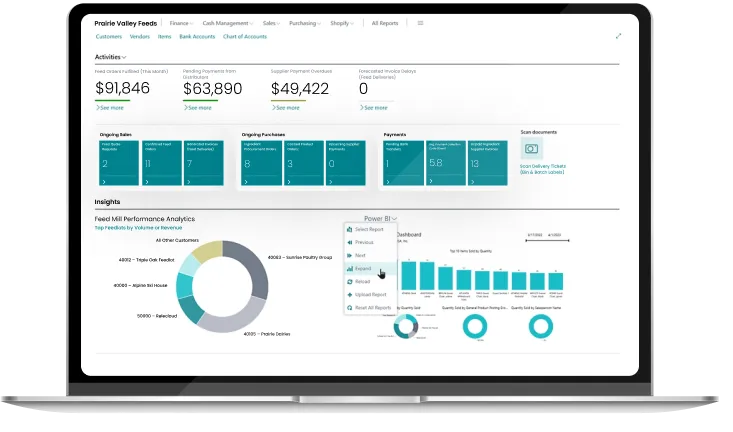
The CFO’s dashboard segments this data by location, allowing direct comparison of margin-per-ton for a dairy ration produced in Ohio versus the same ration in Indiana. The finance department stops being historical bookkeepers and becomes strategic margin protectors. Month-end close goes from 18 days of manual reconciliation to 3 automated days.
For operations considering where to start, the benefits of ERP for the agriculture industry make the financial case across different operation types. Teams already past the decision stage will find the ERP implementation guide for agriculture covers the full project lifecycle from scoping to go-live.
Replacing fragmented legacy software with a unified Agriculture ERP produced measurable, verifiable results across every function of the feed manufacturing enterprise:
Metric | Before ERP | After ERP | Impact |
Month-end financial close | 18 days | 3 days | 83% faster |
Batching accuracy | ~95% (manual) | 99.9% | Errors near-zero |
VFD / FDA audit violations | Exposure risk | Zero | 100% compliant |
Silo inventory visibility | Phone checks / guesswork | Real-time bin allocation | 100% across 3 mills |
COGS per location | Unknown / aggregated | Mill-wise margin-per-ton | Strategic pricing enabled |
“The ERP became the central nervous system of our enterprise. We eliminated the gap between what our nutritionists designed, what our operators mixed, and what our accountants reported. That alignment between production precision, compliance integrity, and financial clarity is what scale actually looks like.”
— CEO, Ohio Feed Enterprise
If your nutrition team is governing formulas by email, your intake operators are guessing at silo capacity, and your CFO is assembling financial reports from CSV exports, this story is your mirror.
The shift to a single system of record doesn’t start with ripping out everything at once. It starts with identifying the highest-cost disconnect in your operation right now.
Explore Folio3’s Feed Mill ERP, purpose-built for commercial feed manufacturers who need formula governance, weighbridge integration, compliance, and mill-wise margin visibility under one system. Or talk to a Folio3 AgTech Solutions Architect to map out your modernization strategy.
Get a Free Consultation Within 24 Hours, with a No-Obligation Ballpark Estimate
[contact-form-7 id="5196998" title="Intent Popup Form"]